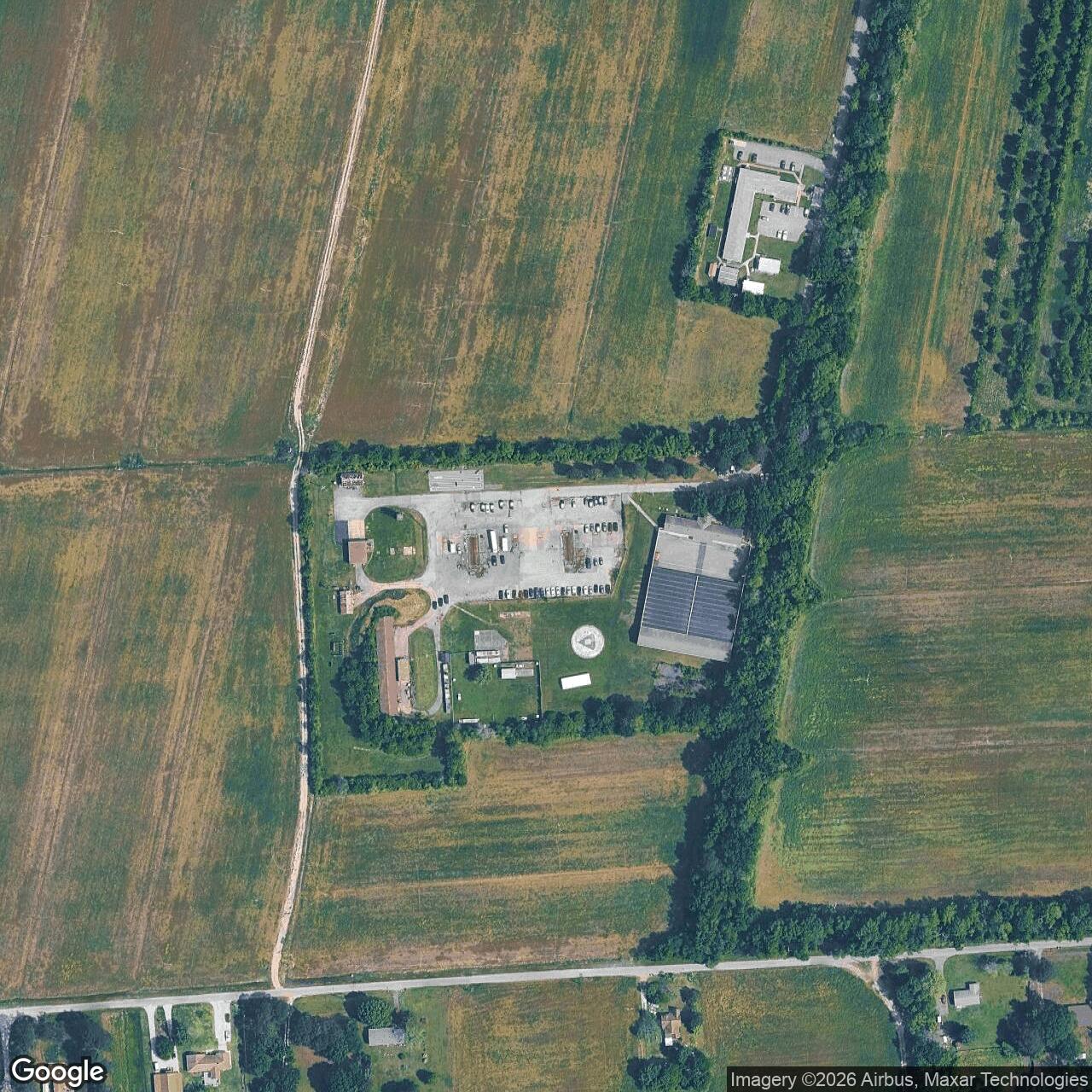
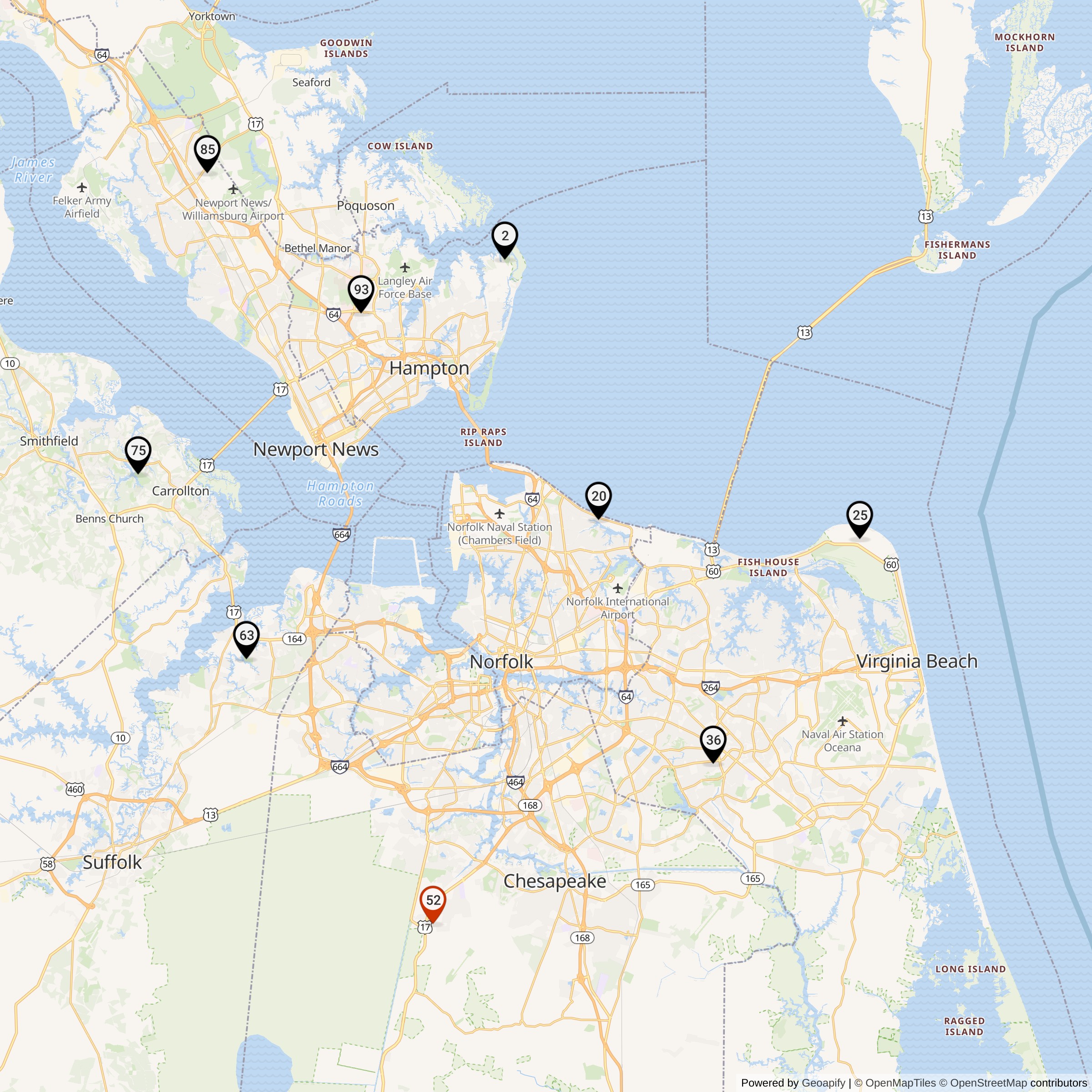
Nike Missile Site N-52 Launcher, Deep Creek Virginia
Longitude: -76.3413316235419
This location was part of the Norfolk Defense Area
Site ID: N-52
The missiles at this Launch Area were controlled by the Integrated Fire Control site located here.
Site Role: Launcher
A typical Nike air defense site consisted of two separate parcels of land. One area was known as the Integrated Fire Control (IFC) Area. This site contained the Nike system's ground-based radar and computer systems designed to detect and track hostile aircraft, and to guide the missiles to their targets.
The second parcel of land was known as the Launcher Area. At the launcher area, Nike missiles were stored horizontally within heavily constructed underground missile magazines. A large, missile elevator brought the Nikes to the surface of the site where they would be pushed across twin steel rails to one of four satellite launchers.
Elaboration on how Nike worked here.
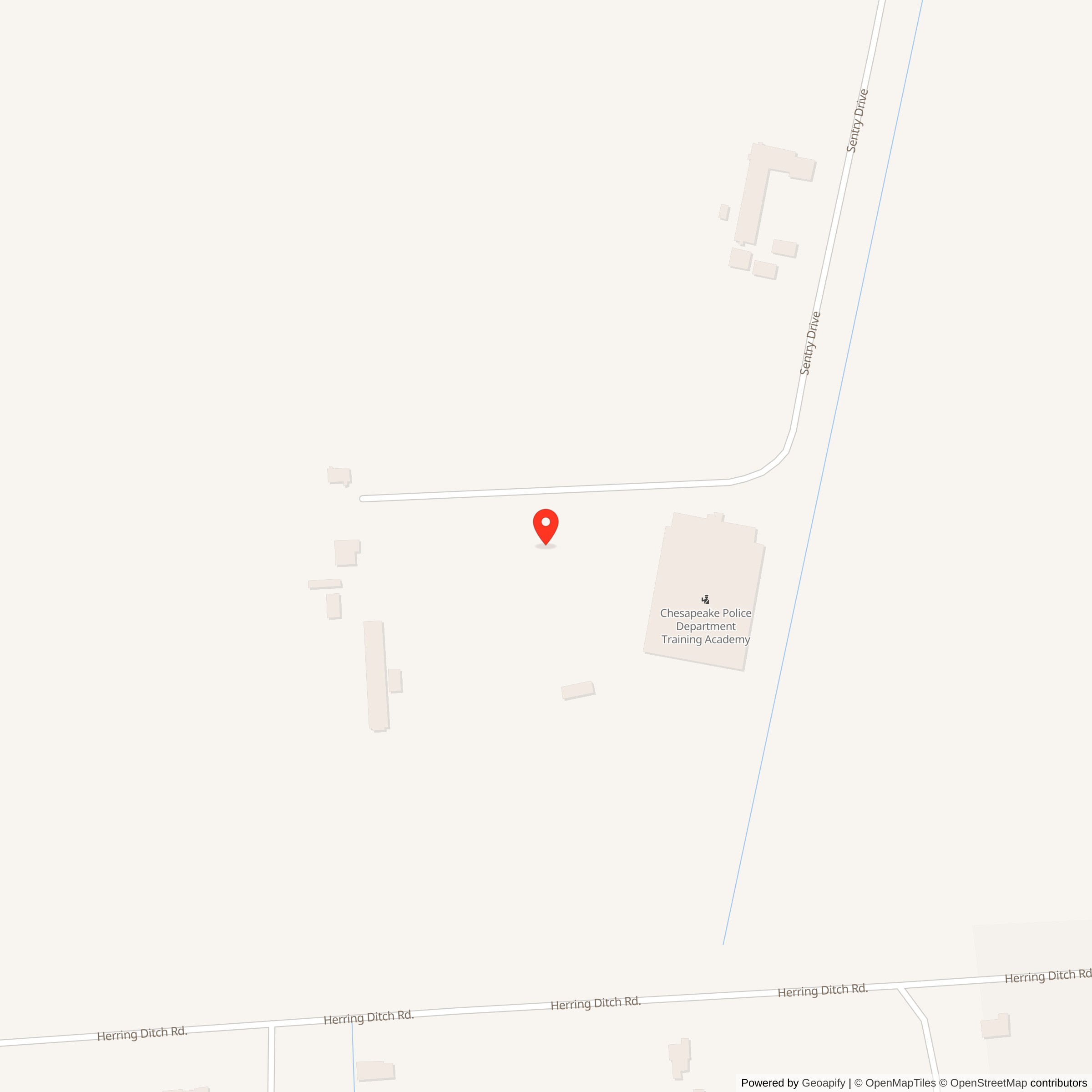
Current site status: Chesapeake Law Enforcement Training Academy
Nike Missile Site N-52 was a U.S. Army surface-to-air missile battery in the Norfolk Defense Area, located in what is now the City of Chesapeake, Virginia. The site was historically identified as Deep Creek / Portsmouth and was also carried in some Nike lists as N-52 / later N-59. It was built during the mid-1950s as part of the defensive missile ring around the Hampton Roads military and naval complex, then modernized for Nike Hercules service. It was decommissioned as an operational Nike site in April 1974.
N-52's significance comes from its long service life and from the specific mission it served. The Norfolk Defense Area protected one of the densest military concentrations in the United States: the Norfolk naval complex, Hampton Roads port facilities, shipyards, Army and Navy terminals, airfields, and associated command and logistics facilities. N-52 was one of the Norfolk-area sites that survived the transition from Nike Ajax to the more capable Nike Hercules. In that role, it represented the later phase of Cold War air defense, when the Army concentrated fewer but more powerful Hercules batteries around the highest-priority military and industrial targets.
Location
N-52 was located in the Deep Creek section of present-day Chesapeake, Virginia, southeast of the main Norfolk-Portsmouth urban core and near the Dismal Swamp / southern Chesapeake landscape. The choice of location reflected the basic requirements of a Nike battery: the launch area needed enough land for magazines, launchers, fueling/service areas, and security standoff, while the Integrated Fire Control area needed a clear radar position with line-of-sight relationship to the defended airspace and the launcher.
The Norfolk Defense Area
The Norfolk Defense Area was not a city-defense ring in the same sense as New York, Chicago, Philadelphia, or Los Angeles. Its core purpose was to protect a massive military and maritime operating base. Hampton Roads contained Naval Station Norfolk, ship-repair and shipbuilding capacity, naval and Army terminals, important airfields, and command facilities that would have been critical in any Cold War mobilization or Atlantic naval conflict. Soviet long-range bomber attack planning would have treated such infrastructure as high-value military targets.The Nike network around Norfolk included several batteries spread across the Tidewater region. The federal Cold War missile history lists the Norfolk sites as Fox Hill, Ocean View, Fort Story, Kempsville, Deep Creek / Portsmouth, Nansemond / Suffolk, Smithfield / Carrollton, Denbigh / Patrick Henry, and Hampton / Spiegelville, with headquarters facilities at Fort Monroe, Ballantine School in Norfolk, Reedsville / South Norfolk, Craddock Branch / Portsmouth, and Newport News. N-52's Deep Creek position gave the Army a southern and southwestern component in that network, covering approaches over the lower Chesapeake Bay, the Atlantic approaches, and the inland routes toward Portsmouth and Norfolk.
The Norfolk network used command-and-control arrangements typical of later Nike defense areas. The federal history states that command and control was operated from a BIRDIE site at the Hampton Roads Army Terminal. BIRDIE, the Battery Integration and Radar Display Equipment system, was a solid-state command system used by ARADCOM to coordinate multiple Nike batteries in a defense area. For N-52, this meant the battery was not simply an isolated missile post. It was part of a larger radar, communications, and command system that integrated Army air-defense fire units with regional air-defense warning and command networks.
Site Layout and Facilities
Like other Nike batteries, N-52 was divided into two geographically separated but operationally linked areas.The Integrated Fire Control area, or IFC, contained the radars and command equipment that detected, tracked, and engaged hostile aircraft. A Nike battery's radars normally included acquisition radar, target-tracking radar, missile-tracking radar, and associated control vans or buildings. The IFC was the "brain" of the battery. Crews there detected an incoming aircraft, assigned it as a target, tracked both the target and missile, and generated the guidance commands that directed the missile toward interception.
The launch area contained the missile magazines, launchers, assembly/service functions, security fencing, generator/support buildings, and ready facilities. In the Ajax era the missiles were stored horizontally in underground magazines and raised to the surface on elevators. Hercules conversion required modifications because the Hercules was larger and heavier than Ajax and because its operational storage, handling, launcher, warhead-security, and safety requirements differed. N-52's technical listing, Nike 2B/18H,30A/8L-UA, indicates a two-magazine site with modified magazine capability and a launcher/missile arrangement reflecting both Ajax and Hercules-era equipment. The "B" magazine code means the magazines were originally compatible with Ajax but could be modified to handle Hercules; the UA launcher notation indicates a mixed universal/Ajax launcher configuration rather than a completely new above-ground Hercules-only installation.
Operational History
N-52 entered active service in 1955, during the first large wave of permanent Nike Ajax deployments around major U.S. targets. Nike Ajax was the Army's first operational guided surface-to-air missile system. It was intended to replace or supplement conventional antiaircraft artillery by using radar-guided missiles to intercept high-altitude bomber formations before they reached protected targets. In the mid-1950s, this was a major technological shift: the air-defense mission moved from gun batteries to radar-controlled missiles, with crews trained in electronics, missile handling, radar operation, target tracking, and tightly controlled launch procedures.The Deep Creek / Portsmouth site began as part of this Ajax network. Its mission was local and regional defense rather than strategic deterrence. The site did not threaten the Soviet Union; instead it was a final defensive layer around Norfolk and Hampton Roads if deterrence failed and hostile bombers reached the continental United States.
By the late 1950s, the Army began replacing selected Ajax batteries with Nike Hercules. Hercules had greater range, higher altitude capability, and the ability to carry either conventional or nuclear warheads. In practical terms, it allowed the Army to reduce the number of sites while retaining a powerful defense against bomber formations. The Norfolk Defense Area was one of the areas retained for Hercules defense because of its military importance. N-25, N-52, and N-85 were the Norfolk sites modernized to fire Nike Hercules.
Appendix D of Mary T. Cagle's Nike Hercules history lists N-52 among converted defense sites. The table records N-52 in the Norfolk Defense Area with 2B magazines and shows a Hercules-related construction period of June 1960 to September 1960. The same appendix notes that Hanford Site H-06 was redeployed to Norfolk Site N-52 in fiscal year 1961. This helps explain N-52's place in the later Hercules network: equipment and resources were shifted from reduced or closed defense areas to higher-priority surviving sites.
After conversion, N-52 remained one of the long-lived Norfolk Hercules sites. The federal site listing gives its active service as 1955 to April 1974. That date is important. By April 1974 most of the U.S. Nike network had already been reduced or dismantled. The surviving batteries tended to be those protecting the most important military installations or those retained in a shrinking number of ARADCOM defense areas. N-52's survival until April 1974 places it among the final generation of operational Nike sites in the continental United States.
Units and Personnel
The available summary sources do not provide a clean, continuous battery-by-battery unit lineage for N-52 alone. They do confirm that both Regular Army and Virginia Army National Guard units manned the Norfolk Defense Area over the life of the network. One Norfolk-area historical note records that in 1958 men of the 4th Missile Battalion, 51st Artillery formed an integrated choral group that performed locally at hospitals and other venues, a small but useful reminder that Nike sites were not only technical installations but also staffed military communities embedded in their regions.A local veteran note preserved in Nike site research identifies N-52 in its later days as associated with B Battery, 4th Battalion, 111th Artillery, Virginia Army National Guard. That is consistent with the broader ARADCOM pattern in the 1960s and early 1970s, when National Guard units increasingly operated or supported remaining Nike batteries after many Regular Army units were redeployed or reduced. Because the currently available sources do not give a complete unit roster for N-52, that Guard association should be treated as a high-confidence field note rather than as a fully documented official lineage.
Closure and Decommissioning
N-52 was deactivated in April 1974. Its closure came during the final drawdown of Nike air-defense sites in the continental United States. Several forces drove that drawdown. First, the Soviet threat shifted from manned bombers toward intercontinental ballistic missiles and submarine-launched ballistic missiles, against which Nike Ajax and Nike Hercules were not designed to provide a national defense. Second, the cost of maintaining dispersed missile batteries, radars, magazines, security forces, and trained crews became harder to justify during the late Vietnam War and post-Vietnam defense environment. Third, the continental air-defense mission itself changed as the United States moved toward different warning, fighter-interceptor, and strategic-deterrence concepts.For Hampton Roads, the closure of N-52 did not mean that the region ceased to matter militarily. Naval Station Norfolk, shipyards, airfields, and command functions remained important. What ended was the particular Cold War method of defending those assets with Army-operated, ground-based, nuclear-capable surface-to-air missile batteries.
Post-Closure Reuse and Current Status N-52's post-closure history is especially useful because both the IFC and launcher areas retained identifiable public uses.
The site listing records the former control site as Chesapeake Alternative School. Later field notes describe the IFC as gated and secured, with maintained grounds and buildings in apparently good repair but without radar towers. A Wikimapia entry states that the command site was also used by Chesapeake Alternative School until 2009. These notes suggest that the radar/control property was reused for institutional or municipal purposes after the Army departed, rather than being immediately demolished or heavily redeveloped.
The launch site became associated with public-safety training. The City of Chesapeake currently lists the Chesapeake Law Enforcement Training Academy at 1080 Sentry Drive. The city describes the academy as a Virginia Department of Criminal Justice Services-certified training facility for law-enforcement candidates and incumbent officers, with firearms, defensive tactics, emergency vehicle operations, physical fitness, specialty training, classrooms, and a state-of-the-art thirty-lane firing range.
Chronology
- 1955 N-52 entered service as a Nike Ajax battery in the Norfolk Defense Area, located at Deep Creek / Portsmouth in what is now Chesapeake, Virginia.
- 1958 Norfolk Defense Area sources record Regular Army and Virginia Army National Guard participation in Nike manning; men of the 4th Missile Battalion, 51st Artillery were noted in local community activity.
- June 1960 Hercules conversion/construction work for N-52 began according to Appendix D of the Nike Hercules history.
- September 1960 Appendix D records the end of the N-52 Hercules construction period.
- Fiscal Year 1961 Appendix D notes that Hanford Site H-06 was redeployed to Norfolk Site N-52.
- Early 1960s N-52 functioned as one of the Norfolk sites modernized to fire Nike Hercules, along with N-25 and N-85.
- November 1964 Norfolk Site N-63, the last Nike Ajax site in the area, was deactivated; after this point, the Norfolk network was centered on the remaining Hercules-capable batteries.
- March 1972 Appendix D marks N-52 with an asterisk denoting active status as of March 1972.
- April 1974 N-52 was deactivated, ending its operational role in the Norfolk Defense Area.
- Post-1974 The former control site was reused for school/municipal purposes, including Chesapeake Alternative School; the former launch site became associated with Chesapeake public-safety/law-enforcement training.
- Current status The site is closed as a military installation and is not an active Army air-defense site. The launch area is identified by EPA as the former NIKE SITE N-52 LAUNCH at 1080 Sentry Drive and is associated with the Chesapeake Law Enforcement Training Academy / public-safety training use.
List of all Nike Installations in Virginia