Nike Missile Site N-75 Launcher, Smithfield/Carrollton Virginia
Longitude: -76.5636228192177
This location was part of the Norfolk Defense Area
Site ID: N-75
Weapon system: Nike Ajax only
Configuration: Nike 1B,2C/30A/12L-A
The missiles at this Launch Area were controlled by the Integrated Fire Control site located here.
Site Role: Launcher
A typical Nike air defense site consisted of two separate parcels of land. One area was known as the Integrated Fire Control (IFC) Area. This site contained the Nike system's ground-based radar and computer systems designed to detect and track hostile aircraft, and to guide the missiles to their targets.
The second parcel of land was known as the Launcher Area. At the launcher area, Nike missiles were stored horizontally within heavily constructed underground missile magazines. A large, missile elevator brought the Nikes to the surface of the site where they would be pushed across twin steel rails to one of four satellite launchers.
Elaboration on how Nike worked here.
Current site status: Carrollton Nike Park
Nike Missile Site N-75 was a former U.S. Army Nike Ajax surface-to-air missile battery in Isle of Wight County, Virginia. It was part of the Norfolk Defense Area, the Cold War air-defense ring built around Hampton Roads to protect the United States Navy's largest naval base complex, the Newport News shipbuilding and repair industry, Langley Air Force Base, Fort Monroe, the Hampton Roads Army Terminal, harbor approaches, and other military and industrial targets that would have been exceptionally important in any Cold War attack on the Atlantic seaboard.
N-75 is no longer active as a military installation. It was an Ajax-only Nike battery, active in the mid-1950s and closed as a missile site by the early 1960s. Most site inventories list the operational period as 1955 to June 1961. Local history sources often say the Carrollton Nike battery was operational by 1954, reflecting the early establishment and construction period. The Virginia Department of Historic Resources describes the site as established in 1954 and deactivated in 1961 after the Nike Hercules system displaced Ajax at selected defense sites. Isle of Wight County's public history page says the base ceased to be used as a missile site in 1963 and then became an Army Signal Corps radar/radio relay site. For this entry, the preferred interpretation is: established/construction beginning in 1954, operational Nike Ajax service 1955-June 1961, followed by non-missile Army Signal Corps reuse into the early 1970s.
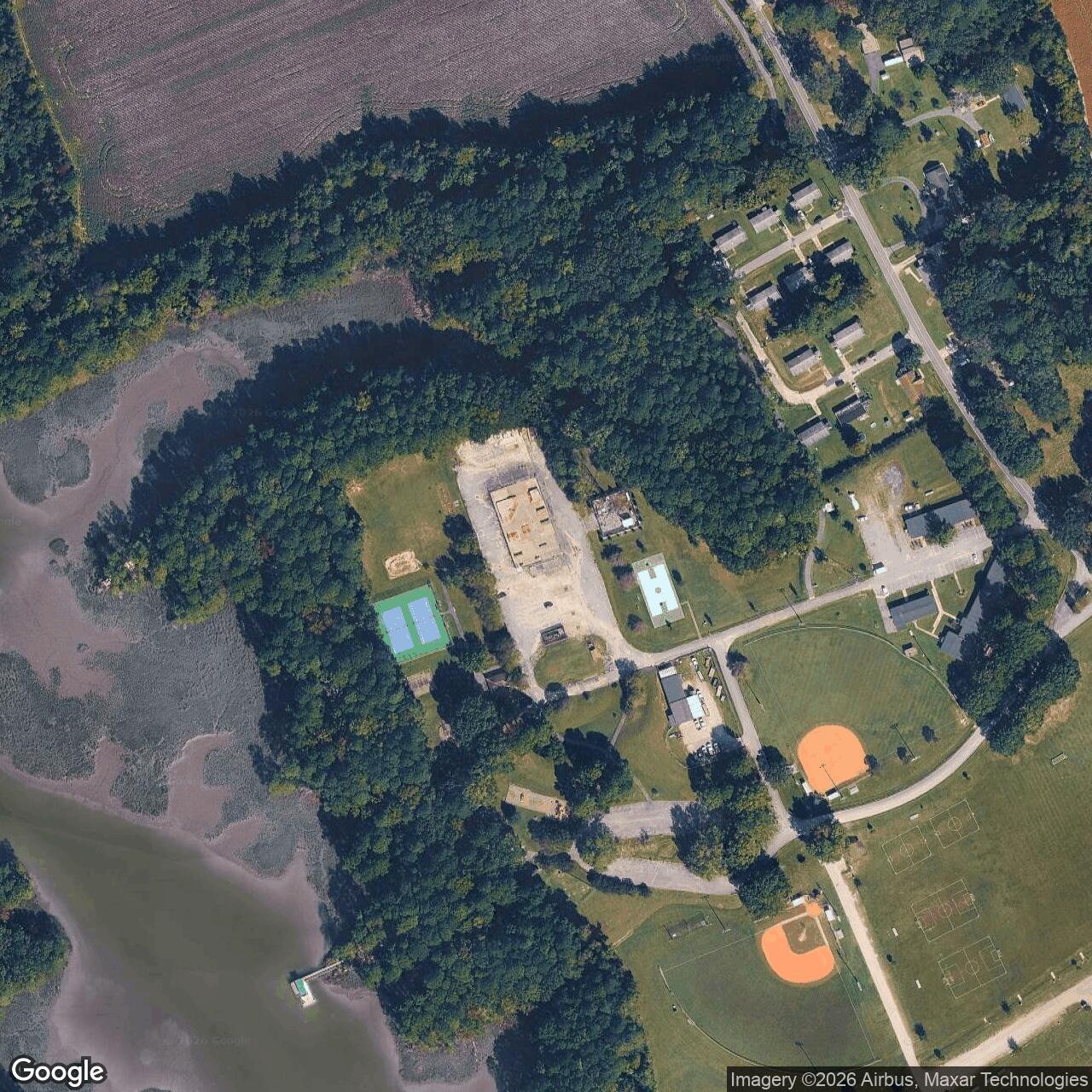
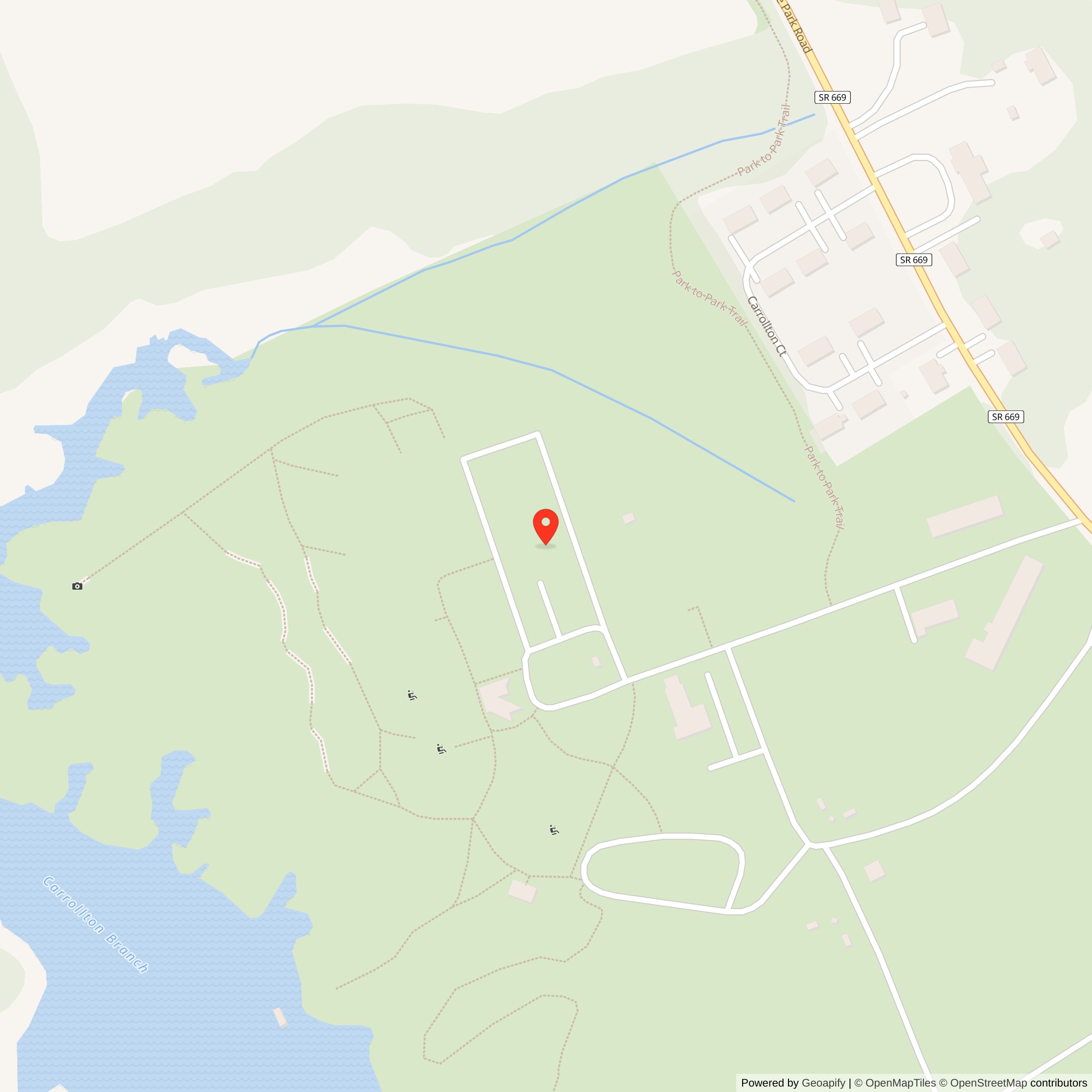
The launch area was along Nike Park Road near Titus Creek in the present Carrollton Nike Park landscape. The IFC/control area was northeast of the launch area near the Boundary Road / Wood Duck Road / Jones Creek area. Later field notes and county reuse indicate that the launch area is the surviving public historic landscape, while the IFC/control area has been heavily altered or largely obliterated by later county development, park, boat-ramp, maintenance, and transfer-station uses.
Location and Military Setting
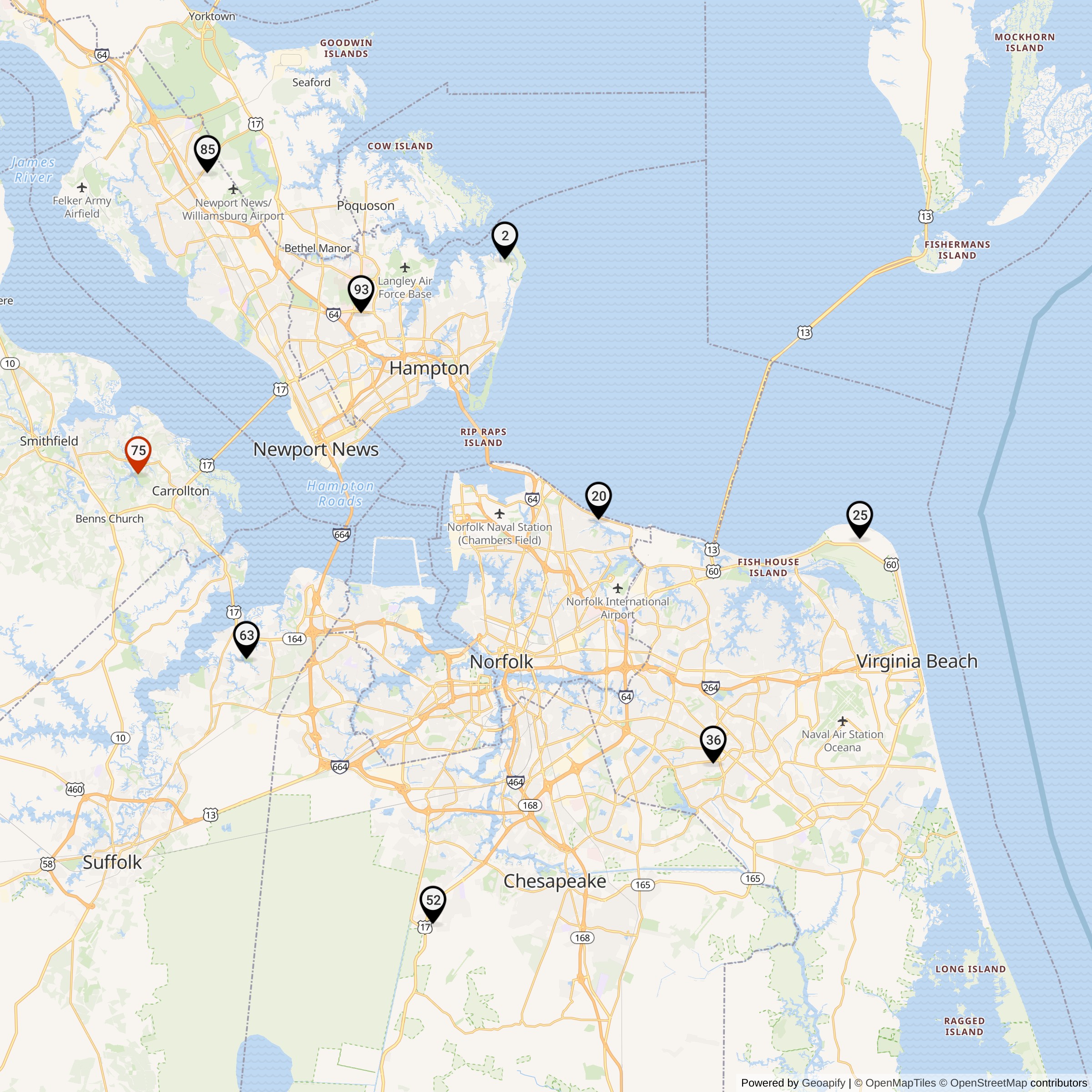
N-75 was located near Carrollton, southeast of Smithfield and west of the main Hampton Roads urban core. In Cold War Nike records, the site is usually described as Smithfield/Carrolton, with the older or alternate spelling "Carrolton" appearing in several Nike site inventories. The launcher area sat in what is now Carrollton Nike Park, at 13036 Nike Park Road, Carrollton, Virginia. The IFC/control area stood roughly 1,500 yards northeast of the launcher area in the Jones Creek vicinity.The site's military setting was defined by Hampton Roads rather than by Isle of Wight County alone. Hampton Roads contained one of the densest combinations of Navy, Army, Air Force, shipbuilding, port, and logistical assets in the country. Naval Station Norfolk, the naval shipyard and port complex, Newport News Shipbuilding, Langley Air Force Base, Fort Monroe, the Hampton Roads Army Terminal, and associated bridges, channels, and waterfront infrastructure made the region an obvious target for Soviet long-range bombers in early Cold War planning. The Norfolk Defense Area therefore placed Nike batteries in an arc around the harbor and its approaches, with sites in Hampton, Newport News, Virginia Beach, Suffolk, Chesapeake/Portsmouth, Fort Story, and Isle of Wight County.
N-75 occupied the western/southwestern side of that ring. Its location near Carrollton put an Ajax battery across the James River from the Newport News and Hampton sides of the defense area and gave the Norfolk network coverage from a direction away from the most crowded base complex itself. Nike sites were selected to create overlapping defensive arcs. A bomber formation approaching from the west, southwest, or up the waterways toward the harbor would have been vulnerable to batteries such as N-75, N-63, N-52, N-85, and the other Norfolk-area sites.
Nike System
The Nike Ajax system was the first operational U.S. guided surface-to-air missile defense system. It was created after World War II, when conventional antiaircraft guns no longer seemed sufficient against high-speed, high-altitude bombers carrying atomic weapons. The Army's Nike program placed fixed missile batteries around major cities, defense-industrial regions, and strategic military installations. By the mid-1950s, Nike batteries had become a visible part of the Cold War landscape around American metropolitan areas.Nike Ajax was a command-guided system. The missile did not simply seek its own target after launch. The battery used ground-based radars and computers to track the target, track the missile, and calculate the intercept. The Integrated Fire Control area contained the acquisition radar, target-tracking radar, missile-tracking radar, computer equipment, communications gear, and radar-control functions. The launch area contained the underground magazines, launchers, missile assembly and test building, fueling and servicing area, generator support, launch-control equipment, and guard/security structures. The two areas were separated for safety and geometry, but they had to remain within line-of-sight and were connected by communications and control cables.
N-75's technical configuration, Nike 1B,2C/30A/12L-A, identifies it as a three-magazine Ajax site. The code indicates one type-B and two type-C Ajax magazines, 30 Ajax missiles, and 12 Ajax launchers. Unlike the later Hercules-converted Norfolk sites, N-75 did not receive the larger nuclear-capable Nike Hercules. It remained part of the first generation of Nike deployment and closed when the Army concentrated resources on fewer, longer-range Hercules batteries.
Norfolk Defense Area
The Norfolk Defense Area was built to defend the Tidewater region. The principal permanent Nike sites included N-02 at Fox Hill, N-25/later N-29 at Fort Story, N-36/later N-49 at Kempsville, N-52/later N-59 at Deep Creek/Portsmouth, N-63/later N-69 at Nansemond/Suffolk, N-75 at Smithfield/Carrollton, N-85/later N-97 at Denbigh/Patrick Henry, and N-93/later N-99 at Hampton/Spiegelville. There was also a temporary Ocean View site, N-20. Headquarters and command facilities were associated with Fort Monroe, Ballantine School in Norfolk, Reedsville/South Norfolk, Craddock Branch/Portsmouth, Newport News, and later a BIRDIE command-and-control site at Hampton Roads Army Terminal.Within this network, N-75 was an Ajax-only battery. This is an important distinction. The Norfolk Defense Area did not modernize every Nike Ajax site for Nike Hercules. Sources for the defense area identify N-25, N-52, and N-85 as the Norfolk sites modernized for Hercules. N-63 remained an Ajax site until November 1964 and is frequently described as the last Ajax battery to operate in the continental United States. N-75 closed earlier, in the 1961 period, because the Hercules transition and changing air-defense priorities made some Ajax-only batteries redundant.
The Norfolk network reflected a layered Cold War defense system. Nike batteries were intended to engage bombers that penetrated outer radar and fighter defenses. They were not isolated weapons. They operated in a broader environment of Air Force radar sites, interceptor squadrons, Army command posts, communications lines, and later automated or semi-automated command-and-control systems. In the Norfolk area, the Army's BIRDIE system at Hampton Roads Army Terminal helped coordinate Nike fire units so that batteries could be assigned targets, avoid duplicate engagements, and maintain area-wide coverage.
Site Layout and Facilities
N-75 followed the standard two-part Nike pattern. The launch area contained the missiles and launcher magazines. The IFC/control area contained the radars and fire-control equipment. At N-75, those areas were separated by roughly 1,500 yards.The launch area is the historic core that survives at Carrollton Nike Park. National Register and state historic-preservation sources describe it as one of Virginia's few surviving intact Nike Ajax launch sites. The site retains its historic character because many of the original concrete-block buildings and landscape features remain. Important surviving launch-area features include three underground missile magazines, earthen berms, separate launcher and administrative areas, the missile assembly and test building, and other Nike-era support buildings. Tourism and local sources identify surviving or reused buildings including the barracks, mess hall, administration and recreation building, family housing, and related structures.
The underground magazines were the heart of the launch area. Nike Ajax missiles were stored below ground and raised to the surface by elevators. Once on the surface, they could be moved along rails to aboveground launch positions. At N-75, the magazine area remains recognizable in the landscape even though the magazines are sealed. Later public-park reuse placed parking, recreation, and skate-park functions over or near the former magazine surfaces, but the surface concrete, blast-deflector areas, capped elevator features, berms, and spatial arrangement still allow the site to be read as a former Nike battery.
The IFC/control area was more vulnerable to later alteration. It was located northeast of the launcher site, in the Jones Creek area. Field notes identify it near Boundary Road and Wood Duck Road and describe later county uses such as park, boat-ramp, maintenance, trash-transfer, or recycling functions. Early 2000s field accounts noted some surviving structures or radar-tower remnants, but later field visits described the IFC area as essentially obliterated by development and reuse.
Operational History
N-75 was developed during the first wave of nationwide Nike Ajax deployment. Local public history states that the Carrollton Nike Missile Battery was operational by 1954 and was one of eight bases in the Norfolk Defense Area. National Register and federal site inventories place construction or establishment in 1954 and the active missile period in 1955-1961. The site's role was to stand ready to engage hostile bomber aircraft approaching the Hampton Roads defended area.During its Nike Ajax period, the site would have functioned as a 24-hour alert military installation. Crews maintained radars, computers, communications systems, missile magazines, launchers, fuels, oxidizers, generators, security fencing, and support buildings. Nike Ajax used a liquid-fueled sustainer and solid booster, so operational readiness also required careful handling of fuel and oxidizer and strict safety procedures. Unlike later Nike Hercules batteries, which could carry nuclear warheads and had much longer range, N-75's Ajax missiles were conventional-warhead defensive weapons intended to destroy aircraft through radar-commanded intercepts.
The site's military life was relatively short. By 1958, the Army was already fielding Nike Hercules, a longer-range, higher-altitude missile that could carry nuclear or conventional warheads. In many defense areas, the Hercules transition reduced the number of batteries needed for the same general coverage. Rather than convert every Ajax site, the Army selected some sites for modernization and closed others. In the Norfolk Defense Area, N-25, N-52, and N-85 became the Hercules sites. N-75 did not.
The Virginia Department of Historic Resources states that Nike Hercules eventually replaced Ajax and forced deactivation of Site N-75 in 1961. Federal inventories list N-75 as deactivated in June 1961. Isle of Wight County's public page says the base ceased to be used as a missile site in 1963, then became an Army Signal Corps radar site. The difference likely reflects the distinction between the end of Nike missile battery service and subsequent non-missile military communications/radar reuse.
Post-Missile Military Reuse
After Nike missile service ended, N-75 was not immediately erased from the military landscape. The Virginia Department of Historic Resources states that the Army Signal Corps adapted the facility for reuse as a radio relay station between 1961 and 1971, after which the U.S. military ceased using the property. Isle of Wight County's public history says the Army Signal Corps used the base as a radar site after the missile period. Ed Thelen field notes refer to the base as a CONARC transmitter site beginning in 1962. These descriptions are consistent in the broad sense: after its missiles were removed, the property remained useful to the Army as a communications or radar-related fixed facility.This reuse helps explain why so much of the launch-area fabric survived. Many Nike sites were demolished, filled, redeveloped, or heavily altered after closure. N-75's continued military and later public use preserved a large number of buildings and landscape elements. When the site eventually passed into county hands, it was reused rather than wiped clean.
Local records and field notes indicate that the county acquired the property in 1972 and that it became Nike Park sometime after 1975. The present park is associated with Isle of Wight County Parks and Recreation and is one of the rare publicly accessible Nike Ajax launch sites where visitors can still understand the original layout.
Current Site Use and Preservation
Today the former N-75 launch area is Carrollton Nike Park, operated as an Isle of Wight County public recreation facility. The park address is 13036 Nike Park Road, Carrollton, Virginia 23314. County sources describe the park as more than 100 acres in size, with softball and soccer fields, basketball, volleyball, and tennis courts, picnic areas, nature and mountain-bike trails, a skate park, playgrounds, a senior center, a recreation hall, and fishing access at Jones Creek. The county lists the park as open daily from dawn until dusk, while the county recreation reservation page identifies the facility as open and gives 8:30 a.m. as the standard opening time for park operations.N-75's preservation value is unusually high for a former Nike Ajax site. The Virginia Department of Historic Resources describes the launch site as one of Virginia's few surviving intact surface-to-air Nike Ajax missile sites. The site was listed in the Virginia Landmarks Register on June 20, 2019, and in the National Register of Historic Places on August 7, 2019, under reference number SG100004266. DHR emphasizes that the site retains nearly all of its original concrete-block buildings and key design elements, including three underground missile magazines, earthen berms, separate launcher and administrative areas, and other historic features.
The park also has interpretive value. Local and visitor sources describe walking and driving access through the former site and note that visitors can see the fueling area, concrete slabs marking the underground missile-magazine area, and surviving buildings. DHR's current listing includes 2019 and 2026 photographs of the site, including a view of the preserved launch-site landscape and a later view showing a missile artifact display setting. The presence of historic signage, preserved physical fabric, and county historic-resource interpretation makes N-75 one of the better public examples of a Cold War Nike Ajax installation in Virginia.
Code Drift: N-75 and N-79
N-75 has an important code issue. Federal and most national Nike site inventories identify the site as N-75. However, local field notes report that 1954 site survey maps used N-79L and N-79C, and a 2012 field note says historical signage at the launch site indicated N-79 as the proper designation. This appears to be genuine early-code or local-code drift rather than a completely separate site.
Units and Manning
The Norfolk Defense Area was manned by both Regular Army and Virginia Army National Guard units. Federal histories note that in 1958, men of the 4th Missile Battalion, 51st Artillery formed an integrated choral group that performed at local hospitals and other community venues, showing that the Nike soldiers were not invisible to the Hampton Roads community.A Nike Ajax battery required a technically trained crew. Soldiers worked in radar operations, missile tracking, target tracking, computer operation, launcher operation, missile assembly, fueling, electrical generation, communications, fire direction, security, maintenance, supply, administration, and mess operations. At a site like N-75, the everyday mission was readiness. Most days did not involve firing missiles; they involved maintaining a complex system so that it could launch within minutes if the air-defense network ordered an engagement.
Post-Closure Reuse and Current Condition
The former N-75 launch site is one of the strongest surviving Nike landscapes in the Norfolk Defense Area. Unlike N-63, where later park development appears to have erased much of the Nike fabric, N-75 retains buildings, earthworks, concrete pads, magazine traces, and the general spatial organization of the launch area. The park's recreational reuse has altered the site, but it did not obliterate the missile-site landscape.The administrative/support area and launch area remain legible. The barracks, mess hall, administration and recreation building, missile assembly and test building, underground magazine surfaces, berms, and other former military features either survive or are reflected in the current park layout. Local sources state that many buildings are still standing and used for public or private purposes. Later field notes describe the launch area as still very recognizable, with most elevators and hatches visible but concreted over, metal blast pads still in place, and no public access to the sealed magazines.
The IFC/control area has not survived in the same condition. Its location near Boundary Road, Wood Duck Road, Jones Creek, a boat ramp, and county maintenance/transfer functions has been heavily altered. Some field notes from the early 2000s recorded surviving towers or structures, but later notes reported little or no recognizable Nike-era fabric. For historical interpretation, the launch site is therefore the principal surviving resource.
Chronology
- 1945: The Army began the guided-missile development program that became Nike.
- 1951: A Nike missile successfully destroyed a QB-17 drone during testing at White Sands, helping validate the system.
- 1953: The United States began deploying Nike Ajax batteries at strategic locations throughout the country.
- 1954: Construction or establishment of the Smithfield/Carrollton Nike site began; local sources say the Carrollton Nike Missile Battery was operational by 1954.
- 1955: Federal site inventories list N-75 as active in the Norfolk Defense Area.
- 1955-1961: N-75 operated as a Nike Ajax battery defending the Hampton Roads / Norfolk Defense Area.
- 1958: The Army began converting selected Nike Ajax sites to Nike Hercules; in the Norfolk Defense Area, N-25, N-52, and N-85 were selected for Hercules modernization, while N-75 remained Ajax-only.
- 1961: DHR and federal site inventories identify N-75's deactivation as a Nike Ajax missile site; common site tables give June 1961.
- 1961-1971: The Army Signal Corps adapted the facility for reuse as a radio relay station, according to DHR.
- 1962: Field notes identify the site as having entered CONARC transmitter-site reuse.
- 1963: Isle of Wight County's public history page says the base ceased to be used as a missile site and the Army Signal Corps used it as a radar site; this is treated as post-Ajax, non-missile military reuse rather than a continuation of Nike missile operations.
- 1971: DHR states that Army Signal Corps radio-relay reuse ended around this year and the U.S. military ceased using the property.
- 1972: Field notes indicate Isle of Wight County acquired the property.
- 1975: Field notes indicate that the property became Nike Park sometime after this date.
- 2000s: Local preservation advocates and historians documented the launch site as a highly intact Nike Ajax launch area and promoted preservation and interpretation.
- June 20, 2019: The site was listed in the Virginia Landmarks Register.
- August 7, 2019: The site was listed in the National Register of Historic Places as Nike-Ajax Missile Launch Site N-75, NRHP reference number SG100004266.
- Present: The former launch area is preserved within Carrollton Nike Park, a public recreation and historic-resource landscape operated by Isle of Wight County Parks and Recreation.
List of all Nike Installations in Virginia