Nike Missile Site CL-13 IFC, Willowick Ohio
Longitude: -81.46939
This location was part of the Cleveland Defense Area
Site ID: CL-13
This site controlled the missiles at the Launch Area located here.
Site Role: IFC
A typical Nike air defense site consisted of two separate parcels of land. One area was known as the Integrated Fire Control (IFC) Area. This site contained the Nike system's ground-based radar and computer systems designed to detect and track hostile aircraft, and to guide the missiles to their targets.
The second parcel of land was known as the Launcher Area. At the launcher area, Nike missiles were stored horizontally within heavily constructed underground missile magazines. A large, missile elevator brought the Nikes to the surface of the site where they would be pushed across twin steel rails to one of four satellite launchers.
Elaboration on how Nike worked here.
Missile Type: Ajax/Hercules
The Nike Ajax was the first in the Army's family of guided missiles, and the world's first operational, guided, surface-to-air missile system. Nike Ajax had a burnout speed of Mach 2.3, a range of 25-30 miles, and a ceiling of 65,000 feet.
Designed to carry either nuclear and/or high-explosive warheads, the Nike Hercules missile could attack supersonic aircraft operating at altitudes in excess of 150,000 feet and at a range of more than 87 miles.
Battery Type: single
Nike Site CL-13 was a U.S. Army Nike Ajax air-defense missile battery in the Cleveland Defense Area. The site was built during the mid-1950s as one of the fixed surface-to-air missile batteries positioned around Greater Cleveland to defend the city, its Lake Erie shoreline, its industrial districts, its transportation facilities, and the broader northeastern Ohio region against possible Soviet bomber attack.
CL-13 operated as a Nike Ajax site from 1956 until 1963. It was not converted to Nike Hercules. After the Army ended the site's air-defense mission, the control area was redeveloped as Robert Manry Park in Willowick, and the launcher area became part of the Willoughby-Eastlake School District property, including school-bus and support use.
History
Nike Missile Site CL-13 was one of the eight original Nike Ajax sites built for the defense of Greater Cleveland. Cleveland was considered a high-value Cold War target because it was a major industrial, transportation, and population center on Lake Erie. Its factories, rail links, harbor facilities, petroleum and steel-related industries, and dense urban area made it a logical part of the national Nike deployment pattern, which placed missile batteries around metropolitan areas, air bases, ports, weapons-production facilities, and other strategic targets.The Cleveland Nike program developed during the early Cold War air-defense emergency. The Soviet Union's acquisition of nuclear weapons in 1949, the outbreak of the Korean War in 1950, and the expected threat of long-range bomber attack pushed the United States to expand continental air defense. The Air Force operated the broader early-warning and fighter-interceptor network, but the Army's Nike batteries formed the local last line of defense around the targets themselves. Nike Ajax was the first operational version of that system.
Public officials and residents in metropolitan Cleveland learned in 1954 that the Army intended to build a Nike Ajax defense ring around the city. The local program was controversial from the beginning. Communities objected to having missile bases near residential neighborhoods, public officials were reluctant to give up park or municipal land, and some private landowners resisted selling property. As in other Nike defense areas, the Army needed land that offered enough separation between launch and control areas, a clear radar line of sight, and enough room for safety clearances around explosives, fuel-handling areas, and the underground magazines.
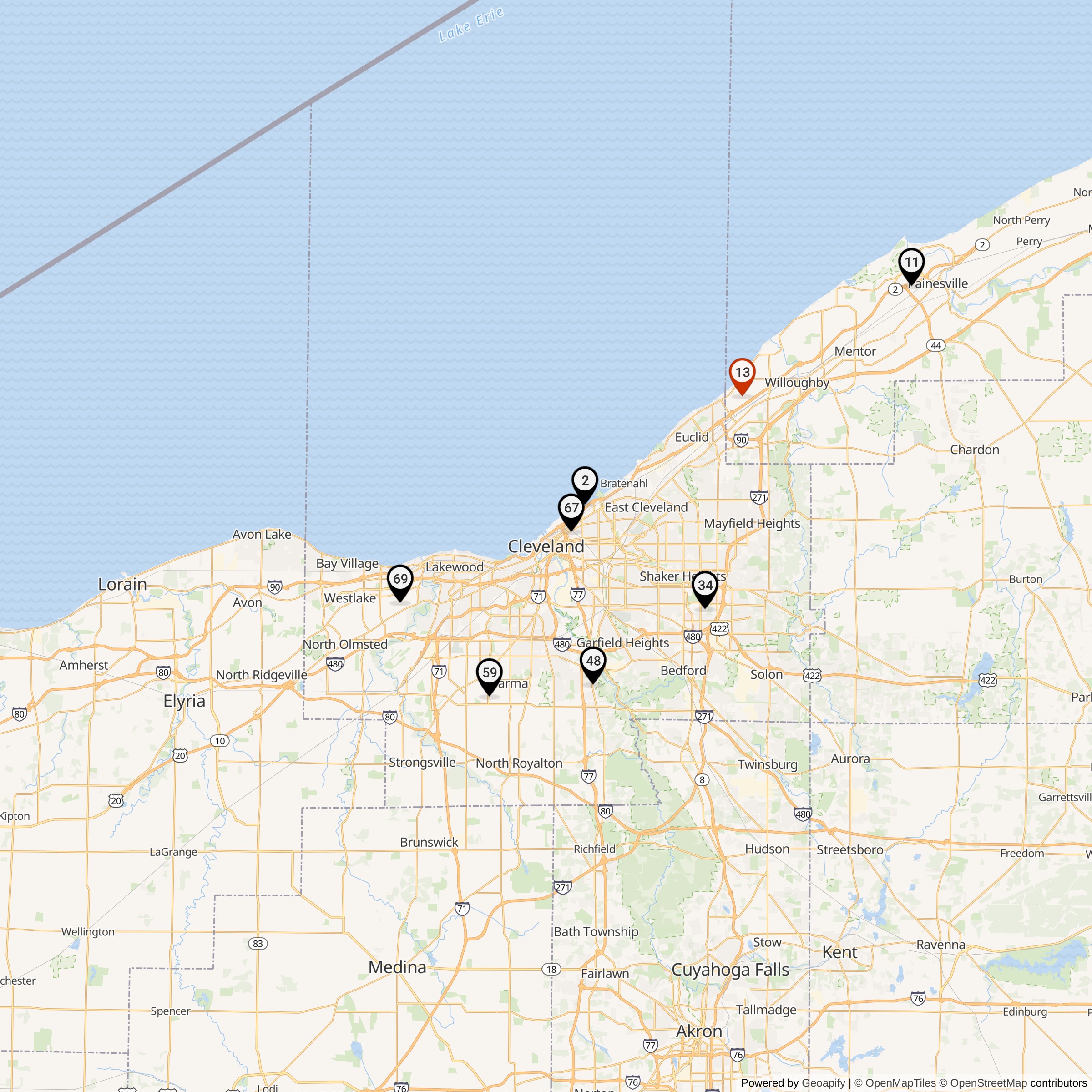
After negotiation, compromise, and land acquisition, the Cleveland Nike Ajax network took shape at eight locations: CL-02 at Bratenahl, CL-11 at Painesville, CL-13 with its launch area in Eastlake and control area in Willowick, CL-34 at Warrensville Township, CL-48 at Independence / Garfield Heights, CL-59 at Parma / Parma Heights, CL-67 at Burke Lakefront Airport, and CL-69 at Fairview Park / Rocky River. Headquarters facilities were located at the Shaker Heights Armory and in Cleveland, and construction responsibility lay with the U.S. Army Corps of Engineers Pittsburgh District, then part of the Ohio River Division.
CL-13 became operational in 1956. It was an Ajax site rather than a later Hercules site. Its missile type is listed in the standard Nike inventory as Nike 3B/30A/12L-A. In practical terms, the site had three underground missile magazines, a nominal Ajax missile storage capacity of 30 missiles, and 12 Ajax launchers. The suffix "A" in the launcher designation indicates Ajax launchers rather than Hercules universal launchers. Although the magazine designation used the "B" type, CL-13 was not one of the Cleveland batteries converted to Hercules.
The CL-13 layout followed the basic Nike pattern. The launcher area, on the Eastlake side of the site, held the underground magazines, launchers, launcher-control facilities, generator support, assembly and maintenance functions, and security perimeter. The control area, in Willowick, held the radar and fire-control equipment used to acquire and track aircraft, track missiles, and feed the ground-based computer that generated steering commands. The two parts of the site had to be separated for safety and operational reasons but still remain close enough, and visually aligned enough, to function as a single guided-missile battery.
Nike Ajax was a command-guided, radar-controlled missile. At a typical battery, acquisition radar searched for incoming aircraft, target-tracking radar locked onto the hostile target, missile-tracking radar tracked the launched missile, and a ground-based computer calculated the intercept point. The missile itself was not a fire-and-forget weapon. It depended on the battery's radar and computing system throughout the engagement. For the soldiers at CL-13, readiness therefore meant more than keeping missiles in storage. Crews had to maintain radars, communications, generators, missiles, launch rails, elevators, warhead-handling procedures, fueling equipment, and the security system around the exclusion area.
The original Cleveland Nike Ajax installations were built under intense Cold War pressure. A contemporary Cleveland Nike history described each Ajax base as normally consisting of two separate facilities: a launch area and a radar-control area. The launch area included a missile-assembly building, generator building, acid-storage building, fueling area, underground missile storage, storage launchers, firing launchers, and barracks. The control area contained radar towers, a control van or control building, mess and administration space, and barracks. Because Ajax used liquid-fuel components and conventional high-explosive warheads, the sites also required strict fueling, handling, and safety procedures. Public tours sometimes occurred, but the underground launch and control areas were generally kept closed to the public.
CL-13's daily operation would have been similar to other Ajax batteries in the Cleveland ring. One battery in the defense area could be placed in "hot battery" status, ready for immediate response, while other batteries maintained readiness and practiced alert drills. During a red-alert drill, launch crews had to move quickly from standby to launch configuration. Missiles stored horizontally below grade were raised by elevator, moved on rails, and prepared for firing. The radar crews in the control area had to acquire and track targets, maintain communications, and coordinate the firing sequence.
The site's position on Cleveland's east side was strategically useful. From Willowick and Eastlake, CL-13 covered an approach sector along and inland from Lake Erie east of Cleveland. It complemented CL-02 at Bratenahl, CL-11 at Painesville, CL-67 at Burke Lakefront Airport, and the inland sites south and southwest of the city. The purpose was not to defend Willowick alone; the site was one piece of an interlocking defense ring around the metropolitan and industrial target complex.
By the late 1950s, Nike Ajax was already being overtaken by changing technology. The Army began replacing selected Ajax batteries with Nike Hercules, a larger solid-fuel missile with much greater range and altitude capability and the ability to carry either conventional or nuclear warheads. In Cleveland, only three sites were converted to Hercules: CL-02 at Bratenahl, CL-11 at Painesville, and CL-69 at Fairview Park / Rocky River. Those three sites remained active until June 1971. CL-13 did not receive the Hercules conversion. It remained an Ajax battery and was part of the group of Cleveland Ajax sites phased out as the Army reduced the number of batteries needed for local air defense.
The choice not to convert CL-13 is historically significant. Nike Hercules required fewer batteries to cover the same general defense area because it had greater range and destructive power. The Army could therefore close a number of Ajax-only sites while concentrating resources at the converted Hercules batteries. The Cleveland network illustrates that transition clearly: eight Ajax-era sites in the mid-1950s were reduced to three Hercules-capable batteries by the early 1960s.
CL-13 was deactivated in 1963. Its closure came during the broader disappearance of the Ajax-only portion of the Cleveland Defense Area. That timing also reflected the strategic shift away from dense local antiaircraft missile rings around cities. By the early 1960s the Soviet bomber threat had not disappeared, but intercontinental ballistic missiles and submarine-launched ballistic missiles were becoming the dominant strategic threat. Fixed urban air-defense batteries still had value against bombers, but they no longer represented the center of national defense planning.
Post-Closure
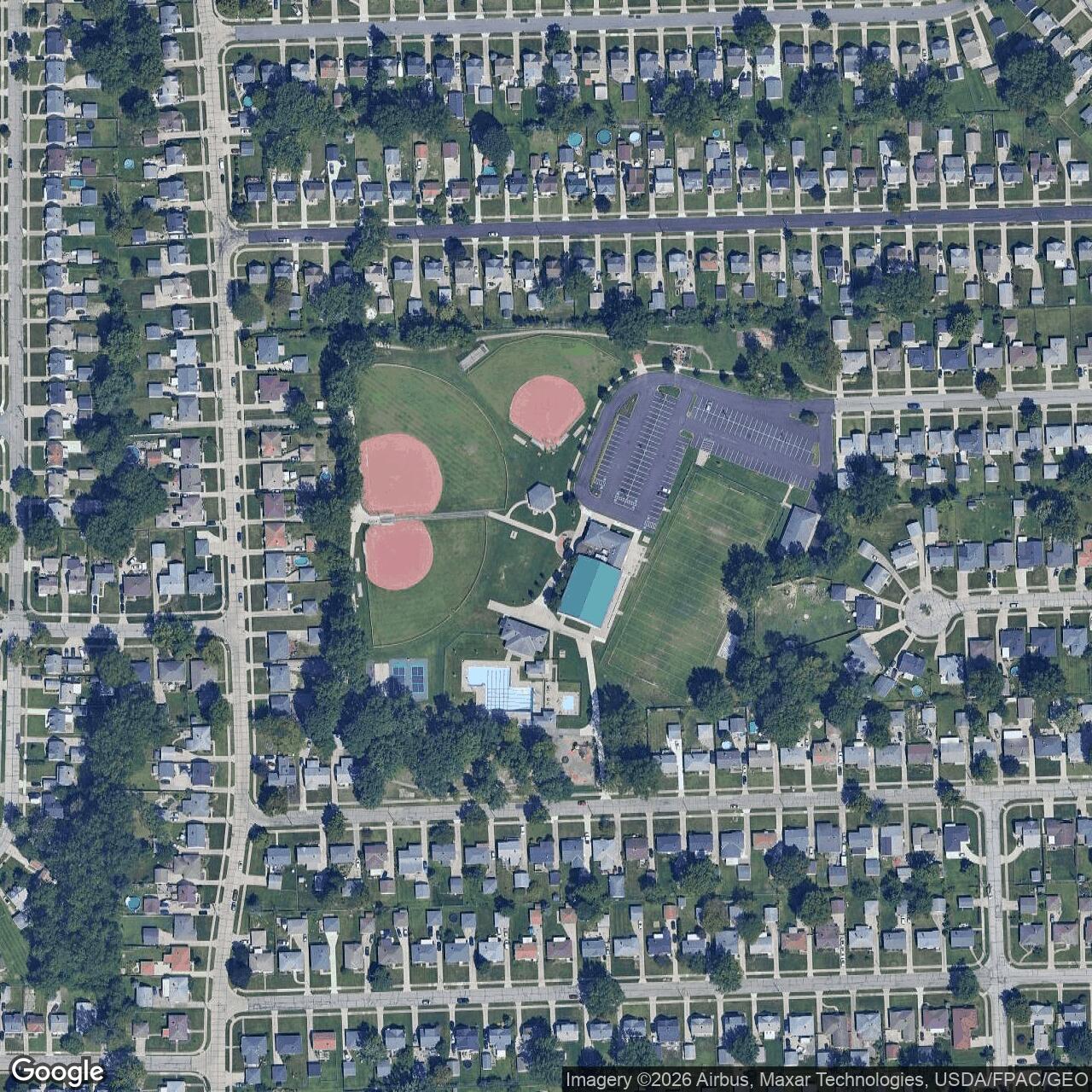
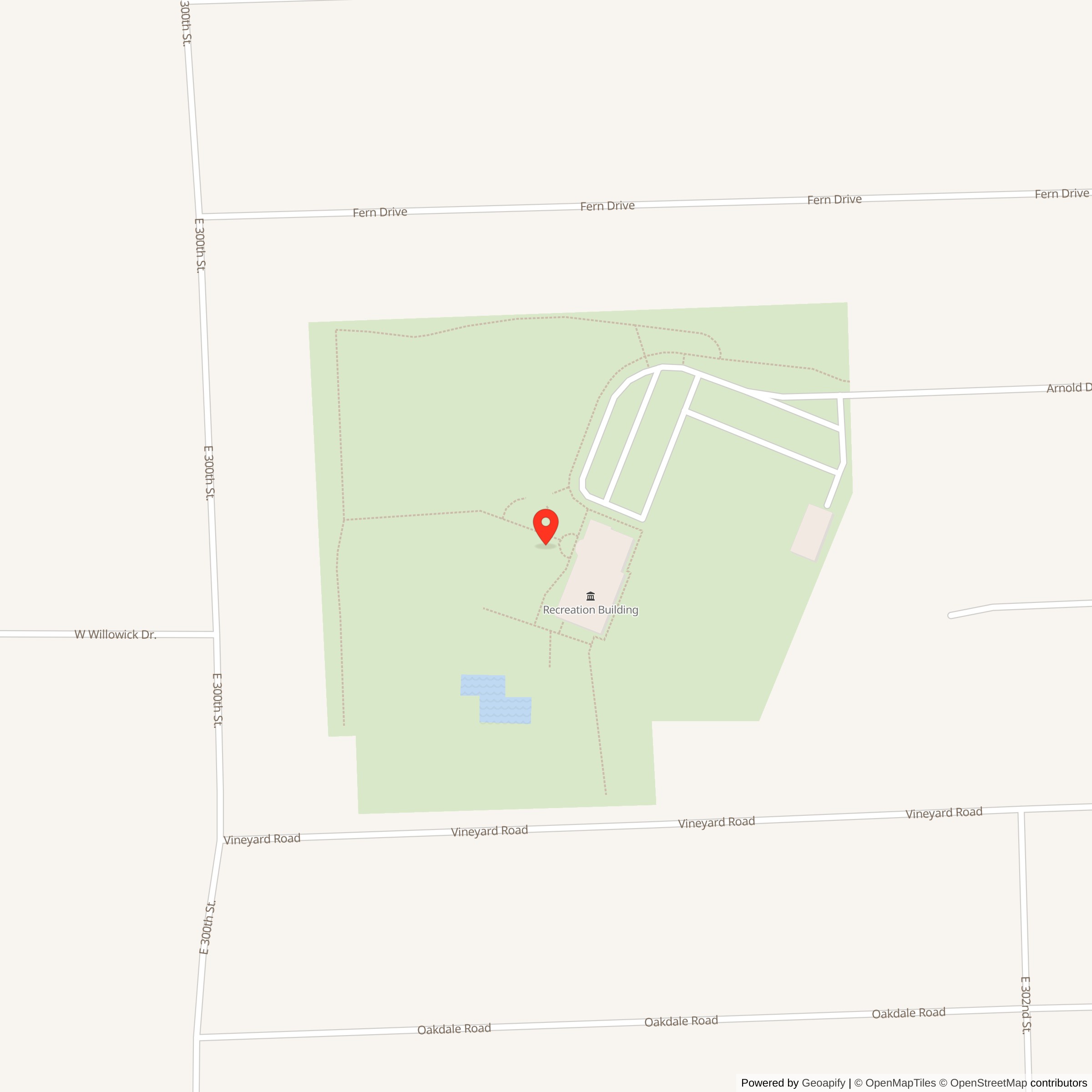
After CL-13 closed, the site was transferred out of Army air-defense use and gradually absorbed into civilian life. The control area became Robert Manry Park in Willowick. Public site inventories describe the former control site as redeveloped into the park, with only a small pump-house type structure remaining from the former IFC complex. This means the aboveground radar-control identity of the site has largely disappeared, although the location still marks the western half of the former CL-13 battery.The launch area became associated with the Willoughby-Eastlake School District. Later site-status listings describe the launch area as being in reasonable condition, with the underground magazine area capped by approximately one foot of concrete and used for school-bus parking. The air vents, stairways, hatches, and other obvious launch-area openings were reportedly removed. This post-closure use is typical of many former Nike launcher areas: the large paved or concrete magazine pads were useful for municipal, school, vehicle, storage, or industrial purposes even after the military equipment had been removed.
Virtual and public-location sources identify the launcher area as a present-day bus yard, with the underground launchers once rising to the surface from below-grade magazines. They also describe the targeting radar/control site as west of the launcher area, off East 305th Street, at what is now Manry Park. That pattern is consistent with the Nike requirement that the IFC be separated from, but operationally tied to, the launch site.
List of all Nike Installations in the Cleveland Defense AreaList of all Nike Installations in Ohio