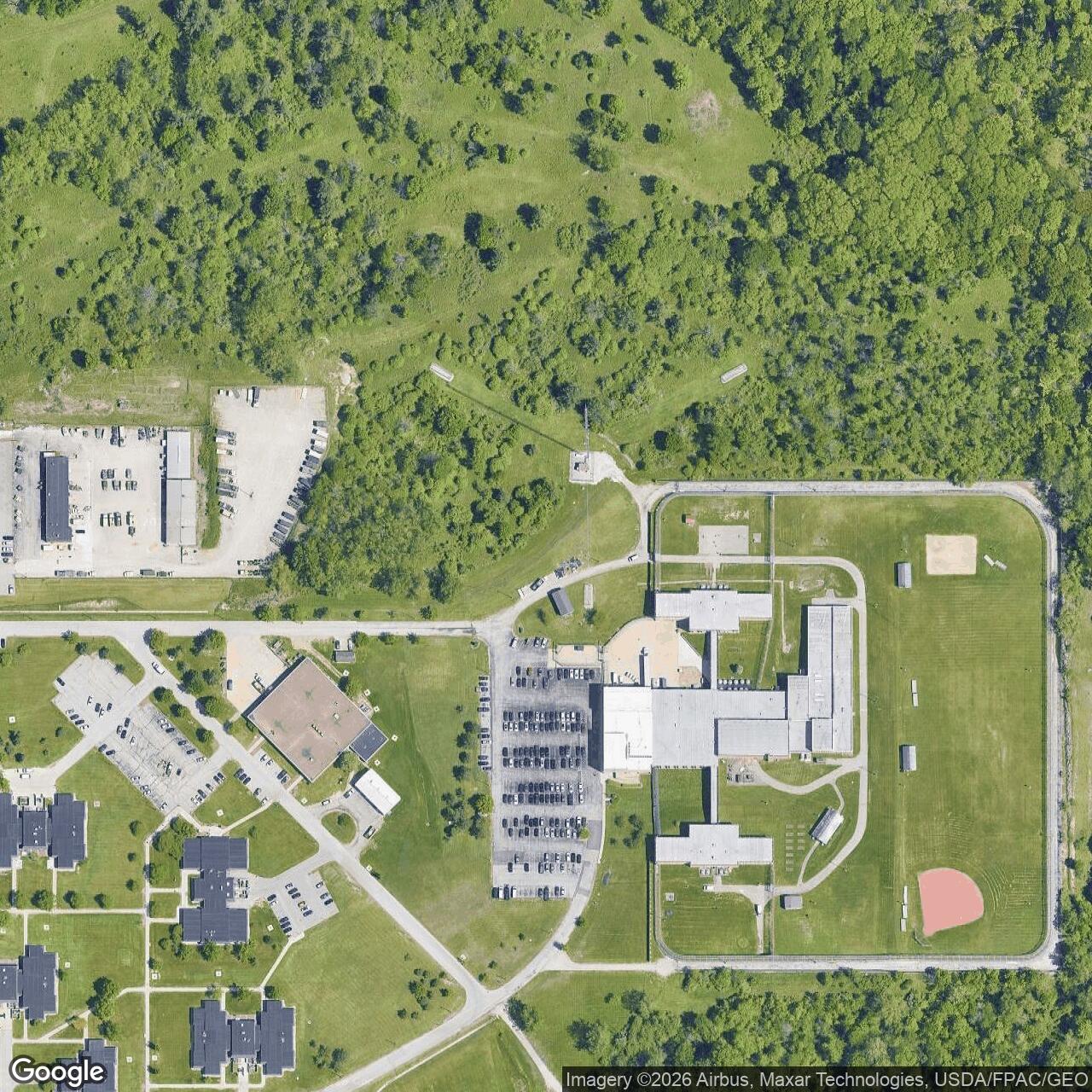
Nike Missile Site CL-34 IFC, Warrensville Ohio
Longitude: -81.5112
This location was part of the Cleveland Defense Area
Site ID: CL-34
This site controlled the missiles at the Launch Area located here.
Site Role: IFC
A typical Nike air defense site consisted of two separate parcels of land. One area was known as the Integrated Fire Control (IFC) Area. This site contained the Nike system's ground-based radar and computer systems designed to detect and track hostile aircraft, and to guide the missiles to their targets.
The second parcel of land was known as the Launcher Area. At the launcher area, Nike missiles were stored horizontally within heavily constructed underground missile magazines. A large, missile elevator brought the Nikes to the surface of the site where they would be pushed across twin steel rails to one of four satellite launchers.
Elaboration on how Nike worked here.
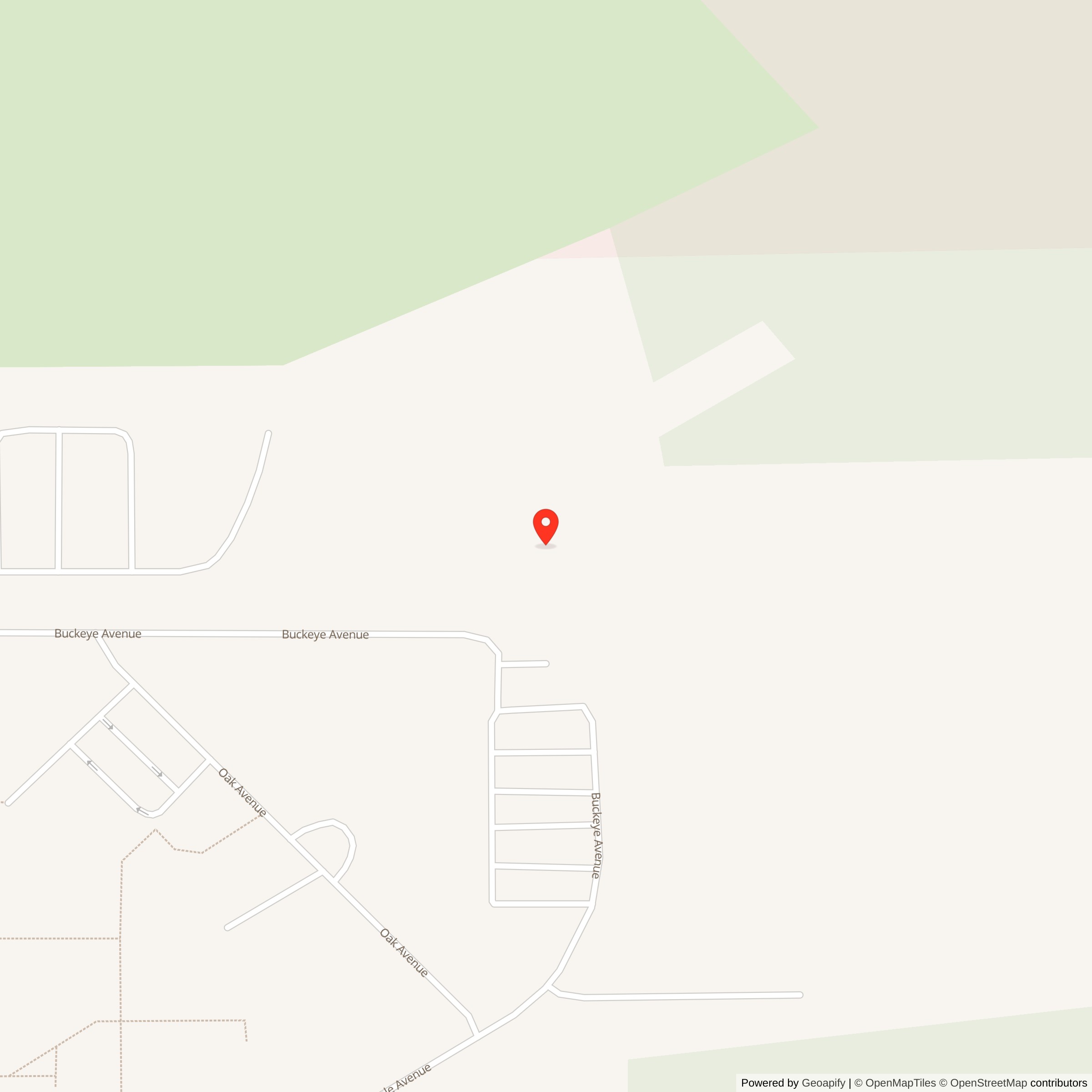
Nike Missile Site CL-34 was a U.S. Army Nike Ajax air-defense missile battery in the Cleveland Defense Area. The site was located in the Warrensville Heights / Highland Hills area of Cuyahoga County, southeast of central Cleveland, near the Richmond Road and Harvard Road corridor. It was one of the fixed surface-to-air missile batteries built during the mid-1950s to defend Greater Cleveland, its Lake Erie port and transportation network, and its industrial and population center from the perceived threat of Soviet bomber attack.
It operated as a Nike Ajax site during the first generation of Cleveland Nike defenses and was not converted to Nike Hercules. Standard site inventories list the site as active from 1956 to 1963; the site-specific Detroit-Cleveland Nike reference gives a formal activation date of July 1957 and a deactivation date of 1963. The practical interpretation is that CL-34 belonged to the 1956 Cleveland Ajax buildout and entered its identified operational period by July 1957.
Units that served at CL-34
Reported unit sequence:- July 1956-February 1957 - Battery B, 351st U.S. Army
- February 1957-September 1958 - Battery B, 508th U.S. Army
- September 1958-January 1961 - Battery B, 3rd Battalion, 65th U.S. Army
- June 1961-1963 - Battery C, 1st Battalion, 137th Ohio Army National Guard
The unit sequence shows CL-34 moving through the typical Cleveland-area transition from Regular Army manning to Ohio Army National Guard operation during the Ajax drawdown period. The 351st and 508th Missile Battalions belonged to the original Regular Army manning of the Cleveland Nike network. By the early 1960s, the Ohio Army National Guard's 1st Battalion, 137th Artillery, had taken over some of the remaining Ajax batteries before the Ajax-only sites closed.
Historical Background
CL-34 was part of the Army's postwar Nike system, the nation's first operational guided surface-to-air missile network. The Nike program grew from World War II and early Cold War concerns that conventional antiaircraft guns would not be adequate against faster, higher-flying bombers. The Soviet Union's atomic bomb test in 1949, the Korean War, and the broader rearmament climate of the early 1950s gave continental air defense new urgency. The Air Force operated the larger early-warning, fighter-interceptor, and command network, while the Army supplied the local last line of defense around strategic targets.Cleveland was an obvious candidate for Nike defense. It was a major industrial city on Lake Erie, with steel production, manufacturing, rail and highway corridors, harbor facilities, energy and petroleum infrastructure, and dense urban population. The region formed part of the Great Lakes industrial belt that Cold War planners treated as both economically vital and vulnerable. A hostile bomber force approaching over the Great Lakes or across the Midwest could threaten the city and its industrial region, so the Army placed missile batteries around the metropolitan area to provide overlapping coverage.
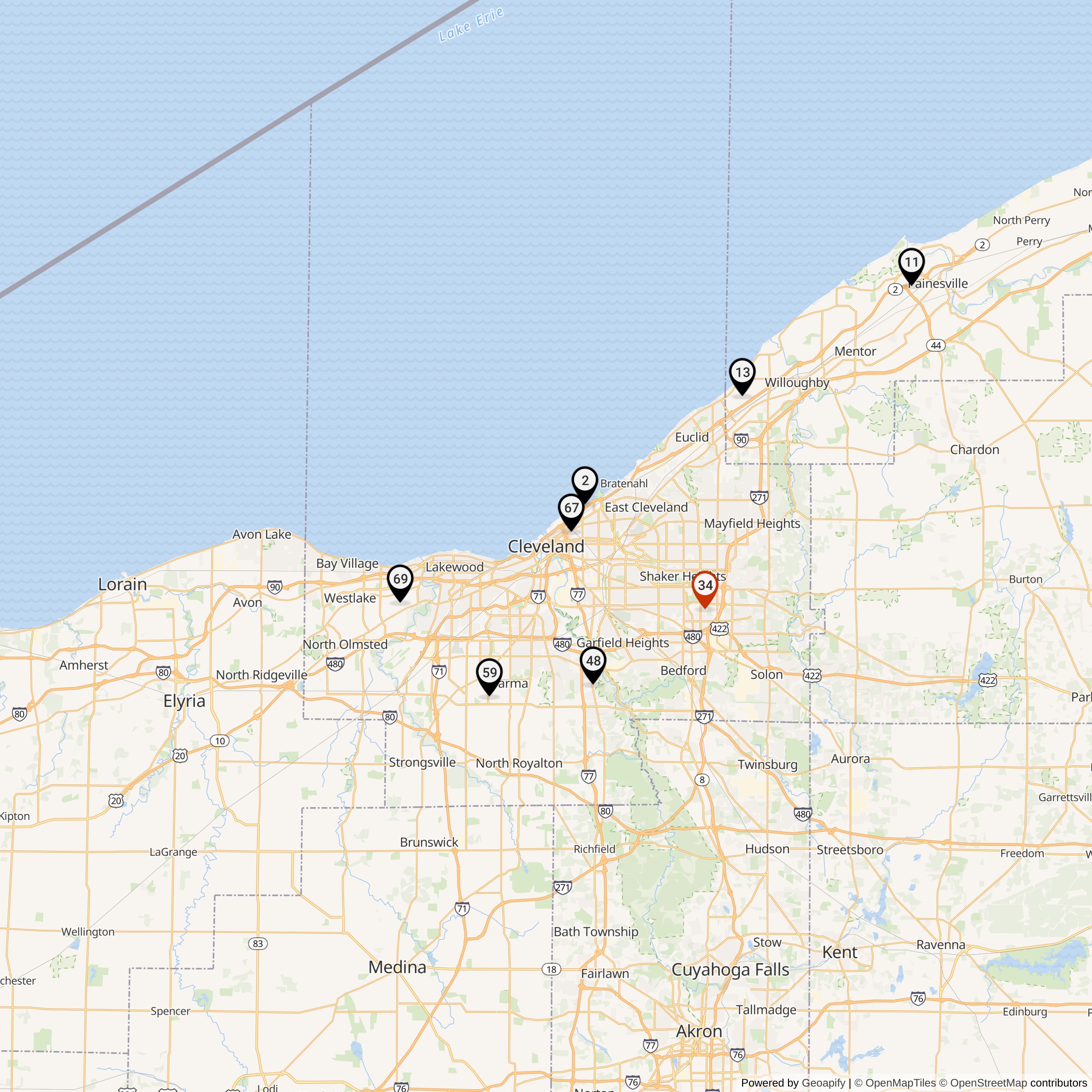
The Cleveland Defense Area was built as a ring of Nike Ajax sites during the mid-1950s. Federal missile-site summaries identify the Cleveland-area Nike Ajax sites as CL-02 at Bratenahl, CL-11 at Painesville, CL-13 at Willowick, CL-34 at Warrensville, CL-48 at Garfield Heights, CL-59 at Parma / Midpark Station, CL-67 at Lakefront Airport, and CL-69 at Lordstown / Fairview Park. Headquarters facilities were located at the Shaker Heights Armory and in Cleveland. The U.S. Army Corps of Engineers Pittsburgh District, then a component of the Ohio River Division, had responsibility for construction of these Cleveland-region sites.
CL-34 occupied the southeast sector of the Cleveland defense pattern. That location gave the Army a missile battery south and east of the city's core, complementing the lakefront, western, eastern, and southwestern sites. It was not built to defend Warrensville Heights alone. Its mission was to contribute to a wider defensive envelope around the Cleveland target complex by engaging hostile aircraft approaching the city from the southeast, south, or eastern inland approaches, and by overlapping with nearby Cleveland-area Nike batteries.
Construction and Nike Ajax Configuration
CL-34 was an Ajax-only site. It is listed in standard Nike inventories as Nike 3B/30A/12L-A. In practical terms, that meant the launcher area had three underground Type B missile magazines, a nominal capacity of 30 Nike Ajax missiles, and 12 Ajax launchers. The "A" launcher designation indicates Ajax launchers rather than Hercules universal launchers. Although the Type B magazine design could appear at some sites later adapted for Hercules, CL-34 itself was not one of the Cleveland batteries converted to Hercules.The site-specific CL-34 reference lists the battery's radar as LOPAR, or Low-Power Acquisition Radar. That is consistent with Nike Ajax operation. In the Ajax system, LOPAR was the long-range search radar used by the battery to detect aircraft. Once a target was identified as hostile, a target-tracking radar followed the aircraft, a missile-tracking radar followed the launched missile, and a ground-based computer calculated the steering commands needed to guide the missile to its intercept point.
Like other Nike batteries, CL-34 was divided into two major sections: the Integrated Fire Control area and the launcher area. The IFC area contained the radar, fire-control, command, and support equipment needed to detect, identify, track, and engage a target. The launcher area contained the underground magazines, elevators, launch rails, launchers, missile-assembly and maintenance facilities, generators, fencing, access roads, and launch-control equipment.
Case Western Reserve University's Cleveland history article describes a typical Cleveland Nike launch base as including Nike Ajax missiles, missile-assembly facilities, a generator building, acid-storage building, fueling area, underground missile storage and launchers, barracks, and a launcher-control trailer. The same article describes the control area as a separate installation roughly one-half mile from the launcher, with a mess hall, administration building, barracks, radar tower, and control van. CL-34 followed that basic split-site pattern, with the launch base near Richmond and Harvard roads and the control area on Richmond Road.
Nike Ajax Operations at CL-34
The Nike Ajax was a command-guided missile system, not a self-contained missile that found its own target after launch. The battery's ground radar and computer system guided the missile throughout the engagement. A normal firing sequence began with warning from the air-defense network. The battery would go to alert, launcher crews would prepare missiles, IFC crews would acquire the incoming aircraft, and the battery commander would decide whether to engage.At the launcher area, missiles were stored below grade in horizontal underground magazines. Elevators raised the missiles to the surface, where crews moved them along rails to the launchers. The launch area therefore required both heavy physical infrastructure and constant maintenance: magazine elevators, rails, launch stands, electrical systems, generator support, warhead and missile-handling equipment, security fencing, fueling equipment, and safety controls. Because Ajax used liquid-fuel components, the launch area included fueling and acid-storage functions that made the site more hazardous and maintenance-intensive than the later solid-fuel Hercules system.
At the IFC area, radar and fire-control soldiers operated the LOPAR search radar, target-tracking radar, missile-tracking radar, and associated computer equipment. LOPAR searched for targets; the target-tracking radar locked onto the hostile aircraft; the missile-tracking radar tracked the missile in flight; and the computer generated guidance commands. The missile's high-explosive fragmentation warheads detonated at the calculated intercept point.
The Ajax system had limitations. It was designed primarily for high-altitude bomber defense and could engage only one target at a time per battery. It was also part of an air-defense network that had to avoid redundant engagements, friendly-fire risk, and confusion between multiple Nike batteries and Air Force aircraft. These limitations drove later improvements in command-and-control systems and helped explain why the Army eventually favored the longer-range, more capable Nike Hercules for the batteries it retained.
Place in the Cleveland Defense Area
CL-34's role becomes clearer when viewed within the entire Cleveland Nike ring. CL-02 guarded the Bratenahl / near-east lakefront sector; CL-67 covered Burke Lakefront Airport and the immediate lakefront; CL-69 covered the western side near Fairview Park and Rocky River; CL-59 covered the Parma / Midpark sector; CL-48 covered the Garfield Heights / Independence sector; CL-13 and CL-11 extended coverage east and northeast into Lake County; and CL-34 occupied the Warrensville Heights / Highland Hills southeast sector.The Cleveland system was therefore both geographic and technological. It surrounded the city with fixed batteries and linked those batteries into the broader continental air-defense system. The presence of the Shaker Heights Armory and Cleveland headquarters facilities gave the defense area an administrative and command structure beyond the individual launch sites. CL-34 was one of the local firing units within that larger system.
The site's location near the Richmond Road and Harvard Road corridor also demonstrates how Nike sites were placed within ordinary postwar suburban landscapes. CL-34 sat in a suburbanizing area rather than on a remote military reservation. Its soldiers worked beside roads, neighborhoods, industrial and institutional land uses, and later highway infrastructure. This is one of the defining historical features of the Nike program nationwide: Cold War missile batteries were inserted into the daily geography of American metropolitan life.
Why CL-34 Was Not Converted to Nike Hercules
By the late 1950s, the Army began replacing selected Nike Ajax batteries with Nike Hercules. Hercules was larger, solid-fueled, longer ranged, and capable of carrying either conventional or nuclear warheads. It allowed fewer batteries to cover wider areas and made some Ajax-only batteries redundant.In the Cleveland Defense Area, only CL-02, CL-11, and CL-69 were converted to fire Nike Hercules missiles. CL-34 was not among the converted sites. It remained an Ajax battery until its closure in 1963. The decision not to convert CL-34 is important because it marks the site as a first-generation Cold War air-defense installation. Its historical significance lies especially in the Ajax period: the moment when the Army placed liquid-fueled guided missiles around American cities as the last defensive layer against nuclear-armed bombers.
The Cleveland pattern shows the broader national transition clearly. The mid-1950s defense ring had eight Ajax sites. Once Hercules entered service, the Army concentrated the long-term Cleveland mission at fewer upgraded batteries and phased out Ajax-only locations such as CL-34, CL-13, CL-48, CL-59, and CL-67. This was not a simple abandonment of Cleveland air defense; it was a technological consolidation.
Deactivation
CL-34 was deactivated in 1963. That date matches the national phaseout of the last Nike Ajax batteries, which occurred as the Army Air Defense Command completed the transition away from Ajax at remaining continental defense sites. By the time CL-34 closed, the Cleveland Defense Area's surviving air-defense role had shifted to the Hercules batteries at CL-02, CL-11, and CL-69.The closure also reflected the changing strategic environment. The bomber threat that had driven the original Nike Ajax deployments remained part of Cold War planning, but intercontinental ballistic missiles and submarine-launched ballistic missiles were becoming the dominant strategic threat. Fixed Nike batteries around cities could not defend against ballistic missiles. The Army continued some Hercules operations into the early 1970s, but Ajax-only sites like CL-34 no longer fit the reduced and modernized air-defense network.
Post-Closure Use and Site Condition
After closure, CL-34's two areas followed the typical post-Nike pattern of separate civilian reuse. Standard Nike inventories list the control site as associated with a U.S. Army Reserve Center and the launch site with Ohio Department of Transportation use. Other public site listings and later condition summaries describe the former CL-34 property as heavily altered, with the launch site redeveloped or absorbed into highway, transportation, commercial, or public-works surroundings.The CL-34 launcher area lay near major road and interchange development. Later aerial-photo documentation from the Nike Detroit-Cleveland Defense Area site shows the launcher area as it appeared in 2001 near the Richmond / Harvard / highway corridor. In such a location, the underground magazines and launch infrastructure were vulnerable to grading, paving, filling, and redevelopment. Many former Nike launcher sites survived because their concrete pads and underground magazines were difficult to remove; CL-34 appears to be one of the sites where post-military land use substantially erased the visible missile-base landscape.
The IFC area, identified by the site-specific coordinates at approximately 41.45329, -81.50166, also appears in 2001 aerial-photo documentation. The control area's military character depended heavily on radar towers, control vans or buildings, support buildings, barracks, and communications infrastructure. Once the radars and military equipment were removed, IFC areas were often much easier to clear or reuse than launcher areas. At CL-34, the control site's later identification with the U.S. Army Reserve Center indicates continued government or military-related use of the general area after the Nike battery itself closed, though not as an active Nike missile site.
Because CL-34 was not a Hercules site and did not remain in service to 1971, it did not receive the same prolonged Cold War operational identity as the three surviving Cleveland Hercules batteries. Its post-closure visibility is therefore lower than sites that retained larger, later facilities or whose underground magazines survived in public ownership. Even so, the site's coordinates, road relationships, and historical records preserve the split-site geography of the former battery.
List of all Nike Installations in the Cleveland Defense AreaList of all Nike Installations in Ohio