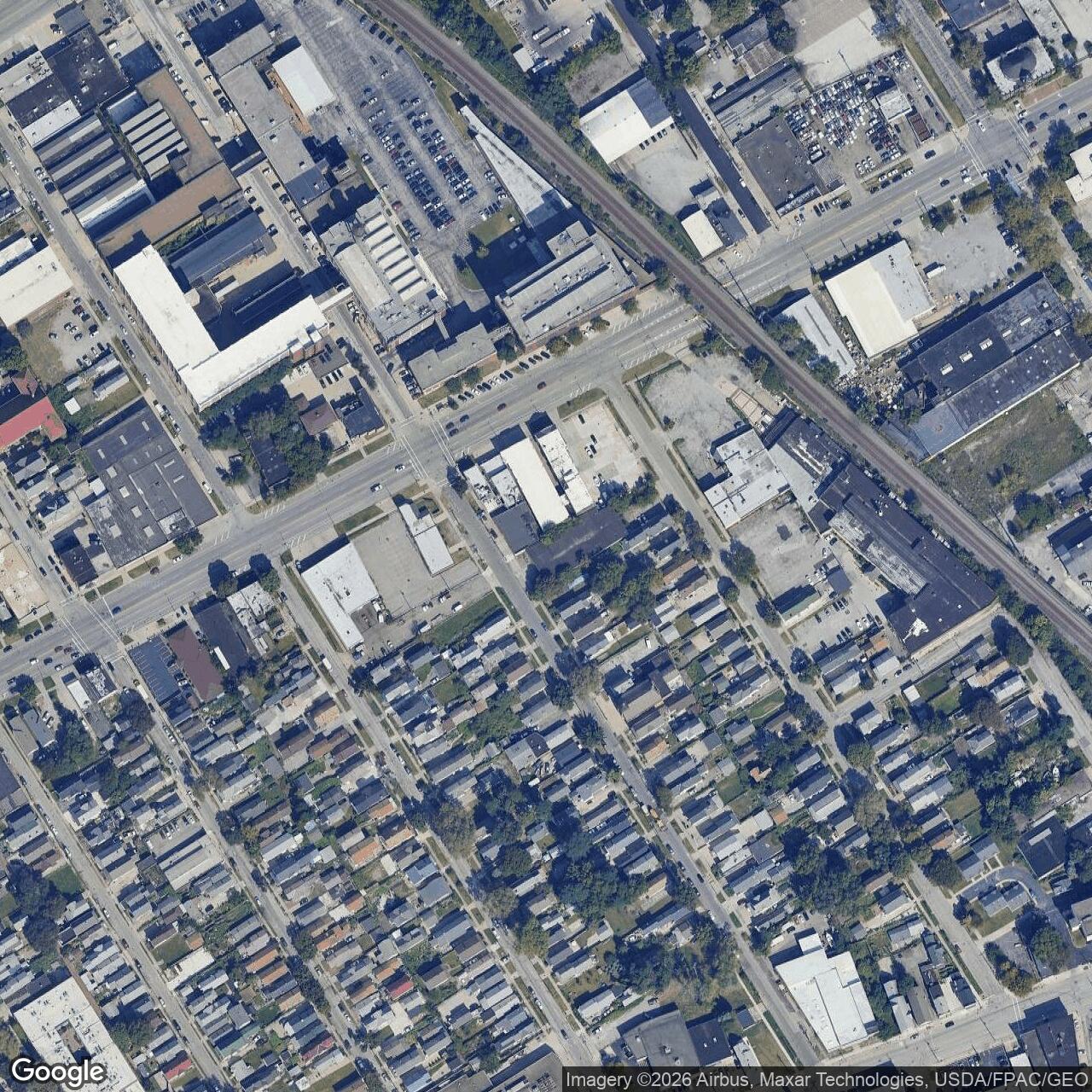
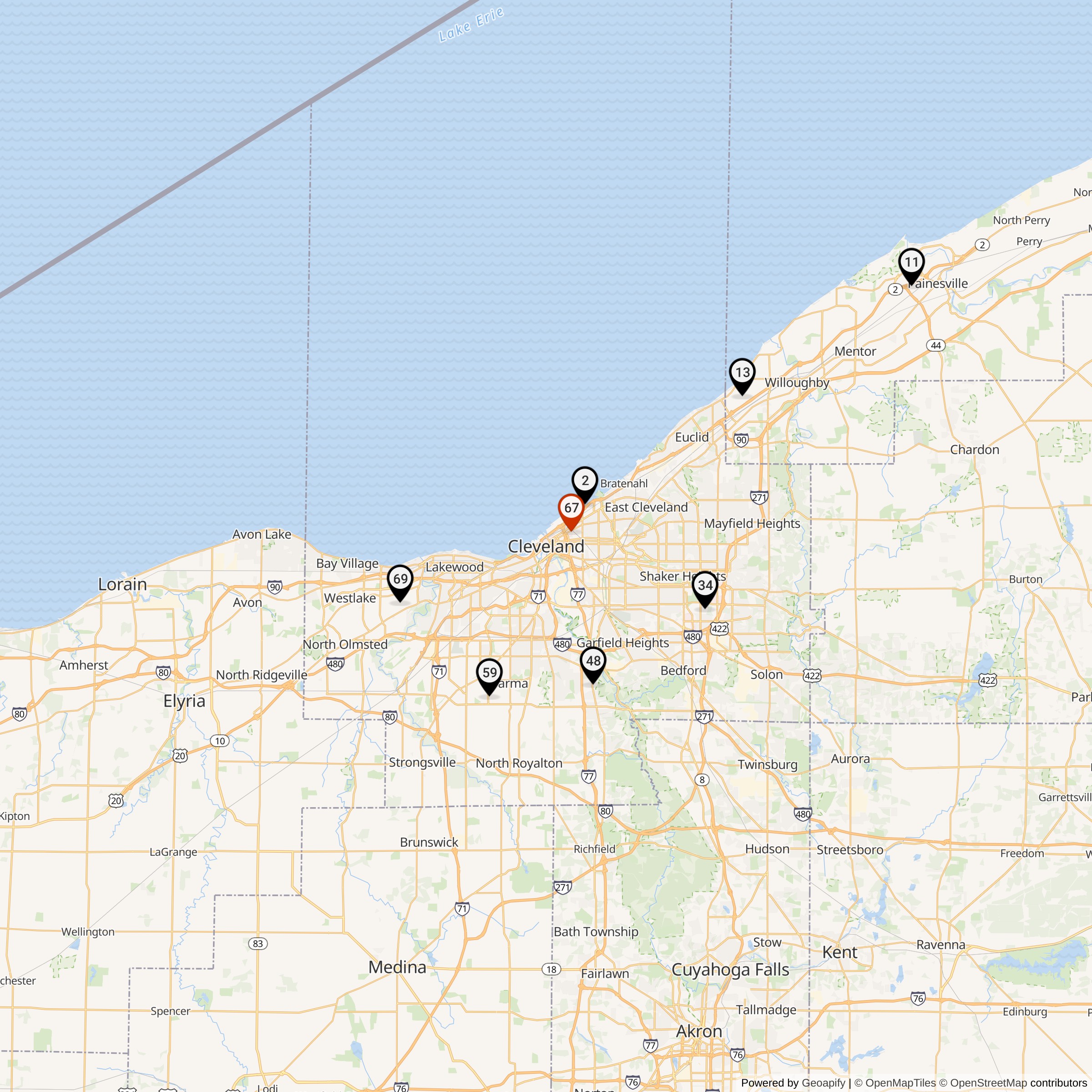
Nike Missile Site CL-67 IFC, Burke Ohio
Longitude: -81.665
This location was part of the Cleveland Defense Area
Site ID: CL-67
This site controlled the missiles at the Launch Area located here.
Site Role: IFC
A typical Nike air defense site consisted of two separate parcels of land. One area was known as the Integrated Fire Control (IFC) Area. This site contained the Nike system's ground-based radar and computer systems designed to detect and track hostile aircraft, and to guide the missiles to their targets.
The second parcel of land was known as the Launcher Area. At the launcher area, Nike missiles were stored horizontally within heavily constructed underground missile magazines. A large, missile elevator brought the Nikes to the surface of the site where they would be pushed across twin steel rails to one of four satellite launchers.
Elaboration on how Nike worked here.
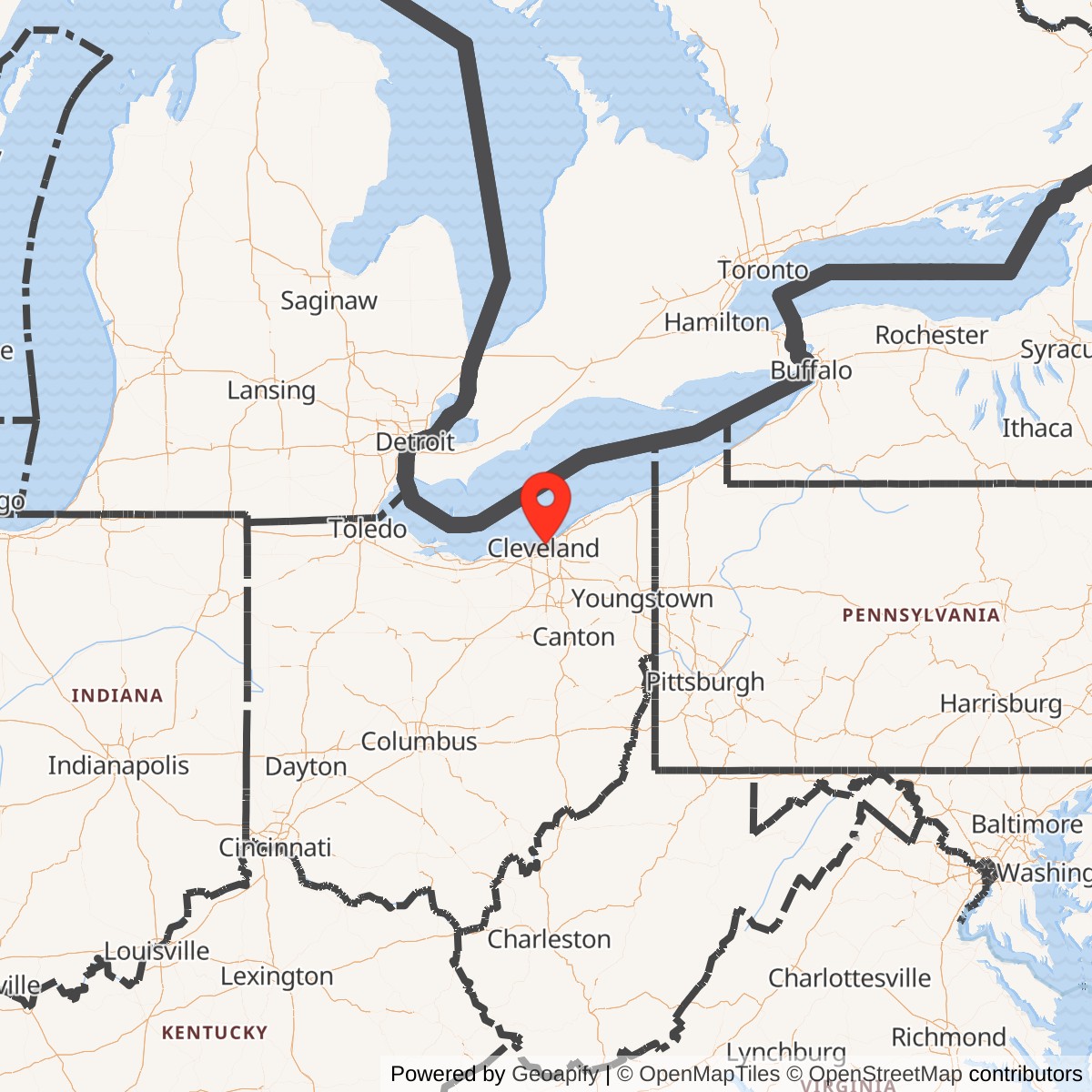
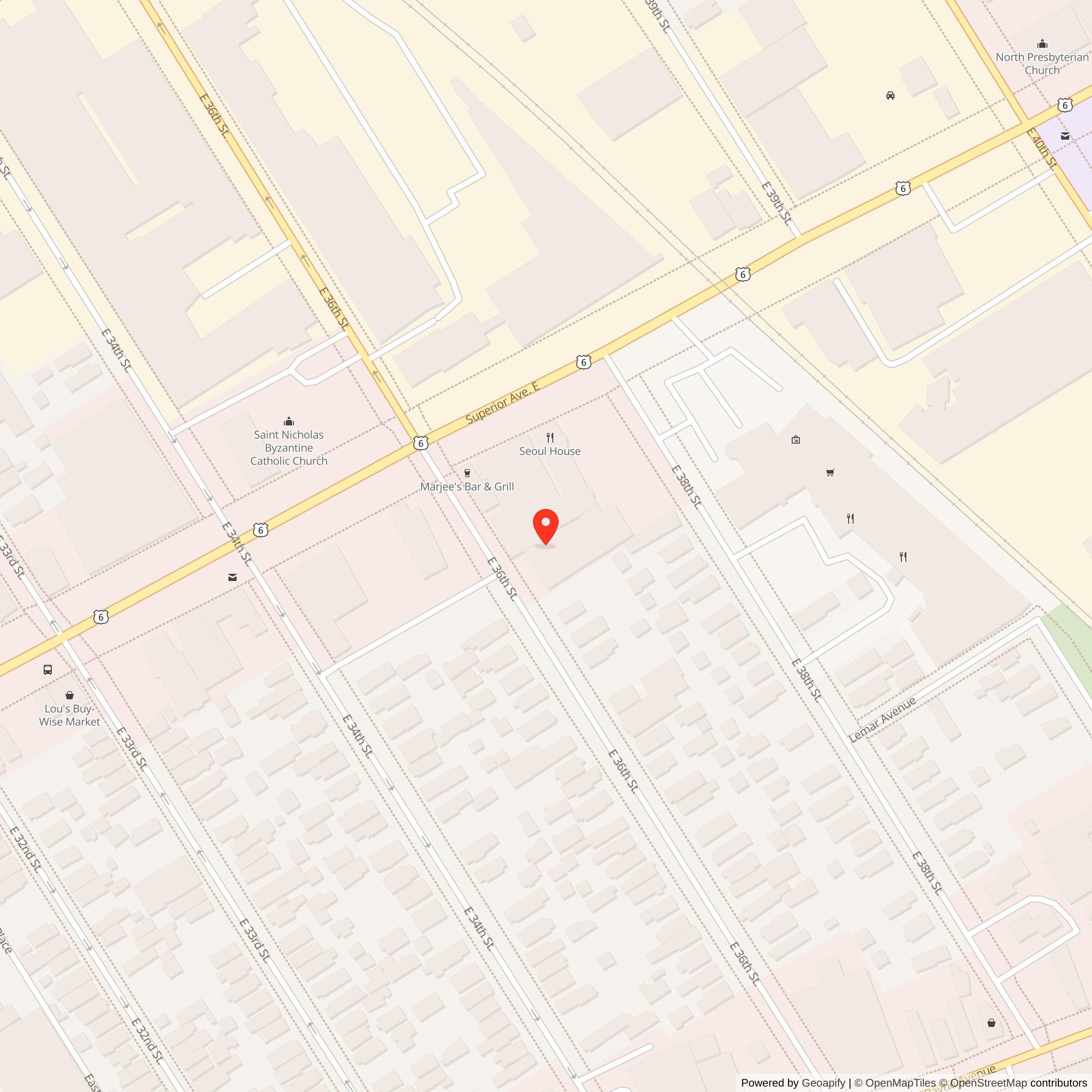
Nike Site CL-67 was a U.S. Army Nike Ajax surface-to-air missile battery in the Cleveland Defense Area. It was located on Cleveland's downtown lakefront at Burke Lakefront Airport, with the launcher area on the airport side of the lakefront and the Integrated Fire Control area near East 40th Street and the Memorial Shoreway. The site was part of the Cold War air-defense system placed around Cleveland to defend the city, its lakefront, its port and industrial district, transportation corridors, and the larger northeastern Ohio urban-industrial region from possible Soviet bomber attack.
CL-67 was activated in July 1956 and deactivated in 1963. It was a Nike Ajax site only; no strong operational source found for this file identifies CL-67 as having been converted to operational Nike Hercules service. Its reported configuration was Nike 3B/30A/12L-A: three missile magazines, 30 Nike Ajax missiles, and 12 Ajax launchers. The launcher suffix "A" matters because it indicates Ajax launchers, not universal Hercules-capable launchers. The site's post-closure fate was also unusual within the Cleveland Nike network: the launcher area was demolished, capped, buried, and paved over as part of Burke Lakefront Airport's Runway 6L environment, while the former IFC area became associated with City of Cleveland park / service-center use.
Units that served at CL-67
The site-specific CL-67 page identifies the following unit sequence:- July 1956-September 1958: Battery C, 351st U.S. Army
- September 1958-January 1961: Battery C, 1st Battalion, 68th U.S. Army
- January 1961-1963: Battery B, 1st Battalion, 137th Ohio Army National Guard
The unit sequence is important because it shows the site's transition from Regular Army operation to Ohio Army National Guard manning. That transition was common in the later life of many Nike batteries. The Guard could keep fixed local air-defense sites manned while reducing the burden on active Army forces, and it also tied the Cleveland missile defenses more directly to local reserve-component institutions.
Historical Background
The Cold War Nike program grew out of the Army's conclusion that conventional antiaircraft guns were no longer adequate against modern bomber aircraft. During World War II and the early Cold War, bombers became faster, flew higher, and could potentially carry atomic weapons. After the Soviet atomic test in 1949 and the Korean War mobilization that followed, American planners treated direct air attack on the continental United States as a real enough danger to justify a nationwide system of early warning, fighter interception, command-and-control centers, and fixed Army missile batteries.Cleveland was a logical place for Nike defenses. In the 1950s it was a major Great Lakes industrial city. Its metropolitan area included steel and metalworking, machine and vehicle production, chemical and petroleum-related facilities, rail and highway connections, port facilities, utility infrastructure, and a dense population center. The lakefront also mattered because Lake Erie created a broad open approach to the city, while the harbor and downtown industrial district concentrated facilities that would have been important in a war economy. Nike missile sites were not placed only at military bases; they were placed around civilian cities whose industrial capacity and transportation networks were considered strategic.
The Cleveland Nike system consisted of a ring of sites around the metropolitan area. Local Cleveland history identifies seven sites in Cuyahoga County and an eighth in Lake County. The local sites included Rocky River / Fairview Park, Parma / Parma Heights, Garfield Heights / Independence, Warrensville Heights, Willowick, Bratenahl, Lakefront Airport, and Painesville. CL-67 filled the lakefront / downtown role in that network. Unlike suburban sites that were inserted into parkland, school property, or former rural edge conditions, CL-67 was directly embedded in an airport landscape beside Lake Erie and near downtown Cleveland.
The site also reflected a recurring Nike siting problem: the Army needed tactical coverage, open sight lines, a launcher area with enough space for underground magazines, and an IFC area separated from the launchers but still able to communicate and track targets effectively. In dense urban districts, the Army often used public or already-developed land because the land requirements for a standard battery were difficult to meet. At CL-67, the lakefront airport site provided open ground, proximity to the defended city, and the kind of cleared operating environment that made it possible to install launchers and radar facilities in a metropolitan setting.
Nike Ajax at CL-67
CL-67 was armed with Nike Ajax, the first operational guided surface-to-air missile system deployed by the U.S. Army. Nike Ajax was conceived near the end of World War II and brought into operational use during the early Cold War. It was designed to attack high-flying enemy bombers before they reached defended cities or installations. It was a command-guided system: the missile did not independently home on a target. Instead, the battery's ground equipment tracked the hostile aircraft, tracked the outgoing missile, calculated the intercept, and transmitted steering commands to the missile in flight.The Nike Ajax missile was a two-stage weapon. A solid-propellant booster launched the missile from its rail, and a liquid-fueled sustainer carried it toward the target. Official Army technical summaries give Nike Ajax a range of roughly 25 to 30 miles, a speed of about Mach 2.3, an engagement altitude up to about 70,000 feet, and three high-explosive fragmentation warheads. Those specifications made Ajax far more capable than conventional antiaircraft guns against high-altitude bombers, but the system had limitations. It could engage only one target at a time, and its conventional warhead was less useful against dense bomber formations than the later nuclear-capable Nike Hercules.
CL-67's configuration, Nike 3B/30A/12L-A, indicates a substantial Ajax launcher area. The "3B" portion identifies three Type B magazines. The "30A" portion indicates 30 Nike Ajax missiles. The "12L-A" portion indicates 12 Ajax launchers. A standard underground Nike magazine stored missiles horizontally below grade and used an elevator to raise missiles to the surface. Once at the surface, crews moved the missiles along rails to the launchers. The launchers were then elevated for firing.
At CL-67, the launcher photographs are especially valuable because they show the unusual visual relationship between the missile battery and Cleveland's skyline. Historic images show Nike Ajax missiles raised on launcher racks with downtown buildings visible in the background. That setting is one of the clearest examples of how close the Nike program could be to the cities it defended. CL-67 was not an isolated rural base; it was a missile battery on an urban lakefront, at an airport, within sight of downtown Cleveland.
Site Layout and Daily Operation
Like other Nike batteries, CL-67 was divided into two operational halves: the launcher area and the Integrated Fire Control area. The launcher area held the underground missile magazines, elevators, launchers, assembly and test facilities, generator and support structures, launch-control equipment, fencing, lighting, and security systems. The IFC area held the radars, control vans, communications equipment, power plant, and associated support and personnel facilities. The two areas had to operate as a single weapon system. The IFC found and tracked the target; the launcher area readied and fired the missile.The IFC area for CL-67 was listed at 4200 South Marginal, near East 40th Street and the Memorial Shoreway. The IFC reportedly used LOPAR, the Low-Power Acquisition Radar. In a Nike Ajax engagement sequence, LOPAR provided initial target acquisition. The target-tracking radar then locked onto the hostile aircraft, the missile-tracking radar followed the outgoing Ajax missile, and the battery-control computer calculated commands to guide the missile to the intercept point.
The launcher area was on Burke Lakefront Airport property.
The launch area was reportedly demolished and paved over to form Runway 6L, with the missile pits capped and buried before paving. This post-closure treatment removed the most visually obvious Nike structures but also likely left the former launcher footprint embedded beneath later airfield construction. In other words, the site did not become a park landscape where magazine outlines or access roads could remain visible. It was absorbed into active airport infrastructure.
The site's daily operation would have resembled other Ajax batteries despite its unusual airport setting. Soldiers maintained readiness around the clock, performed radar checks, inspected launchers and missiles, maintained generators, secured the launch area, monitored communications, and participated in drills that tested response time from alert to simulated launch. Because Ajax used hazardous liquid propellants, the launch area included fueling and storage procedures that required discipline and specialized handling. The physical presence of acid-storage and fueling facilities at Cleveland Nike sites is noted in local summaries of the city's Nike base layout.
CL-67 in the Cleveland Defense Area
CL-67's role was to defend the downtown and lakefront approach to Cleveland. It was one of the close-in sites placed near the city rather than on the far suburban perimeter. The battery's position at Lakefront Airport gave it coverage over Lake Erie, the central waterfront, and the industrial corridor near downtown. It also complemented the other Cleveland sites. CL-02 at Bratenahl guarded the northeast lakefront side and later converted to Hercules. CL-69 at Fairview Park / Rocky River guarded the western side and later converted to Hercules. CL-59 covered the Parma / southwestern sector. CL-34, CL-48, CL-13, and CL-11 filled other suburban and regional sectors.The larger Cleveland system changed quickly. Nike Ajax sites were constructed in the mid-1950s, but by the late 1950s the Army was already converting selected batteries in many defense areas to Nike Hercules. Hercules had greater range and altitude and could carry high-explosive or nuclear warheads. In the Cleveland Defense Area, CL-02, CL-11, and CL-69 were the sites converted to Hercules.
That shorter operating life is historically important. CL-67 illustrates the first phase of Cleveland Nike defense: urgent mid-1950s construction for the manned-bomber threat, followed by rapid obsolescence or consolidation as Hercules conversion, changing strategic doctrine, and the rise of ballistic-missile threats reshaped air defense. Ajax-only sites such as CL-67 could be closed relatively early because upgraded Hercules batteries covered larger areas with fewer sites.
Burke Lakefront Airport Setting
The location at Burke Lakefront Airport made CL-67 one of the most distinctive Cleveland Nike sites. The airport was a downtown lakefront aviation facility, not a conventional Army reservation. Modern City of Cleveland information identifies Burke Lakefront Airport as a reliever airport for Cleveland Hopkins International Airport and as the region's premier business airport, with major medical and emergency-transport activity. The airport's runway environment remains active, and official runway information lists the primary 6L and 24R runway components along with the secondary 6R/24L runway.The military use of part of the airport during the Nike era shows how flexible Cold War air-defense siting could be. The Army needed a missile battery close enough to defend the city but with enough open space for underground magazines, launchers, safe arcs, radar line-of-sight, and security. The lakefront airport met those conditions better than many dense urban parcels. The later removal of the launch complex for airport runway development also shows that the site's civilian aviation function ultimately outweighed its short-lived military function once the Ajax battery closed.
The Cleveland lakefront also gave CL-67 a striking symbolic position. The site placed guided missiles in the foreground of a city skyline, connecting national Cold War fears to local urban space. The battery protected Cleveland, but it also made the Cold War visible in Cleveland. Historic photographs of the launcher area and missiles on racks are therefore not merely technical images; they are evidence of a city adapting its public lakefront to national defense.
Deactivation and Post-Closure Use
CL-67 was deactivated in 1963. This was consistent with the broader decline of Ajax-only sites as Nike Hercules conversion and defense-area consolidation proceeded. By the early 1960s, many Ajax batteries either closed or gave way to longer-range Hercules sites. CL-67 was not retained as one of Cleveland's final Hercules batteries.After deactivation, the launcher area was removed from the military landscape. The site-specific CL-67 page states that the launcher area was demolished and paved over to form Runway 6L, and that airport staff reported the missile pits were capped and buried before paving.
The IFC area survived differently. The IFC belongs to the City of Cleveland Park Maintenance Department and gives 1155 East 40th Street as the later listed address.
The Cleveland Nike network as a whole ended by 1971, when the remaining Hercules batteries were deactivated.
List of all Nike Installations in the Cleveland Defense AreaList of all Nike Installations in Ohio