
BOMARC at Langley AFB, Virginia

Longitude: -76.47833
Squadron activated: September 1, 1959
Documented operational milestone: October 1, 1960
Operations ended: October 1, 1972
Squadron inactivated: October 31, 1972
Location And Identity
The Langley Air Force Base BOMARC Missile Site was a geographically separate Air Defense Command installation at Oyster Point in Newport News, Virginia. The 22d Air Defense Missile Squadron operated its long-range surface-to-air missiles as part of the SAGE-controlled defense of the Atlantic seaboard. Despite its Langley name, the missile field was not at the airfield in Hampton. Its location, later municipal reuse, and environmental history belong to the Oyster Point property, not automatically to the continuing Joint Base Langley-Eustis installation.
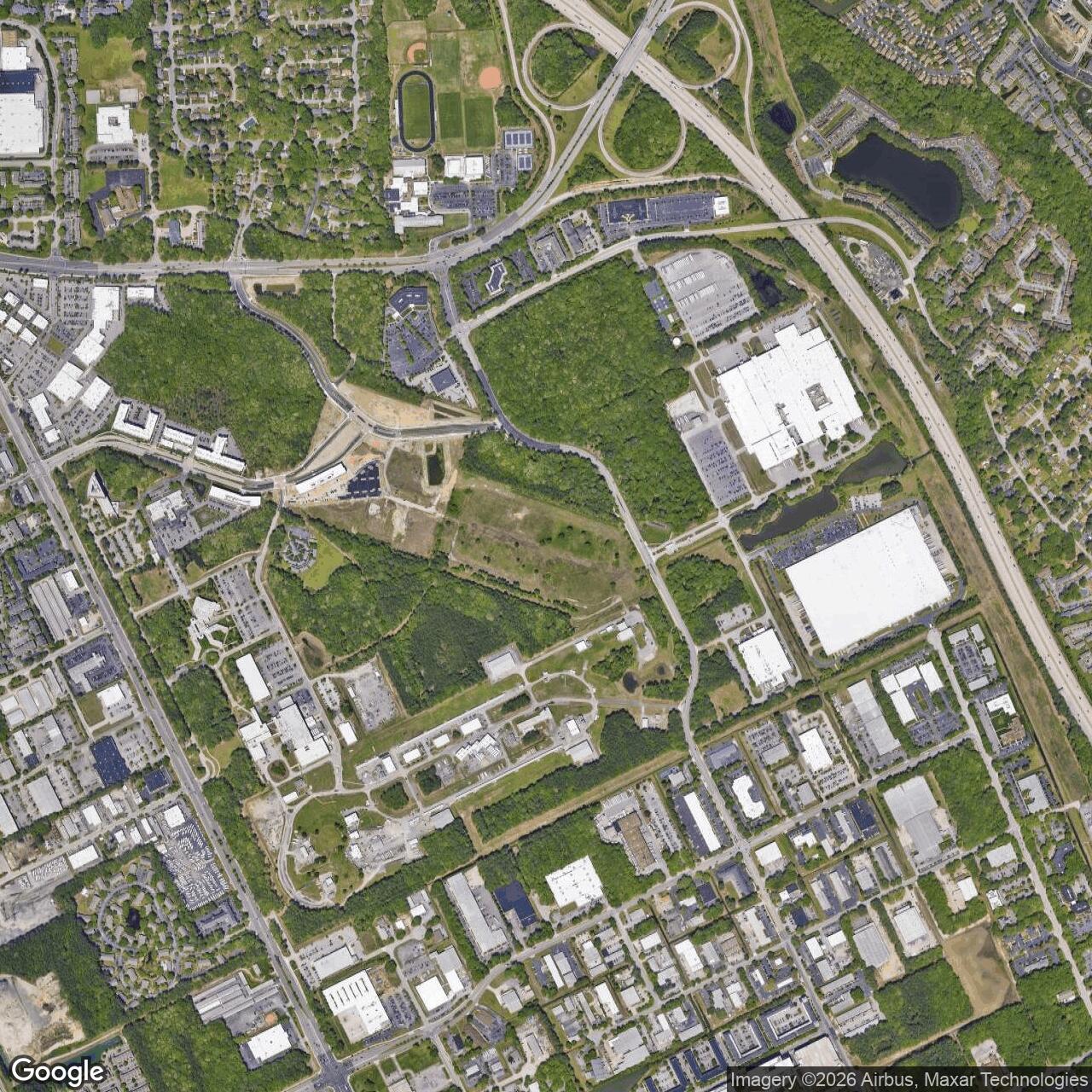
Interstate 64 lies to the east of the former military landscape, while Jefferson Avenue provides a useful western reference. Later roads, development parcels, and institutional boundaries should not be projected backward onto the original installation without a dated plan.
Three related properties must be distinguished. The BOMARC launcher and support complex occupied part of the much larger Oyster Point ammunition-storage reservation. A detached ground-air transmitter facility provided a separate radio-guidance function. Langley Air Force Base remained the supporting air base. These relationships explain the recurring use of the Langley name without making the storage reservation, missile battery, transmitter parcel, and airfield interchangeable. The former missile field also should not be confused with a Nike battery or an underground strategic-missile silo complex.
Origins In The Defense Of Hampton Roads
Hampton Roads concentrated shipbuilding, naval bases, military aviation, ports, and Army installations in a region accessible from the Atlantic. An attack on that concentration could affect fleet support, military transportation, and industrial production together. The Air Force's long-range interceptor missile offered one component of the response to the Soviet bomber threat. At Langley, the mission was regional air defense, extending interception beyond the immediate vicinity of a single defended installation. It complemented other defenses without replacing their different detection, interception, and command functions.
BOMARC combined an unmanned interceptor with a dispersed ground organization. Surveillance information entered the air-defense command system, which could direct a missile toward a hostile aircraft. The launcher base maintained the weapons and their supporting equipment in readiness, but it did not independently duplicate the entire regional radar and command network. This dependence on an integrated system is essential to understanding why a relatively compact field of shelters required communications, specialized maintenance, dependable utilities, trained crews, and a distant direction center.
The national deployment program contracted substantially from its early ambitions. Langley became one of eight operational United States BOMARC complexes, rather than one battery in the much larger network once contemplated. Two operational Canadian bases added a binational dimension to the program. Within the American group, Langley belonged to the original five A-model locations and subsequently became one of the three sites equipped with both A and B facilities. That sequence made it a particularly useful example of technological change within an existing installation.
Oyster Point Before The Missiles
The land already had a military storage identity when the missile project arrived. Boeing's 1959 bases manual placed the new complex in the northern portion of approximately 1,380 acres of government property identified as the Air Force's Oyster Point Bulk Ammo Storage area. The broader reservation therefore preceded and exceeded the BOMARC field. Federal environmental inventory material also describes early-1940s storage igloos, utilities, and railroad infrastructure. The missile program reused part of an established military landscape rather than creating every element of Oyster Point's military history from the beginning.
This distinction helps explain conflicting acreage figures. A later unit-history compilation describes a 110-acre missile complex, while an older disposal-era inventory places missile structures on a 127-acre redevelopment holding. Boeing's 1,380 acres concerns the surrounding storage reservation. These numbers describe different historical extents and cannot simply replace one another. No verified final survey establishing the complete A-and-B missile installation boundary was located, so a single definitive acreage is not assigned to the missile site here.
The site's physical conditions mattered to construction and maintenance. Boeing described ground generally 30 to 40 feet above sea level, with soft clay, low-density sand, a high water table, and limited natural drainage. The land was relatively flat and heavily wooded before development. The manual placed the missile base about thirteen road miles from Langley over the roads then available. That historical road distance should not be confused with a straight-line measurement between the two installations or with a modern driving route.
Building Base No. 5
Boeing identified Langley as IM-99A Base No. 5. Its early layout was still being revised in June 1959 to accommodate equipment for the advanced missile system alongside the A-model installation. This contemporary design note is more informative than describing the finished site as merely a standard battery. Langley was planned during a transition in the weapon program, when the requirements of the existing liquid-propellant booster system and the anticipated B-model equipment had to be reconciled on the same property.
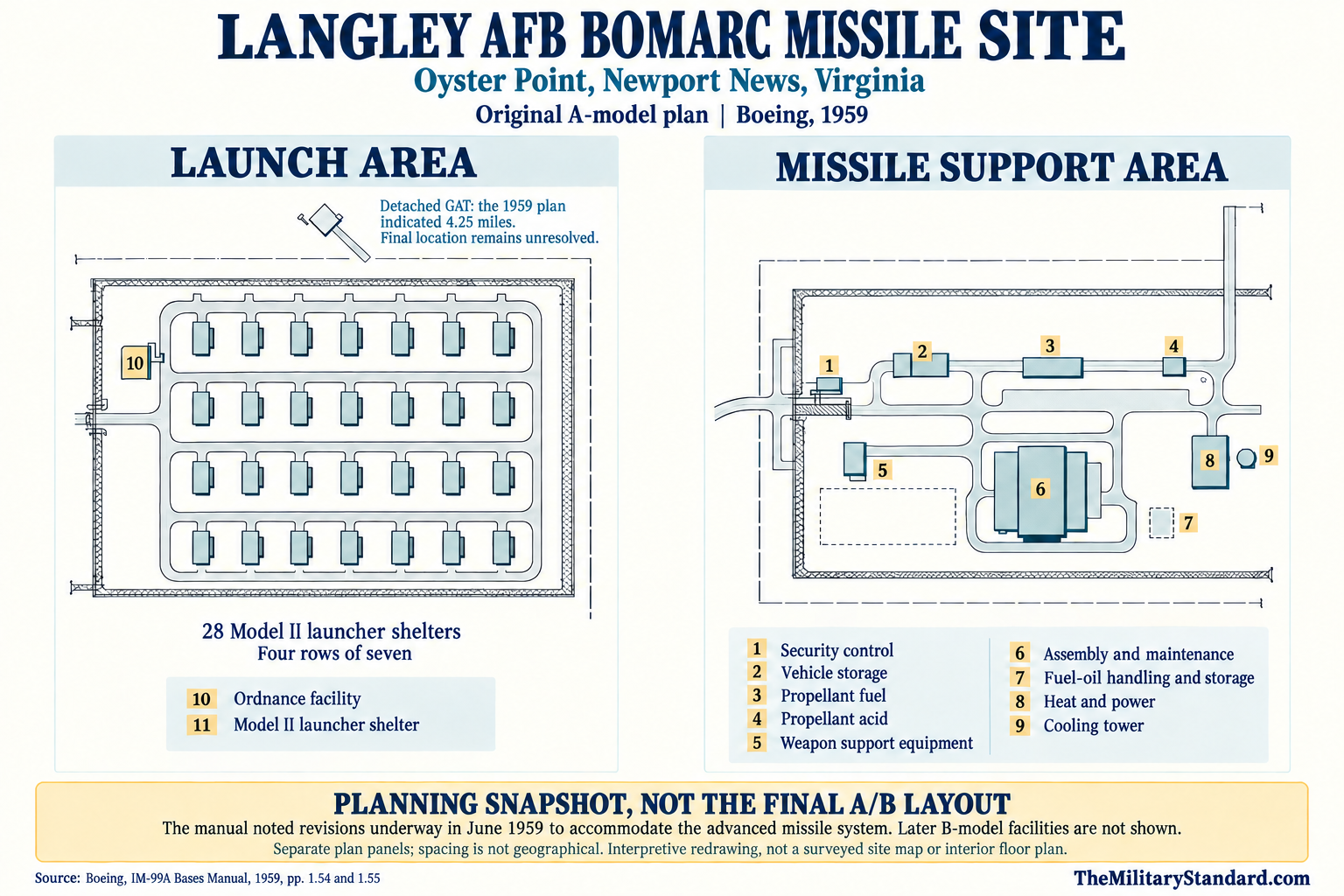
The original plan divided the installation into a launch area and a missile-support area. Twenty-eight Model II shelters were arranged in four rows of seven, with internal roads giving access to the individual positions. An ordnance facility stood within the launch-area plan. The support area contained security control and identification, vehicle storage, propellant-fuel and acid facilities, weapon-support equipment, the assembly and maintenance shop, fuel-oil storage and handling, a heat-and-power building, and a cooling tower. The numbered plan identifies functions, not a verified final building-number schedule.
Separating these functions reduced interference between routine support traffic and the protected missile area. It also gave equipment receiving, inspection, maintenance, and movement a physical sequence. Missiles and major components could pass through the assembly shop before being taken to shelters. Fuel and oxidizer support required their own facilities. Electrical generation and cooling sustained the conditions needed for ready storage. Roads, security points, utility distribution, and workshops were therefore integral parts of the weapon system, not incidental additions to a row of launchers.
An account assembled from unit-history material reports a Corps of Engineers missile complex costing approximately $5.5 million, with billeting and messing retained at Langley. That arrangement connected the detached technical installation to the host base's personnel support. It did not make Oyster Point a self-contained air base with a runway, a major hospital, and a complete residential cantonment. The available evidence supports a specialized missile operation supplied through Langley, with its most distinctive buildings concentrated on weapons, utilities, communications, and security.
The 22d Air Defense Missile Squadron
The official Aerospace Defense organization handbook records activation of the 22d Air Defense Missile Squadron at Langley on September 1, 1959. It was assigned to the Washington Air Defense Sector. This establishes the unit's organizational beginning, not the date on which an entire launcher field was ready for combat. The September 15 activation date found in some summaries and the 1958 date repeated in some site accounts are not adopted. The official handbook and the unit-history compilation agree on September 1, 1959.
Preparation for operational service involved trained technicians, supply organization, equipment receipt, security preparation, and inspection of the facilities. The unit-history account describes a three-month training period at Hurlburt Field in Florida before the squadron returned to its home station. It identifies Lieutenant Colonel Robert L. Andrews as commander beginning January 4, 1960. These details show that the battery's development involved building a working organization as well as completing construction. The missile shelters alone could not establish operational readiness.
The squadron's work continued well beyond launch-crew duties. Its stated mission encompassed missiles, launchers, data-processing equipment, associated communications and electronics, and the facilities supporting SAGE-directed air defense. The organization received an Air Force Outstanding Unit Award for September 1, 1963 through February 28, 1965, according to the compiled lineage record. That award period overlaps the transition away from the A model. It recognizes unit performance, but does not by itself establish a combat firing or a particular crisis action at Oyster Point.
Personnel lived and worked within an already crowded military region. Boeing's contemporary orientation material warned of a peninsula housing shortage intensified by the tourist season. That setting helps explain the value of retaining billeting and messing support at Langley while developing a detached technical workplace at Oyster Point. It also cautions against imagining a large residential community inside the missile fence. No verified squadron manpower table or detailed shift roster was located, so staffing totals and daily schedules are not supplied as if they were known.
Operational Readiness And Conflicting Dates
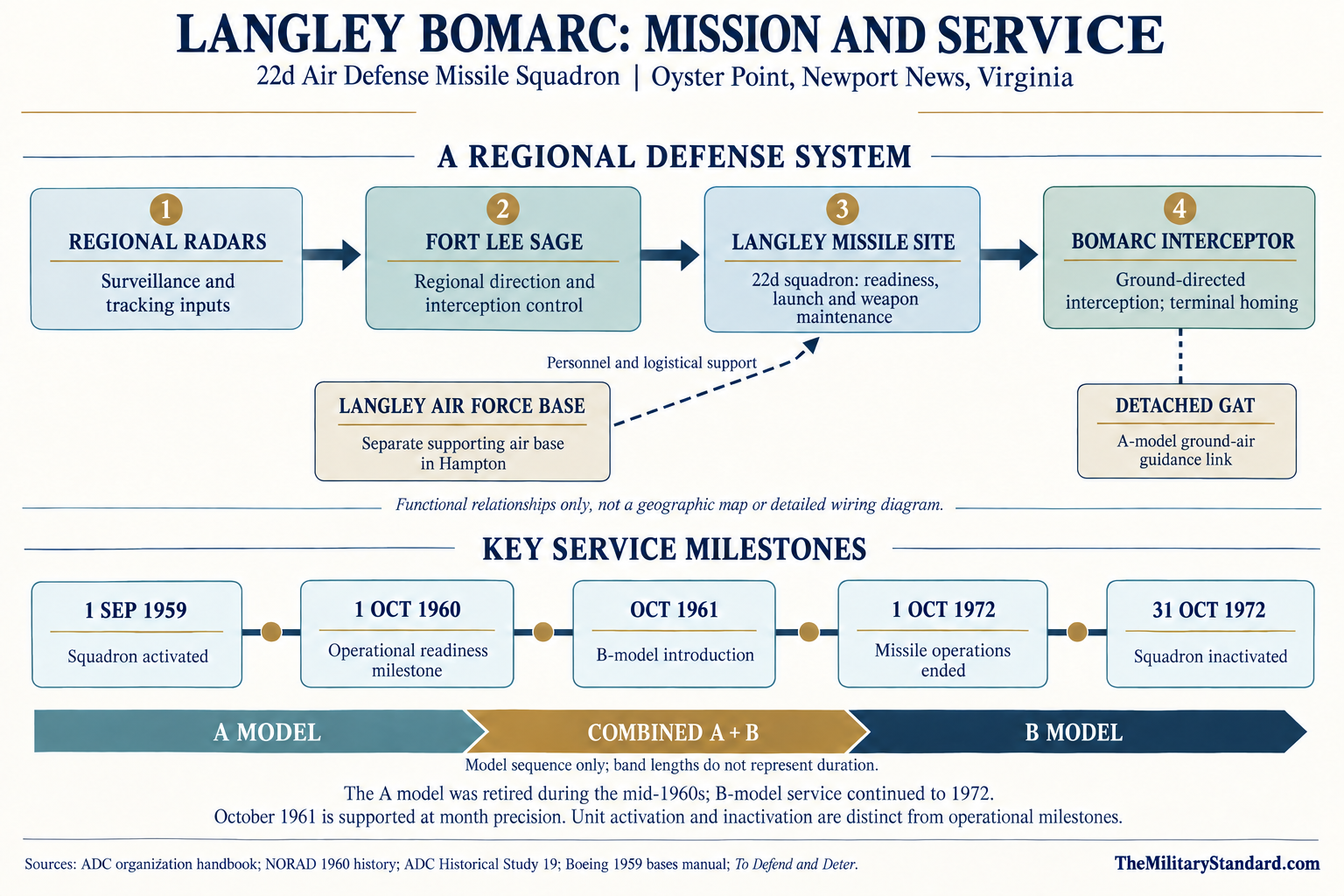
The strongest contemporary operational milestone located is October 1, 1960. The NORAD and CONAD historical summary for July through December 1960 explicitly identifies the 22d at Langley as the newest operational BOMARC unit and gives that date. Several later accounts instead describe an alert beginning in September 1960. Those accounts may reflect an earlier stage of preparation or acceptance, but the records reviewed do not explain the difference. October 1 is therefore used for the documented NORAD operational milestone, with the September claim acknowledged rather than silently substituted.
Another discrepancy concerns the first missiles. A later compilation says the first two arrived by late November 1960, after the operational date recorded by NORAD. Without the underlying delivery documentation, that statement cannot be treated as proof that Langley had no missiles before November. It may contain a date error or refer to a narrower delivery event. Activation, construction completion, individual deliveries, readiness acceptance, and full complement were separate milestones. Combining them into one opening date would obscure the actual sequence and overstate the evidence.
From BOMARC A To BOMARC B
The A-model installation depended on a demanding ground-support system. The missile used a rocket booster for initial acceleration and ramjet propulsion for sustained flight. At the base, keeping it ready required more than protecting its airframe from weather. Propellant-related facilities, cooling, electrical power, pressure systems, test equipment, and reliable shelter machinery all contributed to readiness. Langley's layout reflected those requirements in separate support buildings and in utility connections to the launch area.
The improved B model changed important parts of that burden, especially through its solid-propellant booster, but it did not eliminate maintenance or the need for controlled storage, dependable power, and command links. The new missile also improved the interceptor's capabilities. These changes should not be condensed into the claim that all of Langley's pipelines and air conditioning became unnecessary as soon as B missiles arrived. For a period the site had both A and B facilities, and the old system's supporting plant belonged to that continuing A-model capability.
October 1961 is the generally reported month for Langley's introduction of the B model. The earlier NORAD deployment schedule specifically projected October 1, 1961 for the Langley B component. A schedule is not, by itself, evidence that every acceptance step occurred on that exact day. This history therefore uses month-level precision for the introduction, while preserving the planned day as a planning milestone. The site's later combined configuration is independently documented by the dated photographic record and the official program's identification of Langley as an A-and-B location.
The completed two-model arrangement is commonly described as 28 A-model positions and 28 B-model positions. The A field lay to the west and the B field to the east in the historical aerial interpretation. The resulting 56-position layout must not be treated as a constant inventory of 56 ready missiles throughout the site's life. Actual missiles assigned, missiles available for alert, spare weapons, and surviving shelter structures were different measures. Later retirement and demolition changed those totals again without necessarily changing the name of the installation.
For scale, the Canada Aviation and Space Museum describes the B model as approximately 45 feet long with an 18-foot wingspan and a published range of about 440 statute miles, or 700 kilometers. Its solid booster and two ramjets supported a supersonic interception mission. Those are reference characteristics of the missile type, not a guarantee of usable coverage in every direction from Langley. Radar coverage, guidance, target conditions, and command arrangements also affected an engagement. The original IM-99A and IM-99B designations later became CIM-10A and CIM-10B.
Nuclear Air Defense
BOMARC B was a nuclear-armed interceptor, making the site's mission part of the Cold War's nuclear air-defense posture. The nuclear role increased the consequences of an accident or unauthorized action and the importance of security, accountability, and disciplined command. It did not turn the battery into an offensive strategic-missile base. No dated local warhead inventory or complete custody record was located. Consequently, the number of shelters is not presented as proof of an equal number of nuclear warheads present on a particular day.
Shelters, Maintenance, And Utilities
The Model II shelter kept a missile horizontally supported on its launcher-erector. At launch preparation the roof opened and the missile was brought upright. Boeing's manual describes two roof halves moving apart on transverse beams, with associated doors providing clearance. This is not the operation of an underground silo, and the roof should not be illustrated as a generic hinged drawbridge. The shelter combined a missile room with an equipment room containing the supporting electrical, pressure, hydraulic, and cooling systems needed for the original A installation.
The assembly and maintenance shop supported a repeated cycle of receiving, assembly, testing, repair, and return to service. Boeing described a production-line arrangement with handling equipment and successive test positions. Components did not merely remain untouched after delivery. A weapon removed from readiness could require inspection, replacement of assemblies, engine work, and functional testing before it returned to its shelter. This maintenance cycle explains the importance of the large support building that later observers identified as suitable for civilian vehicle-maintenance reuse.
The original manual also described mobile inspection equipment and calibration support. Technicians needed confidence that a failed indication came from the missile rather than a faulty test set. Supporting equipment therefore required servicing of its own. The workshop, parts storage, test areas, and vehicle accommodation formed a linked maintenance system. A launcher's visible readiness was the final result of work distributed through these facilities, not simply a missile being present behind closed doors.
Langley's power arrangement differed from the earlier bases. Boeing listed two 750-kilowatt generator sets for Base No. 5 together with a 2,000-kVA commercial-power substation. These are different electrical ratings and should not be added together as though they express a single interchangeable measure. The heat-and-power and cooling facilities sustained operations in the humid coastal environment. The relatively high water table and poor drainage made the management of the site and its utility routes another continuing consideration, although no unsupported flood incident is assigned to the squadron.
The layout and technical manual provide a firmer basis for understanding these buildings than a later photograph alone. A surviving industrial-looking structure can have a recognizable form without establishing its exact original function. Conversely, a removed building may remain well documented in an original plan. The best reconstruction therefore combines the dated plan, the equipment description, and historical imagery, while leaving room for construction revisions. The 1959 diagram is evidence of that design stage, not a complete as-built plan for every year through 1972.
SAGE Control And The Detached Transmitter
The Washington Air Defense Sector linked Langley's weapons to the regional SAGE system, associated with the direction center at Fort Lee. SAGE combined radar information with command personnel and digital processing to support interception. A BOMARC unit was an assigned weapon resource within that system. It was not a stand-alone radar station, nor was the entire engagement conducted by a radar dish at the missile base. This division of labor explains the operational relationship among distant surveillance sites, a direction center, communication links, and the launcher installation.
Boeing's Langley plan explicitly shows a detached GAT facility, with an indicated separation of 4 1/4 miles in that planning diagram. The ground-air transmitter received command information and transmitted missile-guidance signals. The manual describes paired equipment chains, radio amplification, antennas, local monitoring, and independent power support. Redundancy mattered because a functioning missile and launcher would not compensate for a failed guidance link. The GAT was consequently a distinct operating property in the larger system, not simply another name for the battery's support area.
A specialist site record identifies the Langley A-model GAT and supplies coordinates farther north, but those coordinates do not reconcile with the distance on the early Boeing plan. The plan was explicitly subject to revision, so the difference could reflect a changed location or an error in a later locator. The existence and function of the detached facility are established more securely than its final parcel boundary. It should be inventoried separately, with the final coordinate left unresolved pending a stronger property or site-plan match. It also should not be conflated with a voice ground-air transmit-receive station solely because the abbreviations resemble one another.
Alert Service, Training, And Command Changes
The battery's operational purpose was to maintain a dependable interception capability during the Cold War. Readiness depended on equipment condition, communications, crew proficiency, security, and command availability at the same time. Routine inspection and maintenance supported that mission even when no missile was fired. The available records do not establish a hostile engagement from Oyster Point, an overseas combat deployment by the 22d, or a site-specific launch during the Cuban Missile Crisis. Its role should be described as continental defense without inventing a local action to attach it to a famous event.
Live-fire evaluation was conducted within the wider BOMARC training and test system rather than by routinely launching operational weapons over Newport News. One particularly useful contemporary episode appears in the 1966 NORAD history. The 22d could not perform a scheduled April 26 evaluation launch because of a conflict with an upcoming operational-readiness inspection. Canada's 446 Surface-to-Air Missile Squadron took the slot and made the successful launch. It would be incorrect to credit that particular firing to Langley simply because the 22d appeared in the original schedule.
The same episode illustrates the relationship between readiness inspections and live-fire programs. Both drew on trained personnel, working equipment, and a limited evaluation schedule. A substituted launch did not necessarily mean that the home battery had failed an inspection or that its missiles were inoperable. The official account identifies a scheduling conflict. It also places the event in a program recovering from range-safety destruct-system problems, which should not be recast as evidence of a missile accident at Langley.
On April 1, 1966, the squadron transferred from the Washington Air Defense Sector to the 33d Air Division. On November 19, 1969, it was reassigned to the 20th Air Division. These dates come from the official organizational handbook. Changes in higher headquarters reflected reorganizations of the air-defense system rather than relocation of the Oyster Point launch field. The continuing technical mission remained associated with the same 22d squadron while its administrative chain evolved.
The End Of The BOMARC Mission
The A model was withdrawn from the operational program in the mid-1960s, leaving the longer-lived B system to carry the remaining BOMARC mission. At Langley, a 1965 photograph contributor specifically identified the A component as deactivated. The combination of an inactive A field with an operating B field is important when interpreting later shelter counts and photographs. A building could remain physically present after the weapon type it supported had left service.
The larger defense program increasingly confronted the ballistic-missile threat as well as the continuing bomber threat. BOMARC was designed for aircraft interception, not as an ICBM-defense system. Its retirement therefore belongs to changes in force structure, resource allocation, and technology, not to a claim that hostile aircraft had ceased to matter. Langley remained among the final operational BOMARC locations after other American sites had already ended their missile missions.
The official ADC chronology separates two final milestones at Langley: the 22d ceased operational status on October 1, 1972, and was inactivated on October 31, 1972. The latter date is also given in the organizational handbook. The 46th at McGuire was inactivated on October 31 as well. Thus Langley belonged to the final pair of United States BOMARC squadrons, even though a later Air Force commemorative item singles out the 22d as the last squadron. Unit inactivation did not itself establish the day of every equipment removal or property conveyance.
Transfer And Civilian Reuse
After the missile mission ended, Oyster Point entered a prolonged period of disposal and redevelopment. The former storage reservation was divided among different public and other users. Jefferson Lab's historical account describes transfers involving the Commonwealth of Virginia, NASA, the Department of Energy, the City of Newport News, and the Southeastern Universities Research Association. These transactions concern the broader landscape. They do not mean that the whole missile battery became Jefferson Lab or that all former military acreage passed to one owner on one date.
The former missile installation acquired practical municipal uses. Mark Morgan's 1992 visit recorded school-system operations and transportation in the support buildings, including vehicle maintenance in the large former missile-maintenance building. He also reported fire-department storage and training in the launcher area. His account is valuable as a dated observation of reuse, but not as a current property survey. Later photographs and aerial comparisons document the disappearance of the launcher shelters during the 1990s, while portions of the support area remained in use.
The specialist photographic comparison places the major shelter-removal interval between 1992 and 1995. A May 2001 visitor reported that all shelters were gone and only a few original buildings appeared to remain. The exact count of original survivors was uncertain even then. Neither account supports presenting the site's structures as intact today. Nor should the nominal 56-position operational layout be forced to match every later building count: a 1965 contributor reported that four A shelters had already been removed.
School-system reuse also has an end point that older radar-site descriptions miss. In 2016 the Corps of Engineers published a permit notice for a replacement Newport News Public Schools Service Center for Operations and Transportation at another location. The notice connected the relocation to planned Jefferson Lab expansion and Tech Center Research Park development. In March 2021, City Council minutes recorded completion and School Board acceptance of the new facilities and authorized the related conveyance. The old statement that the BOMARC property is simply the current school-bus service center is therefore no longer adequate.
Environmental Legacy
Environmental responsibility for the former site is associated with the Oyster Point Storage Area Formerly Used Defense Site, not automatically with the active Langley Air Force Base environmental program. The Corps' Virginia inventory identifies Oyster Point as C03VA0098, with project 01 categorized for hazardous, toxic, and radioactive waste response. The title of that program category does not itself prove radioactive contamination at the missile battery. The wider reservation and its individual investigation areas must be distinguished from the former launch and support areas when interpreting environmental records.
The most current authoritative site-related statement located is in Jefferson Lab's June 2026 Safety Assessment Document. It identifies the nearby former BOMARC base as owned by the City of Newport News and describes residual groundwater contamination, principally benzene and chlorinated solvents, extending toward the northeastern portion of the fenced laboratory site. It assigns management of that legacy contamination to the U.S. Army Corps of Engineers and explicitly distinguishes it from laboratory operations. This establishes a continuing environmental issue without attributing a new release to the present laboratory.
Older inventories and budget reports help trace the longevity of the response, but their projected completion dates are not proof that remediation has finished. A 2023 Defense Department transparency report still carried Oyster Point in the restoration program. No final closeout determination or current parcel-by-parcel unrestricted-use finding was located. Similarly, the well-known 1960 BOMARC fire at McGuire cannot be imported into Langley's history. Shared equipment type is not evidence that the same accident or radiological conditions occurred at both sites.
Current Condition
As of the September 2026 research date, the reliable description is a closed and substantially altered missile installation within the redeveloped Oyster Point landscape, with a documented municipal ownership description and a continuing groundwater legacy. Its school-service-center phase is historical, and the surrounding area has been involved in research-campus and technology-park redevelopment. A contemporary building-by-building inventory was not located. Exact current tenants, surviving original structures, and individual parcel boundaries require evidence more precise than an old aerial photograph or a general institutional address.
Detailed Chronology
- Early 1940s Storage igloos, utilities, and rail infrastructure were developed within the broader Oyster Point military storage landscape, according to the disposal-era inventory.
- 1959 Boeing described the missile base within the northern part of the approximately 1,380-acre Oyster Point Bulk Ammo Storage reservation.
- 1959-06 The Langley layout was being revised to accommodate the advanced missile system alongside IM-99A equipment.
- 1959-09-01 The 22d Air Defense Missile Squadron activated at Langley and was assigned to the Washington Air Defense Sector.
- 1959-1960 Personnel trained, equipment and supplies were organized, and the detached missile installation prepared for operational service; the unit account includes a three-month Hurlburt training phase.
- 1960-01-04 Lieutenant Colonel Robert L. Andrews began command, according to the compiled unit record.
- 1960-09 Later site histories place the beginning of alert activity in this month; the contemporary NORAD operational milestone falls on October 1.
- 1960-10-01 NORAD recorded the 22d as operational, making Langley the fifth operational American BOMARC unit.
- 1960-1961 Langley's initial 28-position A-model installation was prepared for addition of the B system.
- 1961-10 Reported introduction of BOMARC B at Langley; the earlier NORAD schedule had projected October 1.
- 1963-03-30 A USGS aerial photograph reproduced in the historical photo collection documents the two-field A-and-B configuration.
- 1963-09-01 Beginning of the Air Force Outstanding Unit Award period listed for the 22d.
- 1964-1965 A-model retirement left the B installation as the continuing BOMARC component; a 1965 photograph contributor identifies the A field as deactivated.
- 1965-02-28 End of the listed Outstanding Unit Award period.
- 1965 USAF Public Affairs aerial photographs document the combined installation; a contributor notes prior removal of four A-model shelters.
- 1966-04-01 The 22d transferred to the 33d Air Division.
- 1966-04-26 Canada's 446 Surface-to-Air Missile Squadron conducted an evaluation launch originally scheduled for the 22d, which had a readiness-inspection scheduling conflict.
- 1969-11-19 The 22d was reassigned to the 20th Air Division.
- 1972-10-01 The 22d ceased operational status.
- 1972-10-31 The 22d was inactivated; the 46th at McGuire was also inactivated that day.
- After 1972 Defense property in the broader Oyster Point area passed into multiple civilian and governmental uses; a single transfer date for every former missile parcel is not established.
- 1986 The City of Newport News conveyed a 44-acre adjacent tract to SURA, according to Jefferson Lab's property history; this is not a 44-acre measure of the missile battery.
- 1987 NASA conveyed property to the Department of Energy in the wider research-campus area.
- 1992 Mark Morgan documented reuse by Newport News Public Schools and the fire department, with missile shelters still visible.
- 1992-1995 Historical aerial comparison places the main launcher-shelter demolition within this interval.
- 2001-05 Tom Page photographed the reused site and reported removal of all missile shelters, with only a few possible original support buildings remaining.
- 2004-2005 Jefferson Lab's environmental report distinguished its parcels from the adjacent former missile site and summarized the broader land-transfer history.
- 2015 The Corps' published FUDS inventory listed Oyster Point Storage Area, C03VA0098, project 01.
- 2016-09 A Corps permit notice described the proposed replacement school service center and linked relocation to Jefferson Lab and Tech Center development.
- 2021-03-09 City Council recorded completion and acceptance of the replacement service center and approved the related conveyance.
- 2023 A Defense Department environmental-restoration transparency report continued to list Oyster Point.
- 2026-06 Jefferson Lab's revised Safety Assessment Document described municipal ownership of the former BOMARC site and residual groundwater contamination managed by the Corps of Engineers.
Sources & References
- WEB Canada Aviation and Space Museum, Boeing CIM-10B Super Bomarc National museum reference for the B missile's dimensions, propulsion, published range, nuclear role, and SAGE-directed interception; not a Langley inventory.
- PDF A Handbook of Aerospace Defense Organization, 1946-1980, Office of History, Aerospace Defense Center Official unit lineage, printed page 150, for activation, assignments, and inactivation; original page visually checked.
- PDF NORAD and CONAD Historical Summary, July-December 1960 Contemporary October 1, 1960 operational milestone and planned B-model deployment schedule, printed pages 34 and 35.
- PDF Boeing Airplane Company, IM-99A Bases Manual, D5-4684, 1959 Original Base No. 5 environment and layout, pages 1.50-1.55, plus Model II shelter, maintenance, utilities, and GAT descriptions; Langley plan visually checked.
- PDF 22 Air Defense Missile Squadron (BOMARC), USAF Unit History compilation AFHRA and yearbook-based mission, training, command, award, and construction details; conflicting late-November delivery statement not accepted as the opening date.
- PDF ADC Historical Study 19, A Chronology of Air Defense, 1914-1972 Official printed page 135 distinguishes October 1, 1972 cessation of operations from October 31 inactivation and identifies the simultaneous McGuire inactivation.
- PDF NORAD and CONAD Historical Summary, January-December 1966 Contemporary account of the April 26 evaluation-launch substitution and distinction between the Langley schedule and the Canadian firing.
- PDF Protecting America: Cold War Defensive Sites, National Historic Landmarks Theme Study National context for the deployed A and B systems, air-defense networks, and the distinction between aircraft interception and ballistic-missile defense.
- PDF To Defend and Deter: The Legacy of the United States Cold War Missile Program Comparative missile-base history and Langley's transitional design; its September 1960 alert statement is distinguished from contemporary NORAD evidence.
- WEB Langley AFB (BOMARC), Virginia, Radomes site record Specialist identification of the detached A-model GAT, historical reuse, and locator evidence; final GAT coordinates remain unresolved against the early plan.
- WEB Langley AFB (BOMARC), Virginia, Radomes recent-photo collection Dated firsthand observations by Mark Morgan in 1992 and Tom Page in May 2001; not treated as a present-day building inventory.
- WEB Abandoned and Little-Known Airfields: Virginia, Hampton area, Paul Freeman USGS and USAF aerial-photo sequence, John Eckert's photograph notes, two-field interpretation, and the 1992-1995 shelter-removal interval.
- WEB Thomas Jefferson National Accelerator Facility, Site Environmental Report for Calendar Year 2004 Section 1.4 traces the larger Oyster Point property and distinguishes the former missile site from DOE, NASA, state, city, and SURA holdings.
- PDF Thomas Jefferson National Accelerator Facility, Safety Assessment Document, Revision 10, June 2026 Current authoritative ownership description and legacy groundwater statement in section 3.1, printed page 6; contamination managed by the Corps and distinguished from lab operations.
- PDF U.S. Army Corps of Engineers, Virginia FUDS Inventory, 2015 Official Oyster Point Storage Area identity, Newport News location, C03VA0098 project 01, and response-category listing.
- PDF Department of Defense, Environmental Restoration Program Transparency report, 2023 Continuing Oyster Point program entry; projected costs and schedules are not treated as completed remediation.
- WEB U.S. Army Corps of Engineers, Norfolk District, Public Notice NAO-2015-01840, September 2016 Proposed replacement school service center at a different location and its relationship to Jefferson Lab and Tech Center development.
- WEB City of Newport News, City Council adopted minutes, March 9, 2021 Official confirmation that replacement SCOT facilities were complete and accepted and that the associated conveyance was approved.
- WEB ProPublica, Bombs in Your Backyard: Oyster Point Storage Area Reproduced Corps disposal-era description of the larger storage property, 127-acre holding, and structure-removal proposals; legacy projections are not current clearance findings.
- PDF Department of the Air Force, Commander's Call Topics, October 30, 2014 Retrospective Air Force commemoration of the 22d's October 31, 1972 inactivation, compared with the official chronology's final-pair distinction.
- PDF ADC Historical Data, 1946-1973, uploaded reference volume (17.67 MB) Radar-network and ground-air-radio background; this volume was not used as a substitute for the missile squadron's official lineage or a parcel survey.