
Kincheloe Air Force Base BOMARC Missile Site / Raco Missile Site, Michigan
Longitude: -84.805
Site Number: BOMARC B; 37th Air Defense Missile Squadron; first operational B-model site; shared former Raco military property E05MI0026
Official Base Website: Former Raco BOMARC Missile Site / Smithers Winter Test Center Landscape
Current Role: Former launcher area within Hiawatha National Forest and the controlled Smithers Winter Test Center landscape. The adjoining triangular airfield supports cold-weather vehicle testing under Forest Service special-use authority. Military vestiges, Forest Service roads, recreation where permitted, monitoring wells, and the active Raco AAF FUDS groundwater remedy occupy the broader property.
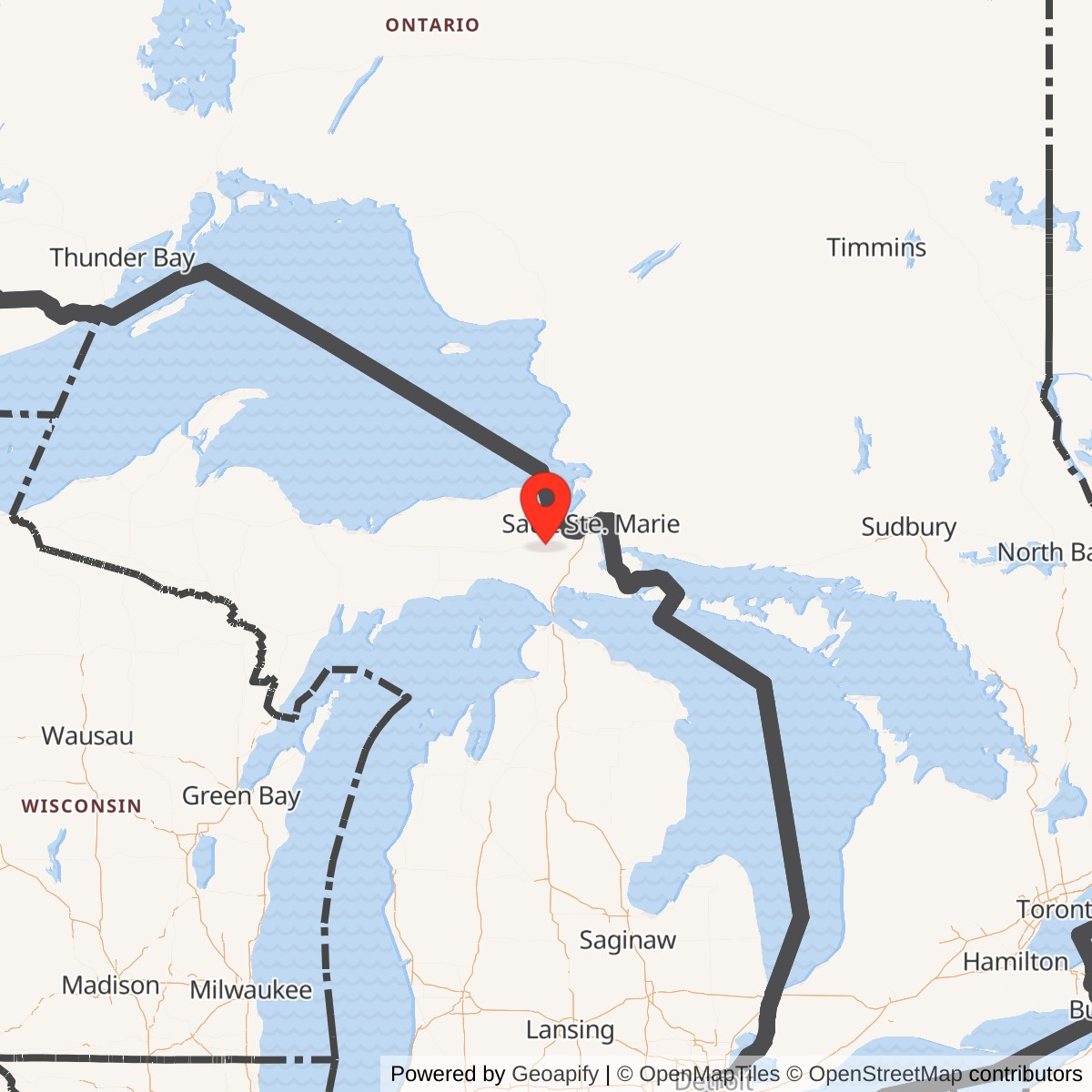
The Kincheloe Air Force Base BOMARC Missile Site was a detached Air Defense Command guided-missile installation at Raco in Michigan's eastern Upper Peninsula. It stood about 32 road miles northwest of Kincheloe Air Force Base and approximately 18 miles west of Sault Ste. Marie. The 37th Air Defense Missile Squadron operated 28 CIM-10B BOMARC long-range surface-to-air interceptors from above-ground launcher shelters built southeast of the former Raco Army Airfield. The weapon was intended to destroy hostile bombers before they reached the industrial Great Lakes, the Soo Locks, northern air bases, Canadian targets, and the interior United States.
Raco was a complete combat installation, not merely a missile storage area or an extension of the Kincheloe flight line. The squadron headquarters initially formed at Kincheloe while the detached site was under construction, then moved to Raco during the first half of 1961. The site became operational by June 1, 1961 and reached a full alert complement of 28 missiles by December 31. Official lineage material identifies it as the first operational BOMARC B installation, a major transition from the liquid-booster A model to the longer-range solid-booster version.
The battery depended on a distributed command system. Radar stations created aircraft tracks, direction centers processed the regional air picture, and SAGE computers generated engagement commands. Ground-Air Transmitter and Frequency Division Data Link equipment relayed midcourse guidance to the missile. Raco crews maintained the weapons, launcher shelters, electronics, power, security, and local alert posture. The system therefore linked the remote missile plant to Kincheloe, regional radar units, K.I. Sawyer's SAGE direction center, the Duluth direction center after 1963, Air Defense Command, and the binational NORAD network.
The 37th remained in continuous operational service for more than eleven years. It held full alert for 27 days during the October 1962 Cuban Missile Crisis, when continental air-defense forces prepared for possible Soviet bomber operations. The squadron earned two Air Force Outstanding Unit Awards and served through repeated command realignments. No combat missile was launched from Raco. Its daily mission was deterrence and readiness, expressed through maintenance, checks, drills, security, and a sustained ability to respond.
The Air Force inactivated the 37th on July 31, 1972 as the BOMARC B force was phased out. The missile property was released to the U.S. Forest Service in June 1973. Its specialized launcher area was later demolished and altered, while the adjoining triangular airfield became an important cold-weather vehicle proving ground under Forest Service special-use permits. The larger former military property now combines Smithers Winter Test Center operations, Hiawatha National Forest management, public recreation where permitted, surviving airfield pavement, military vestiges, and an active Formerly Used Defense Sites environmental program addressing trichloroethylene in groundwater.
Installation Identity, Location, and Boundaries
The formal name used here is Kincheloe Air Force Base BOMARC Missile Site / Raco Missile Site. Period and later sources also use Kincheloe AFB BOMARC Site, Raco Missile Base, Raco BOMARC Base, Raco Airbase Missile Area, and the 37th Air Defense Missile Squadron site. The Kincheloe name records the parent-base relationship. The weapons were not at Kincheloe's runway or cantonment, and the Raco installation needs its own permanent identity.
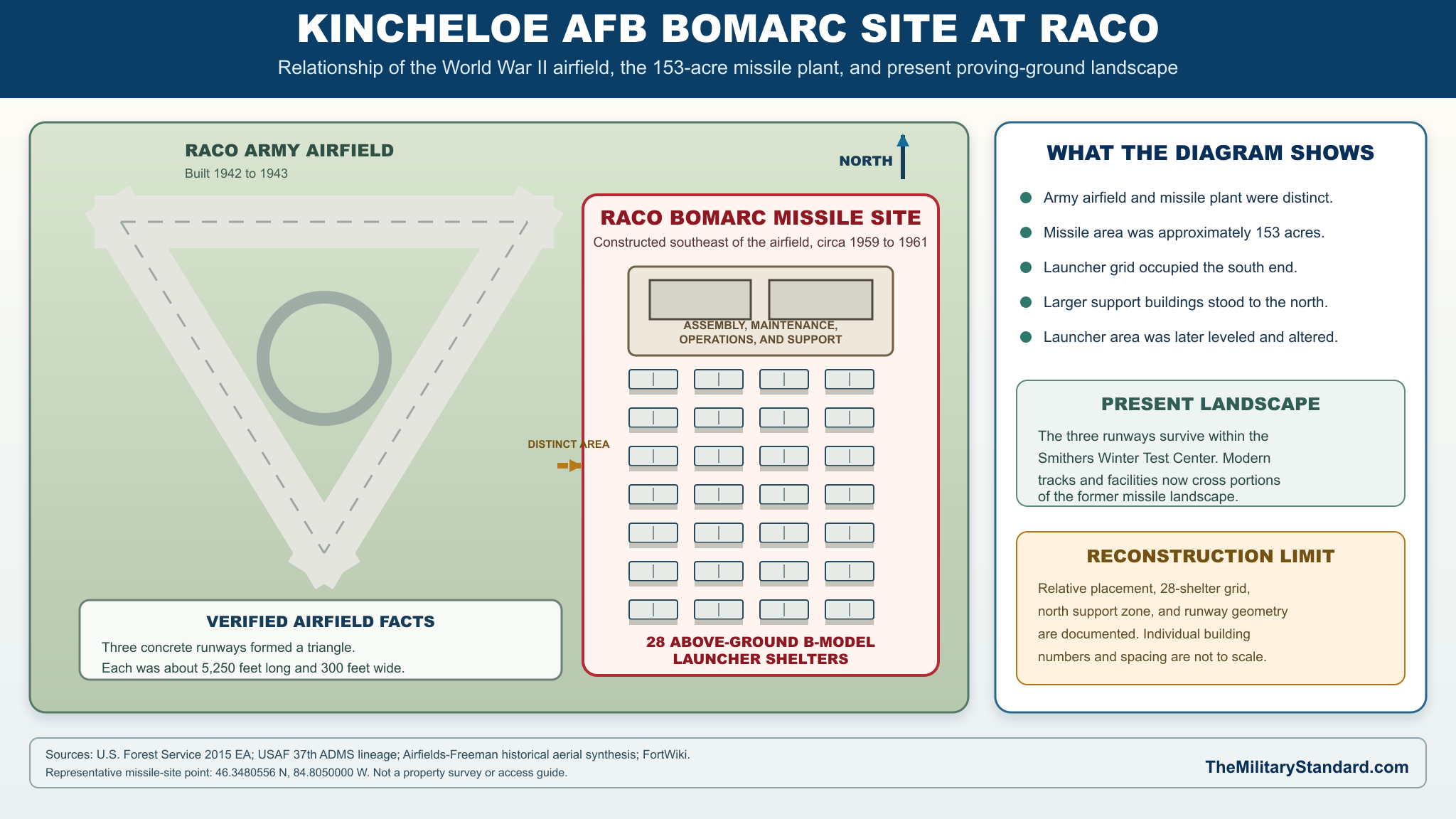
The former Raco Army Airfield is a distinct predecessor installation sharing the broader physical site. The airfield was constructed in 1942 and 1943 as a triangular three-runway complex. The missile base was constructed southeast of it around 1960. The Air Force released the airfield property to the Forest Service in January 1964 but retained the missile area until June 1973.
The Raco missile plant also must remain separate from Kincheloe Air Force Base, K.I. Sawyer Air Force Base, the SAGE direction centers, regional radar stations, any remote communications facilities, environmental monitoring locations, and current Smithers improvements. These places interacted operationally or geographically, but each had its own property, mission, personnel, and historical sequence. Modern use of the phrase Raco Airbase can refer to the entire former military landscape and should not erase those distinctions.
The Raco Airfield Predecessor
The federal military story began during World War II. The Forest Service records construction of the airfield between 1942 and 1943, when northern Great Lakes air routes, the Sault Ste. Marie locks, and movement toward Alaska carried national-defense importance. The field's three concrete runways formed a triangle, each approximately 300 feet wide and 5,250 feet long. Their substantial pavement later made the place unusually suitable for winter vehicle testing.Army Air Forces use centered on an auxiliary and staging function rather than a permanent bomber base with a large cantonment. The field supported movement, emergency recovery, training, dispersal, and defense planning in a remote northern setting. Later accounts also associate the property with postwar antiaircraft activity.
The Air Force retained the former airfield into the Cold War even though its principal wartime flying mission had ended. That available federal property, its isolation, durable access, and proximity to Kincheloe made the Raco area useful when Air Defense Command sought a BOMARC B location. The launcher plant was not simply placed on a runway. It formed a new fenced and specialized facility southeast of the triangular pavement.
Strategic Origins of the BOMARC B Mission
BOMARC emerged from a postwar requirement for a pilotless interceptor that could engage hostile aircraft far from defended targets. It was a surface-launched air-defense missile, not an intercontinental ballistic missile and not a ground-attack weapon. The name joined Boeing and the Michigan Aeronautical Research Center, organizations associated with development. Air Defense Command integrated it with radar, communications, computers, fighters, and command posts rather than treating it as an independent artillery battery.Initial plans imagined a much larger network than the one completed. Development delays, cost growth, competition with Army Nike Hercules, the expense of SAGE, and a strategic shift toward the ballistic-missile threat repeatedly reduced the program. By 1960 the revised force envisioned a limited number of United States and Canadian batteries, commonly with 28 launchers and approximately 30 missiles in a squadron allowance. Raco's full alert complement was specifically reported as 28, matching its launcher count.
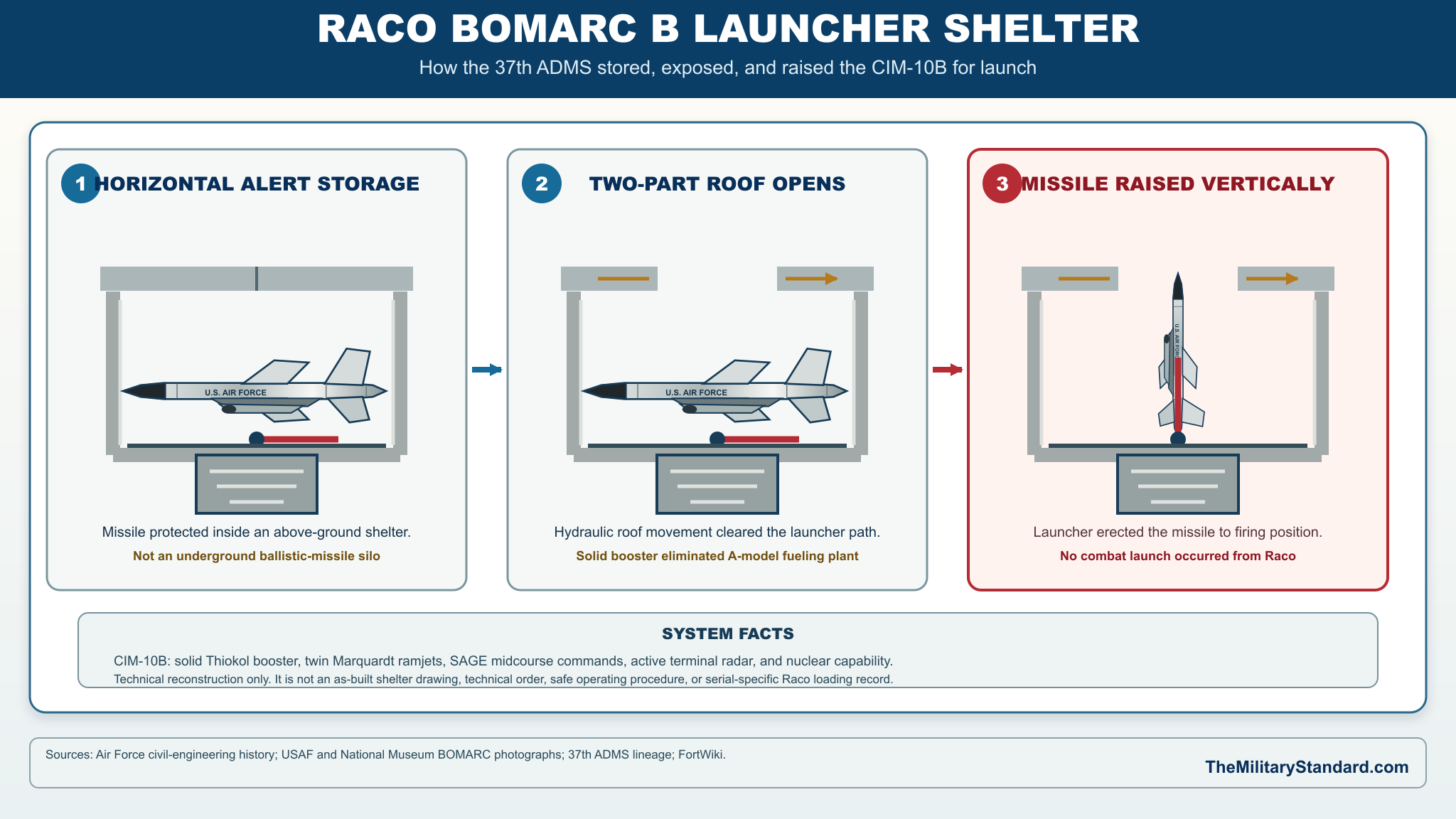
The B model addressed important weaknesses in the A model. It replaced the liquid-fueled booster with a solid-propellant rocket booster, increased range and ceiling, improved electronics, and reduced the specialized ground plant needed to maintain a ready missile. Air Force civil-engineering history explains that B-model shelters could use steel frames and precast concrete walls rather than the massive environmentally controlled concrete structures of the A sites. Solid propulsion eliminated the A-model liquid-fuel and oxidizer facilities.
Raco's geography reflected regional defense priorities. The eastern Upper Peninsula lay near the international border and the Great Lakes air approaches. The Soo Locks were a critical transportation feature, while Kincheloe, K.I. Sawyer, and bases farther west and south supported interceptor, bomber, tanker, and warning missions. A long-range missile battery at Raco could contribute to defense of both United States and Canadian airspace under the NORAD framework.
Site Selection and Construction, 1959-1961
The Air Force constituted the 37th Air Defense Missile Squadron on September 23, 1959 and activated it at Kincheloe on March 1, 1960. The new unit initially remained at the parent base while it monitored construction of the detached Raco plant and built personnel proficiency. This headquarters arrangement allowed administration, supply, training, and coordination to begin before the launcher site could support a full alert organization.Construction converted forested land southeast of the old airfield into a specialized missile installation. The work required grading, drainage, internal roads, secure fencing, power, communications, utilities, launcher foundations, 28 individual shelters, missile maintenance and support buildings, and facilities for operations, munitions, gases, emergency response, and personnel. Northern Michigan winters made heating, snow removal, roof movement, pavement maintenance, and standby power important design concerns.
The B shelter was an above-ground launcher building. The missile rested horizontally inside on its launcher. A distinctive two-part cantilevered roof rolled away under hydraulic power, and the launcher raised the weapon to firing position. Public and Forest Service documents sometimes call the former structures silos, but that shorthand can mislead. Raco did not use underground vertical launch silos of the type associated with strategic ballistic missiles.
Standard B-model planning included a missile launch area, an air-munitions or warhead-support function, one or two gas-compressor buildings, maintenance and checkout areas, power and utility support, access control, security circulation, and connections to the command network. An authenticated Raco as-built drawing is still needed to fix every building number and dimension. This history therefore distinguishes standard system requirements from features proven only at another BOMARC installation.
The squadron moved approximately 32 miles from Kincheloe to Raco during the first half of 1961. Official lineage material places operational status by June 1. The site then completed acceptance, missile loading, communications integration, and alert buildup, reaching its full complement of 28 missiles on operational alert by December 31, 1961. These milestones explain why activation in 1960 is not the same as site operational readiness in 1961.
The CIM-10B BOMARC Weapon System
The Raco battery operated the IM-99B, redesignated CIM-10B in 1962 under the joint service designation system. A solid-propellant Thiokol booster accelerated the missile from its launcher. After booster separation, two Marquardt ramjet engines sustained high-speed atmospheric flight. SAGE-generated commands guided it through the midcourse phase, while an onboard active radar seeker supported terminal interception.Published performance varies by test condition and source, but the B model is generally associated with a range near 400 miles, speed above Mach 2, and an engagement ceiling substantially higher than the A model's. These figures describe system capability, not a Raco firing record. Weather, target course, command-network geometry, missile status, and engagement doctrine affected any actual intercept solution.
The B model was nuclear capable and normally associated with the W40 warhead in the operational air-defense force. The nuclear option allowed one interceptor to attack a bomber formation or compensate for terminal guidance and fuzing limits, but it required strict security, custody, maintenance, safety, and authorization procedures. Public sources do not provide Raco warhead serial numbers, a daily custody log, or a shelter-by-shelter configuration record.
The missile's effective operation depended on far more than propulsion. Electrical checkout equipment, guidance receivers, telemetry and test functions, pressurized gases, hydraulic launcher machinery, power distribution, communications, environmental protection, spares, and trained specialists had to work together. A weapon could be physically present yet unavailable because of maintenance, inspection, launcher work, communications status, or command restrictions. The 28-shelter capacity must not be interpreted as proof that every weapon was continuously ready.
No combat launch occurred from Raco. Operational proficiency came from inspections, simulated engagements, alert exercises, launcher cycles, equipment checks, and live-fire training conducted at controlled ranges. Secondary accounts connect squadron personnel with annual firing activity at Eglin's Gulf range. That relationship is consistent with Air Force practice, but a complete year-by-year Raco firing roster has not been located.
SAGE Guidance and Direction Center Changes
BOMARC used the Semi-Automatic Ground Environment as its principal command and control system. Long-range and gap-filler radars sent track data to a direction center, where computers and weapons directors built a regional air picture. After identification and engagement decisions, the system calculated an intercept and sent commands through a data-link transmitter to the missile. Terminal guidance then shifted to the missile's own radar seeker.
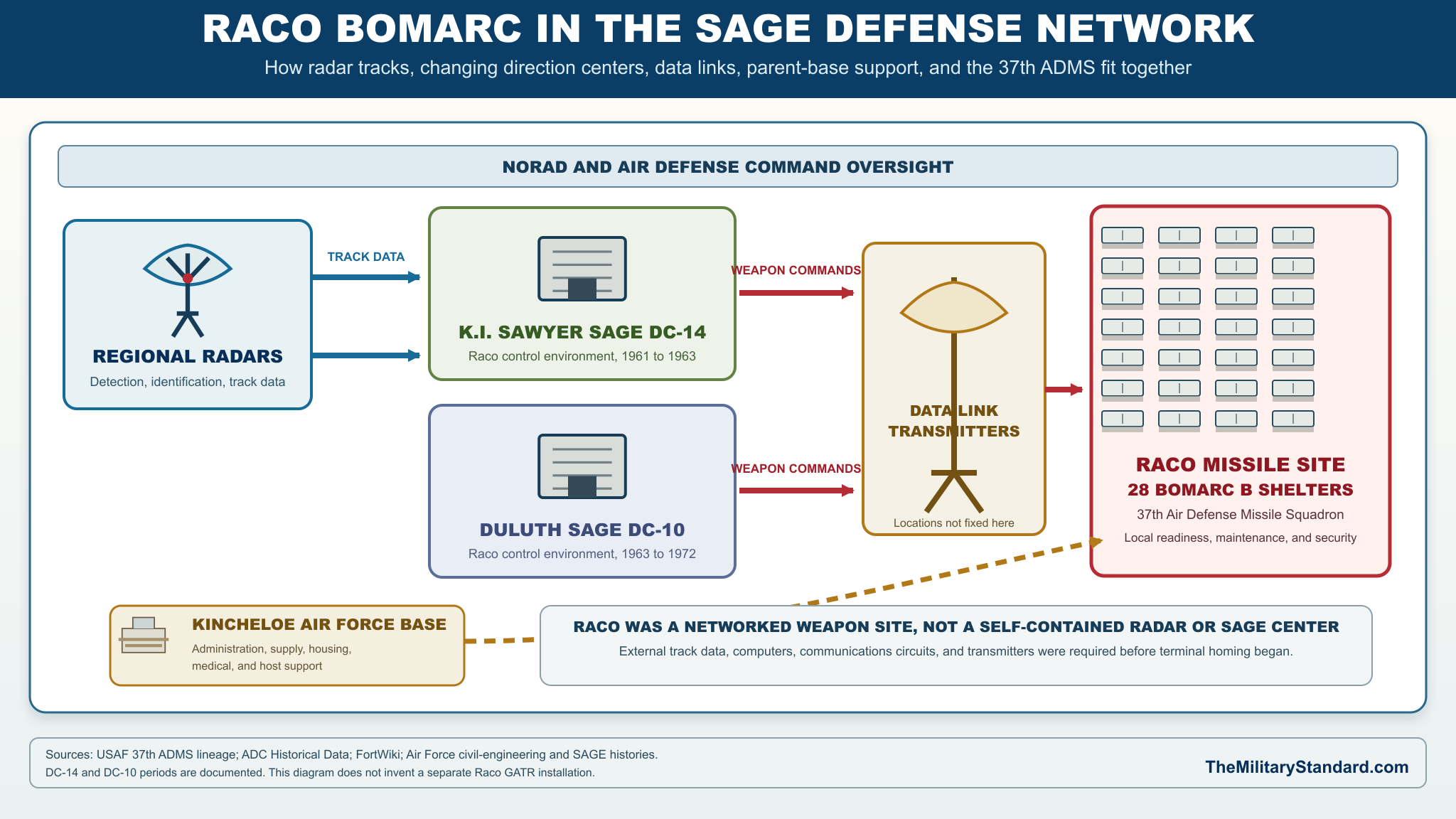
The data-link path included geographically separated transmitters and communications circuits. Raco's launcher plant provided missiles and local readiness; it did not independently create the continent-wide radar picture or all midcourse commands. A loss of external tracking, computer service, communications, or transmitter coverage could affect engagement capability even when the missiles and shelters were serviceable.
This distributed design explains why the missile installation belonged to a network rather than a simple parent-base chain. Radar squadrons, SAGE direction centers, sector headquarters, communications units, and the 37th each maintained different components of one defensive process. The network extended across the United States and Canada through NORAD, while Air Defense Command and later Aerospace Defense Command provided the Air Force organization.
The 37th Air Defense Missile Squadron
The 37th was assigned to the 30th Air Division at activation, transferred to the Sault Ste. Marie Air Defense Sector on April 1, 1960, and transferred to the Duluth Air Defense Sector on October 1, 1963. It returned to a numbered division structure under the 29th Air Division on April 1, 1966, then served under the 23rd Air Division from November 19, 1969 until inactivation. These changes reflected repeated consolidation of the air-defense command structure rather than physical movement of the missile plant.Known commanders from official lineage compilation include Major Gail G. Currie Jr. in temporary command from activation, Lieutenant Colonel Robert E. Kaempfer from February 20, 1961, Lieutenant Colonel John H. Keene from November 23, 1965, Major Fred S. Dudney Jr. from January 1, 1969, and Lieutenant Colonel Mitchell A. Jacque from January 8, 1970 through inactivation. Command dates establish continuity but do not substitute for a full personnel roster.
The unit combined operations, missile maintenance, munitions, electronics, communications, civil engineering, security, supply, transportation, administration, and emergency-response work. Kincheloe provided many host services that a detached missile site did not duplicate. Personnel nevertheless worked at Raco around the clock because alert status, security, power, temperature, communications, and missile condition required continuous attention.
Daily life at the site was shaped by distance and climate. Crews traveled through heavy snow and cold, maintained roofs and paved areas, protected utilities from freezing, and kept emergency access open. Shift work could be repetitive, but every inspection and drill supported a mission in which an actual launch would have left little time for improvisation. The physical isolation also strengthened unit identity and placed a premium on dependable local maintenance.
The squadron's emblem was approved on October 26, 1960. Its motto, SEMPER VIGILANS, meant Always Vigilant and matched an alert mission defined by readiness rather than frequent firing. The unit later received Air Force Outstanding Unit Awards for August 30, 1965 through March 3, 1967 and March 31, 1971 through March 31, 1972. Those periods cover mature operation near the middle and end of the site's service life.
Alert Operations and the Cuban Missile Crisis
Routine alert required a verified chain from radar detection through command decision, data transmission, missile fire-up, launcher raising, and release. Crews tested command circuits, cycled launcher mechanisms, inspected missiles, maintained power and gas systems, and practiced emergency actions. The installation's purpose was to make a launch possible on short notice while preventing accidental, unauthorized, or unsafe action.During the Cuban Missile Crisis in October 1962, the 37th maintained its full force on alert for 27 days. The crisis centered on Soviet missiles in Cuba, but continental air-defense units also prepared for bomber threats, reconnaissance reactions, misidentification, and wider escalation. Raco's sustained alert is the clearest documented instance when its combat readiness was raised for an international emergency.
Full alert did not mean that Raco fired a missile or that Soviet aircraft approached the Upper Peninsula. It meant the squadron sustained a higher readiness condition within the national defense posture. Personnel workload, maintenance scheduling, access control, communications checks, and command reporting would have intensified. The official lineage record preserves the 27-day fact without providing a daily operations log.
Large exercises tested the broader system during the 1960s. Radar, SAGE, fighters, missile units, communications, and warning organizations practiced against simulated tracks and electronic conditions. Raco's participation is inherent in its operational assignment, but no public source provides a complete list of exercise names, dates, simulated launches, or individual missile status.
Security, Safety, and Support
Raco protected nuclear-capable weapons, classified electronics, explosives, high-pressure systems, and critical communications. Security therefore included controlled entry, restricted areas, patrols, identification, physical barriers, lighting, alarm or reporting procedures, and coordination with Kincheloe and higher headquarters. Exact guard-force strength and every restricted-area boundary remain unresolved in public sources.The B model reduced liquid-propellant hazards but did not make the site simple or risk free. Solid motors, warheads, pyrotechnics, gas systems, electrical power, launcher hydraulics, heavy handling equipment, solvents, fuels, and batteries required formal procedures. Fire, accidental ignition, launcher failure, electrical faults, transportation incidents, and winter conditions remained credible emergencies.
Missile readiness also depended on supply and depot support. Components beyond local repair moved through Air Force logistics channels, while contractors and technical representatives supported complex equipment. Kincheloe linked the detached unit to housing, medical care, personnel administration, finance, transportation, dining, recreation, chapel, and broader base services. Raco was operationally distinct but administratively supported.
Program Decline and Closure, 1969-1973
By the late 1960s the strategic balance had changed. Intercontinental ballistic missiles could bypass defenses designed for aircraft, while improved fighters and surface-to-air systems competed for resources. BOMARC remained useful against bombers, but a small specialized network with aging missiles, unique support equipment, and nuclear requirements became harder to justify. Air-defense headquarters consolidation reflected the same pressure.
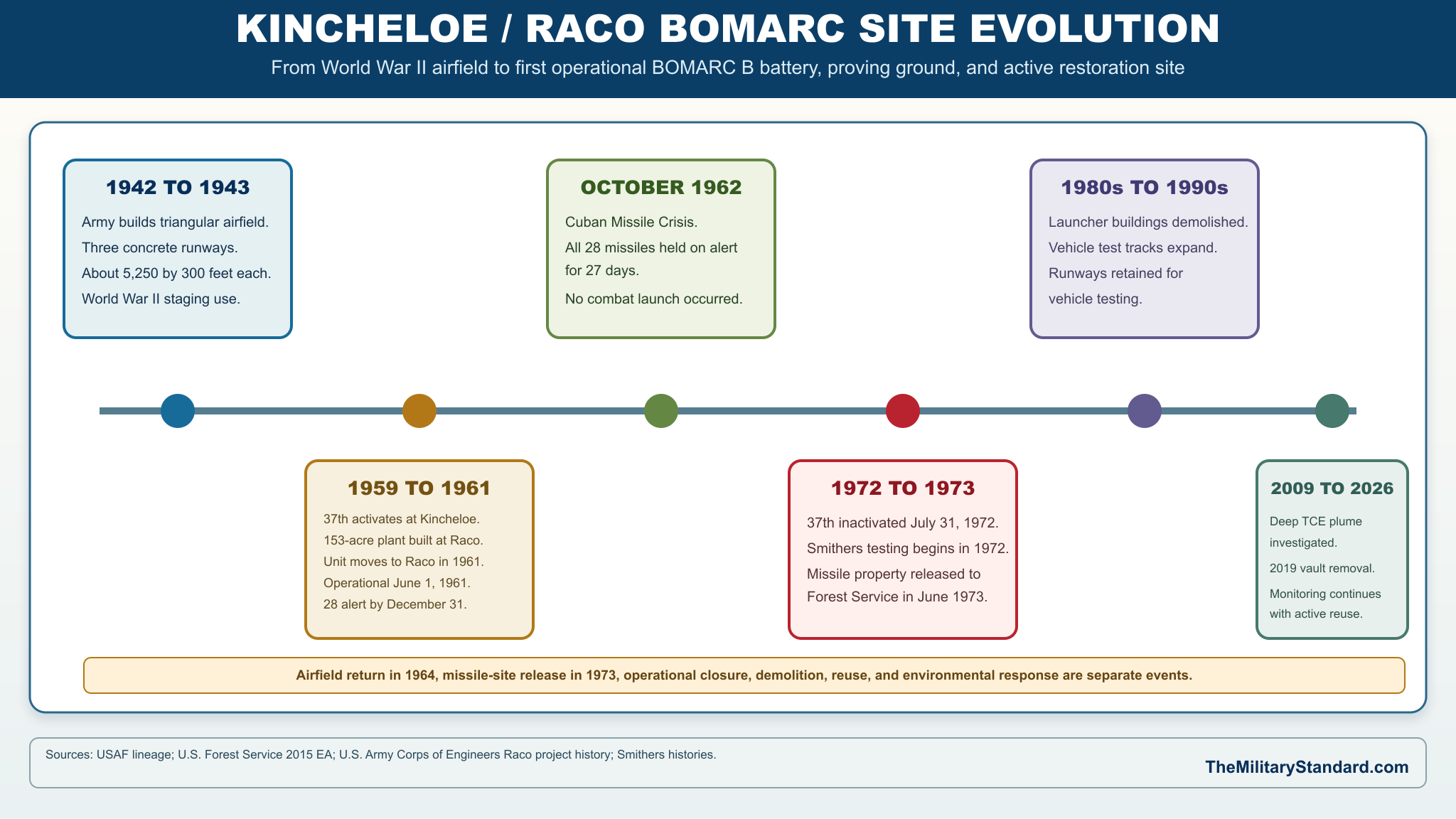
The squadron inactivated on July 31, 1972 as the Air Force phased out BOMARC B. Missile removal, warhead withdrawal, equipment disposition, property cleanup, utilities shutdown, contract termination, and real-estate release did not necessarily occur on the same day.
The Air Force later consolidated the inactive 37th with earlier unit lineages and redesignated it the 37th Tactical Missile Squadron on September 19, 1985. That administrative action did not reactivate Raco or restore the BOMARC mission. Organizational lineage continued on paper while the physical site moved into Forest Service management and civilian reuse.
Forest Service Transfer and Winter Testing
Smithers' predecessor began using the Raco property for vehicle and component testing in 1972 under Forest Service special-use authorization. The durable runways, severe winter climate, lake-effect snow, open space, and secluded setting suited cold-weather development work. A 2015 Forest Service assessment reported continuous testing use since 1972 under a series of permits and described the facility as an abandoned airbase rather than an active military installation.The Forest Service released chronology distinguishes the two military phases. The Air Force returned the airfield property in January 1964, while the missile area followed in June 1973. The Smithers operation therefore began around the operational closure of the missile battery but was based principally on the airfield surfaces.
The 2015 proposed permit area covered approximately 828 acres and included three one-mile runways, each about 300 feet wide and 5,250 feet long, with concrete 12 to 18 inches thick. Smithers developed snow, ice, asphalt, split-friction, hill, off-road, and support facilities for vehicle testing. The permit landscape also contained Forest Service roads, military vestiges, environmental wells, wildlife habitat, and areas open to public recreation when testing and seasonal restrictions allowed.
Current Smithers material describes a secure winter proving ground of more than 800 acres at 21105 West M-28 in Brimley. Access is controlled and client confidentiality is important because prototype vehicles and components are tested. The current business address and acreage describe the proving ground, not the former 153-acre missile-installation boundary or a public invitation to visit the BOMARC area.
Demolition, Alteration, and Surviving Features
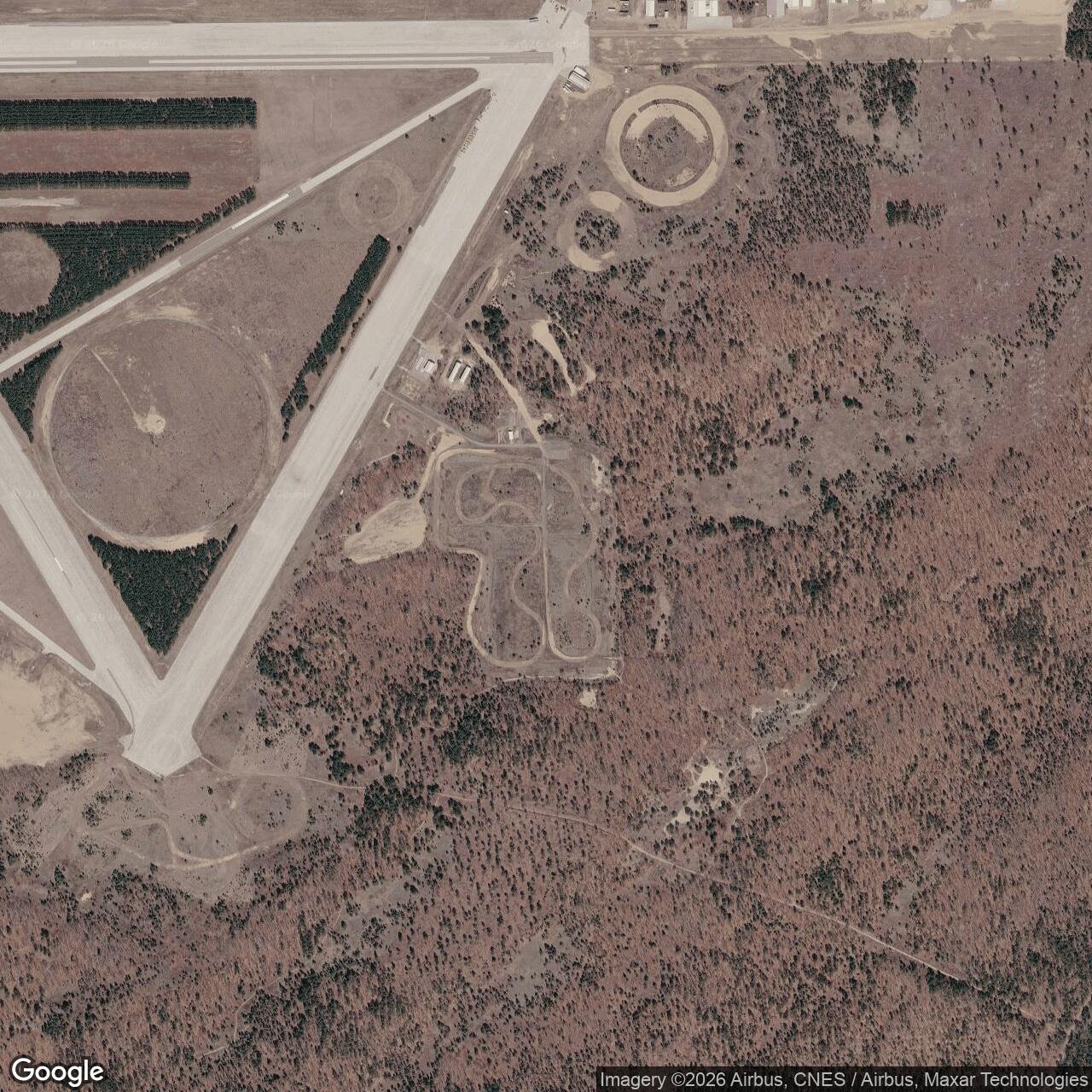
The former missile launcher area has lost much of its original form. Specialist surveys report that the site was leveled and that little of the missile plant remains visibly intact. Aerial evidence preserves the location and some circulation or foundation traces, while the adjacent triangular airfield remains the dominant historic feature. The exact survival of foundations, utility corridors, pavement, fencing, drainage, and buried components requires a controlled field survey.Forest Service documents refer to pads and other military vestiges within the broader permit area. Those references confirm that removal was not total, but they do not identify every remaining feature as part of the BOMARC plant. Some remnants belong to the World War II airfield, some to the missile period, and others to later vehicle testing. Interpretation requires dated plans, photographs, and ground verification.
The three runways survive because their massive concrete construction became an asset for winter testing. Their preservation does not mean the BOMARC launcher shelters survive. The airfield and missile plant had different facility patterns and post-military value.
Environmental Investigation and Trichloroethylene
The U.S. Army Corps of Engineers manages the former Raco military property through the Formerly Used Defense Sites program under property number E05MI0026. The federal inventory identifies both a container or hazardous, toxic, and radioactive waste project and a separate HTRW project. Program records use the name Raco AAF-Hiawatha National Forest even when work addresses contamination associated with the combined airfield and missile history.Investigations have occurred since the 1980s. A principal concern is trichloroethylene, or TCE, in groundwater. TCE is a chlorinated solvent historically used for degreasing and other industrial or military work and is carcinogenic. A contaminant plume was identified beneath and downgradient of the former military property, requiring progressively deeper investigation in a complex aquifer.
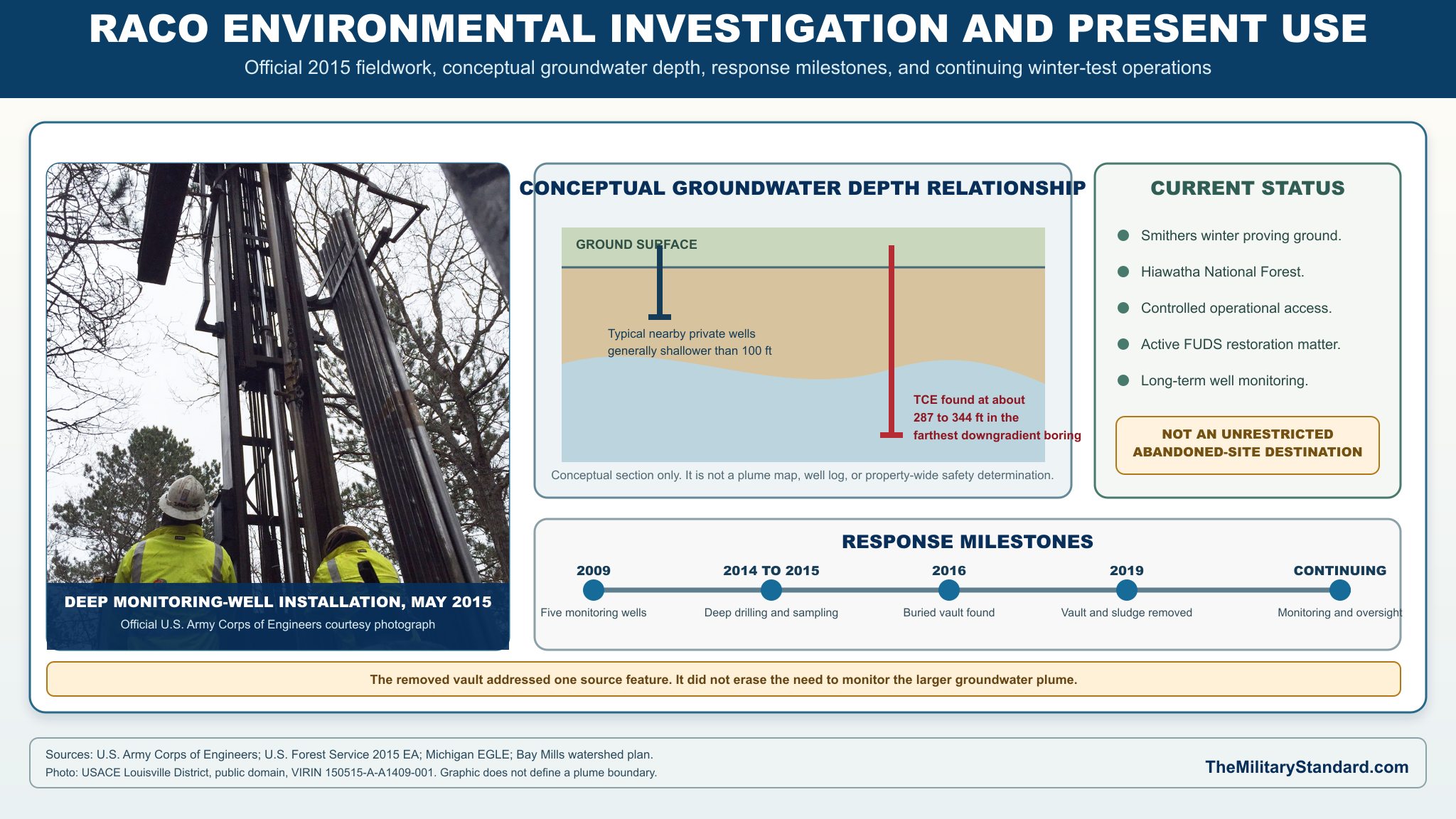
In 2009 the Corps focused investigation on the TCE plume and installed five monitoring wells. Fieldwork in 2014 and 2015 added deep borings and wells, collected more than 400 groundwater samples, and used a mobile laboratory and three-dimensional plume interpretation. One Corps account reported more than 3,600 feet of drilling, seven new wells reaching about 330 feet, and more than 259 volatile-organic-compound samples during the 2015 phase.
The investigation found TCE at depths approximately 287 to 344 feet at the farthest downgradient borehole. The plume extended more than one-half mile from the nearest residential wells identified in the 2020 Corps account. Nearby private wells were generally shallower than 100 feet and considered unlikely to be affected by the deep plume, but routine sampling remained part of the protective approach. Four residential wells sampled during the 2015 work had no detected volatile organic compounds.
In 2016 investigators discovered a partially demolished underground tank or vault approximately 18 feet deep that contained TCE-contaminated sludge. An October 2019 non-time-critical removal action excavated the structure and its contents. Follow-up soil beneath it did not exceed the cited Michigan groundwater-protection or EPA screening levels. The removal addressed a source feature but did not eliminate the need to monitor the larger groundwater plume.
The Corps proposed monitored natural attenuation with long-term groundwater monitoring as the continuing remedy. The approach relies on natural processes while sampling verifies plume behavior and protects potential receptors. Private-well sampling and contingency action are important because groundwater conditions, well construction, and plume migration can change. A 2023 Corps presentation anticipated remedial-design or construction work, but that planning statement is not proof that every later action is complete.
Michigan's current Superfund project-assignment list continues to identify Raco AAF in Brimley, Chippewa County, under Corps and state oversight. It does not list an EPA National Priorities List identifier for the property. This is an active federal restoration matter, but the reviewed evidence does not justify declaring the entire proving ground unsafe, assigning the plume solely to one building, or treating every current well as contaminated.
The Forest Service separately evaluated Smithers operations and groundwater use. Its 2015 assessment reported that samples from the high-capacity well and domestic wells were non-detect for volatile organic compounds and required continued annual monitoring with shutdown and notification if residential criteria were exceeded. The environmental record thus distinguishes the deep former-military plume from tested water supplies while retaining surveillance and contingency requirements.
Current Status and Access
The BOMARC military mission is closed and the 37th is inactive. The former federal property is managed within Hiawatha National Forest, with Smithers operating a controlled vehicle proving ground under Forest Service authorization. The airfield pavement and modern testing facilities dominate present use, while the former missile area has been substantially removed or altered.The location is not an unrestricted abandoned site. Smithers maintains gates and security for confidential testing, Forest Service roads may be temporarily closed, environmental work involves monitoring wells and protected equipment, and seasonal wildlife restrictions affect operations. Visitors must follow current Forest Service rules, posted closures, private operational controls, and environmental restrictions.
Detailed Chronology
- 1942 The federal government obtains and prepares land near Raco for a northern Michigan military airfield.
- 1942-1943 Construction produces a triangular airfield with three concrete runways approximately 300 feet wide and 5,250 feet long.
- 1943-1945 Raco Army Airfield supports World War II auxiliary, staging, emergency, training, dispersal, and regional-defense purposes.
- 1945-1950s The airfield's operational role declines, but federal military control and intermittent defense-related use continue.
- 1950s Air Defense Command develops the BOMARC surface-launched interceptor and its integration with the SAGE system.
- 1957-1959 BOMARC deployment plans contract while the Air Force shifts emphasis toward a smaller number of tactical sites and the improved B model.
- 1959-09-23 The Air Force constitutes the 37th Air Defense Missile Squadron.
- Circa 1959-1960 The Air Force begins construction of the 153-acre missile installation southeast of the Raco airfield.
- 1960-03-01 The 37th activates at Kincheloe Air Force Base under the 30th Air Division.
- 1960-04-01 The squadron transfers to the Sault Ste. Marie Air Defense Sector.
- 1960-10-26 The Air Force approves the squadron emblem and SEMPER VIGILANS motto.
- First half of 1961 The 37th moves approximately 32 miles from Kincheloe to the completed Raco site.
- 1961-06-01 Official lineage material identifies the Raco BOMARC B installation as operational.
- 1961-12-31 The squadron reaches its full operational-alert complement of 28 missiles.
- 1962 The joint service designation system changes IM-99B to CIM-10B.
- October 1962 Raco holds its full force on alert during the Cuban Missile Crisis.
- October-November 1962 The full-alert condition lasts 27 days according to the unit lineage record.
- 1963-10-01 The 37th transfers to the Duluth Air Defense Sector.
- 1963-1972 The battery is associated with the Duluth SAGE direction-center environment in specialist histories.
- 1964-01 The Air Force releases the former airfield property to the Forest Service, while retaining the separate missile area.
- 1965-08-30 The first documented Outstanding Unit Award period begins.
- 1966-04-01 The 37th transfers to the 29th Air Division during air-defense reorganization.
- 1967-03-03 The first Outstanding Unit Award period ends.
- 1968 Smithers' predecessor begins regional winter vehicle testing before occupying the Raco airfield property under later permits.
- 1969-11-19 The squadron transfers to the 23rd Air Division.
- 1971-03-31 The second documented Outstanding Unit Award period begins.
- 1972-03-31 The second Outstanding Unit Award period ends.
- 1972 Smithers begins continuous vehicle and component testing at Raco under Forest Service special-use authority.
- 1972-07-31 The Air Force inactivates the 37th Air Defense Missile Squadron and ends the Raco operational mission.
- 1972-1973 Missiles, warheads, launch equipment, and other military property are removed or disposed of on schedules not fully reconstructed here.
- 1973-06 The Air Force releases the missile-area property to the Forest Service.
- 1980s Federal environmental investigations begin at the former Raco military property.
- 1985-09-19 The Air Force consolidates and redesignates the inactive lineage as the 37th Tactical Missile Squadron without reactivating Raco.
- 1986 Smithers' Raco testing use expands to year-round operation except for later seasonal wildlife restrictions.
- 1996-10-04 A Forest Service special-use permit formalizes a major phase of Smithers operation.
- 2003-2005 The Forest Service evaluates Smithers permit modifications and issues a decision notice and finding of no significant impact.
- 2009 The Corps focuses investigation on the TCE groundwater plume and installs five monitoring wells.
- 2011 The Forest Service reviews additional testing-season and wildlife-noise information for the proving ground.
- 2012 Water samples cited by the Forest Service show no detected volatile organic compounds in Smithers wells tested.
- 2014-2015 The Corps expands deep groundwater delineation, collecting more than 400 samples and installing additional wells.
- 2015-03 The Forest Service issues a draft environmental assessment for a proposed 20-year Smithers special-use permit reissuance.
- 2015-05 Corps contractors conduct deep drilling and monitoring-well installation at the former military property.
- 2016 Investigators discover a partially demolished underground tank or vault containing TCE-contaminated sludge.
- 2019-10 A non-time-critical removal action removes the underground structure and contaminated contents.
- 2020-01 to 2020-02 The Corps presents a proposed plan for monitored natural attenuation, long-term monitoring, and private-well sampling.
- 2023 A Corps planning presentation anticipates remedial design or construction activity for the selected Raco groundwater approach.
- 2026 Michigan continues to list Raco AAF as an active Corps-managed federal environmental project, while Smithers operates the former airfield as a controlled winter proving ground.
Sources & References
- PDF United States Air Force, 37th Tactical Missile Squadron Lineage and Honors History Source for Constitution, activation, assignments, move to Raco, operational dates, 28-missile alert complement, Cuban Missile Crisis alert, commanders, awards, inactivation, later consolidation, emblem, and motto.
- PDF ADC Historical Data, 1946-1973, Aerospace Defense Command (17.67 MB) Source for Air Defense Command organizational context, BOMARC units and assignments, SAGE relationships, operational period, and comparison with the completed missile network.
- PDF Department of Defense, Leading the Way: The History of Air Force Civil Engineers Source for BOMARC construction history, differences between A-model and B-model facilities, standard tactical-site components, shelter construction, rolling-roof design, solid-booster simplification, and engineering context.
- WEB U.S. Army Corps of Engineers, Louisville District Shares Proposed Plan for Raco Army Airfield Project Source for Combined property history, duration of military use, Forest Service transfer, 2009 and 2014-2015 investigation, TCE plume depth and extent, private-well relationship, 2016 vault discovery, 2019 removal, and proposed remedy.
- PDF U.S. Forest Service, Draft Environmental Assessment for the Smithers RAPRA Special Use Permit Reissuance Source for 1942-1943 airfield construction, circa-1960 missile-base construction, January 1964 and June 1973 release dates, runway dimensions, 828-acre proposed permit area, Smithers history, current uses, recreation, groundwater monitoring, and access controls.
- WEB U.S. Army Corps of Engineers, Monitoring Wells Installed at Raco Army Airfield and Missile Site Source for Official public-domain visual evidence of 2015 monitoring-well construction and confirmation of active FUDS field investigation.
- PDF U.S. Army Corps of Engineers, Formerly Used Defense Sites Inventory for Michigan Source for Property number E05MI0026, Raco AAF-Hiawatha National Forest naming, and identification of the two environmental restoration projects.
- WEB U.S. Army Corps of Engineers, Restoration Advisory Board Plays Vital Role in Environmental Cleanup Source for Public-participation framework, community involvement, and the role of advisory review in the Raco cleanup process.
- WEB U.S. Army, Corps Program Promotes Green Cleanups Source for Raco remedial-investigation field practices, reuse of clean materials and water, transportation reduction, and environmental-management context.
- PDF U.S. Army Corps of Engineers Louisville District, May-June 2015 District Publication Source for April 2015 fieldwork start, drilling footage, seven deep wells, mobile-laboratory sampling, three-dimensional plume modeling, and no VOC detections in four sampled residential wells.
- PDF Michigan Department of Environment, Great Lakes, and Energy, Superfund Project Assignment Contact List Source for Current Raco AAF project listing, Brimley and Chippewa County identity, Corps and state oversight, and absence of a listed EPA National Priorities List identifier.
- WEB U.S. Government Accountability Office, Defense Environmental Restoration Program, Michigan Property Status Source for Historical environmental project status, early investigation and remedial activity, and the distinction between completed response phases and the continuing HTRW project.
- WEB U.S. Army Corps of Engineers, 2023 Louisville District Open House Source for Planned remedial-design and monitored-natural-attenuation implementation context, treated as planning evidence rather than proof of completion.
- PDF Bay Mills Indian Community, Waishkey River Watershed Management Plan Source for Watershed context, mapped TCE plume relationship, potential migration concern, and regional environmental planning.
- WEB Smithers, For New and Current Winter Test Center Clients Source for Current address, controlled access, client preregistration, active winter-testing operation, and present business identity.
- WEB Smithers, Winter Proving Ground Courses and Surfaces Source for Current proving-ground acreage, snow, ice, pavement, hill and off-road capabilities, and distinction between modern test features and former missile facilities.
- WEB Smithers, 50 Years at the Smithers Winter Test Center Source for Local winter-testing origins, transition to Raco, continuous commercial use, and the proving ground's long operating history.
- WEB Smithers, Expansion at Winter Test Center Source for 2017 proving-ground expansion, later acreage, employment and investment context, and warning against using current acreage as missile-base acreage.
- WEB National Museum of the United States Air Force, Boeing CIM-10B BOMARC Photograph Source for Authoritative visual identification of the B-model missile and public-domain illustration context.
- WEB Tinker Air Force Base, Douglas IM-99 BOMARC Missile Source for Official Air Force description of BOMARC as the service's ground-based long-range antiaircraft missile and general weapon-system history.
- PDF Congressional Record, 1960 BOMARC Program Debate, Part 12 Source for Revised national deployment plan, 28-launcher squadron structure, United States and Canadian site count, program cost, and strategic-policy context.
- PDF Congressional Record, 1960 BOMARC Program Debate, Part 10 Source for Revised 28-launcher and 30-missile squadron planning, bomber-threat debate, ballistic-missile shift, and limits of planned versus installed inventory.
- WEB FortWiki, Kincheloe AFB BOMARC Missile Site Source for Specialist coordinate comparison, 28-launcher layout, first B-model operational status, K.I. Sawyer and Duluth direction-center relationships, reported staffing, closure, and surviving-condition observations.
- WEB Radomes.org, BOMARC Sites and Kincheloe Roster Source for Specialist comparison of operational BOMARC locations, unit identification, site relationships, and links to contributor photographs and personnel records.
- WEB Abandoned and Little-Known Airfields, Raco Army Airfield Source for Secondary airfield chronology, historic and aerial-image comparisons, runway geometry, postwar use, missile-area relationship, and present
- WEB https://www.airfields-freeman.com/MI/Airfields_MI_N.htm Michigan Technological University, CIM-10 BOMARC Missiles at Raco AAF
- WEB against official records https://ss.sites.mtu.edu/mhugl/2016/10/16/cim-10-bombarc-missiles-at-raco-aaf/