
Dow Air Force Base BOMARC Missile Launch Facility, Maine
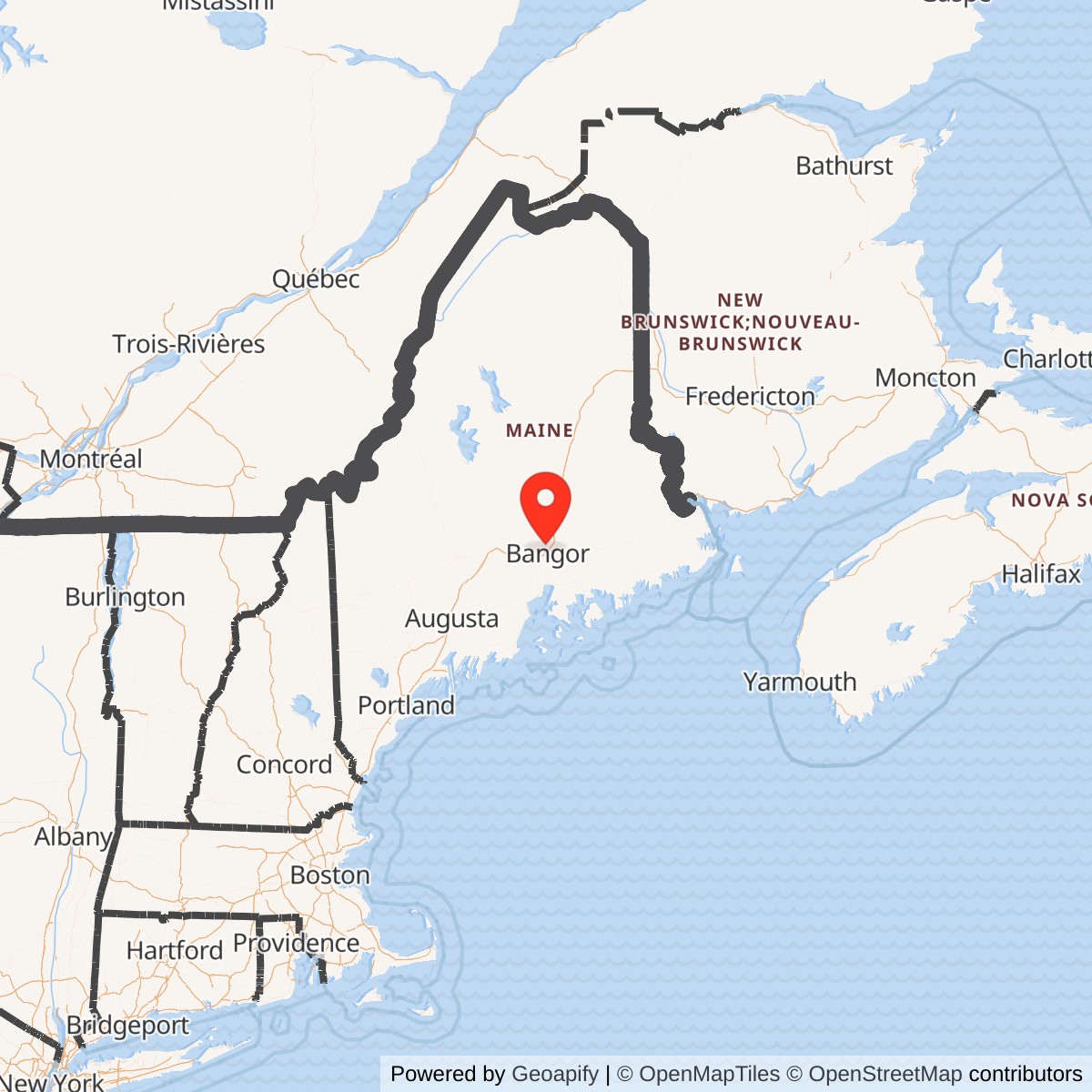
Longitude: -68.7858333
Site Number: BOMARC; 30th Air Defense Missile Squadron; IM-99A/CIM-10A; Bangor Air Defense Sector
Official Base Website: Bomarc Industrial Park / Former Dow AFB BOMARC Missile Site
Current Role: Former launch and support property reused as Bomarc Industrial Park. Current Bangor assessment, planning, road, business, and code records show multiple owners and industrial, commercial, utility, storage, food-production, and communications uses. All 28 launcher shelters appear to survive with varying alterations. The former military mission is closed, and the representative coordinate does not establish public access.
The Dow Air Force Base BOMARC Missile Launch Facility was a separate Air Defense Command missile installation in northern Bangor, Maine, approximately four miles north-northeast of the parent airfield. The 30th Air Defense Missile Squadron operated the site as one of the eight completed operational United States BOMARC batteries. Its 28 above-ground launcher shelters held liquid-booster IM-99A missiles, later redesignated CIM-10A, for long-range interception of hostile bombers approaching Maine, New England, strategic air bases, industrial centers, and the northeastern United States.
The site formed one part of a distributed weapon system rather than functioning as an independent missile battery. Radar stations detected and tracked aircraft, the Bangor Air Defense Sector assembled the regional air picture at its SAGE direction center in Topsham, and computer-generated commands guided a selected BOMARC through most of its flight. Dow supplied the alert missiles and local operating organization. A separate Ground-Air Transmitter installation in Glenburn carried guidance communications between the SAGE network and airborne missiles.
Construction was underway during 1958, and the 30th Air Defense Missile Squadron activated on 1959-06-01. Official Air Defense Command chronology states that the Dow site became the fourth operational BOMARC installation in June 1960. A later unit-lineage compilation instead places operational status in December 1960. The difference may represent initial operational capability, formal acceptance, or full squadron readiness.
Dow remained an all-A-model installation. The battery did not receive the solid-booster BOMARC B or the simplified B-model launcher configuration. The 30th became nonoperational on 1964-12-01 and was discontinued and inactivated on 1964-12-15 as the Air Force withdrew the maintenance-intensive A model. Its short combat-alert life reflected a rapid change in technology and strategy rather than a failure to complete the physical plant.
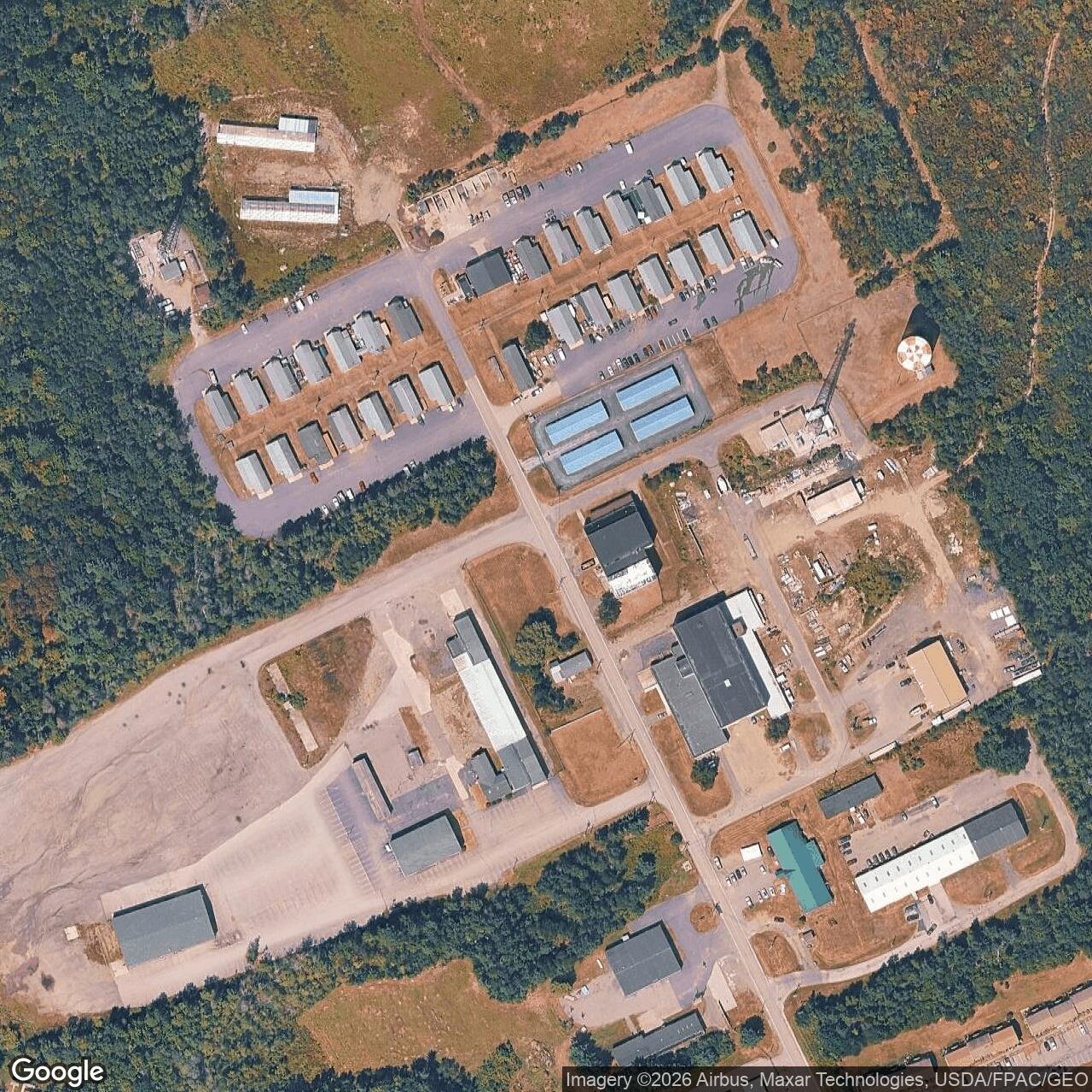
The former missile property entered civilian reuse and became the Bomarc Industrial Park. All 28 launcher shelters appear to survive, although commercial alterations have changed doors, roofs, exterior finishes, and interior arrangements. Support buildings and the road pattern also remain to varying degrees. Current tax, business, and planning records show multiple owners and users rather than one intact military parcel. Maine Department of Environmental Protection records list the BOMARC Missile Facility on Bomarc Road as a federal-facilities remediation site in an investigation stage awaiting resources.
Installation Identity, Location, and Boundaries
The formal name is Dow Air Force Base BOMARC Missile Launch Facility. Period and later records also use Dow AFB BOMARC Site, Dow BOMARC Missile Site, Bangor BOMARC Site, Bangor Missile Site, 30th Air Defense Missile Squadron site, and Bomarc Industrial Park. The name Dow describes the administrative relationship to the air base. It does not mean that the launcher shelters stood within the main airfield cantonment or that the current Bangor Air National Guard Base includes the former missile parcel.
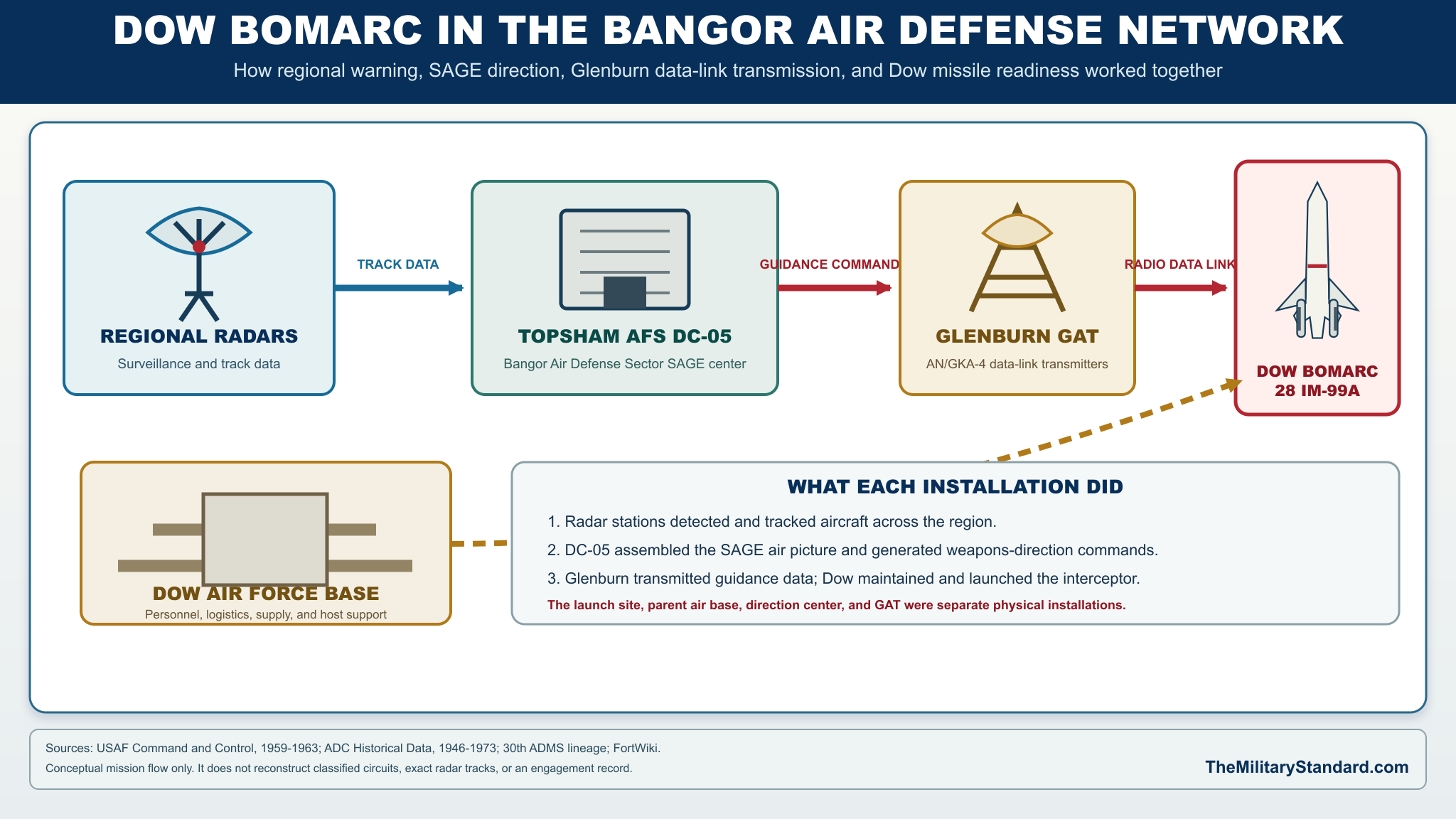
The site must be separated from Dow Air Force Base, now Bangor International Airport and Bangor Air National Guard Base. The airfield supported the squadron with personnel services, transportation, supply, administration, medical care, communications, security coordination, and other base functions. It also hosted fighters and Strategic Air Command activities during the BOMARC years. The launcher area remained a physically detached weapons installation whose shelters, hazardous-material plant, perimeter, and operating spaces served a specialized mission.
The remote Glenburn Ground-Air Transmitter site was another separate installation. It housed communications and guidance equipment associated with the Dow BOMARC system and later became the location of Glenburn municipal facilities and water-supply concerns. Its property, facilities, environmental record, and post-military use are not merged with the Bomarc Road launch complex.
Strategic Origins of BOMARC
BOMARC grew from the postwar requirement to intercept Soviet bombers before they reached American cities and military targets. Early warning lines in Canada and Alaska, coastal and interior radar stations, airborne warning aircraft, Navy radar picket ships, SAGE direction centers, fighter-interceptor bases, Air Force missiles, and Army Nike defenses formed overlapping layers. BOMARC was intended to extend the engagement zone beyond local point-defense missiles and to make a long-range unmanned interceptor available to the same regional command system that directed fighters.The weapon's name combined Boeing with the Michigan Aeronautical Research Center, two organizations associated with its early development. The Air Force ordered the system into production in the 1950s after a difficult development program. BOMARC was not a strategic ballistic missile and Dow was not an intercontinental missile launch base. The missile flew within the atmosphere, using a rocket booster and ramjet cruise propulsion to reach an airborne target assigned through the continental air-defense network.
Initial deployment concepts called for dozens of sites and very large missile inventories. The plan changed repeatedly as development costs rose, Army Nike Hercules competed for air-defense resources, SAGE construction consumed large appropriations, and the perceived threat shifted toward intercontinental ballistic missiles. By the end of 1958, Dow ranked fourth in Air Defense Command's proposed construction sequence. In March 1960, national decisions reduced the operational program to eight United States sites and two Canadian sites.
Dow's geography made it a logical early choice. Maine faced the northeastern and polar approaches used in air-defense planning, and Bangor supported both fighter and bomber operations. A BOMARC battery near the city could add a long-range engagement option for aircraft approaching New England and the strategic facilities of northern Maine. Its relationship to radar stations across Maine and adjacent regions gave the battery access to a much larger warning picture than any local search radar could supply.
Congressional Authorization and Site Selection
Congressional debate in 1958 identified Dow among the first four BOMARC locations funded through the fiscal year 1958 military-construction program, together with McGuire, Suffolk County, and Otis. The Air Force requested substantial national construction funds because a BOMARC squadron required far more than missiles. Shelters, handling equipment, hazardous propellant systems, environmental controls, power, communications, maintenance spaces, security, roads, and drainage all had to be coordinated with the weapon's evolving design.The City of Bangor's 1958 annual report listed the BOMARC missile site among the major projects transforming the community, alongside the expansion of Dow Field, Capehart housing, interstate construction, and industrial development. Contemporary local reporting identified the John A. Volpe Construction Company as the principal contractor and described clearing work by J. R. Cianchette. These reports show that the project was physically underway before the missile squadron activated in 1959.
Site selection balanced strategic coverage with practical construction. The tract needed separation from dense development, sufficient space for 28 ready shelters and hazardous support facilities, road access to Dow, reliable utilities, clear communications paths, drainage, and a secure perimeter. Bangor's cold winters added requirements for heating, snow removal, freeze protection, roof operation, and dependable power. The same climate that complicated construction made the site operationally important because the system had to remain ready during severe weather.
The installation was one of the earliest attempts to build a complete missile weapon system as an integrated facility. Air Force construction history notes that design problems at Santa Rosa Island and the first tactical bases required engineers, the Corps of Engineers, Boeing, and the Air Force to reconcile equipment changes with building plans. Dow therefore embodied a national learning process in which shelter dimensions, environmental systems, propellant handling, and support machinery had to remain compatible with a missile still moving through production and acceptance.
Site Design and Physical Layout
The site comprised a launch area, missile support area, and connections to the separate remote GAT facility. The launch area contained 28 above-ground shelters in two parallel groups, access paving, a compressor building, an ordnance or air-munitions function, utilities, drainage, and security controls. The support area included assembly and maintenance, heating and power, liquid-propellant facilities, vehicle storage, fuel storage, and entrance-control functions. The arrangement separated routine support from the secure ready-missile area while keeping critical services close enough for rapid preparation.
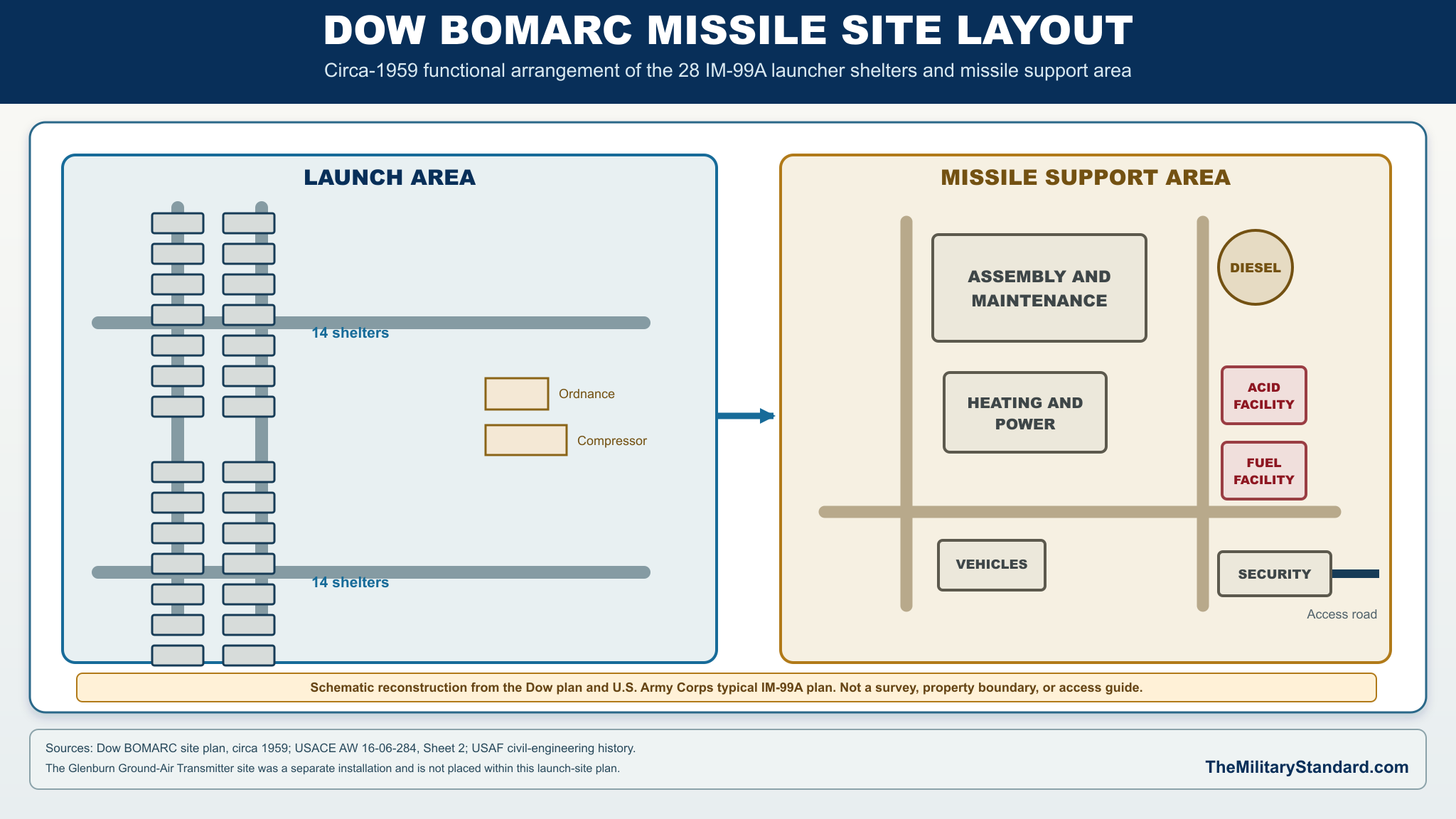
The 28 shelters represented one standard BOMARC squadron module. Their layout supported readiness, inspection, maintenance scheduling, and controlled access without requiring every missile to be in the same status at the same time. A missile could be unavailable for testing, repair, warhead work, or system checks while the squadron still maintained an alert force. Public records do not establish the day-by-day load of every Dow shelter, and the authorized physical capacity should not be mistaken for a continuously available missile count.
The A model imposed facilities that later B-model sites could simplify. Construction histories identify chilled-water generation and distribution, a propellant acid facility, propellant fuel facilities, gas compressors, air-munitions space, maintenance, and power as characteristic requirements. Dow's surviving support buildings and site plans reflect these functions. The exact inventory, dimensions, building numbers, and alteration dates require an authenticated as-built drawing, but the functional organization of the plant is well established.
Security extended beyond a fence and gate. The site stored a nuclear-capable guided weapon, hazardous fuels and oxidizers, explosives, classified guidance and communications equipment, and specialized test devices. Entry control, identification, restricted areas, patrols, lighting, emergency communication, and coordination with Dow security forces were necessary. Public photographs show an entrance arrangement and internal road plan, but they do not establish the complete period security system or present access rights.
The 30th Air Defense Missile Squadron
The Air Force constituted the 30th Air Defense Missile Squadron on 1959-01-23 and activated it at Dow on 1959-06-01. The squadron was assigned to the Bangor Air Defense Sector. Its mission was to maintain the IM-99 BOMARC weapon system and remain prepared to launch against hostile aircraft that penetrated the defense area. This required a permanent operating organization even when no combat missile ever left the Bangor shelters.Squadron work divided among operations, missile maintenance, munitions and warhead support, communications, supply, civil engineering, security, administration, and emergency response. Operators maintained alert status and coordinated with SAGE. Missile technicians tested guidance, electrical, propulsion, and launcher systems. Civil engineers kept heating, power, chilled water, hydraulics, roads, drainage, and buildings serviceable. Security and munitions personnel protected sensitive areas and enforced nuclear and explosive safety procedures.
Personnel depended on the parent base for many daily services. Dow provided housing connections, dining and commissary support, medical and dental care, transportation, payroll, personnel administration, recreation, chapel services, and major supply channels. The detached site required its own shift work and immediate response capability, but it was not intended to reproduce an entire air base. This parent-child arrangement explains why unit records often list Dow AFB even though the missiles stood miles away on Bomarc Road.
Training began before full operational acceptance. Missile crews learned system theory, checkout, maintenance, launch procedure, communications, safety, and emergency action through the Air Force's BOMARC training establishment at Eglin and Santa Rosa Island. Live training launches occurred at the Gulf range because an operational battery could not fire over surrounding communities during ordinary readiness work. At Dow, most proficiency came from inspections, simulations, drills, equipment exercises, and carefully controlled maintenance rather than local missile launch.
In 1962, the 30th Air Defense Missile Squadron received one of the Air Force's first missile safety awards. The award recognized the difficulty of maintaining combat readiness while handling unfamiliar equipment and hazardous materials. It does not prove that Dow experienced no incidents, nor does it replace a site accident record. It does show that missile safety, maintenance practice, and disciplined operation were major parts of the squadron's institutional identity during its brief alert period.
The IM-99A and CIM-10A BOMARC
Dow operated only the A model. The missile was designated IM-99A during most of the site's life and became CIM-10A under the 1962 tri-service designation system. It used an Aerojet-General liquid-propellant rocket booster to accelerate vertically. Two Marquardt ramjet engines then sustained high-speed cruise. Ground commands provided midcourse guidance, while the missile's Westinghouse terminal radar acquired the assigned target for the final attack phase.
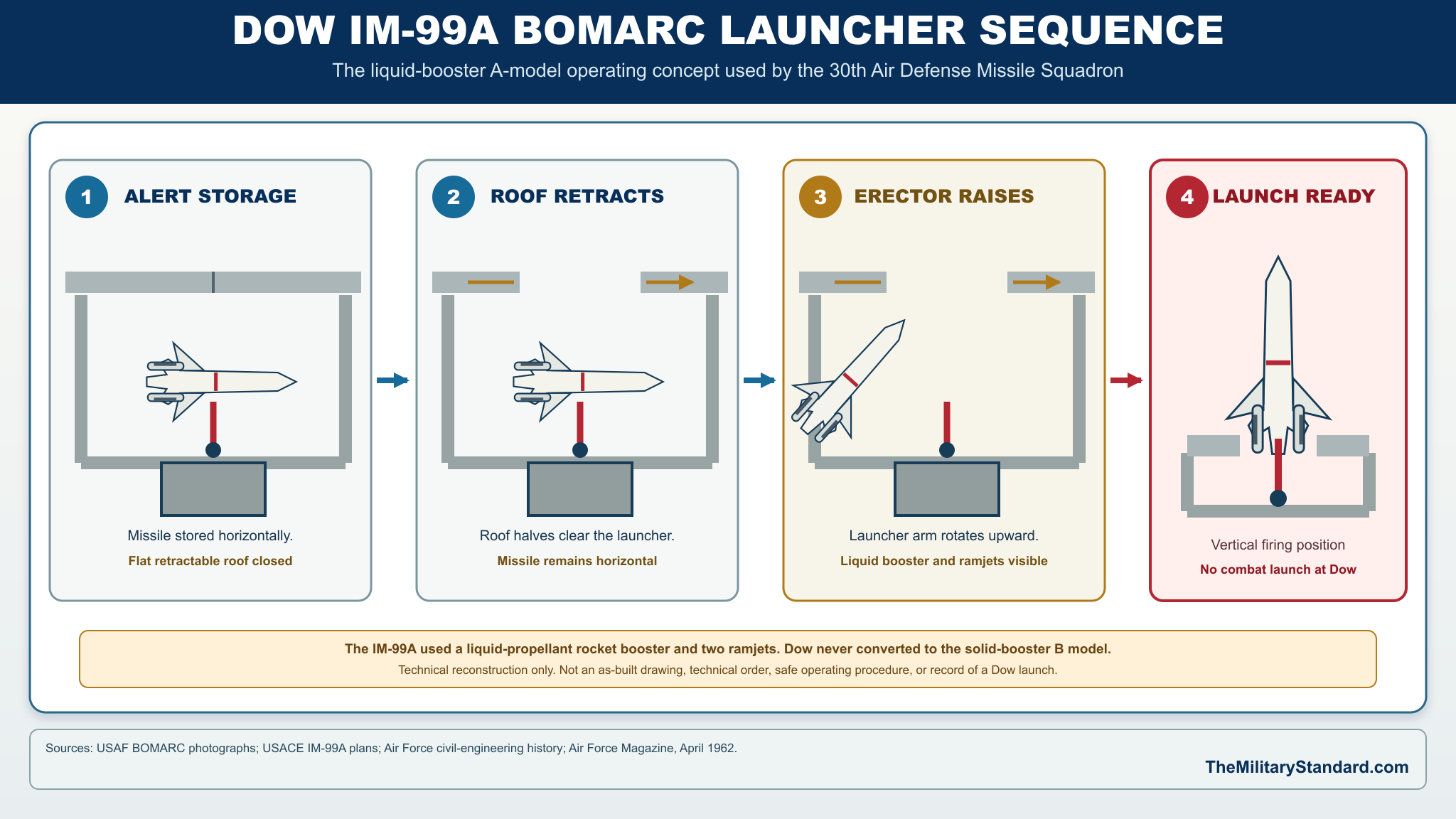
The A model could carry a conventional or W40 nuclear warhead. Later unit histories describe the Dow alert force as nuclear armed, while period public material often stated the system capability without disclosing site-by-site custody details.
Nuclear readiness required more than possessing a warhead. Personnel reliability, two-person controls where applicable, restricted access, technical inspections, secure communications, emergency plans, explosive limits, and periodic maintenance had to function together. Warheads normally remained associated with missiles while specialized spaces allowed required servicing.
Liquid Propellants, Maintenance, and Safety
The liquid booster made the Dow plant unusually demanding. Model A support involved a corrosive oxidizer, combustible fuel components, high-pressure gases, chilled water, pumps, valves, piping, environmental controls, and protective equipment. A missile on alert was not simply parked in a building. Its support systems had to be monitored, exercised, inspected, and kept within specified conditions so the weapon could move from readiness through fire-up and launch without injuring personnel or damaging adjacent equipment.Maine weather complicated this work. Cold, snow, ice, moisture, and freeze-thaw cycles affected roofs, doors, paving, drainage, exposed lines, vehicles, and emergency access. Heated support spaces and dependable utilities were essential, while snow removal could not obstruct shelter movement or security circulation. The northern climate also placed heavy demands on standby power. A regional power interruption could not be allowed to erase the site's ability to maintain safe storage and communicate with its command system.
The 1960 BOMARC fire at McGuire demonstrated what could happen when an A-model missile and its nuclear warhead burned, but that accident occurred in New Jersey and must not be assigned to Dow. It nevertheless influenced procedures across the same weapon system. Dow personnel operated comparable liquid-booster equipment and therefore had to prepare for propellant leaks, fire, pressure-system failure, contaminated runoff, evacuation, explosive hazards, and the special consequences of an accident involving a nuclear-configured missile.
Routine maintenance generated its own environmental legacy. Solvents, fuels, oxidizers, oils, batteries, metal treatment, paint, wastewater, spills, fire-training materials, and disposal practices could affect soil or groundwater even without a dramatic accident. The modern Maine DEP investigation listing does not identify a confirmed Dow release by contaminant or assign a completed remedy.
SAGE Control and the Bangor Air Defense Sector
The Bangor Air Defense Sector operated the SAGE direction center at Topsham Air Force Station, identified as DC-05. The center became operational in 1959 and used dual AN/FSQ-7 computers to combine radar tracks, identification information, flight plans, weapons status, and command decisions. When a track required interception, sector personnel could assign fighters, BOMARC, or coordinate with Army air defenses. The computer supported the decision and generated guidance, but commanders and trained operators retained responsibility for engagement authority.For a BOMARC mission, SAGE evaluated a target and battery relationship, selected an available missile, and transmitted commands through the communications network. The missile received ground guidance during the long midcourse portion of flight and activated its own homing radar near the target area. Dow therefore depended on radar stations and communications far outside Bangor. A shelter could be fully serviceable yet operationally useless if the direction center, data circuits, or GAT link failed.
The separate Glenburn GAT site provided the radio path between the ground command system and the airborne missile. Its location away from the launcher field reduced radio obstruction and allowed the antenna plant to serve the required geometry. The launch facility and GAT had to be synchronized but should not be treated as one parcel.
Radar inputs to the Bangor sector came from a changing network of staffed stations, gap fillers, airborne warning sources, and neighboring sectors. Dow did not need its own long-range search radar to detect every threat. Its role began after the larger network had detected, identified, and tracked an aircraft. That architecture made BOMARC powerful but also complex. Readiness depended on multiple installations, communications routes, computer programs, operators, and maintenance organizations functioning at the same time.
Alert Operations and Exercises
Daily operations centered on maintaining a credible alert force rather than repeated launching. Crews monitored missile status, tested circuits, inspected shelters, exercised launcher mechanisms, verified environmental conditions, maintained propellant and gas systems, and coordinated with the sector. Simulated tracks and readiness exercises allowed weapons directors and local personnel to practice assignment, fire-up, launch sequencing, communications, and abort procedures without releasing a missile from Bangor.The North American air-defense system conducted major exercises during Dow's operational years, including continent-wide SKY SHIELD events. These exercises grounded or controlled civilian traffic and tested radar, identification, communications, command centers, fighters, missiles, and warning systems under simulated attack. Public summaries do not provide a complete Dow shelter-by-shelter exercise log. The battery's assignment to Bangor Sector means that its status and communications formed part of that larger readiness system even when no public record names an individual Dow missile.
Alert status was not a simple count of shelters. Missiles passed through maintenance and inspection cycles, support equipment could be temporarily unavailable, crews rotated, and the command network could change readiness condition. The official designation of the site as operational signifies accepted combat capability, not proof that all 28 missiles were continuously ready. Gold-plus treatment distinguishes authorized capacity, assigned inventory, available weapons, and actual launch events whenever the evidence permits.
The 1962 missile-safety recognition suggests that the squadron successfully combined training and maintenance with alert responsibility during a demanding period. It also reflects the Air Force's institutional concern after early missile accidents and rapid expansion. Personnel had to develop procedures while the weapon system was still relatively new. Their work turned a complex collection of shelters, pumps, computers, radios, and missiles into a functioning part of continental defense.
Program Contraction and the End of the a Model
BOMARC entered service as the strategic threat was changing. The Soviet bomber remained important, but intercontinental ballistic missiles could not be stopped by a weapon designed to intercept aircraft. Nike Hercules offered another nuclear-capable air-defense option, and increasingly capable fighters competed for funding. BOMARC B improved range, electronics, and readiness with a solid booster, but the Air Force chose not to convert every A-model site.Dow and Suffolk County remained all-A batteries and became the first operational sites selected for closure. Their liquid systems demanded maintenance and specialized plant that the B model reduced. National force reductions therefore translated directly into local shutdown. The closure does not indicate that the Bangor plant was unfinished or that the squadron never served on alert. It indicates that the Air Force ended the A-model portion of the force while keeping selected B-model locations into the early 1970s.
The 30th became nonoperational on 1964-12-01. The unit was discontinued and inactivated on 1964-12-15. The two dates record different stages and both belong in the history. Missile removal, warhead withdrawal, propellant disposal, equipment transfer, contract termination, and real-property disposition likely followed their own schedules.
The Air Force later consolidated the inactive 30th Air Defense Missile Squadron with earlier units and redesignated the combined lineage as the 30th Tactical Missile Squadron in 1985. That paper lineage did not reactivate the Bangor installation or restore its BOMARC mission. The physical site had already entered civilian reuse. Organizational heritage and real-property history therefore separated after 1964.
Closure, Transfer, and Civilian Reuse
Bangor's 1964 annual report recognized that announced deactivation of the BOMARC installation and Dow Air Force Base would require extensive planning. The city viewed closure as both an economic threat and a redevelopment problem. Roads, utilities, large specialized buildings, and substantial federal property could support new activity, but the shelters and support plant were not ordinary commercial construction. Successful reuse required subdivision, alteration, services, investment, and resolution of ownership and environmental questions.
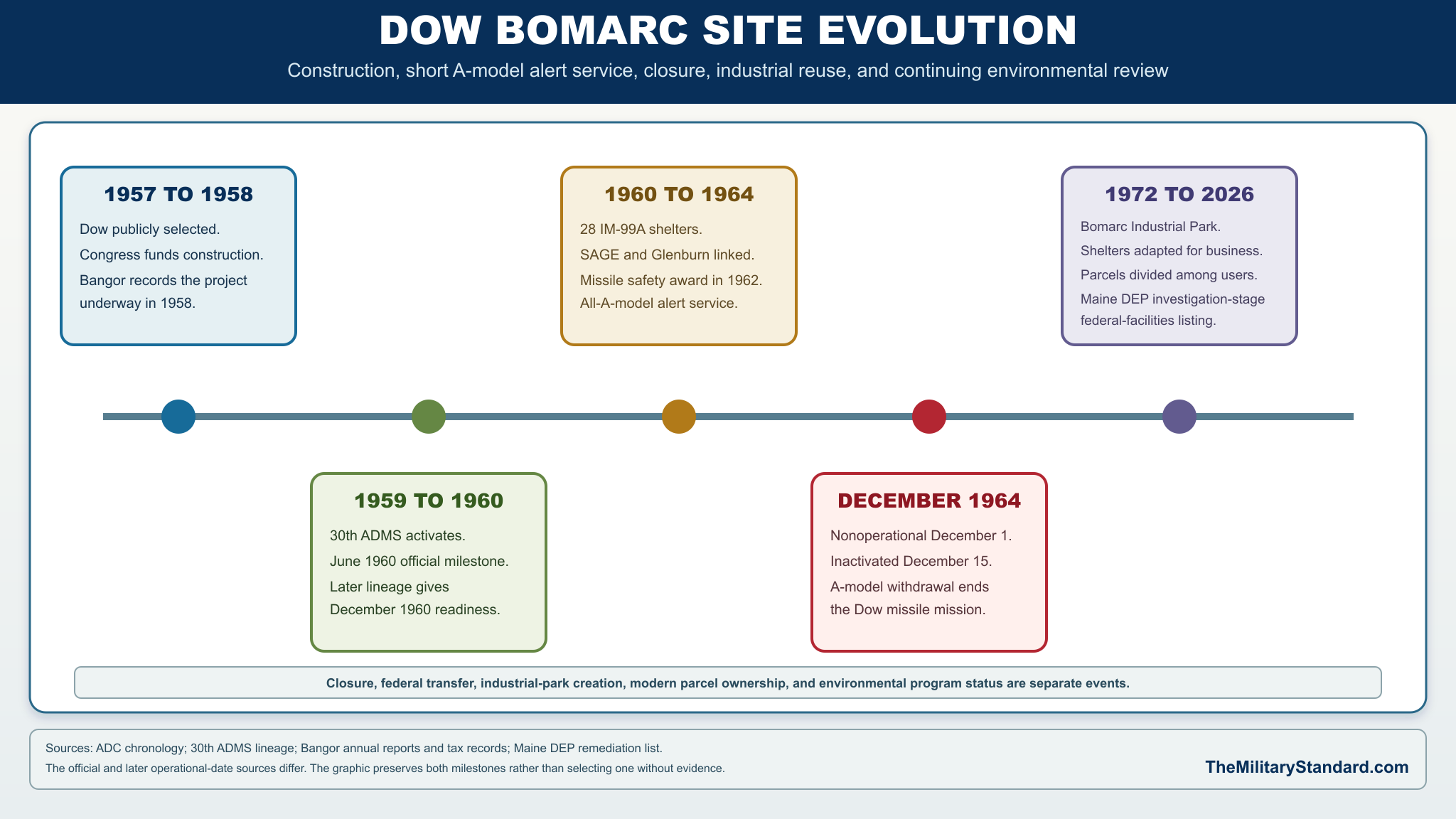
Commercial alteration preserved the basic shelter rows while obscuring military details. Siding, conventional roofs, new doors, partitions, utilities, additions, and parking changed the appearance and function of individual structures. Some support buildings also survive in altered form, while the original security and identification building is reported removed. The road geometry and repeated long shelter footprints remain the clearest evidence of the launch plant's original organization.
Current municipal tax records show several parcels and addresses along Bomarc Road, including properties held by Bomarc Inc., private development companies, Bangor Water District, and communications interests. This fragmented ownership means that the former installation cannot be described accurately as one city-owned park or one private parcel.
Surviving Structures and Historic Fabric
All 28 launcher shelters are reported to remain, making Dow one of the most legible surviving A-model BOMARC landscapes. Their continued existence is significant because the A shelters preserved the relationship among horizontal storage, retractable roof, launcher mechanism, and readiness support. Commercial conversion means that survival does not equal integrity. Original mechanical equipment, roofs, interior fixtures, environmental systems, blast-related features, and security details may be removed, enclosed, or altered.

Environmental History
The former launch complex handled materials capable of producing long-term environmental concerns. Likely sources included liquid missile propellants, fuels, oils, solvents, batteries, metal treatment, paint, compressed gases, wastewater, fire-protection materials, transformers, and routine disposal. Nuclear weapons introduced radiological planning requirements, but no reviewed evidence identifies a Dow missile fire or a confirmed release of warhead material comparable to the separate McGuire accident.Maine DEP lists the BOMARC Missile Facility on Bomarc Road as site REM03132 under the Federal Facilities program. The published list gives a status date of 2020-05-06 and describes the property as in the investigation stage with a need awaiting resources. It also shows no institutional-control flag in that listing. These database fields are a program snapshot, not a declaration that the property is clean, contaminated in every parcel, unsafe for current use, or subject to no other legal restrictions.
The Defense Environmental Restoration Program and Formerly Used Defense Sites process evaluates former military properties under federal law, but program inclusion does not itself prove a release. The reviewed public FUDS project list does not provide a completed contaminant-specific project for the Bomarc Road installation. Further research would require the inventory project report, title and transfer records, environmental sampling, regulatory correspondence, spill history, and parcel-specific redevelopment files.
Environmental conclusions must also remain separate from Glenburn. Public accounts associate trichloroethylene and water-supply concerns with the remote GAT installation, not automatically with the missile shelters. The two facilities supported one weapon system but occupied different land and had different operating processes.
Current Status
The BOMARC mission is closed, and the former federal missile property now supports private and local industrial, commercial, utility, storage, and communications uses. Bomarc Road remains part of Bangor's current street network, and the city continues to identify Bomarc Industrial Park in municipal regulations. Current assessment records confirm active parcelization and taxable improvements. These records support continued reuse while also showing why a single current-use label cannot describe every former military building.The site is not an abandoned public attraction. Individual parcels, occupied businesses, industrial traffic, private property rights, and possible environmental work limit casual access. The coordinate is supplied for historical mapping only. Researchers should use public roads and records, obtain permission before entering private property, and avoid interpreting a visible shelter exterior as evidence of safe or lawful access to its interior.
The most accurate present name is Bomarc Industrial Park / former Dow AFB BOMARC Missile Site. The road plan and all 28 shelter forms reportedly survive, with extensive adaptive alteration. Maine DEP retains a federal-facilities investigation listing. No current military launch mission or retained Air Force operational control was found, although neighboring Bangor International Airport and Bangor Air National Guard Base continue the aviation history of the former parent airfield.
Chronology
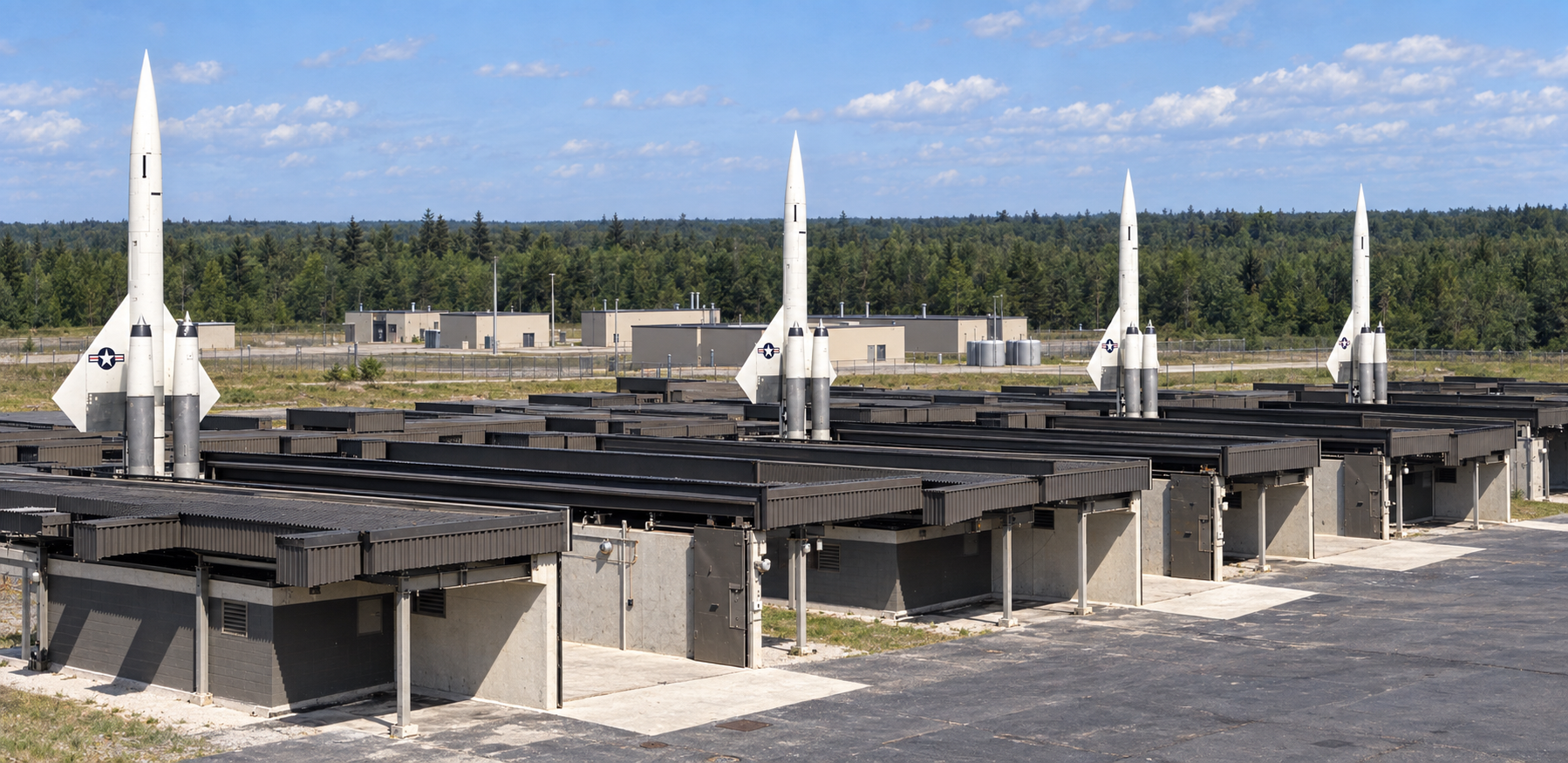
- 1945-1946 The Army Air Forces and contractors develop requirements for long-range pilotless interception that evolve into BOMARC.
- 1951-1955 Boeing-led development continues while Air Defense Command considers a large national deployment of long-range missile squadrons.
- 1955 The Air Force moves toward production while early deployment concepts envision dozens of sites and much larger inventories than the completed force.
- 1957-12-04 The Air Force publicly announces initial BOMARC sites at Dow, McGuire, Otis, and Suffolk County.
- Fiscal year 1958 Congress funds construction initiation at the first four tactical BOMARC locations, including Dow AFB.
- 1958 Bangor's annual report records BOMARC construction among the major federal and local projects changing the city.
- 1958 Site clearing and construction proceed on the tract north-northeast of Dow, with local reports naming Volpe Construction and J. R. Cianchette.
- Late 1958 Air Defense Command's proposed sequence places Dow fourth among planned United States BOMARC bases.
- 1959-01-23 The Air Force constitutes the 30th Air Defense Missile Squadron (BOMARC).
- 1959-03-01 The Bangor Air Defense Sector's SAGE direction center at Topsham becomes operational according to the commonly cited sector chronology.
- 1959-06-01 The 30th Air Defense Missile Squadron activates at Dow and is assigned to the Bangor Air Defense Sector.
- 1959-1960 Squadron personnel train, accept equipment, test communications, and prepare the 28-shelter Model A plant for alert duty.
- 1960-03-25 National decisions further reduce BOMARC deployment, leaving the eventual eight-site United States force and two Canadian sites.
- 1960-06 Official Air Defense Command chronology identifies Dow as the fourth operational BOMARC installation.
- 1960-12 A later unit-history account places the squadron's operational status in December, creating an opening-date conflict preserved in this history.
- 1960-1964 The 30th maintains IM-99A BOMARC alert under Bangor Sector and SAGE direction.
- 1961-09-19 A Santa Rosa test demonstrates remote SAGE control of a BOMARC against a Regulus II target, validating the type of end-to-end command relationship on which Dow depended.
- 1962 The tri-service designation system changes IM-99A to CIM-10A.
- 1962 The 30th receives one of the Air Force's first missile safety awards for readiness and accident-prevention performance.
- 1962-10 The Cuban Missile Crisis raises readiness across United States air-defense and strategic forces. Public sources do not provide a shelter-level Dow action log.
- 1963 Period Air Force material continues to list the A model as operational at Dow while distinguishing it from B-model sites.
- 1964 The Air Force decides to close the all-A Dow and Suffolk County BOMARC batteries as the liquid-booster force contracts.
- 1964-12-01 The 30th becomes nonoperational, beginning final mission shutdown.
- 1964-12-15 The 30th Air Defense Missile Squadron is discontinued and inactivated.
- 1964-1965 Bangor begins planning for reuse of the BOMARC installation and the larger transition of Dow Air Force Base.
- 1968 W. A. Bean and Sons establishes operations in the Bomarc Industrial Park, demonstrating early industrial reuse of the former military property.
- 1972 A regional planning source later dates formal creation of the approximately 300-acre Bomarc Industrial Park to this year.
- 1974 An early Bushmaster firearms enterprise begins work from the Bomarc Industrial Park, illustrating another phase of adaptive industrial use.
- 1985-09-19 The inactive 30th ADMS lineage is consolidated with earlier units and redesignated the 30th Tactical Missile Squadron, without reactivating the Bangor site.
- 2002 A regional economic-development plan describes Bomarc Industrial Park as about 300 acres, much larger than the more than 50-acre immediate project figure reported during construction.
- 2004-2025 Municipal assessment records document continuing subdivision, ownership changes, utilities, communications, and industrial improvements along Bomarc Road.
- 2020-05-06 Maine DEP's published remediation list assigns the BOMARC Missile Facility an investigation-stage status awaiting resources.
- 2026 Bomarc Road and Bomarc Industrial Park remain active parts of Bangor's industrial geography, while the former military shelter pattern remains visible in adaptive reuse.
Sources & References
- PDF Department of Defense, Leading the Way: The History of Air Force Civil Engineers Source for BOMARC development, missile-facility engineering, Santa Rosa design lessons, standard tactical-site components, Model A support requirements, and construction-program context.
- PDF Air Defense Command Historical Study No. 30, Interceptor Missiles in Air Defense, 1944-1964 Source for Strategic origins, changing deployment plans, Dow's construction priority, force reductions, and the operational relationship between BOMARC and continental air defense.
- PDF Air Defense Command Historical Study No. 19, A Chronology of Air Defense, 1914-1972 Source for June 1960 official Dow operational milestone, BOMARC program changes, SAGE development, and national air-defense chronology.
- PDF ADC Historical Data, 1946-1973, Aerospace Defense Command (17.67 MB) Source for 30th Air Defense Missile Squadron assignment, operational period, equipment context, and comparison with the other operational BOMARC installations.
- PDF NORAD and CONAD Historical Summary, January-June 1960 Source for Continental command context, 1960 BOMARC force growth, radar and fighter relationships, and the wider North American defense system.
- PDF Air Force Historical Division, Command and Control, 1959-1963 Source for Bangor Sector SAGE direction-center location at Topsham, regional control structure, AN/FSQ-7 context, and weapons-direction relationships.
- PDF Congressional Record, Senate, 1958 Military Construction and BOMARC Program Source for Fiscal year 1958 construction initiation at Dow and the first four sites, national construction funding, program cost debate, and the stated long-range interceptor mission.
- PDF United States Air Force, American Aerospace Events: Firsts, Lasts, and Significant Accomplishments Source for The 1957 public announcement that BOMARC facilities would be built at Dow, McGuire, Otis, and Suffolk County.
- WEB City of Bangor, Annual Report for 1958 Source for Direct contemporary confirmation that the Bangor BOMARC installation was under construction in 1958 and its relationship to local infrastructure growth.
- WEB Bangor Public Library, City of Bangor Annual Reports, 1933-1965 Source for Bangor's 1964 recognition of BOMARC and Dow deactivation, municipal transition planning, and local economic context.
- PDF Maine Department of Environmental Protection, Remediation Sites List Source for Site REM03132, Bomarc Road address, Federal Facilities program classification, 2020-05-06 status date, investigation-stage status, and institutional-control field.
- WEB Maine Department of Environmental Protection, Federal Facilities and Superfund Programs Source for State regulatory framework, federal-facility oversight, DERP and FUDS context, and limits on interpreting program status.
- WEB U.S. Army Corps of Engineers, Formerly Used Defense Sites Inventory and Program Source for Current FUDS program purpose, property and project distinctions, investigation process, and the warning that program presence does not prove contamination.
- WEB U.S. Army Corps of Engineers, FUDS GIS Reference Sheet Source for Coordinate qualification, distinction between general reference points and exact property boundaries, and current federal geospatial terminology.
- WEB City of Bangor, Fiscal Year 2026 Real Estate Tax Commitment Book Source for Current Bomarc Road parcelization, private ownership, assessed improvements, industrial use, and the reason no single present owner or acreage is assigned.
- WEB City of Bangor, Fiscal Year 2025 Counter Book by Map and Lot Source for Bomarc Road addresses, Bangor Water District and communications parcels, acreage examples, and current fragmented property control.
- WEB City of Bangor Code, Off-Premises Signs and Industrial Parks Source for Current municipal recognition of Bomarc Industrial Park as an industrial or commercial park.
- WEB City of Bangor, Heavy Load Street Posting Source for Current road-network evidence for Burleigh Road at Bomarc Road and active industrial transportation context in 2026.
- PDF Air Force Magazine, Gallery of USAF Weapons, April 1962 Source for Period BOMARC A dimensions and performance, liquid booster, ramjets, SAGE-linked command guidance, terminal homing, warhead alternatives, and operational listing at Dow.
- PDF Air Force Magazine, Missile Safety Awards, July 1962 Source for The 30th Air Defense Missile Squadron's selection for an early Air Force missile safety award and the operational meaning of that recognition.
- WEB Royal Canadian Air Force Journal, Secrets of the BOMARC, Part 2 Source for W40 maintenance context, protected warhead-maintenance facilities, shelter and custody practices, and comparison across United States and Canadian operational sites.
- WEB Association of Air Force Missileers, BOMARC Source for Operational-site and squadron roster, distinction between A and B units, and Dow's place in the completed BOMARC force.
- PDF 30th Tactical Missile Squadron Unit History Compilation Source for Squadron constitution and activation, stated mission, Bangor Air Defense Sector assignment, 1964 inactivation, later consolidation, and alternative December 1960 operational date.
- WEB FortWiki, Dow AFB BOMARC Missile Site Source for Site plan, coordinate comparison, 28-shelter layout, reported support-building inventory, all-A-model status, survival observations, and separation of the Glenburn GAT.
- WEB Radomes.org, Dow AFB BOMARC Site Source for Specialist site identification, representative coordinate, operational dates, photographs, and comparison with other BOMARC installations.
- PDF Orrington Strategic Economic Development Plan, Bangor Area Business Parks Source for Later description of Bomarc Industrial Park as approximately 300 acres, its 1972 creation date, and warning that the park figure is not a verified original military acreage.
- WEB Bangor Daily News, Bangor Company's Red Snapper Hot Dogs Are a Beloved Taste of Maine Source for W. A. Bean and Sons operation in Bomarc Industrial Park since 1968 and long-term adaptive industrial reuse.
- WEB Bangor Daily News, Bangor-Area Firearms Inventor Remembered Source for Documented 1974 Bushmaster activity in Bomarc Industrial Park and post-military industrial history.