
Suffolk County Air Force Base BOMARC Missile Annex, Westhampton New York
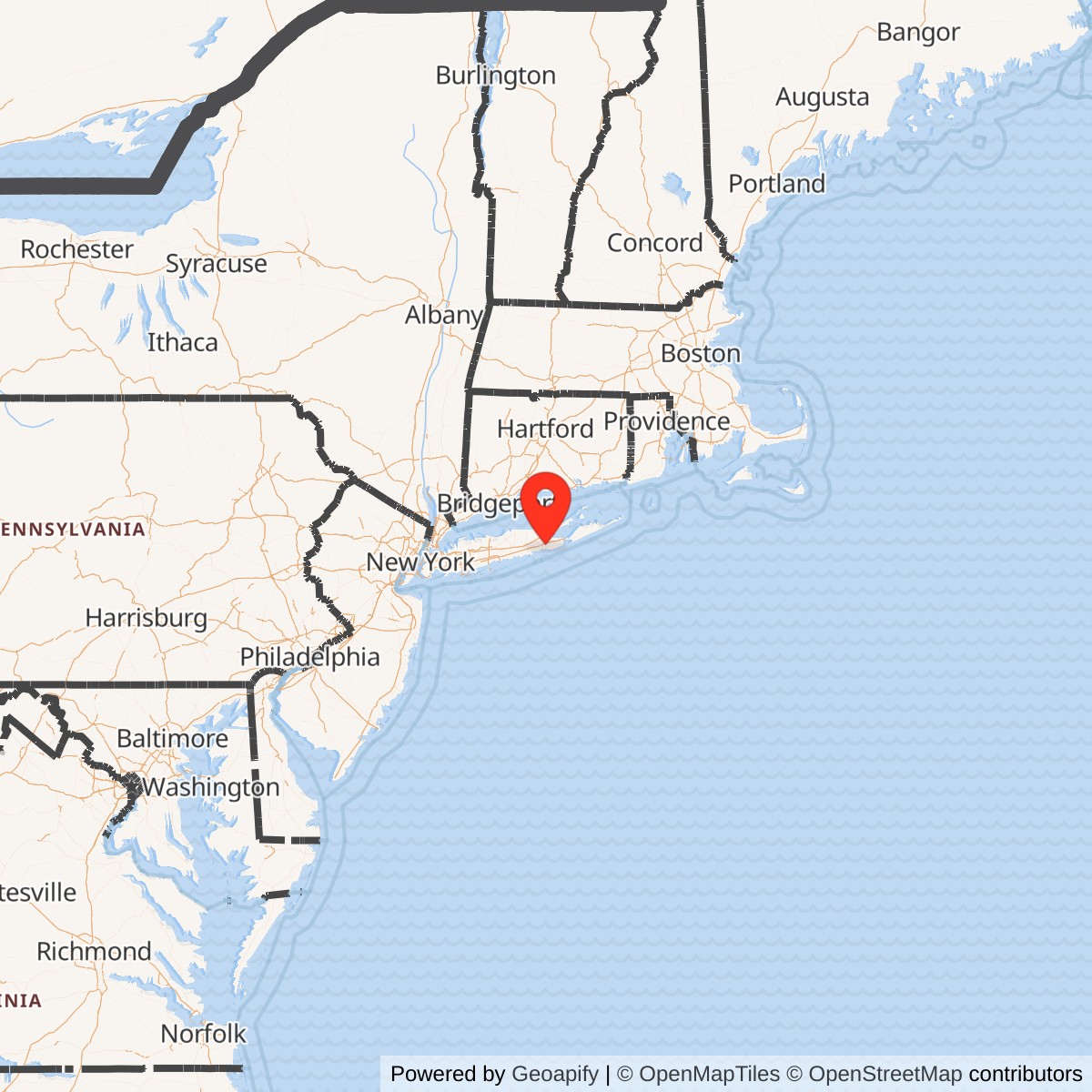
Longitude: -72.681525
Site Number: 6th ADMS; IM-99A; CIM-10A; NYSDEC 152262
Official Base Website: Former Westhampton BOMARC Missile Base / Suffolk County Records and Public Safety Complex
Current Role: Suffolk County Records Management Center in the former missile assembly warehouse; Sheriff and police training functions; police firing range; vehicle impound and storage; emergency vehicle operations and responder training; other controlled county uses. Fifty-six former launcher shelters remain documented. PFAS groundwater investigation, targeted PCB remediation, and public-water response continue.
The Suffolk County Air Force Base BOMARC Missile Annex was a separate Air Defense Command missile installation at 100 Old Country Road in Westhampton, about three miles southwest of the parent air base. It was built during the most ambitious phase of the United States continental air-defense program and operated the liquid-fueled IM-99A, later redesignated CIM-10A, BOMARC interceptor missile. The 6th Air Defense Missile Squadron activated on 1959-02-01, became operational on 1959-12-01, and remained the site's operating organization until its inactivation on 1964-12-15. Its mission was to intercept formations of hostile bombers approaching the New York metropolitan region and the Atlantic approaches before those aircraft could reach their targets.
The annex was neither an ordinary antiaircraft gun position nor a ballistic-missile base. BOMARC was a ground-launched, pilotless interceptor aircraft. A rocket booster accelerated it vertically from an above-ground shelter, two ramjet engines sustained its high-speed flight, the Semi-Automatic Ground Environment, or SAGE, system supplied midcourse guidance, and the missile's own radar supported the terminal attack. At Westhampton, 56 reinforced-concrete launcher shelters formed the visible heart of the installation. Supporting them were missile assembly and maintenance spaces, propellant facilities, compressor buildings, utilities, security features, roads, and operating areas designed around the demanding BOMARC A.
The weapon was nuclear-capable, and official county and state accounts state that the Westhampton missiles carried approximately 10-kiloton fusion-boosted fission warheads. The warheads used tritium, a limited-life material that required scheduled maintenance about every 90 days. That nuclear role shaped security, technical handling, emergency planning, and the separation between the launch annex and ordinary public activity. It also makes the surviving site one of Long Island's most consequential Cold War landscapes.
After decommissioning, the federal property passed to Suffolk County. The county adapted the complex for records storage, law-enforcement training, vehicle storage and impound functions, emergency-vehicle training, and other public purposes. The former missile assembly warehouse became the Suffolk County Records Management Center, while the distinctive rows of launcher shelters remained standing. Environmental investigations beginning in the late 2010s identified PFAS in groundwater and PCBs and other contaminants in selected site features. By 2025, the record included off-site groundwater work, an interim-remedial program, a PCB cleanup plan, and a planned public-water extension for nearby private-well users.
The annex as a distinct installation. It is related to, but must not be merged with, Suffolk County Air Force Base and its present Gabreski Airport and Air National Guard successor; the much larger World War II Suffolk County Army Air Field Bombing and Gunnery Range; the later Riverhead Joint Surveillance System radar site; or the New York Air Defense Sector direction center at McGuire Air Force Base. Each had a different physical footprint, operating purpose, and historical chronology.
Installation Identity, Location, and Boundaries
The installation's formal name is Suffolk County Air Force Base BOMARC Missile Annex. Contemporary and later records also call it the Suffolk County AFB Missile Annex, Suffolk County Missile Annex, Suffolk BOMARC Base, Westhampton BOMARC Missile Base, Westhampton BOMARC Base, and the former BOMARC site. The environmental program identifies it as New York State site 152262. The common name BOMARC combines Boeing with MARC, the Michigan Aeronautical Research Center, although later sources sometimes expand the final element as Michigan Aerospace Research Center. The period name was tied to the weapon system, not to an independent Michigan institution operating in Westhampton.The property lies north of Old Country Road and west of Old Westhampton Road in the hamlet of Westhampton, Town of Southampton. A 2022 interim-remedial work plan and the 2025 PCB cleanup plan identify the site as approximately 186 acres and list Suffolk County tax map 0900-331.00-01.00, lot 001.100 and lots 002.000 through 015.000. The same documents describe undeveloped pine barrens on the north, commercial and industrial land on the east, Old Country Road on the south, and newer residential development on the west. The 2020 county investigation described approximately 90 developed acres, which is compatible with, but not equivalent to, the 186-acre property total.
The annex was physically and administratively separate from Suffolk County Air Force Base. Squadron command, administrative, and logistical elements depended on the parent base, while the weapons, launch shelters, specialized propellant systems, and operating plant occupied the Old Country Road tract. The separation reduced the hazards and land demands of the missile battery at the active airfield while keeping the site close enough for personnel, supply, transportation, and emergency support.
Strategic Origins of BOMARC
The BOMARC program grew from the early Cold War expectation that long-range Soviet bombers posed the principal direct threat to the continental United States. Before intercontinental ballistic missiles became the dominant strategic concern, defense planners sought a layered network of radars, command centers, manned interceptors, Army Nike batteries, antiaircraft weapons, and long-range guided missiles. BOMARC was intended to engage bombers at greater distance than local point-defense weapons and to operate as part of a computer-directed continental system rather than as an isolated battery.Development began in the postwar period. The Air Force's official civil-engineering history states that design began in 1946 and production was ordered in 1955. Testing and training took place through the Eglin Air Force Base range system in Florida, including facilities on Santa Rosa Island. Operational stations were not permitted to conduct routine live missile firings, so the test range carried the burden of proving missiles, launch equipment, guidance, and training procedures. Lessons from the Eglin suitability-test and training facility informed the standard designs adapted for the first tactical sites.
The Joint Chiefs of Staff approved five prospective BOMARC locations in February 1957, including Suffolk. By the 1958 military-construction cycle, work was underway at McGuire, Suffolk County, Otis, and Dow. Congress was told that BOMARC was a supersonic, high-altitude, long-range interceptor guided by advanced electronics and intended to destroy attacking aircraft farther from defended targets than existing missiles could reach. At that moment, Air Force planning imagined a much larger force, but costs, technical difficulties, and changing strategic priorities soon reduced the program.
The official construction history describes BOMARC as the first large missile system critically dependent on a complex set of military-construction facilities. The Air Force, Army Corps of Engineers, and weapon-system contractor had to coordinate missile design with shelters, fueling plant, environmental controls, handling equipment, power, communications, and safety separations. Their compatibility problems anticipated later difficulties on the Atlas and Titan programs. Westhampton therefore represented more than a row of launchers. It was an early integrated weapon-system installation in which the building, machinery, missile, computer network, and operating organization had to function as one system.
Site Selection and Construction
Town historical sources state that the Air Force purchased approximately 186 acres north of Old Country Road that had previously been associated with Strebel's Dairy Farm. County environmental records date construction to 1957. These dates fit the national program: Suffolk was among the first approved tactical locations, and the initial four sites were funded and under construction before the weapon reached regular alert service.The Westhampton location placed the missile force east of New York City and close to likely Atlantic approach routes. It also connected naturally with the existing Suffolk County Air Force Base interceptor establishment. The 52nd Fighter Group and its fighter-interceptor squadrons operated from the airfield, while the region's radar stations and SAGE direction center supplied the detection and control structure. BOMARC added a long-range unmanned interceptor to that network. It did not replace every fighter or Army missile; it supplied another engagement option within a layered defense.
Construction required a level, road-connected tract large enough for separated shelters and hazardous support facilities. The Model A's liquid systems imposed unusual requirements. Official Air Force construction history lists chilled-water generation and distribution; storage and dispensing for inhibited red fuming nitric acid; fuel installations for JP-X, 80-octane gasoline, and aniline furfuryl alcohol; a decontamination facility; and one or two gas-compressor buildings. The site also needed a missile assembly or air-munitions building, utilities, maintenance shops, administrative spaces, security control, paved circulation, and the communication links that tied it to SAGE.
The launcher shelters were above-ground structures, not underground silos. Their massive reinforced-concrete longitudinal walls carried a hydraulically operated rolling roof formed by two cantilevered planes. Tight seals and environmental control protected the BOMARC A and its equipment. During launch preparation the roof opened, the missile was raised to the vertical position, and the booster fired from the shelter's launcher mechanism. The surviving shelter rows still make the military plan legible decades after the missiles and specialized operating equipment disappeared.
The 6th Air Defense Missile Squadron
Air Defense Command activated the 6th Air Defense Missile Squadron at Suffolk County Air Force Base on 1959-02-01. The designation did not mean that two 28-missile squadrons occupied Westhampton. The strongest official and state evidence supports one squadron operating 56 launcher shelters, arranged as two 28-shelter groups or flights. Later summaries that refer to two 28-missile squadrons confuse the physical subdivision with the unit organization.The 6th became operational on 1959-12-01, making Suffolk the second operational BOMARC station after the 46th Air Defense Missile Squadron at McGuire. The NORAD and CONAD history records that only four Suffolk missiles were available for air defense on 1960-01-01. Operational status therefore did not mean that all 56 shelters were immediately filled with fully accepted weapons. The battery grew into its authorized configuration as missiles, equipment, crews, and support capability arrived and passed acceptance.
The squadron belonged to the New York Air Defense Sector. The sector's SAGE direction center was at McGuire Air Force Base, New Jersey, and official county planning material describes the Westhampton launch-control relationship with McGuire. The Air Force historical lineage for the present Eastern Air Defense Sector lists the 6th as a component from 1959-02-01 through 1964-12-15. This command evidence outweighs a later New York State Military Museum page that associates Suffolk guidance with Stewart Air Force Base and gives a 1969 deactivation date.
The unit required operators, missile-maintenance specialists, propulsion and fuel technicians, electronics and guidance personnel, munitions and warhead personnel, security police, utilities staff, vehicle operators, supply personnel, firefighters, administrators, and contractor representatives. Surviving public sources do not provide a reliable month-by-month strength roster for Westhampton. The documentary record does indicate a close Air Force and contractor relationship. Boeing support was associated with the Suffolk program, and secondary site histories place a company support office in the Riverhead area north of the annex.
Physical Plan and the 56-Shelter Launch Area
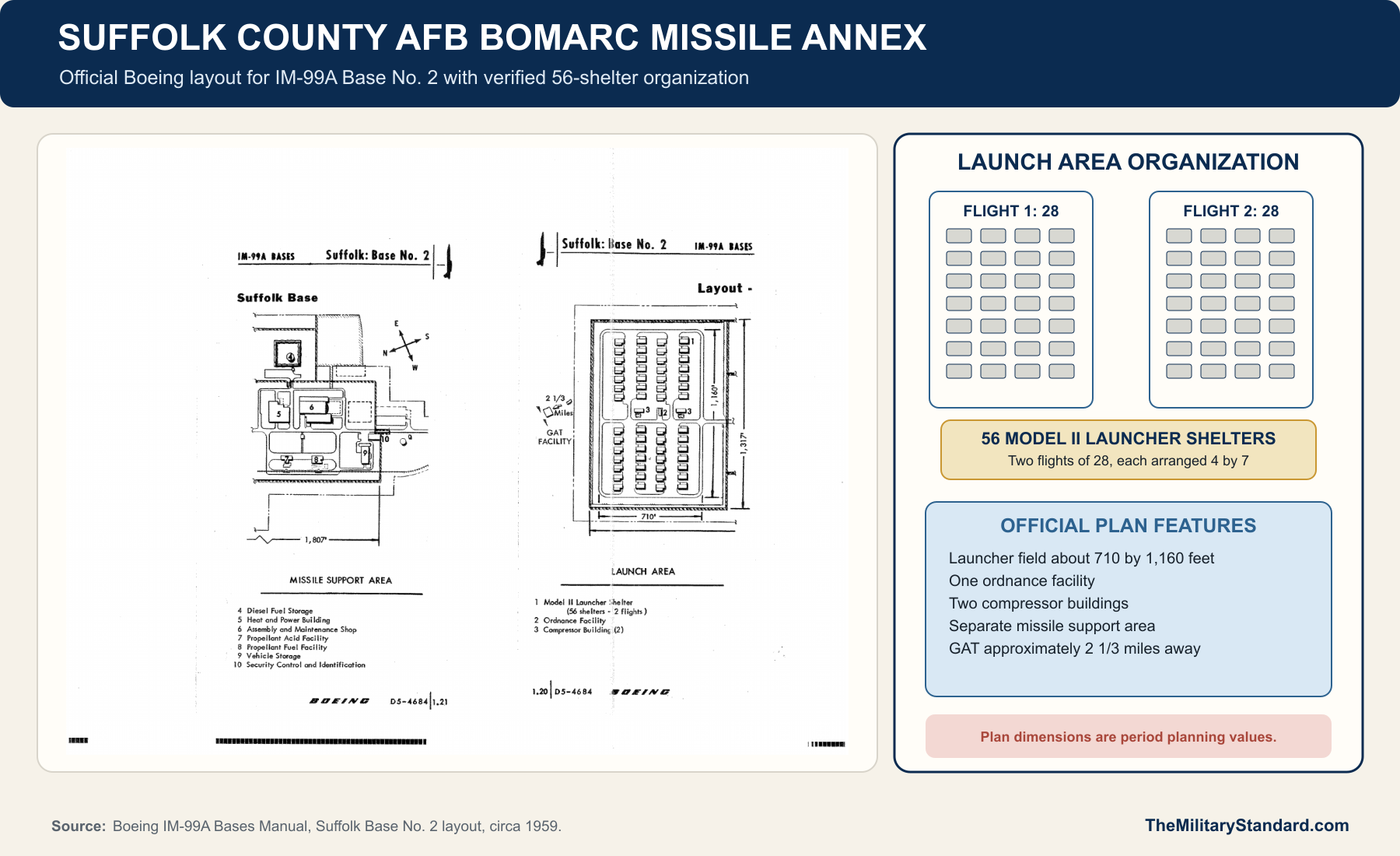
Each launcher shelter combined storage, environmental protection, and launch preparation. The missile rested horizontally on its launching equipment. The rolling roof opened before elevation. The structure had to carry the loads imposed by the moving roof and launcher while resisting weather and protecting sensitive equipment. Because the BOMARC A used liquid systems, temperature control and tight seals mattered more than they would at the simpler solid-fueled BOMARC B shelters.
The missile support area contained the functions that could not be performed safely or efficiently in each launcher. A missile moved between the shelter and maintenance spaces for scheduled inspection, component replacement, warhead work under controlled procedures, defueling, purging, decontamination, and return to alert. Specialized vehicles and handling equipment linked the launch rows to the assembly and maintenance building. Separate fuel and oxidizer facilities reduced incompatible-material hazards. Compressor and helium systems supported readiness, while chilled-water and electrical plant maintained the controlled environment.
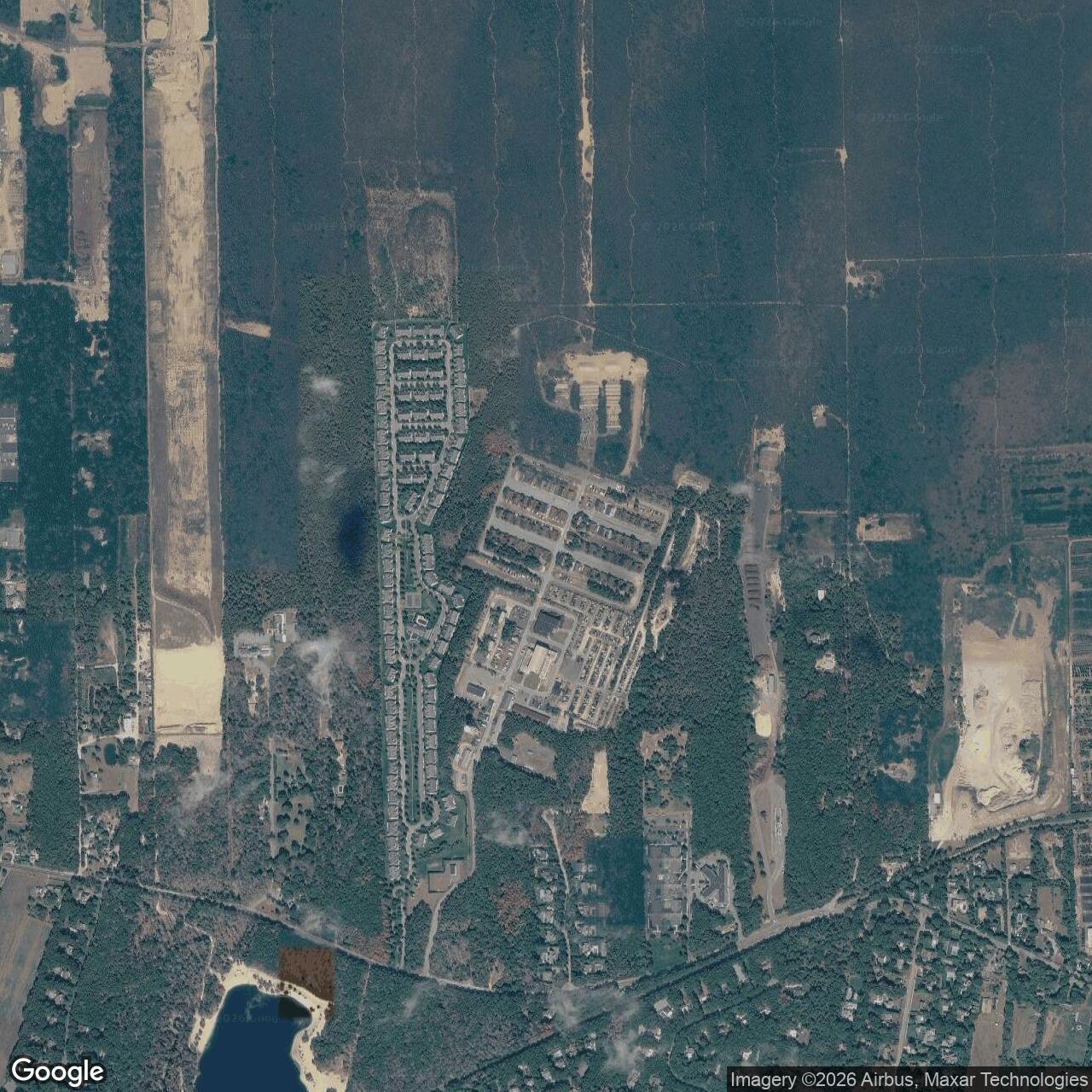
The environmental record helps reconstruct the later site even where military drawings are not readily accessible. It identifies the 186-acre tract, 56 former missile structures, large paved areas, later county buildings, a police firing range, drainage and septic features, former fireworks burn areas, and vehicle-storage zones. The continued survival of all 56 shelter structures in state documents from 2019 through the 2025 cleanup planning record makes Westhampton one of the clearest surviving American BOMARC landscapes.
The BOMARC A Weapon
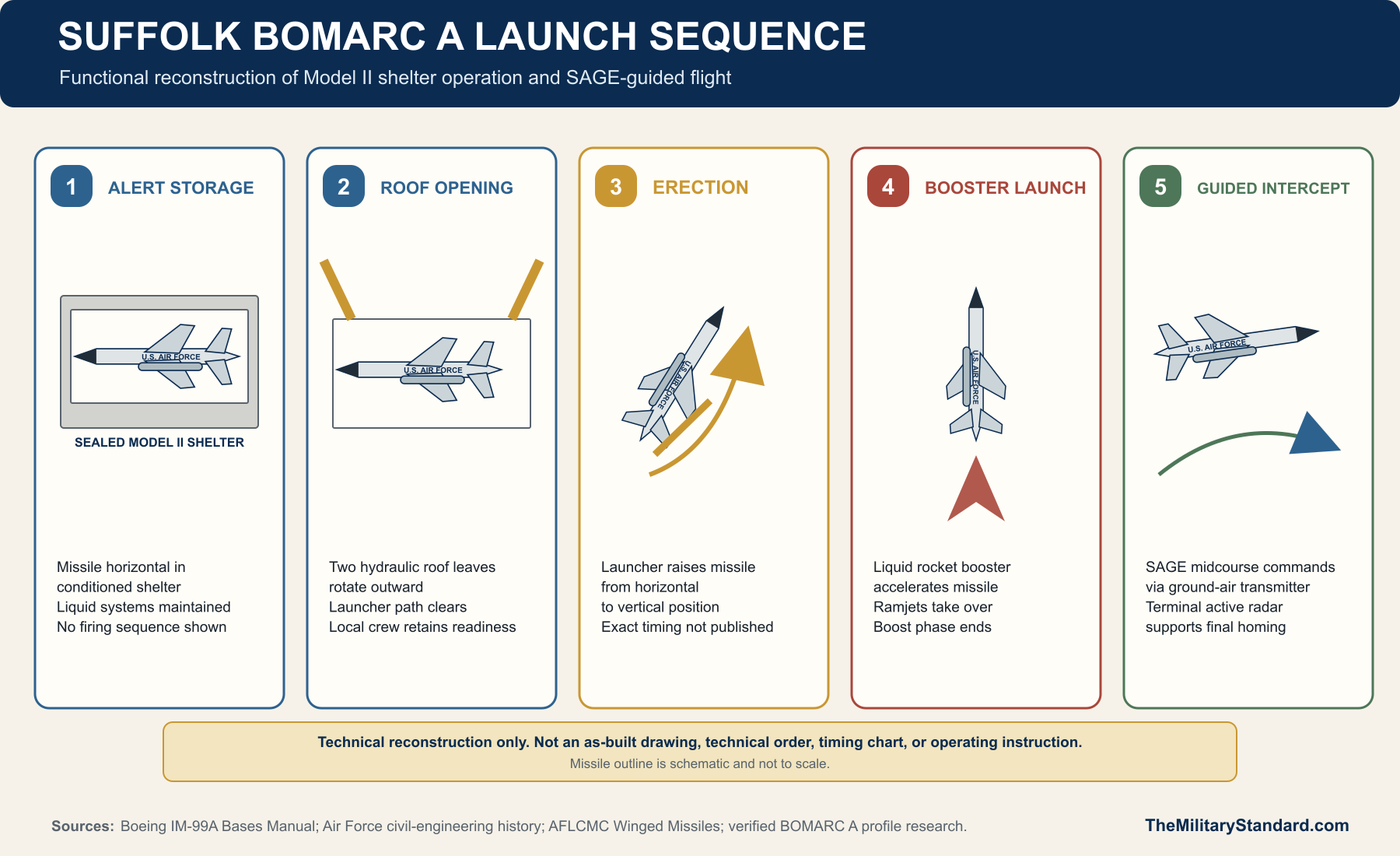
The Model A was approximately 45 to 46 feet long, with an approximately 18-foot wingspan. A liquid-propellant booster provided the vertical launch acceleration. After the booster phase, two Marquardt ramjet engines sustained supersonic flight. Ground commands controlled the missile through most of the interception, and an onboard Westinghouse active radar acquired the target during the terminal phase. An official Tinker Air Force Base history states that terminal acquisition occurred at roughly the final ten miles, a useful general figure rather than a Suffolk-specific performance record.
Published range and speed figures vary with model, profile, and source. A New York military-history summary gives a 230-mile range for the A model. Because operational envelopes were sensitive to altitude, engagement geometry, readiness condition, and guidance coverage, that number should be treated as an approximate family capability, not a guaranteed radius drawn around Westhampton. No missile was routinely fired from the operational site; live training and testing occurred at designated ranges.
The missile's active-homing radar was a major technical feature. SAGE did not simply point the launcher in a direction and leave the missile unaided. Radar tracks were processed at the direction center, an engagement was assigned, and commands steered the missile during the long midcourse segment. Near the target, the onboard seeker took over the final intercept. The combination of distributed sensors, digital computation, communication links, command logic, ground-to-air data transmission, and terminal radar made the weapon an early networked combat system.
Nuclear Warhead and Custody
Official Suffolk County, New York State, and Air Force public histories describe the Westhampton BOMARCs as nuclear-tipped. They report an approximately 10-kiloton warhead; one official Air Force article gives the BOMARC nuclear yield range more generally as about 7 to 10 kilotons. County environmental material describes the weapon as fusion-boosted fission and notes the use of tritium. The specific warhead model is commonly identified in secondary technical literature, but the reviewed Suffolk-specific official sources do not need that model name to establish the nuclear mission.Tritium decays and must be replenished on a controlled schedule. County records state that the Westhampton warheads required maintenance every 90 days. That requirement generated recurring secure movements and specialized work rather than a static condition in which a sealed weapon remained untouched for years. Warhead accountability, restricted access, explosive-safety separation, radiation controls, and coordination with higher headquarters formed part of the site's operating burden.
Publicly available sources do not supply a complete Suffolk-specific custody history, a roster of munitions personnel, serial numbers, a warhead-storage building inventory, or movement logs. They also do not establish that every shelter contained a nuclear-armed operational missile on every day between 1959 and 1964. The safest conclusion is that the squadron was a nuclear-capable alert organization whose authorized 56-shelter complex supported nuclear-armed BOMARC A missiles, subject to maintenance, acceptance, inspection, and availability cycles.
Liquid Propellant, Utilities, and Safety
The BOMARC A's booster and auxiliary systems made Westhampton far more complex than a dry-storage missile park. Inhibited red fuming nitric acid was a highly corrosive oxidizer. Aniline furfuryl alcohol, JP-X, and gasoline created toxic and flammable hazards. High-pressure helium had to be tightly controlled. Chilled water, conditioned shelter environments, electrical power, hydraulics, compressed gases, pumps, piping, valves, and monitoring equipment were all essential to readiness.Maintenance involved more than testing electronics. Personnel had to inspect tanks and plumbing, control leaks, transfer hazardous liquids, maintain environmental seals, service launcher hydraulics, and decontaminate equipment. The Air Force's construction history calls the Model A liquid facilities extremely troublesome. That judgment helps explain both the staffing burden and the attraction of the solid-fueled BOMARC B, whose simpler shelters omitted much of the Model A environmental and liquid-fuel plant.
The 1960 fire at the separate McGuire BOMARC site demonstrated the consequences of the Model A hazard combination. A high-pressure helium failure was associated with rupture of fuel tanks, a prolonged fire, and plutonium contamination from a nuclear warhead. Official Air Force records describe it as the weapon system's only major accident. There is no evidence of a comparable missile accident at Westhampton, and the McGuire event must not be misassigned to Suffolk. It is relevant because the two sites operated the same A model in the same regional command network and because it illustrates why Westhampton needed trained firefighters, emergency procedures, exclusion controls, and disciplined handling.
SAGE Command, Control, and the Engagement Sequence
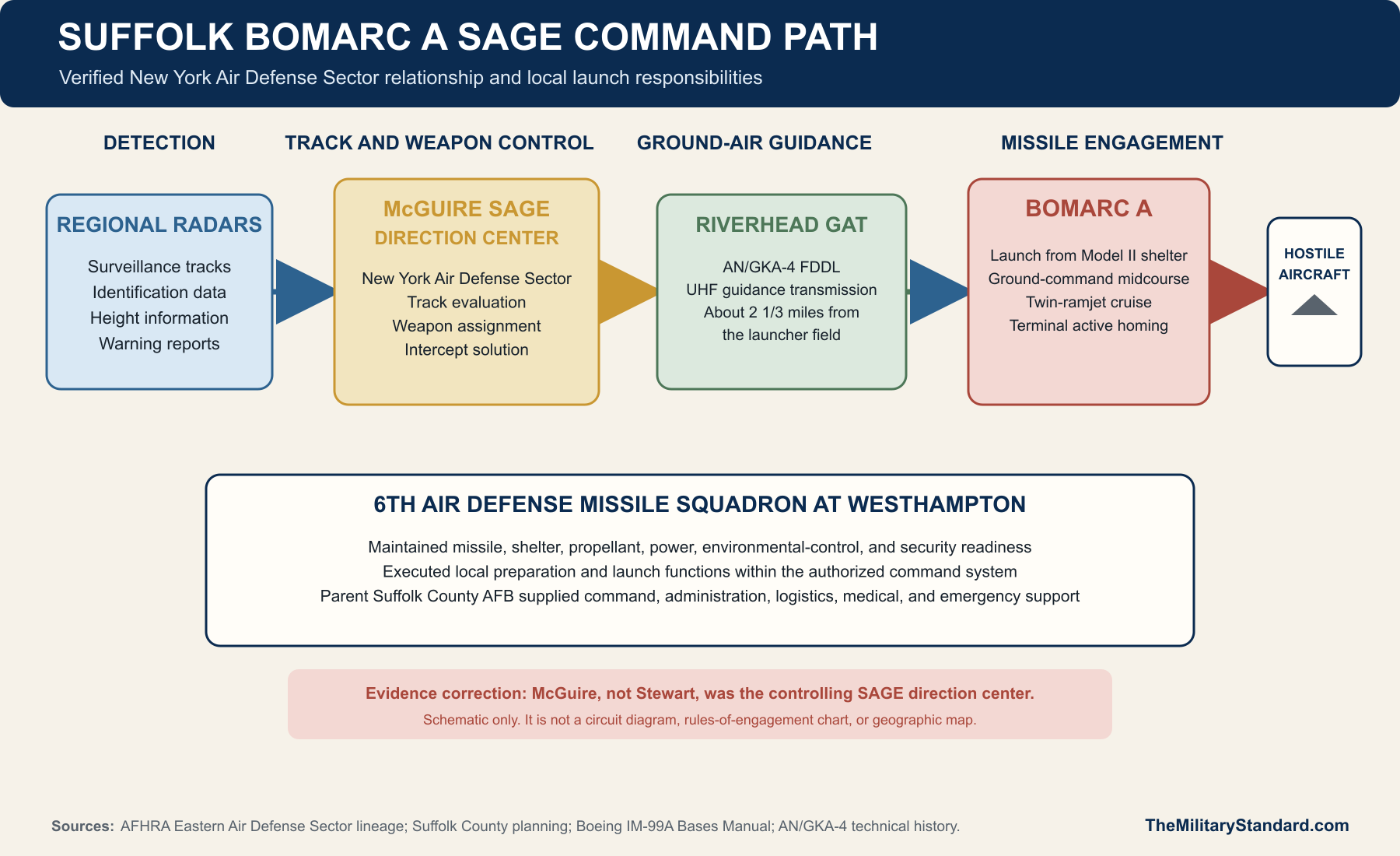
In a notional alert sequence, surveillance radars detected an aircraft, the network correlated the track, controllers evaluated identity and threat, and the direction center assigned the weapon. At Westhampton, a selected missile moved from its protected readiness condition through final preparation. Shelter roof and launcher systems positioned it vertically. After launch, the booster accelerated the missile until ramjet flight could be established. Ground commands guided it toward the computed intercept. The onboard seeker then acquired the target and supported terminal homing.
An Air Force demonstration on 1961-09-19 proved that SAGE could control a BOMARC through launch and interception. This was essential because the system's value depended on end-to-end integration, not only missile aerodynamics. Westhampton's mission therefore relied on many installations beyond its fence: radar stations along the approaches, communication circuits and ground-to-air transmitters, the McGuire direction center, warning and identification agencies, the parent air base, contractor and depot support, test ranges, and national command arrangements.
Secondary histories identify a ground-air communications property in the Riverhead area associated with the Suffolk BOMARC mission, about two and one-third miles from the launcher area, and a Boeing support presence farther north. The later Riverhead Joint Surveillance System radar site occupies land with a documented earlier air-defense communications association. The precise BOMARC-era equipment list, ownership boundary, activation date, and whether every later Riverhead parcel overlapped the earlier communications tract remain unresolved. Because the known later Riverhead JSS row already preserves that site succession, the present research does not create a second speculative installation identity.
Operations, Alert, and Maintenance
The phrase operational on 1959-12-01 marked acceptance of an air-defense role, but the 1959 NORAD history shows a gradual buildup. Four missiles were available at Suffolk on 1960-01-01. As deliveries and acceptance continued, the 56-shelter plant became a full battery. Readiness was not a single permanent state. Missiles moved through inspection, maintenance, fueling, warhead servicing, standby, and ready conditions, with equipment availability determining how many could respond at a given moment.Alert work demanded exact procedures. Operators monitored system status and communications. Maintenance crews kept propulsion, hydraulic, power, environmental, and electronic systems within tolerance. Munitions personnel handled the warhead mission. Security personnel protected a dispersed nuclear-capable area. Firefighters and emergency responders trained for propellant, explosive, and radiological hazards. Vehicle and supply functions linked the remote annex to the parent base and to off-site support.
The facility's physical division encouraged specialized work centers. Launcher crews focused on shelters and preparation. Missile shops handled deeper inspections and component replacement. Utility personnel supported compressors, electrical generation or distribution, chilled water, and environmental conditioning. Communications and electronics specialists sustained the SAGE data path and local command equipment. The site's readiness depended on all of them; a serviceable missile could not compensate for a failed roof, launcher, compressor, data link, or direction-center circuit.
No authoritative public source provides Suffolk's exact alert crew size, shift pattern, monthly missile availability, exercise calendar, or inspection failure rate. The installation was continuously prepared for a mission it never had to execute in combat, and routine competence left fewer public traces than an accident or launch would have produced.
Daily Work, Security, and Community Setting
Westhampton's crew worked in an unusual combination of industrial plant, missile battery, computer-controlled weapon station, and nuclear site. Daily activity included technical inspections, fueling-system control, leak checks, environmental monitoring, electrical and hydraulic maintenance, communications tests, inventory, security patrols, housekeeping in shelters and shops, and recurring proficiency training. Much of this work was preventive because dormant equipment still had to launch without warning.The parent base offered administrative offices, medical services, billeting, dining, supply channels, transportation, and broader emergency support. The annex's few-mile separation meant that many personnel experienced both places as parts of one duty assignment even though the sites require separate historical identities. Contractor engineers and field representatives supplied knowledge that the young Air Force missile organization did not yet fully possess.
The tract stood in a rural and pine-barrens setting that was nevertheless close to farms, hamlets, roads, and expanding Long Island communities. Security had to control access without eliminating ordinary life around the property. The later growth of residential and commercial uses along the site boundaries increased the significance of deed restrictions, environmental monitoring, groundwater flow, and public communication.
Relationship to Suffolk County Air Force Base and Regional Defense
Suffolk County Air Force Base supported manned interceptor squadrons while the missile annex housed the 6th. The two capabilities were complementary. Fighters could investigate, identify, shadow, or engage aircraft and could be redirected after launch. BOMARC offered fast, long-range interception against bomber formations but depended heavily on fixed infrastructure and SAGE. The parent base supplied the annex administratively and logistically, yet the launcher property had its own hazards, mission plant, and security requirements.The New York Air Defense Sector integrated the wider region. Its radar inputs included stations on Long Island and throughout the Northeast. McGuire's direction center provided the computer and controller node associated with Suffolk's missile launch-control relationship. Army Nike installations defended selected metropolitan and military targets at shorter range. Offshore Texas Tower radars and coastal stations extended warning over the Atlantic. The value of the Suffolk BOMARC battery came from its position inside this network, not from independent detection at the launcher area.
This networked identity also prevents several common errors. The Westhampton annex was not the McGuire direction center. It was not Montauk Air Force Station, Riverhead JSS, or an Army Nike battery. It was not located on the Gabreski flight line. Its missiles did not routinely patrol the air like fighters or leave their shelters except for training and maintenance. The annex was a remotely directed, fixed alert battery supported by the air base and connected to a continental command system.
Program Reduction and Rack up
BOMARC entered service while the strategic threat was changing. Intercontinental ballistic missiles shortened warning times and could not be intercepted by a weapon designed for aircraft. At the same time, BOMARC costs, technical burdens, SAGE expenses, and competition with manned interceptors and Army missiles forced repeated program reviews. The original objective of 36 U.S. sites with 2,772 launchers collapsed to a much smaller force. By mid-1962 the operational BOMARC force comprised nine squadrons, with only two all-A organizations and the rest B or mixed units.The A model was particularly vulnerable to budget pressure because its liquid systems were costly and labor intensive. In 1963, NORAD learned that fiscal 1965 operating funds for BOMARC A would fall from $8.3 million to $3.5 million, enough for roughly six months. NORAD proposed closing Langley, McGuire, and Otis A forces in the first quarter of fiscal 1965, followed by Dow and Suffolk in the second quarter.
Air Defense Command's plan, nicknamed Rack Up, avoided an abrupt shutdown. Missiles were to leave alert as they came due for inspection, at approximately ten per month across the affected force. This preserved some capability during withdrawal and prevented a surge of maintenance and supply work on weapons destined for retirement. The plan explains why different sources can describe an operating period, a phased removal, and a final unit inactivation without all using the same date.
1964-12-15 is the controlling close date because it is the official inactivation date of the 6th Air Defense Missile Squadron. County and state sources also describe military operation as 1959 through 1964. The 1963 Rack Up proposal used fiscal-year quarters and may have anticipated activity into early calendar 1965, but the reviewed evidence does not establish a Westhampton operational squadron after 1964-12-15. A secondary page's 1969 deactivation date appears to conflate the later closure of Suffolk County Air Force Base with the earlier missile-annex shutdown.
Inactivation, Disposition, and Property Transfer
As missiles left alert, crews had to remove warheads, drain or neutralize hazardous systems, ship missiles and reusable equipment, secure classified components, and place facilities in a safe inactive condition. Exact Suffolk shelter-by-shelter withdrawal dates and destination records were not located. Nationally, retired BOMARCs were used in test and target programs, but no specific Westhampton missile is traced here without serial-number evidence.The annex did not disappear when the squadron inactivated. The reinforced shelters, paved circulation, warehouse and shop buildings, utilities, drainage, and fences represented a large federal investment. The property was transferred to Suffolk County after decommissioning. Local historical material sometimes dates the transfer or broader base turnover to 1969 or 1970, but the reviewed sources do not provide a deed date for the annex comparable to the 1972 quitclaim documentation for the main airfield. Title-chain research remains necessary before assigning an exact annex transfer date.
County reuse was practical because the structures were strong, separated, and connected by roads. The former missile assembly warehouse became a records facility. Launcher shelters and paved areas served storage, vehicle, training, and public-safety needs. Reuse preserved the site's plan but also overlaid military-era features with police firing, emergency driving, vehicle-fire storage, fireworks disposal, drainage, septic, and other post-military activities. That mixed-use history is essential when evaluating contamination sources.
County Reuse and Surviving Structures
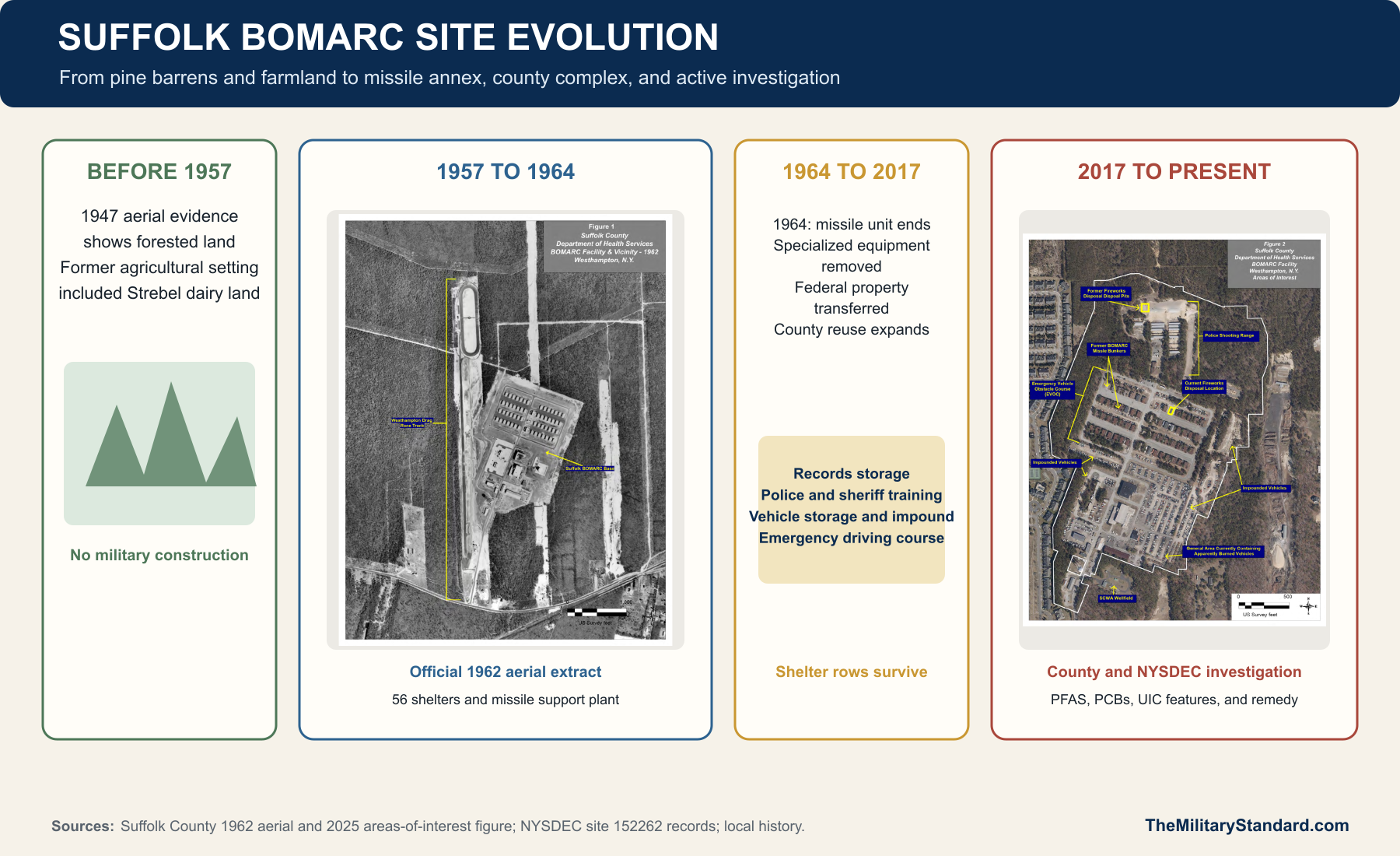
The 56 launcher shelters remained on the property in 2019 and are still included in the 2025 cleanup-plan description. Their survival does not mean that launch equipment, missiles, nuclear material, or operating electronics remain. The military character resides in the massing, rows, reinforced walls, roof forms, and relation to support spaces. Some shelters have been adapted or assigned to county agencies; others may be used for storage or remain unassigned. Current individual-building use requires county confirmation.
Environmental Investigation
In December 2019, the New York State Department of Environmental Conservation listed the property as a potential inactive hazardous waste disposal site under code 152262. The state report assigned classification P, identified county ownership, estimated 186 acres, and described 56 original missile structures. Groundwater was approximately 30 to 35 feet below grade in the preliminary record and generally moved south. The deeper aquifer is interconnected with the overburden and is part of an EPA-designated sole-source aquifer, making migration and drinking-water protection central issues.
The 2020 county report documented PFOS and PFOA in onsite groundwater above later New York drinking-water limits in some locations, along with detections in an upgradient well and near property boundaries that suggested more than one source. Soil sampling found PCBs in selected areas. The site history also identified post-military activities capable of affecting results, including the firing range, vehicle storage and vehicles involved in fires, drainage and septic systems, and fireworks disposal or burn features.
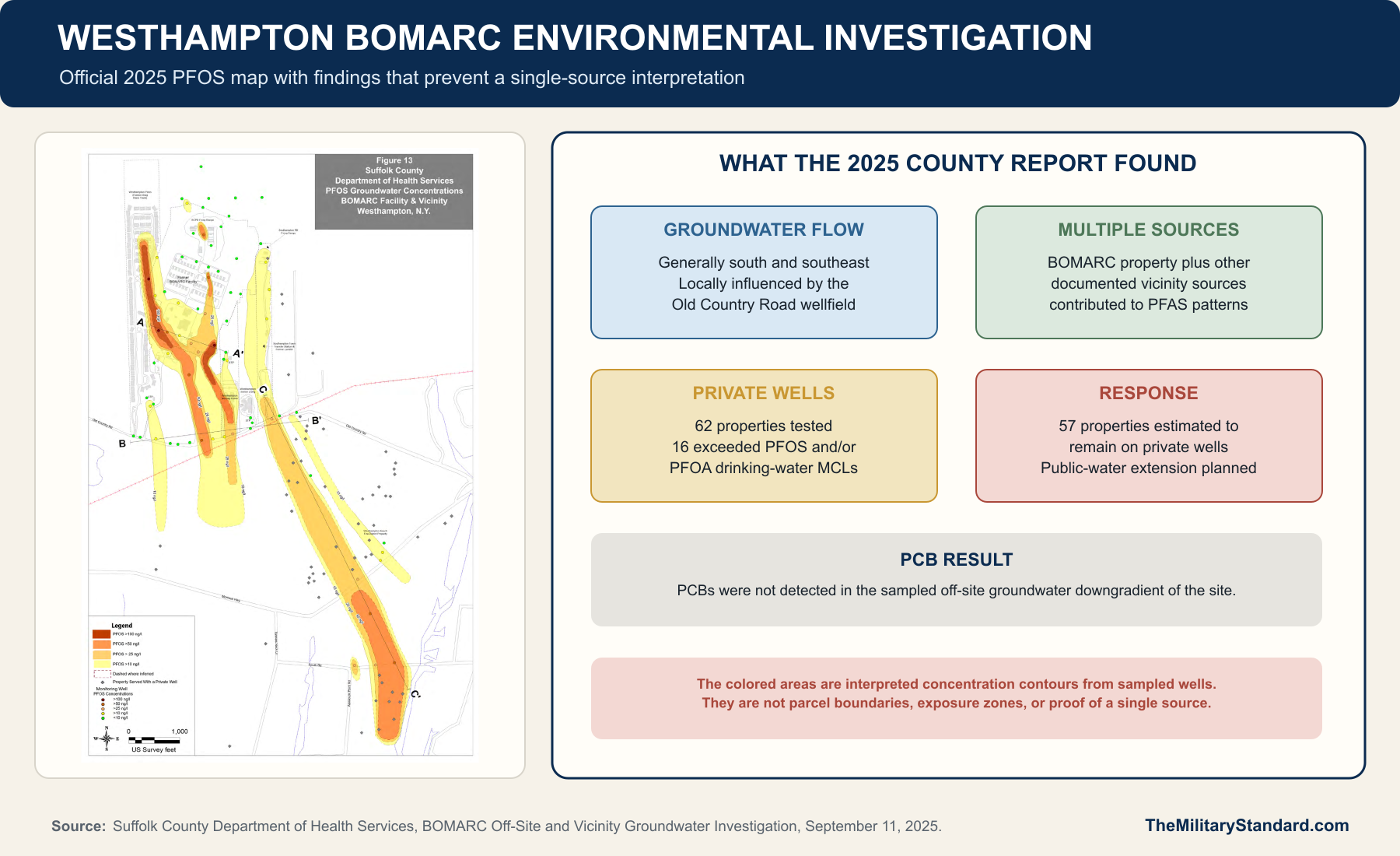
The environmental investigation installed 28 profile wells in its initial phase and evaluated private wells in the surrounding area. Early county public information reported 62 wells or properties surveyed, with drinking-water responses coordinated where detections warranted action. Later work repeated and expanded sampling. The important finding was not a single uniform plume attributable only to 1959-1964 missile operations. It was a complex groundwater setting with onsite and off-site potential sources, multiple land uses, and pumping influences.
Interim Remedial Work and PCB Cleanup
From 2019 through 2021, Suffolk County investigated underground injection control structures. Seven drainage, septic, or related structures contained VOCs, SVOCs, metals, and/or PCBs above applicable standards. A 2022 interim-remedial work plan proposed removing contaminated sediment from onsite drainage systems, septic systems, and former fireworks burn pits. The plan expressly stated that the measure was not the final site remedy.The 2023 characterization record and the March 2025 self-implementing cleanup plan advanced work on PCB remediation waste. The cleanup plan retained the 186-acre description and 56-structure inventory and included an excavation plan, analytical tables, site photographs, and health-and-safety procedures. This demonstrates that environmental management had progressed beyond initial screening into targeted removal planning, while broader groundwater source evaluation continued.
PFAS, GRoundwater, and Public-Health Response
The September 2025 off-site and vicinity groundwater report refined the picture. Groundwater generally moves south or southeast, with local influence from Suffolk County Water Authority pumping and nearby surface-water systems. Investigators identified several distinct PFOS and PFOA plumes. Elevated concentrations occurred on and downgradient of the BOMARC property, but significant off-site source areas were also identified near the former Westhampton Raceway and present Westhampton Pines property, the Southampton transfer station and former landfill, sewage-treatment plants, and a fire-department property.On the BOMARC property, the 2025 report identified an eastern area near stored vehicles involved in fires as an apparent source area and a western plume partly influenced by property to the west. Two onsite PFOS plumes above 100 nanograms per liter were described. PFOA up to approximately 100 nanograms per liter occurred in groundwater on the southeastern side near the vehicle-fire storage area. Pumping from the Old Country Road wellfield altered plume movement, drawing flows together before groundwater resumed a more southerly or southeasterly course.
The investigation tested 62 properties in the private-well survey area. Sixteen wells exceeded New York's 10 nanograms per liter maximum contaminant levels for PFOS and/or PFOA. As of August 2024, an estimated 57 properties still relied on onsite wells, and seven had point-of-entry treatment. Eleven affected properties near the transfer-station and former-landfill plume had treatment or had connected to public water. Suffolk County Water Authority began a project to extend public water to 57 properties, funded through state, federal, town, and county sources.
Off-site groundwater samples downgradient of the BOMARC site did not detect PCBs in the 30 analyzed profile-well samples. Investigators therefore concluded that PCBs did not appear to be migrating off the site in groundwater. That conclusion does not erase onsite PCB soil or sediment issues; it distinguishes the medium and migration pathway. The county continued to coordinate with NYSDEC on potential PFAS sources and cleanup work.
Current Status, Access, and Interpretation
The site is closed as a military installation but active as a county complex. It contains records, law-enforcement, vehicle, training, and environmental-management functions. Access is controlled, and the presence of historic structures does not create public touring rights. Environmental sampling locations, law-enforcement training areas, stored vehicles, and old industrial features add practical safety and security reasons to respect restrictions.The surviving shelters make the site visually compelling, but responsible interpretation must resist sensational shortcuts. The missiles were nuclear-capable and the warheads required tritium maintenance, yet no evidence supports a Westhampton nuclear accident. The launch structures were above-ground shelters, not buried ICBM silos. The site defended against aircraft, not ballistic missiles. SAGE guidance depended on remote sensors and a direction center, while local personnel maintained the physical weapon and launch plant.
Chronology
- 1946 Design work that led to the Air Force BOMARC interceptor began.
- 1949 Early surface-to-air interceptor concepts were presented to the Air Force.
- 1952-09-10 A BOMARC prototype made an early test flight.
- 1955 The Air Force ordered BOMARC into production.
- 1955-02 The operational configuration entered its early flight-test period.
- 1956 The Air Force directed construction of an operational suitability test and training facility on Santa Rosa Island.
- 1957-02 The Joint Chiefs approved five BOMARC sites, including Suffolk.
- 1957 County and town sources date construction of the Westhampton complex to this year.
- 1957-1958 Land north of Old Country Road was acquired and the 186-acre installation was developed.
- 1958 Congress funded or reviewed construction at McGuire, Suffolk County, Otis, and Dow.
- 1958 Early in the year, the Air Staff approved a reduced ten-unit BOMARC establishment.
- 1959-02-01 The 6th Air Defense Missile Squadron activated at Suffolk County Air Force Base.
- 1959-06 National planning reduced the proposed U.S. force to 16 sites and 504 launchers.
- 1959-09-01 McGuire became the first operational BOMARC station.
- 1959-12-01 Suffolk became the second operational BOMARC station.
- 1960-01-01 Four Suffolk IM-99A missiles were available for air defense.
- 1960 Missile deliveries and acceptance continued toward the 56-shelter configuration.
- 1960-06-07 A separate BOMARC A at McGuire burned and released plutonium, illustrating hazards relevant to all Model A stations; no equivalent Suffolk accident is documented.
- 1961-09-19 An Air Force demonstration confirmed that SAGE could control a BOMARC launch and intercept.
- 1961 National planning examined dispersal of BOMARC B flights but contemplated no comparable dispersal of A missiles.
- 1962-06-30 The operational BOMARC force comprised nine squadrons, including two all-A units.
- 1962 The IM-99 family received the CIM-10 designation under the unified system.
- 1963 Budget decisions placed the BOMARC A force on a path toward retirement.
- 1963 NORAD proposed Suffolk and Dow phaseout during the second quarter of fiscal 1965.
- 1963-1964 Air Defense Command implemented the gradual Rack Up withdrawal as A missiles came due for inspection.
- 1964 County and state sources place the end of Westhampton military missile operations in this year.
- 1964-12-15 The 6th Air Defense Missile Squadron inactivated.
- Late 1960s Specialized missile equipment was removed and the property moved toward civil reuse.
- Circa 1969-1970 Local histories associate the broader federal-to-county transition with this period; the exact annex deed date remains unresolved.
- 1970s Suffolk County adapted the former missile structures and support area to public uses.
- 1980s County records, law-enforcement, training, and storage uses became established parts of the complex's post-military identity.
- 1995 The nearby Westhampton transfer station and former landfill received a preliminary environmental assessment relevant to later source analysis.
- 1995 A regional wildfire became one of several later areas evaluated during PFAS source investigation.
- 2017 Suffolk County began private-well sampling after PFOS was detected in a public water-supply well south of the former BOMARC site.
- 2018 County Resolution 1065-2018 directed investigation of the former facility.
- 2018-2020 County personnel installed profile wells and sampled groundwater, soil, and private wells.
- 2019 Underground injection control and drainage-feature investigation began.
- 2019-12-05 NYSDEC issued its potential inactive hazardous waste disposal site report for site 152262.
- 2019-12-19 Suffolk County issued public information on the potential state Superfund listing and private-well work.
- 2020-08-07 A vicinity PFAS groundwater-investigation work plan was issued.
- 2020-09 Suffolk County completed its groundwater and soil investigation report.
- Fall 2020 Additional off-site and vicinity groundwater testing began.
- 2020-2021 The county investigated potential off-site PFAS sources and groundwater flow.
- 2021 Underground injection control characterization continued through this year.
- 2022-08-02 An interim-remedial work plan proposed removal of contaminated sediment from seven structures and former burn features.
- 2023-05-18 The county's underground injection control characterization report entered the state document repository.
- 2024-08 The later groundwater report counted 57 surveyed properties still using onsite wells, seven with treatment.
- 2025-03 A self-implementing PCB remediation-waste cleanup plan was completed.
- 2025-09-11 The off-site and vicinity groundwater investigation documented multiple PFAS source areas and no detected off-site PCB migration in sampled groundwater.
- 2025 Public-water extension planning covered 57 private-well properties in the survey area.
Sources & References
- WEB Suffolk County Department of Health Services, Westhampton BOMARC Missile Base Environmental Investigation Official county source used for the 1959-1964 operating period, 56 nuclear-tipped missiles, tritium maintenance, developed acreage, sampling program, county reuse, and public-health response.
- PDF New York State Department of Environmental Conservation, Potential Hazardous Waste Disposal Site Report, Site 152262, 2019-12-05 Official state source used for site identity, classification, coordinate, estimated acreage, ownership, 56 surviving shelters, setting, hydrogeology, and preliminary contaminant findings.
- PDF Suffolk County Department of Health Services, Groundwater and Soil Investigation at the BOMARC Facility, September 2020 Official county investigation used for construction date, unit and weapon description, tax parcels, developed acreage, groundwater and soil sampling, PFAS, PCBs, private wells, and the 58-count conflict.
- PDF Suffolk County Department of Health Services, BOMARC Off-Site and Vicinity Groundwater Investigation, 2025-09-11 Official county report used for refined groundwater flow, onsite and off-site PFAS source areas, plume findings, private-well statistics, public-water extension, and the conclusion on off-site PCB migration.
- PDF P.W. Grosser Consulting for Suffolk County, Underground Injection Control Interim Remedial Measure Work Plan, 2022-08-02 Official project document used for the 186-acre site, tax parcels, 56 structures, boundaries, seven affected UIC structures, target contaminants, and interim-remedial scope.
- PDF P.W. Grosser Consulting for Suffolk County, Self Implementing Cleanup Plan of PCB Remediation Waste, March 2025 Official cleanup plan used for the current 100 Old Country Road identity, 186-acre description, surviving structures, PCB excavation planning, site photographs, and ongoing remedy status.
- WEB New York State Department of Environmental Conservation, Site 152262 File Listing Official state repository used to verify the sequence and availability of the 2019, 2020, 2022, 2023, and 2025 environmental records.
- PDF Suffolk County Department of Health Services, Update on BOMARC Site, 2019-12-19 Official public notice used for the potential state Superfund context, the 2017 private-well response, and the county and state investigation sequence.
- WEB Suffolk County Clerk, Records Management Center Official county source used to identify the former missile assembly warehouse as the records center and to document current sheriff, police firing-range, and emergency-driving uses.
- PDF Suffolk County, Comprehensive Master Plan 2035 Official county planning source used for the annex's support relationship with Suffolk County AFB, defense of the New York region, and missile launch-control relationship with McGuire AFB.
- WEB Town of Southampton, Draft Historic Resources Survey, Chapter 6 Official municipal planning source used for the 186-acre acquisition, former farm setting, 56 shelters, Westhampton Cold War context, and local historical significance.
- WEB Town of Southampton, Historical Profiles: Eastport, Speonk, Remsenburg, and Westhampton Official municipal history used for the Old Country Road identity, former dairy-farm tract, 1959-1964 6th Squadron presence, 56 launch shelters, and post-military transfer context.
- WEB New York State Military Museum, Boeing and Michigan Aerospace Research Center (BOMARC) Official state military-history summary used for the 6th Air Defense Missile Squadron, BOMARC A period, 56 shelters, nuclear yield, and county reuse.
- WEB New York State Military Museum, Suffolk BOMARC Base Official state secondary summary used for construction identity, missile dimensions, approximate range, active-homing significance, and documented date, unit, and SAGE conflicts that required reconciliation.
- PDF NORAD and CONAD Historical Summary, 1956-1957 Official command history used for the February 1957 approval of Suffolk and four other initial BOMARC sites and for the early force-planning context.
- PDF NORAD and CONAD Historical Summary, July-December 1959 Official command history used for 6th Squadron activation, 1959-12-01 operational status, four available missiles on 1960-01-01, Suffolk's second-site status, and national program reduction.
- PDF NORAD and CONAD Historical Summary, January-June 1960 Official command history used for the early operational environment, SAGE and BOMARC funding pressures, and changing strategic assessment.
- PDF NORAD and CONAD Historical Summary, January-June 1962 Official command history used for the nine-squadron force composition, eastern concentration, and the decision not to disperse BOMARC A missiles.
- PDF NORAD and CONAD Historical Summary, July-December 1963 Official command history used for the fiscal 1965 funding cut, proposed Suffolk phaseout, and Air Defense Command's gradual Rack Up withdrawal procedure.
- PDF Air Force History and Museums Program, Leading the Way: The History of Air Force Civil Engineers, 1907-2012 Official Air Force study used for program origins, initial tactical sites, contractor and Corps integration, Model A propellant plant, compressors, chilled water, decontamination, shelter design, and infrastructure problems.
- WEB Air Force Historical Research Agency, Eastern Air Defense Sector lineage and honors Official lineage source used for the New York Air Defense Sector, McGuire direction-center relationship, and 6th Air Defense Missile Squadron assignment through 1964-12-15.
- PDF Office of Air Force History, The United States Air Force and the New Frontier: 1961-1963 Official Air Force history used for strategic reassessment, SAGE center reductions, BOMARC A and B launcher strength, and the policy decision to retire the A model.
- WEB Tinker Air Force Base, Tinker History: Douglas IM-99 BOMARC Missile Official Air Force article used for the missile's long-range interceptor identity, vertical launch, Model A propulsion, ramjets, nuclear yield range, and terminal active-radar homing.
- PDF Air Force Life Cycle Management Center, Winged Missiles Official Air Force monograph used for BOMARC development and production designations, first-flight chronology, production totals, and aircraft-interception purpose.
- WEB Air Force Life Cycle Management Center, This Week in AFLCMC History, September 19-25 Official Air Force history used for the 1961 demonstration that SAGE could direct a BOMARC launch and interception.
- WEB Twenty-First Air Force, 621st CRW Hosts Ribbon Cutting Ceremony Official Air Force article used for the McGuire SAGE center's 1958 operational date, computer scale, and command of interceptor aircraft, BOMARC, and Nike Hercules weapons.
- PDF Air Force Safety Center, BOMARC Final Remedial Action Report for Site RW-01, McGuire AFB Official Air Force report used only for Model A shelter, maintenance, nuclear, helium, fuel, fire, and emergency-response context at the separate McGuire site.
- PDF Air Force Safety Center, Aerospace Safety, December 1960 Official period publication used for contemporary IM-99A transport, contractor coordination, and missile-handling safety context.
- PDF United States Congress, Congressional Record, 1958, Senate Official period record used for the 1958 construction program, Suffolk's place among the first four sites, mission description, and contemporary cost and force-structure debate.
- WEB Air Force Life Cycle Management Center, This Week in AFLCMC History, July 25-29 Official Air Force article used for the Boeing and MARC name, ramjet interceptor description, conventional or nuclear payload context, and later production history.
- WEB Wright-Patterson Air Force Base, Looking Back: Winged Missiles, 1950-1975 Official Air Force article used to place BOMARC among the early guided-missile programs and to characterize its bomber-interception role.
- WEB National Museum of the United States Air Force, Boeing CIM-10 Bomarc photograph and catalog record Official museum source used for the surviving missile's appearance and the Air Force description of BOMARC as a surface-launched pilotless interceptor.
- WEB Association of Air Force Missileers, BOMARC Unit List Specialist veterans' source used to check the 6th Squadron against other BOMARC A and B organizations and Canadian units.
- WEB Online Air Defense Radar Museum, Documents Relating to Suffolk County AFB BOMARC Specialist archival index used to identify site-specific photographs, local-history material, and future research paths, checked against official records.
- WEB Online Air Defense Radar Museum and FortWiki, Suffolk County AFB Missile Annex Specialist site history used cautiously for the two 28-shelter group layout, parent-base separation, support functions, and ground-air communications context, checked against official sources.