
Hurlburt Field BOMARC Missile Test Launch Facility / Santa Rosa Island Test Site, Florida
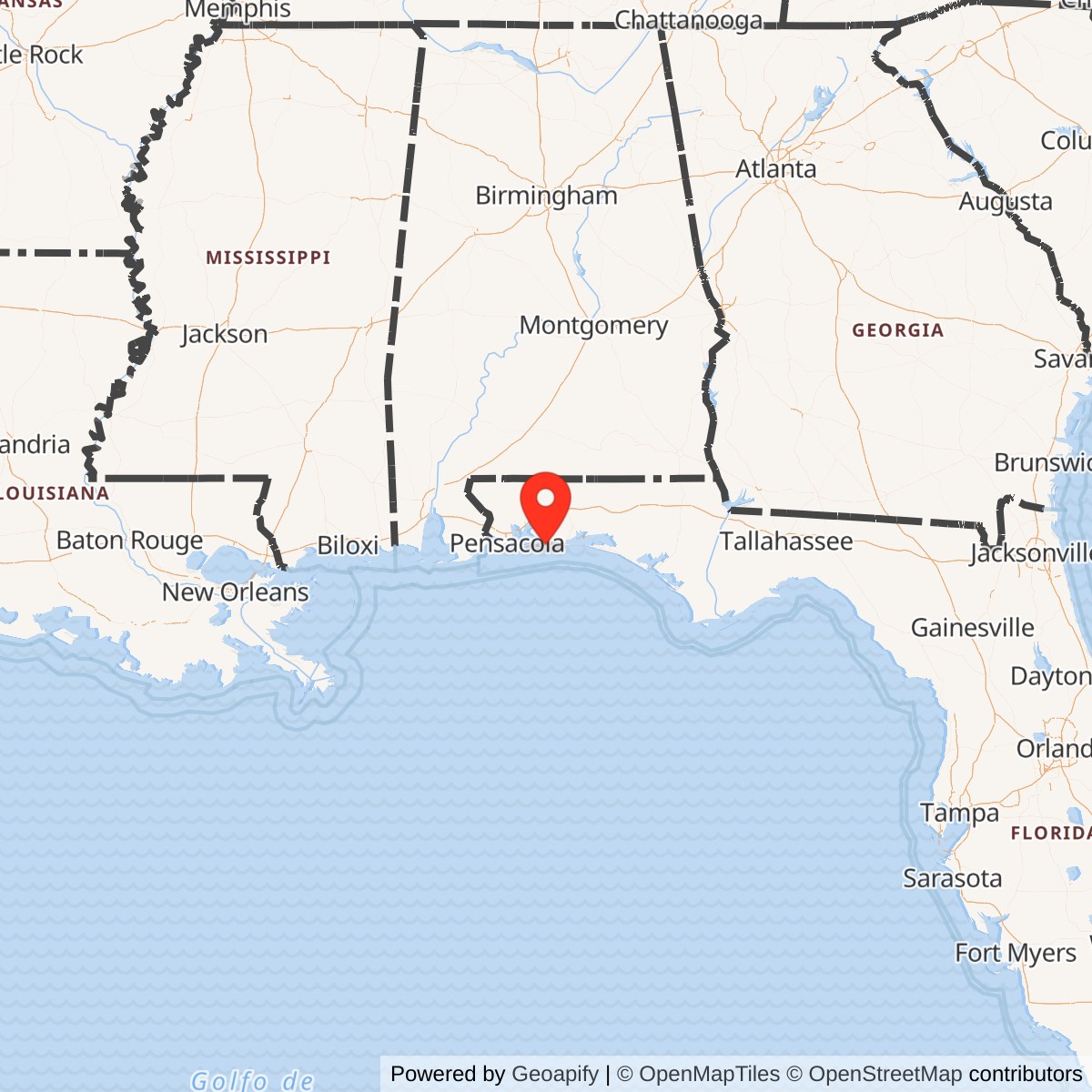
Longitude: -86.80778
Site Number: Site A-15; 4751st Air Defense Missile Wing; 4751st Air Defense Squadron (Missile); IM-99/CIM-10; CQM-10
Official Base Website: Santa Rosa Island Range Site A-15 / Former Hurlburt BOMARC Test Facility
Current Role: Active Department of the Air Force test and training property within Eglin's approximately 18-mile Santa Rosa Island Range. A-15 remains a mapped test area, but the BOMARC mission is closed. Current activities use controlled Gulf hazard areas and restricted beaches with range-safety, natural-resource, and cultural-resource management.
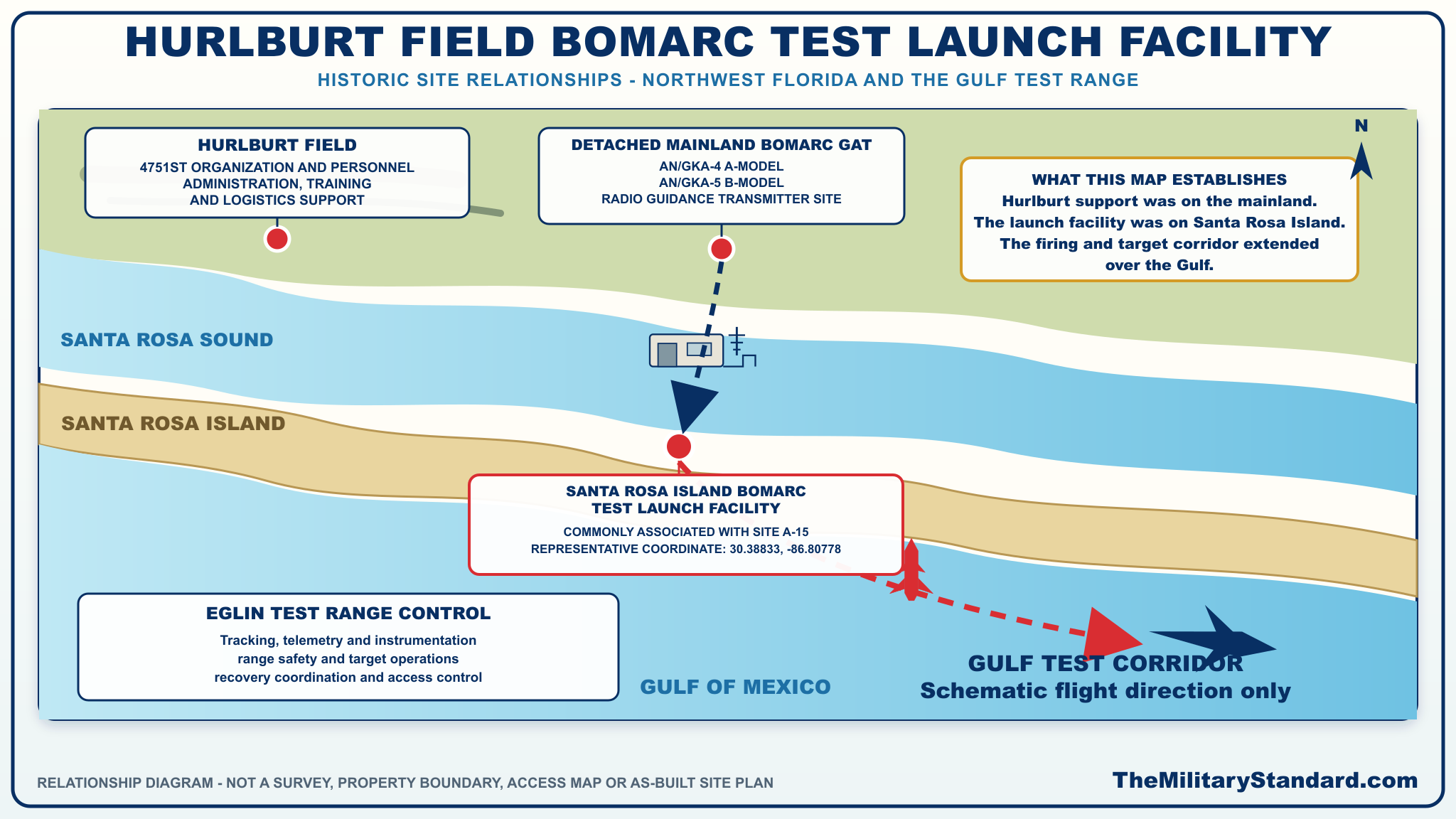
The Hurlburt Field BOMARC Missile Test Launch Facility was a separate Air Defense Command launch, evaluation, and training installation on Santa Rosa Island within the Eglin Gulf Test Range. Hurlburt Field housed the principal missile organization, students, administration, and much of the support activity, but the missiles were fired from the barrier-island complex commonly identified as Site A-15. The separation matters. Hurlburt was an airfield and cantonment north of Santa Rosa Sound, while the launch facility occupied restricted range land on the island with direct access to the Gulf firing corridor.
The Air Force created the facility to convert BOMARC from a development program into an operational continental air-defense weapon. Cape Canaveral had supported earlier research and development launches, but the tactical batteries could not fire missiles from their home stations except in war. Santa Rosa therefore became the place where the Air Force could test operational equipment, validate SAGE guidance, train missile crews, conduct live firings, and evaluate A and B model performance against representative aerial targets over a controlled water range.
The first officially recorded BOMARC launch from Santa Rosa Island occurred on 1959-01-15. During the following years the range supported tests against QF-80 fighter drones, QB-47 bomber drones, Navy Regulus II targets, and other remotely controlled aircraft. The program demonstrated more than missile flight. Each event exercised target launch and control, long-range tracking, identification, SAGE computing, ground-to-air command guidance, telemetry, range safety, recovery or debris planning, and the maintenance and launch procedures used by operational Air Defense Missile Squadrons.
The facility continued to matter after the initial tactical deployment program ended. Hurlburt's principal BOMARC wing gave way to the air-commando mission in the early 1960s, but the 4751st Air Defense Squadron remained associated with Eglin and continued training and evaluation work. By the 1970s retired BOMARC airframes were being used as CQM-10 target missiles. An official Eglin account records A-15 launches in 1975 for air-to-air missile tests. The 4751st organization inactivated on 1979-09-30, which provides the best supported organizational close date even though the exact final launch from the historic BOMARC pads has not been recovered.
The BOMARC mission is closed, but the land is not abandoned civilian property. A-15 remains a named test area inside the active Eglin reservation and Santa Rosa Island Range. Modern Air Force testing still uses the island and Gulf hazard areas, including surface-to-air missile activity, while natural-resource personnel protect sea turtles, shorebirds, dunes, and rare plants. Public access to the closed test beaches is prohibited. The former BOMARC site must therefore be described as a closed historic weapon installation within a continuing Department of the Air Force range, not as a publicly accessible ruin or a transferred surplus parcel.
Installation Identity, Location, and Boundaries
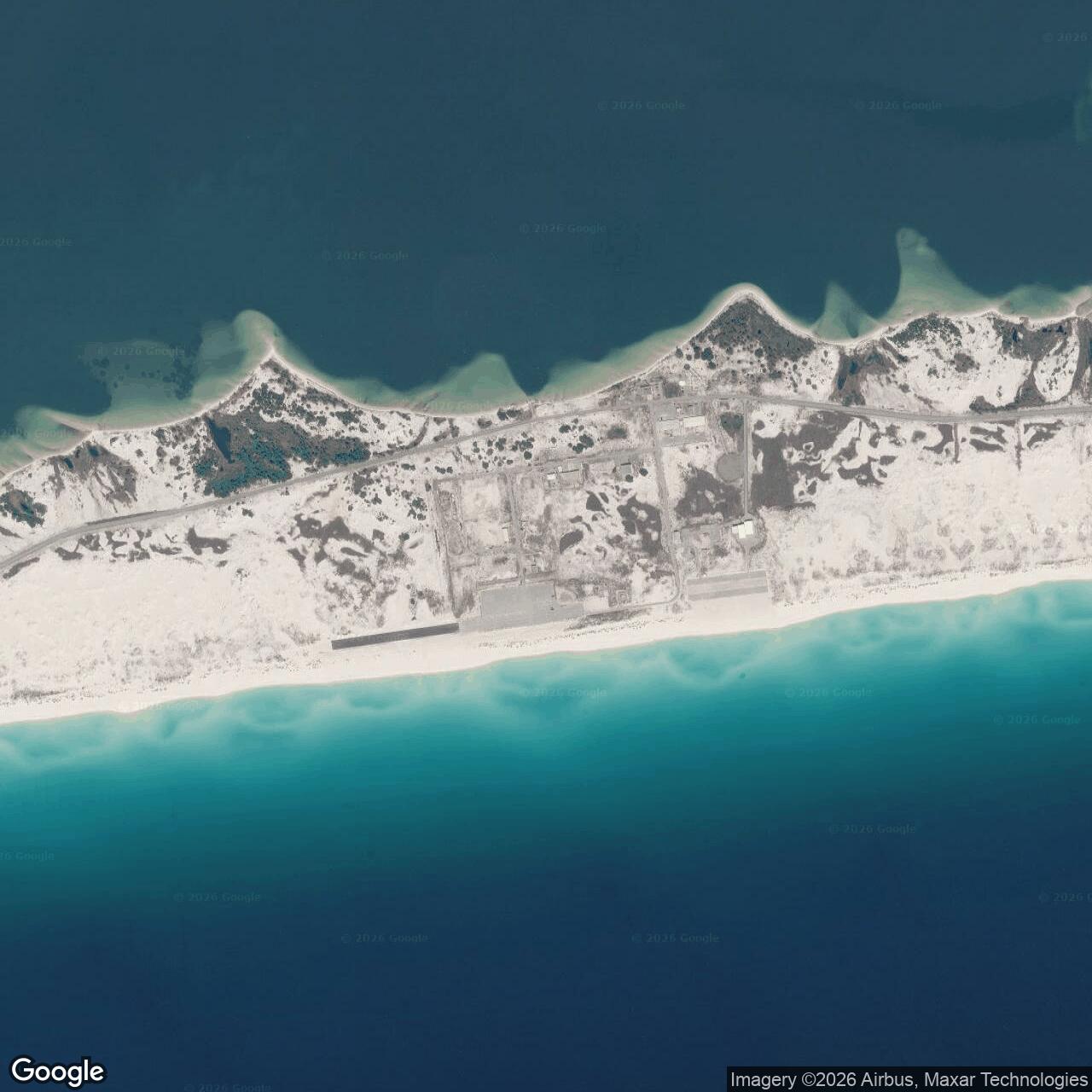
The name used here is Hurlburt Field BOMARC Missile Test Launch Facility / Santa Rosa Island Test Site. Period and later references use Santa Rosa Island BOMARC Site, Santa Rosa BOMARC Facility, Hurlburt BOMARC Site, Eglin BOMARC Test Site, 4751st Air Defense Missile Squadron launch site, Santa Rosa Range Complex, and Site A-15. These names describe overlapping aspects of one testing relationship, but they should not be interpreted as proof that every A-15 structure, every Santa Rosa test activity, and every Hurlburt missile function occupied one small parcel.The site coordinate is 30.38833 north latitude and -86.80778 west longitude. It is derived from a specialist historical inventory and places the former BOMARC launch area on Santa Rosa Island south and southwest of Hurlburt Field. It is not a surveyed boundary, launcher center, range-control point, environmental sampling location, or public-access destination. The current Eglin Customer Guide shows A-15 as a larger test and training area, demonstrating why a single point cannot define the full historic or current operational footprint.
Santa Rosa Island is a narrow barrier island separating Santa Rosa Sound from the Gulf of Mexico. The geometry made it valuable for missile testing because a launch could proceed over water and away from populated land. Hurlburt Field lay across the sound and provided an established base for personnel, logistics, transportation, classrooms, administration, and aircraft support. Eglin's instrumented Gulf range extended the usable test corridor far beyond the island, while regional radars, communications sites, drone units, and SAGE direction centers supplied functions that the launch compound could not perform alone.
The modern Santa Rosa Island Range extends approximately 18 miles, but that figure describes the larger active littoral range and cannot be converted into the acreage of the former missile plant. A-15 is also a test-area designation rather than a deed description.
Hurlburt Field was the parent support base and headquarters location. Eglin Air Force Base owned and operated the larger proving-ground and range system. Gunter Air Force Station in Alabama housed the SAGE direction center used in important controlled intercepts. Cape Canaveral supported earlier BOMARC development launches. These places formed one weapon-system network, but each retained its own land, organization, mission, and permanent installation identity.
Pre-BOMARC Missile Range Setting
Eglin had tested guided weapons long before BOMARC. During World War II the proving ground investigated the JB-2, the American version of Germany's V-1 flying bomb. Launch and support remnants survive at several Gulf-side locations, including two documented archaeological sites on Santa Rosa Island. Those experiments established institutional experience with coastal firing, pilotless targets, launch structures, instrumentation, command guidance, safety corridors, and recovery analysis that later programs could use.Public histories sometimes state that Site A-15 itself began as a JB-2 launch area. The broader relationship is credible, but the reviewed National Park Service material identifies multiple Santa Rosa Island JB-2 sites without proving that the later BOMARC launcher footprint was identical to a particular wartime pad.
After the war, Eglin developed a highly instrumented Gulf range for aircraft, missiles, drones, and armament. The range combined shore stations, optical and electronic tracking, telemetry, communications, boats, aircraft, target-control organizations, and controlled airspace and water. This infrastructure made Eglin suitable for operational suitability testing, which asked whether a system could work under service conditions with trained crews, maintainers, command links, and support equipment rather than merely whether a prototype could fly.
Strategic Origins of BOMARC
BOMARC emerged from the early Cold War requirement to stop Soviet bombers before they reached American cities, air bases, command centers, and industrial regions. The continental defense system combined distant warning lines, coastal radar, airborne early warning, local and long-range radars, SAGE direction centers, fighter interceptors, Army Nike missiles, and the Air Force's long-range pilotless interceptor. BOMARC was designed to extend the engagement zone far beyond local point defense and to attack a bomber under centralized computer direction.The name joined Boeing with the Michigan Aeronautical Research Center, organizations that shaped the missile's development. Design work began in 1946, and the Air Force ordered the weapon into production in 1955. The missile was not an intercontinental ballistic missile and the Santa Rosa site was not a strategic retaliatory base. BOMARC flew through the atmosphere to intercept aircraft or airborne targets. Its mission depended on surveillance and command networks rather than independent local search by the launcher battery.
The first BOMARC test flight occurred in February 1955 in the Cape Canaveral development program. The following spring, according to the Department of Defense construction history Leading the Way, the Air Force directed construction of an Operational Suitability Test and Training Facility on Santa Rosa Island. The facility had to bridge two communities: Air Research and Development Command organizations responsible for system development and Air Defense Command organizations that would train and operate the tactical force.
Initial plans envisioned a much larger BOMARC deployment than the force ultimately built. Technical problems, cost, competition with Army Nike systems, changing bomber and missile threats, and policy disputes reduced the program repeatedly. The Santa Rosa training mission was therefore created while the national deployment plan was still changing. It had to prepare crews for the first four sites at McGuire, Suffolk County, Otis, and Dow and then adapt to the smaller A and B model network that followed.
Planning, Design, and Construction
The public construction record dates planning to the mid-1950s and work on Santa Rosa Island to 1957. Leading the Way states that lessons from the design and construction of the Santa Rosa facility were incorporated into the first tactical BOMARC bases. Architect-engineer firms adapted Eglin plans for the initial sites, and the U.S. Army Corps of Engineers later developed standard plans for additional locations. Santa Rosa was thus both an operating test site and a prototype for the physical plants built elsewhere.This role required more than a launch pad. The facility needed shelters or launch structures, missile receiving and handling space, assembly and maintenance functions, test equipment, secure storage, power, environmental control, communications, instrumentation interfaces, fire protection, roads, drainage, and a protected perimeter. Liquid-booster BOMARC A operations also required procedures and plant for hazardous propellants. The later solid-booster B model changed launch and support requirements but did not eliminate the need for controlled storage, maintenance, guidance links, and range safety.
Barrier-island construction presented unusual engineering problems. Sand, salt spray, humidity, heat, storms, corrosion, shifting dunes, and limited access affected foundations, doors, electrical connections, utilities, roads, and equipment. The launch area also had to be oriented toward a safe Gulf corridor and connected to remote instrumentation and command facilities. A structure that worked at Santa Rosa could inform tactical-base design, but operational sites in colder climates required their own adaptation for snow, freezing, and local soil conditions.
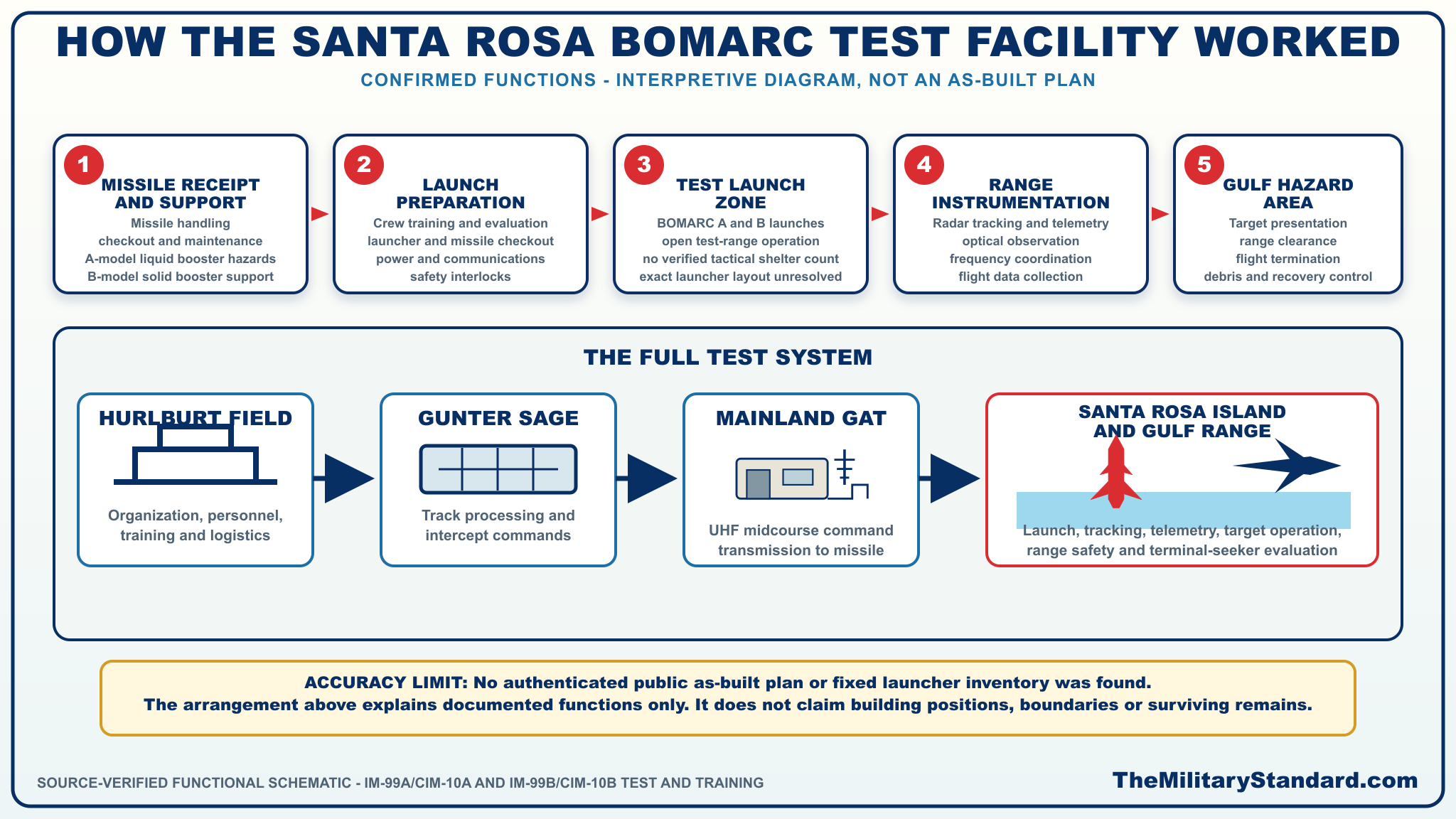
The exact number and arrangement of Santa Rosa BOMARC launch structures remain less certain than the standardized shelter counts at operational batteries. Historical photographs show test-launch and support features, but a full as-built plan was not located. Test programs needed flexibility, instrumentation access, and changing configurations rather than a fixed combat-alert inventory.
Organization and Command
The 4751st Air Defense Missile Wing was established to conduct operational testing and train the Air Defense Missile Squadrons that would staff tactical sites. Official Air Force chronology places activation on 1958-01-15. An Eglin milestone publication instead says the wing activated on 1958-02-27, while some secondary histories describe an organizational beginning on 1957-10-01. These dates may reflect establishment, organization, redesignation, or effective activation events, but the public records reviewed do not fully reconcile them.The 4751st Air Defense Missile Squadron activated on 1959-01-15 and became the continuing test and training organization after the wing period. Lineage summaries derived from Air Force Historical Research Agency material report assignment to the 73d Air Division (Weapons), transfer to the 32d Air Division on 1959-10-01, transfer to the Montgomery Air Defense Sector on 1962-07-01, and a final assignment to Air Defense, Tactical Air Command in September 1979. The squadron was redesignated the 4751st Air Defense Squadron (Missile) on 1960-04-01.
Hurlburt Field was the station named in organizational records because it housed the unit and its support base. Santa Rosa Island was the remote launch and test location. This arrangement resembles the relationship between a parent air base and a detached missile annex, but the mission differed from an alert battery. The 4751st trained and evaluated; it did not maintain a regional combat-alert sector with a permanently assigned ready nuclear force at Santa Rosa.
Air Proving Ground Center and later Eglin test organizations supplied range, engineering, instrumentation, target, and safety support. Air Defense Command controlled the operational doctrine and training requirement. Contractors and system-program offices supported the missile, launcher, guidance, engines, electronics, and specialized test equipment. Drone organizations supplied representative targets. SAGE direction centers provided the computer and command functions that converted tracks into guidance commands.
Training the Operational Force
The training program prepared officers and airmen for work at permanent BOMARC stations. Courses covered missile maintenance, launcher and support equipment, SAGE operations, communications, launch procedures, safety, status reporting, and the responsibilities of operations, weapons, supply, and civil-engineering personnel. Contemporary descriptions indicate a program of about four months, with technicians serving as instructors and students completing an unarmed launch at Eglin as part of operational preparation.Live firing gave the course meaning that classroom work could not provide. A crew had to receive and interpret a valid mission, prepare the missile, coordinate with range and target controllers, maintain communications, observe safety limits, execute launch procedures, and respond to malfunction or abort conditions. Maintenance personnel then had to analyze performance data and prepare equipment for another event. The range reproduced the organizational chain that an operational squadron would use even though the target and warhead conditions were different.
Crews from McGuire, Suffolk County, Otis, Dow, Langley, Niagara Falls, Kincheloe, and Duluth passed through the broader Eglin training system as the network developed. Canadian personnel and system organizations also had a relationship to the joint U.S.-Canadian program. The training site therefore influenced every operational battery even though only a limited number of missiles stood at Santa Rosa at any one time.
Training also fed back into design. Student errors, maintenance difficulty, equipment failure, weather effects, and launch data revealed where procedures or hardware needed improvement. The Santa Rosa facility could test modifications before they reached tactical sites. This made the complex a link between engineering and operations, with lessons flowing from the range to contractors, program offices, training syllabi, technical orders, and construction standards.
BOMARC A Operations
The IM-99A, redesignated CIM-10A in 1962, used a liquid-propellant booster to accelerate from vertical launch to ramjet speed. Twin Marquardt ramjets then sustained supersonic flight. Ground commands guided the missile through the midcourse phase, and the Westinghouse AN/DPN-34 radar supported terminal homing. The system could carry a conventional or nuclear warhead, but test rounds at Santa Rosa were configured for evaluation and training rather than normal tactical alert.Liquid booster operations imposed serious handling and safety demands. Hypergolic propellants and related servicing systems could be toxic, corrosive, and fire-prone. Crews needed protective procedures, compatible materials, reliable valves and connections, emergency response, and close coordination between missile, launcher, and range personnel. The island's heat, humidity, and salt environment increased the importance of inspection and environmental control.
An operational suitability program evaluated more than peak range or speed. It asked whether ordinary service units could keep missiles ready, whether SAGE commands arrived correctly, whether launch equipment worked repeatedly, whether procedures were safe, and whether the complete system could intercept realistic targets. Failures and partial successes were therefore useful evidence. A malfunction could identify a design, maintenance, communications, or training weakness before the same problem affected an alert station.
BOMARC B Operations
The IM-99B, later CIM-10B, replaced the liquid booster with a solid-propellant booster and incorporated improved electronics, propulsion, range, and terminal homing. The Westinghouse AN/DPN-53 pulse-Doppler radar supported the terminal phase. Solid booster storage reduced the servicing burden and improved readiness, while additional fuel and improved ramjets extended the engagement envelope. The B model still depended on SAGE and ground guidance for its long midcourse flight.Santa Rosa had to evaluate the B model as a complete system and prepare crews for sites built or converted around it. Tests examined launches, command guidance, target acquisition, terminal interception, range safety, and the interaction between new missile hardware and existing continental-defense systems. The facility's value was clearest when a missile could be controlled from a distant SAGE center and intercept a target far offshore rather than merely fly a prearranged trajectory.
Because the A and B systems differed, photographs and plans must be dated before they are used as evidence. Launcher hardware, support equipment, booster handling, radar, and missile appearance changed. A generic tactical B shelter cannot automatically be labeled as a Santa Rosa structure, and an A-model launch image cannot explain every later target mission.
Major Tests and Intercepts
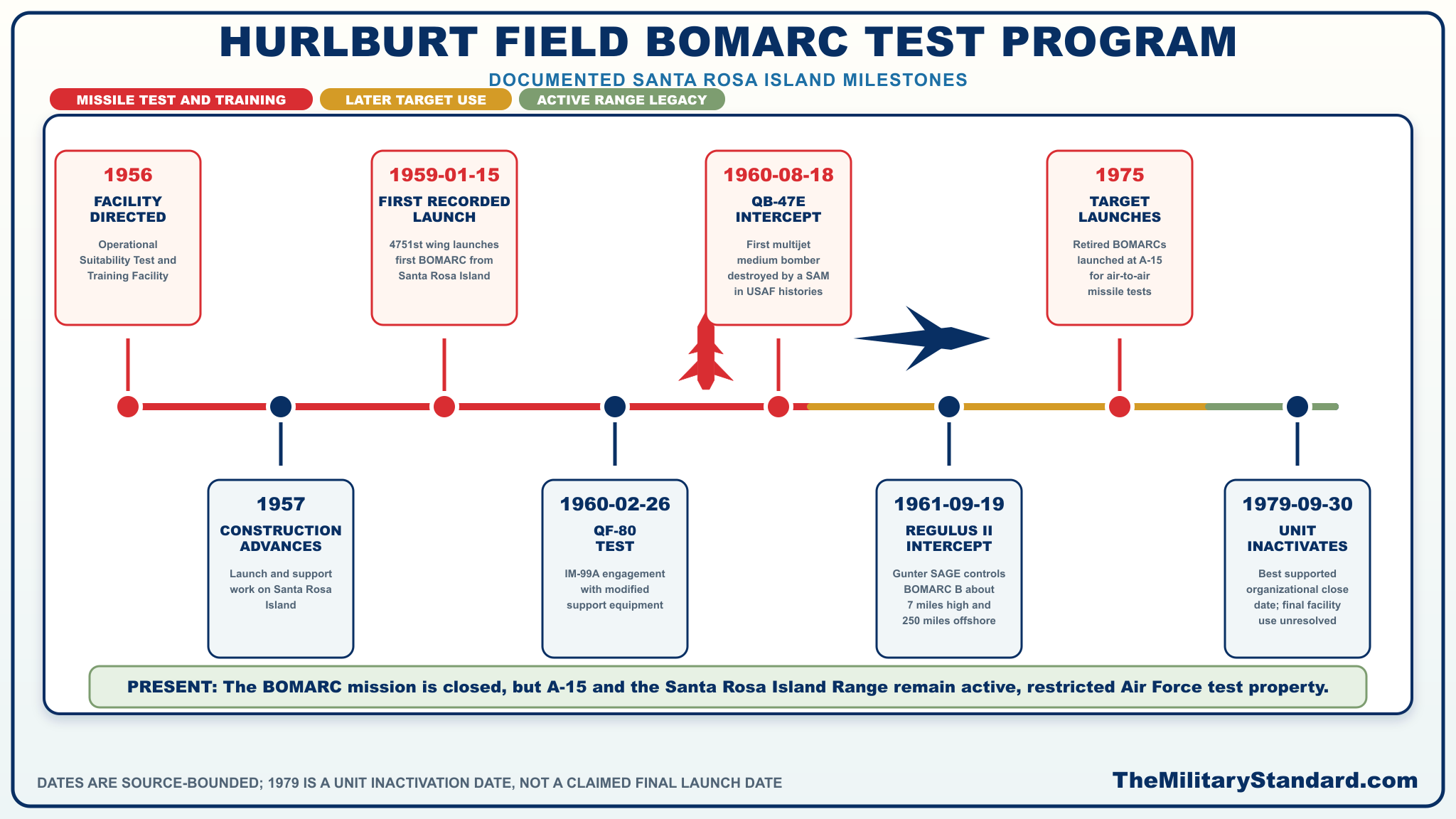
The first Santa Rosa Island BOMARC launch took place on 1959-01-15. Eglin's official milestone publication identifies it as the first surface-to-air interceptor launch from the island site. The date also coincides with the reported activation of the 4751st Air Defense Missile Squadron, linking the physical launch program to the organization that would continue testing and training.A reported 1960-02-26 IM-99A firing targeted a QF-80 drone above 30,000 feet over the Gulf range and tested modified missile-support equipment. The account appears in compiled Eglin chronology and press reporting rather than in the short official milestone sheets reviewed here. It is retained as a qualified event because it illustrates the program's concern with the full support system, not only the airframe.
On 1960-08-18, a Santa Rosa-launched BOMARC struck a QB-47E drone. Eglin and Hurlburt historical accounts identify the event as the first destruction of a multi-jet medium bomber by a surface-to-air missile. The target type mattered because BOMARC existed to defeat long-range bomber threats. A successful intercept against a B-47-derived drone offered a more operationally meaningful demonstration than a simple ballistic flight or a slow target pass.
The Navy's supersonic Regulus II became another important target. On 1961-09-19, an official Air Force Life Cycle Management Center history states that the SAGE center at Gunter Air Force Station controlled a BOMARC B from launch at Eglin to interception of a Regulus II approximately seven miles high and 250 miles off the Florida coast. That event demonstrated the long chain from remote track and computer processing through launch and ground guidance to terminal attack.
Other histories describe BOMARC attacks on QF-80s, QB-47s, and Regulus targets and record tests in which Gunter controlled more than one missile against a bomber drone. The precise date and configuration of every event are not available in the reviewed public sources. The chronology therefore includes only firmly dated launches at day precision and groups the remaining activity by year or program phase rather than inventing exact dates.
SAGE and the Guidance Network
BOMARC did not rely on a radar at the launch site to discover an enemy bomber independently. Surveillance radars fed track data to SAGE direction centers. Computers combined and displayed that information, operators selected or approved an engagement, and command links sent guidance information to the missile during the midcourse phase. The missile's onboard radar took a larger role near the target.Gunter Air Force Station became the most clearly documented direction-center partner for Santa Rosa testing. The Montgomery Air Defense Sector's SAGE facility could control launches through the Eglin range and against targets operating far offshore. The 1961 Regulus II intercept proved that an operational command center could direct the weapon across a long engagement rather than leaving guidance to an isolated test controller beside the launcher.
Radar stations and communications sites across the Southeast also supported surveillance, tracking, safety, and test observation. Cross City and Tyndall appear in specialist accounts of regional BOMARC support, but the exact console procedures and mission dates are not sufficiently documented to assign every launch to a specific radar station. They remain related installations, not unverified components of the Santa Rosa property.
Targets, Instrumentation, and Range Safety
The Eglin Gulf range made realistic targets possible. QF-80 aircraft represented fighter-sized subsonic threats, QB-47 aircraft represented multi-engine bomber targets, and Regulus II offered a fast, demanding unmanned target. Target-control personnel had to launch or direct these vehicles through planned profiles while keeping them inside restricted airspace and away from populated areas and ordinary shipping.Instrumentation recorded the engagement. Radar, optical cameras, telemetry receivers, timing systems, communications recordings, and debris analysis could determine whether the missile followed commands, acquired the target, passed within lethal distance, or failed at a particular stage. This evidence mattered even when a target was not destroyed. Test engineers needed to separate failures in target presentation, guidance, propulsion, launcher equipment, telemetry, and terminal homing.
Range safety protected communities, aircraft, vessels, and test personnel. Controllers established hazard areas, monitored target and missile tracks, delayed launches for weather or traffic, and could terminate a flight that left the safe corridor. An Eglin range-safety officer later recalled that BOMARC target launches were still occurring from A-15 in 1975. His account also explains how range organizations eventually standardized flight-termination systems across major test ranges, a legacy of decades of complex missile work.
Daily Work and Support Facilities
Daily activity centered on readiness for infrequent but demanding launch events. Missile technicians inspected airframes, propulsion, guidance, electrical systems, and connections. Launcher crews exercised elevation and release equipment. Communications personnel checked circuits to range and command facilities. Instrumentation teams calibrated tracking and telemetry systems. Safety staff reviewed hazard zones, weather, emergency procedures, and abort criteria.Hurlburt supported the people behind those tasks. Students and permanent personnel used its housing, dining, medical, transportation, supply, administrative, and recreational systems. Trucks and specialized handling equipment moved between the airfield and island facilities through controlled routes. Eglin organizations supplied range scheduling, targets, aircraft, boats, engineering, explosive ordnance support, and recovery capability.
The test site itself required secure work areas rather than a large family cantonment. Likely functions included launcher positions, missile checkout and maintenance, assembly or handling, protected storage, control and communications, electrical power, environmental conditioning, fire protection, security, roads, and instrumentation interfaces. Public photographs and general construction history confirm this functional plant, but an authoritative as-built building list has not been recovered.
The island environment shaped maintenance. Salt spray attacked exposed metal and electrical connections. Wind-driven sand affected doors, mechanisms, roads, and equipment. Heat and humidity challenged electronics and controlled storage. Tropical storms and hurricanes could interrupt schedules and threaten utilities and shore facilities. These conditions made Santa Rosa a useful operational test environment because tactical units also needed equipment and procedures that could tolerate difficult climates.
Transition From Training to Target Missions
Hurlburt's official history says the BOMARC mission was phased out in 1961 as the air-commando mission grew. That statement accurately describes the end of BOMARC as Hurlburt's defining base mission, but it does not establish that Santa Rosa launch activity stopped in 1961. The 4751st wing ended in 1962, while its missile squadron continued. Official 1961 SAGE testing and the 1975 A-15 target-launch account prove a longer operational afterlife.The tactical BOMARC force contracted in stages. All-A batteries at Suffolk County and Dow closed in 1964. Niagara Falls closed in 1969. The remaining B-model batteries ended in 1972. Retired missiles became CQM-10A and CQM-10B targets for testing newer air-defense and air-to-air weapons. That target role changed the purpose of a launch from demonstrating BOMARC's ability to intercept an aircraft to presenting BOMARC itself as a fast target.
An official Eglin safety account places such target launches at A-15 in 1975, with aircraft firing air-to-air missiles at them over the Gulf. This is the latest specifically dated BOMARC use of the site recovered. The 4751st Air Defense Squadron remained active until 1979-09-30. The public record does not show whether the final four years included additional A-15 launches, caretaker work, other missile evaluations, or mainly organizational support.
Closure, Continuing Range Use, and Current Status
This history uses 1979-09-30 as the close date because it is the documented inactivation date of the continuing 4751st missile organization. This is not presented as the proven date of the last launch, demolition, or removal of the final BOMARC component. The latest confirmed launch activity is in 1975. A complete real-property record may identify different dates for equipment removal, facility conversion, or administrative closure.After BOMARC, A-15 remained part of Eglin's active Santa Rosa Island Range. The 2021 Eglin Customer Guide still maps A-15 among the installation's land test and training areas. Modern Air Force reporting describes an 18-mile Santa Rosa range used for military testing and training. In 2020, a surface-to-air missile fired from Santa Rosa Island destroyed a low-altitude BQM-167A target during an integrated homeland-defense evaluation. Public reporting does not establish that this modern firing used an original BOMARC pad, so it demonstrates mission continuity on the range without proving structure continuity at the historic compound.
The former BOMARC property remains under Department of the Air Force range control within the Eglin reservation. Closed test beaches west of the developed Okaloosa Island area are not open for casual entry. Eglin warns that military testing, unexploded ordnance risk, sensitive natural resources, and cultural resources require access control.
Surviving Structures and Physical Evidence
Historical photographs clearly document Santa Rosa BOMARC launch activity and associated range structures. Public current sources do not provide a verified inventory of surviving BOMARC launchers, shelters, control buildings, foundations, utilities, or instrumentation at A-15. Satellite-image resemblance is not enough to assign a feature. Coastal change, demolition, range redevelopment, and later test projects can produce concrete pads and roads that look similar across decades.The absence of a public structure inventory does not imply that no physical evidence survives. Foundations, roads, utilities, protective works, debris, or modified buildings may remain inside the controlled range. Their identification requires official cultural-resource surveys, real-property records, environmental drawings, or authorized field inspection.
Some secondary compilations place a second 4751st BOMARC location at Eglin Auxiliary Field No. 5, Piccolo Field. The authoritative sources document the Santa Rosa launch site and identify Piccolo with Project Mercury tracking, radar, and microwave work, but they do not prove a separate BOMARC launcher installation there.
Chronology
- 1944 Eglin begins intensive JB-2 guided-missile launch experimentation on Gulf-side and Santa Rosa Island ranges, establishing an earlier pilotless-weapon testing landscape.
- 1946 Design work leading to the Boeing and Michigan Aeronautical Research Center BOMARC system begins.
- Early 1950s Eglin expands its instrumented Gulf range for guided weapons, drones, tracking, telemetry, and operational evaluation.
- 1955-02 The first BOMARC test flight occurs in the Cape Canaveral development program.
- 1955 The Air Force orders BOMARC into production.
- 1956 The Air Force directs construction of an Operational Suitability Test and Training Facility on Santa Rosa Island.
- 1957 Work advances on the Santa Rosa Island BOMARC launch and support facility, commonly associated with Site A-15.
- 1958-01-15 Official Air Force chronology records activation of the 4751st Air Defense Missile Wing to train BOMARC units.
- 1958-02-27 An Eglin milestone publication gives this alternative activation date for the 4751st Air Defense Missile Wing.
- 1958 The 4751st organization replaces the 17th Light Bombardment Wing as Hurlburt's principal mission organization and prepares the BOMARC training program.
- 1958 Congress describes Santa Rosa Island as the location where crews will train in operational employment of BOMARC.
- 1958-09 Air Research and Development Command planning shifts principal operational test emphasis from Cape Canaveral to the Santa Rosa facility.
- 1959-01-15 The first officially recorded BOMARC launch takes place from Santa Rosa Island.
- 1959-01-15 The 4751st Air Defense Missile Squadron activates according to lineage summaries.
- 1959 Training expands for personnel assigned to the first tactical sites at McGuire, Suffolk County, Otis, and Dow.
- 1959-10-01 The 4751st Air Defense Missile Squadron transfers from the 73d Air Division (Weapons) to the 32d Air Division according to lineage summaries.
- 1960-02-26 Compiled Eglin chronology reports an IM-99A launch against a QF-80 target while evaluating modified support equipment.
- 1960-04-01 The 4751st unit is redesignated the 4751st Air Defense Squadron (Missile) according to lineage summaries.
- 1960-08-18 A Santa Rosa-launched BOMARC destroys a QB-47E drone, identified in Air Force histories as the first multi-jet medium bomber destroyed by a surface-to-air missile.
- 1960 Tactical BOMARC deployment plans are sharply reduced while Santa Rosa testing and training continue.
- 1961 Hurlburt begins transition toward the air-commando mission; its official history describes the principal BOMARC base mission as phased out.
- 1961-09-19 Gunter's SAGE center controls a BOMARC B launched from Eglin to intercept a Navy Regulus II target about seven miles high and 250 miles offshore.
- 1962 IM-99A and IM-99B are redesignated CIM-10A and CIM-10B.
- 1962-07-01 The 4751st Air Defense Missile Wing period ends and the continuing missile squadron transfers to the Montgomery Air Defense Sector according to lineage summaries.
- 1964 All-A tactical batteries at Dow and Suffolk County close, while B-model sites and Eglin training and evaluation continue.
- 1969-12-31 Niagara Falls becomes the first operational B-model site to close.
- 1972-04 to 1972-10 The remaining operational U.S. BOMARC batteries end alert service and inactivate.
- 1972 Retired A and B missiles increasingly serve as CQM-10A and CQM-10B aerial targets.
- 1975 An Eglin range-safety officer later recalls launching BOMARC targets from A-15 for air-to-air missile tests over the Gulf.
- 1979-09-01 The 4751st Air Defense Squadron enters its final assignment under Air Defense, Tactical Air Command according to lineage summaries.
- 1979-09-30 The 4751st Air Defense Squadron inactivates.
- 1980s Major test ranges move toward standardized flight-termination systems, building on earlier range-safety experience with complex missile tests.
- 1990s Cultural-resource programs document Eglin's guided-missile heritage, including separate World War II JB-2 resources on Santa Rosa Island.
- 2010 Eglin conducts environmental baseline sampling along the Santa Rosa Island coastline in preparation for possible Deepwater Horizon impacts.
- 2014 Eglin documents continuing sea-turtle patrol and nest protection on the Santa Rosa Island Range.
- 2016 Air Force reporting describes the Santa Rosa Island Range as an 18-mile active test and training corridor and wildlife habitat.
- 2020 A modern surface-to-air missile fired from Santa Rosa Island destroys a low-altitude BQM-167A target during an integrated defense evaluation.
- 2021 Eglin's Customer Guide maps A-15 as a continuing land test and training area within the reservation.
- 2023 Eglin reiterates that closed test beaches on Santa Rosa Island are restricted because of military missions, safety, natural resources, and cultural resources.
- 2026-08 Eglin announces contemporary munitions testing and maritime hazard-zone closures off Santa Rosa Island, demonstrating continued active range control.
- Present The BOMARC mission and 4751st organization are closed, while A-15 and the Santa Rosa Island Range remain active Department of the Air Force test property.
Sources & References
- PDF Department of Defense, Leading the Way: The History of Air Force Civil Engineers Source for BOMARC origins, 1955 production decision, Santa Rosa operational suitability and training facility, design lessons, and tactical-base construction relationships.
- PDF Air Force Historical Research Agency, Air Force Chronology Source for Official 1958-01-15 activation date and the Air Force description of the 4751st training mission.
- PDF Eglin Air Force Base, Historical Milestones Source for 1958-02-27 alternative wing date and the first Santa Rosa Island BOMARC launch on 1959-01-15.
- WEB Eglin Air Force Base, Eglin Air Force Base History Source for Eglin proving-ground development, Gulf range context, and BOMARC as a major postwar test program.
- WEB Hurlburt Field, Hurlburt Field History Source for Hurlburt support relationship, 4751st Missile Wing mission, Santa Rosa launches, and the 1961 base-mission transition.
- WEB Air Force Life Cycle Management Center, This Week in AFLCMC History, September 19-25, 2022 Source for Gunter SAGE control and the 1961-09-19 BOMARC B interception of a Regulus II target.
- PDF Air Force Life Cycle Management Center, Winged Missiles: 1950 to 1975 Source for BOMARC technology, program setting, Santa Rosa launch imagery, Cape Canaveral relationship, and later target-missile context.
- WEB Air Force Life Cycle Management Center, Looking Back: Winged Missiles, 1950-1975 Source for Air Force interpretation of BOMARC as a ramjet-powered long-range interceptor and its place among postwar winged missiles.
- WEB Eglin Air Force Base, Safety Officer Wins Hall of Fame Award for Storied Career Source for Confirmed 1975 BOMARC target launches from A-15 and evolution of flight-termination and range-safety practices.
- WEB Eglin Air Force Base, Eglin Testers Make History with Low-Altitude Missile Shot Source for Modern Santa Rosa Island surface-to-air missile testing and continuing integrated range functions.
- PDF Eglin Air Force Base, Customer Guide 2021 Source for Current range organization, A-15 mapping, land test areas, Gulf range support, and geographic context.
- WEB Eglin Air Force Base, Marine Life on the Water Range Source for 18-mile Santa Rosa Island Range, continuing military use, shorebirds, sea turtles, and natural-resource monitoring.
- WEB Eglin Air Force Base, Turtle Patrol Missions Sustain Sea Life Source for Sea-turtle nesting season, patrol procedures, mission compatibility, and data sharing with Florida.
- WEB Eglin Air Force Base, From the Commander: Closed Test Areas and Beach Access Source for Current access restrictions, closed Santa Rosa test beaches, safety, rare species, and cultural-resource protection.
- WEB Eglin Air Force Base, Eglin Preparing for Oil Impacts Source for Air Force control of 18 miles of Santa Rosa Island, shoreline baseline sampling, and environmental stewardship.
- WEB National Park Service, Eglin Field Historic District Source for Eglin's national testing importance, World War II proving-ground role, and JB-2 guided-missile background.
- PDF National Park Service, CRM Journal, Eglin Cultural Resource Management Source for Santa Rosa Island JB-2 archaeological sites, launch features, preservation, and the distinction between wartime and Cold War missile remains.
- PDF National Park Service, Cold War Defensive Sites Theme Study Source for Continental air-defense setting, deployed BOMARC network, SAGE relationships, and comparative site context.
- PDF Congressional Record, Department of Defense Missile Program Statement, 1958 Source for Contemporary description of the 4751st training unit, Santa Rosa crew training, live operational employment, and planned first tactical sites.
- PDF Congressional Record, BOMARC Program Debate, 1959 Source for Contemporary cost, performance, deployment, and program-reduction debate surrounding the Santa Rosa test period.
- WEB United States Environmental Protection Agency, Eglin Air Force Base RCRA Profile Source for Installation-wide environmental program context and the limit against claiming an A-15-specific remedy without direct evidence.
- PDF ADC Historical Data, 1946-1973, Aerospace Defense Command (17.67 MB) Source for Uploaded program chronology, organizational context, BOMARC deployment, training relationships, and Air Defense Command network background.
- WEB FortWiki, BOMARC System Source for Qualified representative coordinate, comparative site inventory, unit summary, and cross-checking operational battery relationships.