
Camp Adair BOMARC Missile Launch Facility, Oregon
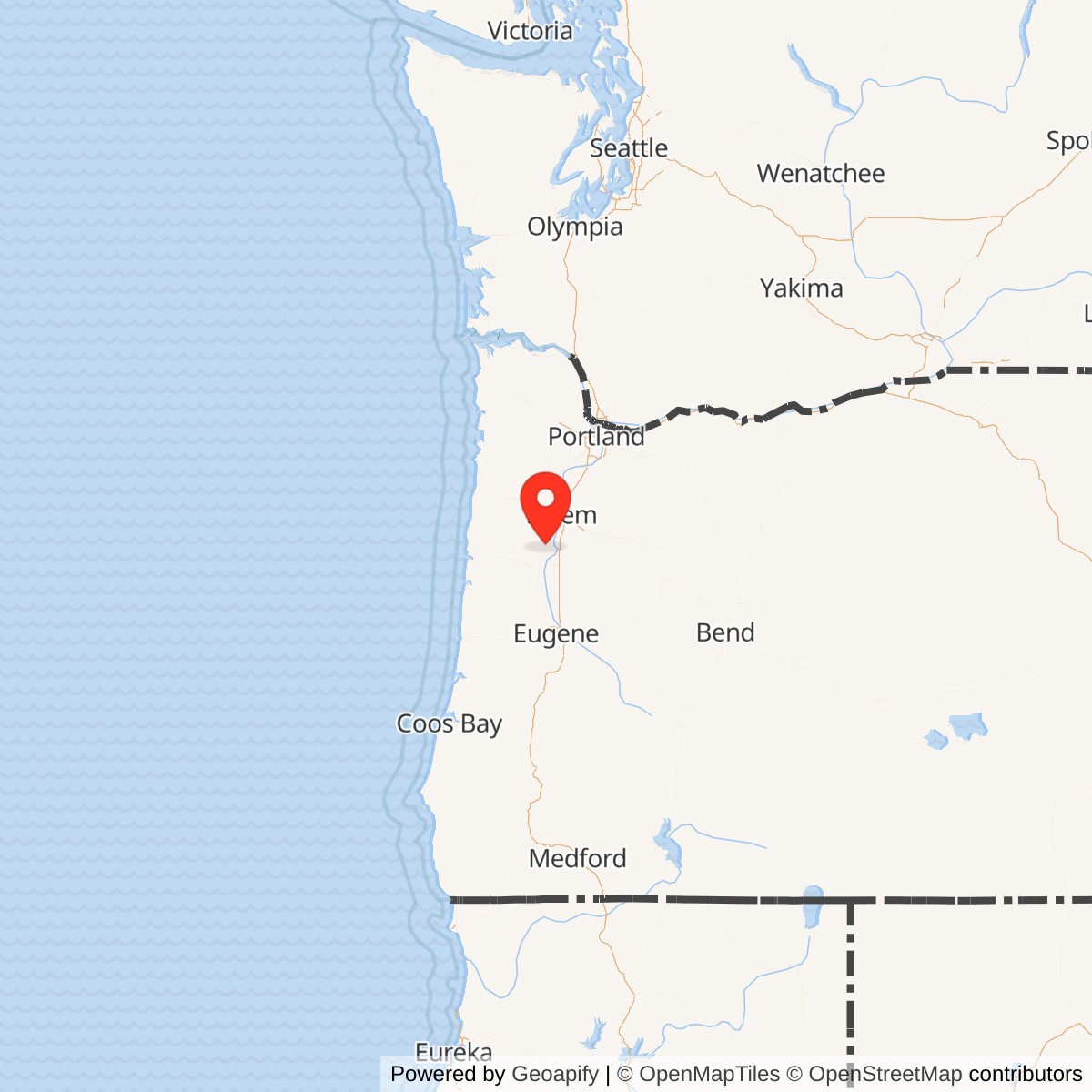
Longitude: -123.2
Official Base Website: Former Camp Adair BOMARC missile-launch site
Current Role: Former unfinished missile-launch site on wooded federal land north of Camp Adair Road. Surviving concrete launcher foundations and related Cold War construction are documented; local and municipal sources associate management with the U.S. Forest Service / Siuslaw National Forest, while a 2022 Benton County record notes possible residual Department of Defense interest in portions of the federal parcel. No active Air Force mission remains.
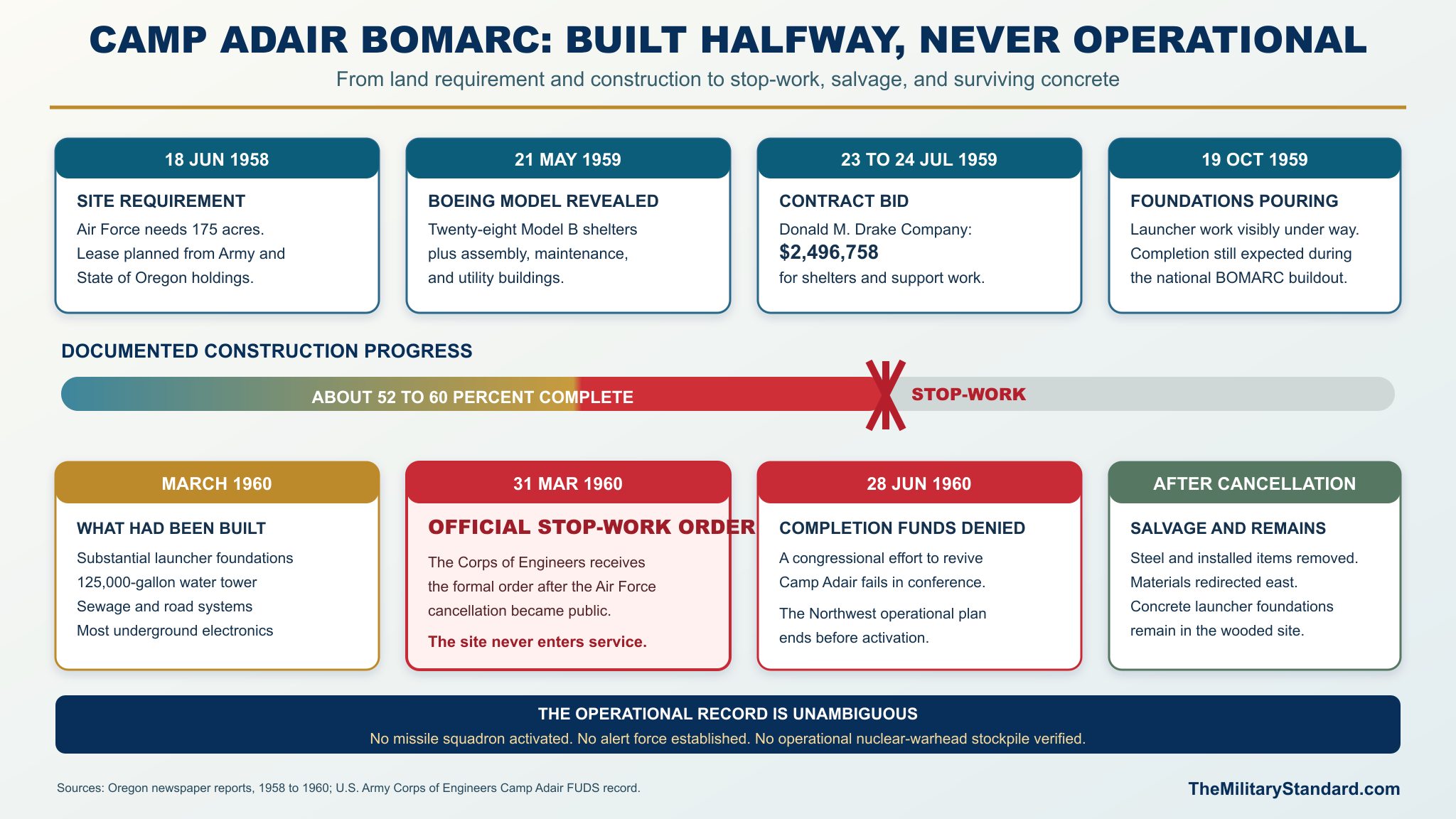
The Camp Adair BOMARC site was planned as a separate twenty-eight-missile BOMARC-B launch facility controlled by Adair AFS SAGE Direction Center DC-13 roughly one mile away. A 1958-06-18 contemporary report stated that the Air Force needed 175 acres and would lease the land from the Army and State of Oregon rather than condemn nearby farmland. A 1959-05-21 scale model showed twenty-eight launch shelters plus assembly/maintenance and utility buildings. The Corps of Engineers reported Donald M. Drake Company as apparent low bidder in July 1959 at $2,496,758 for twenty-eight launcher shelters and related assembly/maintenance, ordnance-storage, and security-control buildings. By 1959-10-19 foundations were being poured. By March 1960 the site had substantial launch construction, a 125,000-gallon water tower, sewage, roads, and mostly installed underground electronics. Contemporary estimates placed construction at roughly 52-60 percent complete. The Air Force announced cancellation 1960-03-25/26 and the Corps received the official stop-work order 1960-03-31. Congress briefly reconsidered completion but denied the required funding on 1960-06-28. No operational missile squadron activated at Camp Adair, no combat-alert missile force was established, and no evidence reviewed shows an operational nuclear-warhead stockpile. A 1959 Oregon Centennial display missile was reported as destined for Camp Adair, but its later status is not established and it is not counted as an operational weapon. The site lies within the larger Camp Adair/Adair AFS FUDS but should not inherit the 56,815.17-acre property figure or World War II range hazards. Local 2017 archaeological survey work documented surviving unfinished pads. Current exact parcel control remains qualified because local sources identify Forest Service management while county records note possible residual DoD interest.
The Camp Adair BOMARC Missile Launch Facility was an unfinished U.S. Air Force air-defense missile base constructed beside, but physically and functionally distinct from, Adair Air Force Station's SAGE direction center. The site was intended to hold twenty-eight operational BOMARC-B missiles in individual launcher shelters and to receive engagement commands from the SAGE system approximately one mile away. Construction advanced far enough to leave launch-pad foundations, roads, utilities, underground electronics, and other infrastructure, but the Air Force canceled the western deployment before missiles entered operational alert.
This distinction from Adair Air Force Station is fundamental. Adair AFS was a staffed command-and-control installation centered on SAGE Direction Center DC-13. The BOMARC site was the planned weapon installation that SAGE would have controlled. Contemporary reporting repeatedly described the missile base and SAGE as neighboring projects, and when the Air Force halted the missile program in 1960 it explicitly retained the SAGE installation. The two projects therefore belong in separate inventory rows even though their missions were designed to operate together.
The site also should not be confused with an intercontinental ballistic missile base. BOMARC was a long-range surface-to-air interceptor weapon intended to destroy hostile aircraft approaching North America. It belonged to Air Defense Command's continental-defense system and was controlled through SAGE. The missile was a defensive weapon against bombers, not a strategic missile designed to strike targets in the Soviet Union. This makes the site appropriate for the Air Force installation inventory even though ICBM launch facilities are managed separately.
The planned property figure is unusually well documented for a project that never became operational. A June 18, 1958 Associated Press report stated that no farmland would be condemned for the missile base and that the Air Force would lease the 175 acres needed for the site from the Army and the State of Oregon.
The installation never reached operational status. No Air Defense Missile Squadron became an alert unit at Camp Adair, no completed launcher complex was accepted for combat service, and no evidence reviewed shows an operational nuclear warhead stockpile at the site. A 1959 newspaper report stated that a BOMARC missile displayed at the Oregon Centennial Exposition was to be installed at Camp Adair after the fair, but the article does not establish that this display missile became an operational weapon. It is therefore not counted as part of an alert inventory.
BOMARC and the Continental Air Defense Problem
BOMARC emerged from the United States' attempt to defend the continent against increasingly fast and high-flying Soviet bombers. Conventional antiaircraft artillery had limited reach against jet aircraft, while manned interceptors could not be everywhere at once. The Air Force therefore pursued a long-range guided weapon that could be launched from fixed sites, accelerated rapidly to altitude, cruise toward a target, and complete the intercept using its own terminal radar.The National Museum of the U.S. Air Force describes BOMARC as a surface-launched pilotless interceptor missile designed to destroy enemy aircraft. The missile used a rocket booster for launch and ramjet propulsion for sustained high-speed flight. In the Air Force's continental-defense concept, the weapon complemented fighter-interceptors rather than replacing the entire fighter force. SAGE could evaluate the track and determine which available weapon offered the best chance of interception.
The relationship with SAGE was central to the program. Radar stations scattered across North America sent track data to automated direction centers. At a SAGE center, computer-assisted processing helped controllers distinguish known traffic from unidentified or hostile tracks. The same system that could vector an F-102 or F-101 toward a target could also send control information toward a BOMARC site. Camp Adair was particularly logical because its SAGE installation and the planned missile base were almost adjacent.
The weapon chosen for the western sites was the improved BOMARC-B. Contemporary May 1959 reporting showed a scale model of the planned Camp Adair and Paine Field installations, with twenty-eight shelters in the background and each shelter intended to hold one Model B missile ready for firing. The BOMARC-B used a solid-fuel booster, addressing some of the lengthy launch-preparation and hazardous-liquid-fuel problems associated with the original BOMARC-A.
The B model was also intended for greater range. Newspapers in 1959 and 1960 commonly described the new missile as capable of reaching targets hundreds of miles away, and local reporting cited engagement ranges of roughly 400 to 500 miles. Those contemporary figures reflected public descriptions rather than precise operational planning data. What mattered strategically was that the missile offered a defensive reach far beyond the Army's point-defense Nike batteries and could cover broad approach corridors when tied into SAGE.
The system's long range also made nuclear armament part of Air Force planning for the operational BOMARC-B force. Camp Adair was intended as a B-model installation, but cancellation occurred before the site became operational and before an alert missile unit was established. It would therefore be inaccurate to describe Camp Adair as an operational nuclear weapons storage site merely because the planned weapon type elsewhere used nuclear warheads.
Site Selection and the 175-Acre Plan
The Camp Adair landscape offered several advantages for the missile project. The federal government already controlled or had access to former Army land, Adair Air Force Station was being developed nearby, roads and utilities from the wartime cantonment remained, and the site lay far enough from Portland to provide a dispersed defensive position while still remaining within the SAGE-controlled regional air-defense system. These factors reduced the need to acquire completely new property.By June 1958, local concern focused on whether nearby farms would be condemned. Representative Walter Norblad announced that no farmland would be appropriated and said the Air Force would lease the required 175 acres from the Army and State of Oregon. This is an important property milestone because it identifies the missile installation as a separately planned parcel within the broader Camp Adair landscape rather than an undefined use of the entire former reservation.
Contemporary political reporting also shows that the project had federal authorization during 1958. Oregon newspapers discussed congressional approval of a defensive missile installation at Camp Adair while contrasting it with offensive strategic-missile programs elsewhere. This was the period when the Air Force was simultaneously constructing the Adair SAGE center and preparing for a weapon installation that would use SAGE-generated targeting and control information.
The physical site was north of the SAGE blockhouse and housing complex. July 1959 reporting described the missile base as the neighbor of the massive concrete SAGE building, with the Air Force housing area located between them. The later Adair local-history record places the missile construction on former cantonment land approximately one mile north along Highway 99. Current municipal history describes the planned missile area as just north of Camp Adair Road.
The 175-acre plan was much smaller than the original Camp Adair reservation but large enough for a secure twenty-eight-launcher complex, maintenance and assembly space, weapons storage, internal roads, utility systems, and perimeter control. The Air Force did not need the thousands of acres associated with a bomber base or training range. BOMARC sites concentrated their principal operational infrastructure into a relatively compact fixed defense installation.
The public property record remains incomplete. The 1958 announcement establishes acreage needed and intended lessors, while later records show the area remaining within a complicated federal and former Camp Adair ownership pattern. Because no final Air Force real-estate map was located, the 175 acres should be read as the documented project requirement rather than a claim that every acre was transferred under one completed instrument before cancellation.
From Authorization to Construction
Planning moved toward construction during the first half of 1959. On May 21, the Oregon Statesman published an Associated Press photograph of a scale model showing what the Camp Adair and Paine Field BOMARC-B installations were expected to look like. The model depicted twenty-eight launch shelters behind an assembly and maintenance hangar and utility buildings. This was no longer a vague proposal. The Air Force and Corps of Engineers were defining a standardized physical installation.The project moved into competitive bidding in July. On July 24, the Oregon Statesman reported that Donald M. Drake Company of Portland was the apparent low bidder among fourteen firms for construction of twenty-eight launcher shelters and related facilities. Drake's bid was $2,496,758 against a government estimate of $2,780,479 for that contract package.
The launcher contract was only part of the total missile-base investment. The same article listed an assembly and maintenance building, an ordnance storage structure, and a security control building as related facilities. Other contracts and site work covered utilities, roads, communications, water, sewage, and support infrastructure. This helps explain why contemporary estimates for the entire Camp Adair missile project reached tens of millions of dollars while the launcher-shelter construction bid was under $3 million.
The Corps of Engineers expected work to begin shortly after award and notice to proceed. By October 19, 1959, construction was visibly underway. An Associated Press report stated that foundations were being poured for the first of twenty-eight underground or semi-hardened launcher positions. The article described individual pads as approximately twenty by sixty feet and again named Donald M. Drake Company as the launcher contractor.
The terminology used in newspapers varied between "launching pads," "launching shelters," and "underground" positions. BOMARC launch architecture was not a simple open concrete slab. Operational missiles were kept horizontally in protective structures with movable roofs and erection equipment so that the weapon could be raised into firing position. At Camp Adair, the project was canceled while many structures were still at foundation or partial-wall stage, leaving remains that look more like concrete pads than completed operational shelters.
The site was intended to be completed during 1960 with missiles installed afterward. Boeing engineer James Dalton told the Oregon Statesman in March 1960 that construction was approximately 60 percent complete and that missiles would have been installed the following year. This timeline matches the broader fact that BOMARC-B was still working through development and deployment problems while western bases were under construction.
Planned Layout and Facilities
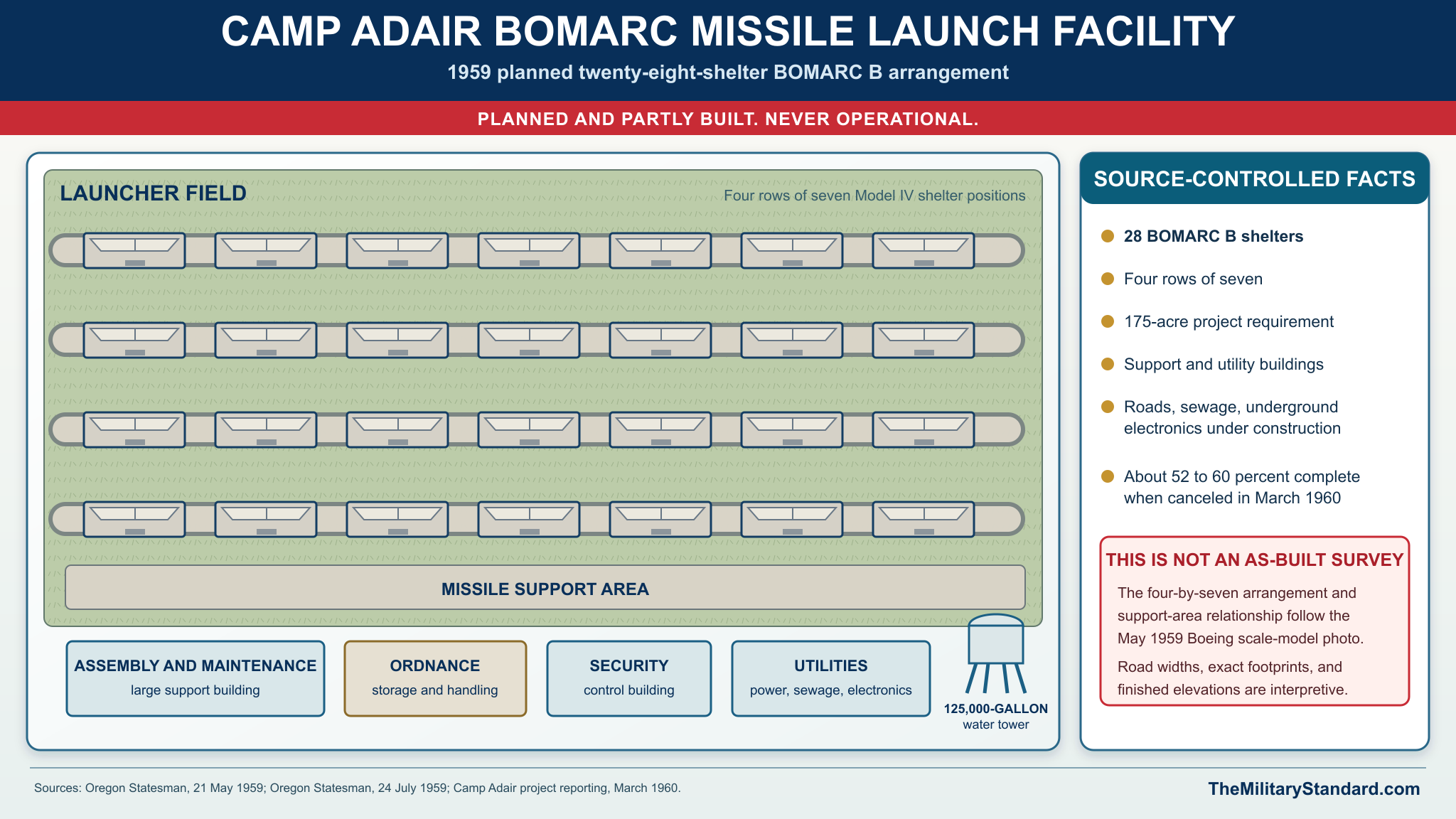
The planned twenty-eight launcher shelters formed the heart of the base. A May 1959 scale-model photograph shows them arranged behind the primary support buildings, while October reporting confirms foundation work for all twenty-eight positions. Each shelter would have held one missile in ready storage, protected from weather and connected to the electrical, communications, mechanical, and security systems required for launch.An assembly and maintenance building was included in the launcher contract package. Such a structure was essential because a missile squadron needed space for inspection, component work, testing, servicing, and technical maintenance outside the individual shelters. Even though BOMARC operations relied heavily on automated and electronic systems, technicians still needed a central facility for missile and ground-support equipment.
The contract also called for an ordnance storage structure. At an operational base this would have supported the controlled storage of weapon-related items and maintenance stocks under security and safety rules. Camp Adair never reached the point at which the planned missile force became operational.
Security control was another planned building function. A guided-missile site required controlled access because of classified electronics, weapon components, and the intended combat mission. The 175-acre property would have needed perimeter security, controlled entry, and internal zones separating launch infrastructure from general access. The incomplete site's later transition back toward open or semi-open federal land stands in sharp contrast to its planned Cold War security posture.
Water infrastructure was already substantial when the project stopped. March 1960 newspaper coverage reported a 125,000-gallon water tower as completed or nearly completed infrastructure associated with the missile base. Reliable water served fire protection, sanitation, domestic support, and industrial functions. Its presence demonstrates that Camp Adair had advanced beyond the earliest foundation stage.
A sewage system and roads were also in place or substantially developed. Roads connected the launch positions, maintenance areas, and support buildings while providing access for construction and, later, missile transport. Sewage represented another investment that would have supported a permanent military workforce. These systems remained useful enough that officials discussed whether some completed facilities could support SAGE after the missile project was canceled.
Underground electronics lines were reported as mostly installed. This was particularly significant because BOMARC depended on remote control and communications from SAGE. The launch complex needed buried circuits connecting shelters, control points, and the neighboring direction center. The unfinished electronics network made the physical relationship between the two installations more than geographic. They were being built as linked components of one air-defense weapon system.
SAGE Control Relationship
The Camp Adair missile site was designed around remote control from SAGE. Contemporary March 1960 reporting stated that the missiles would have been operated from the SAGE unit about a mile down the highway. This arrangement distinguishes BOMARC from a conventional antiaircraft battery where most engagement decisions and tracking occurred locally at the launcher site.This meant that Camp Adair's launch base could never have functioned independently in the way an isolated missile battery might appear to on a map. Its primary sensor and decision environment was distributed across the wider SAGE network. Remote radar sites detected targets. Communications circuits moved track data. The Adair computer and weapons controllers processed the threat. Only then would the missile base have acted.
The architecture also gave the Air Force a reason to build SAGE even when the BOMARC deployment was cut. The direction center controlled interceptor aircraft and other air-defense resources in addition to the planned missile site. When the Air Force canceled Camp Adair BOMARC, it explicitly retained the Adair SAGE operation. This confirms that the missile project was a subordinate weapons component of a broader air-defense network rather than the sole purpose of Adair AFS.
The close proximity of the two facilities also reduced the communications distance between the weapon base and its controlling direction center. Although SAGE could control missiles located many miles away, Camp Adair's design put the launcher installation and DC-13 into an unusually compact relationship. Air Force housing and support activities developed between them, producing a concentrated Cold War defense landscape within the former Army cantonment.
The combined plan also influenced the expected workforce. July 1959 reporting described a growing Adair Air Force community with roughly 1,200 Air Force personnel expected eventually and another 100 civilians anticipated. These totals concerned the wider SAGE and missile installation system rather than the BOMARC site alone, so they should not be used as the missile-base garrison strength.
Construction Status by Early 1960
By March 1960, Camp Adair was neither a paper proposal nor a nearly finished operational base. Contemporary estimates varied between roughly 52 and 60 percent complete depending on date and the construction component being described. Boeing engineer James Dalton used approximately 60 percent for the construction phase on March 27. The Corps of Engineers later described the $5.3 million project as 52 percent complete when the official stop-work order arrived on March 31.Those figures are compatible if they refer to different scopes or were measured at different moments. The more important conclusion is that the site had consumed substantial resources and had visible permanent construction. It was far enough along for cancellation to create an immediate public question about waste, salvage, reuse, and what to do with partially completed launcher structures.
The March 27 Oregon Statesman published a photograph showing fourteen visibly partial launch positions and pre-poured concrete wall sections. The accompanying text also described twenty-eight positions in the planned launcher program.
An estimated $2 million had already been spent on launcher-pad construction by the final weekend of March. This amount did not represent total site investment. Roads, water, sewage, electronics, planning, engineering, and other contracts added to the sunk cost. Newspaper descriptions of the overall project varied depending on whether they were discussing one contract, base construction, or broader program costs.
The site had also become part of Boeing's deployment organization. Dalton was identified as Boeing's chief engineer at Camp Adair, and the company expected a much larger contractor presence when missiles arrived. He told reporters that around 200 Boeing families were expected the following year for missile installation. Cancellation therefore affected not only military planning but also expected local employment and housing demand.
The March 1960 Cancellation Decision
The strategic case for BOMARC weakened as the site was being built. Air Force planning in the late 1950s had assumed that Soviet manned bombers would remain a major continental threat and that long-range defensive missiles could help stop them. By 1960, intercontinental ballistic missiles were reshaping both offensive strategy and defensive spending. Money increasingly flowed toward ballistic-missile warning, reconnaissance satellites, strategic missiles, and other systems.BOMARC also faced development and test difficulties. Contemporary reporting described disappointing tests of the newer missile and debate over whether the weapon justified additional bases. These technical issues did not alone cause the program reduction. Boeing's leadership publicly argued that the weapon remained sound and that the cut reflected a changed threat and funding environment rather than a simple declaration that the missile had failed.
The first public cancellation shock reached Oregon on March 25 and 26, 1960. Representative Norblad announced that the Air Force intended to scrap the Camp Adair missile base while retaining SAGE. On March 27, local contractors and engineers were still waiting for formal orders and work continued because the Defense Department's revised program required administrative approval and a stop-work directive.
This gap between policy decision and construction shutdown matters for the installation close date. March 25 marks the Air Force's announced decision to eliminate the project. March 31 marks the day the Corps of Engineers actually received the official Washington stop-order directing work to halt. Because the facility existed as an active construction project, March 31 is the best documented closing date for its physical development phase.
The March 31 report described the project as $5.3 million and 52 percent complete. That figure appears to describe the active construction package under the Corps rather than all costs ever associated with the planned base. Representative Norblad immediately proposed reusing the site for Minuteman, arguing that existing facilities should not be wasted. No such strategic-missile conversion occurred, and Camp Adair did not become an ICBM installation.
The official order also made clear that the western BOMARC reductions were broader than Oregon. Other proposed western sites faced cancellation as the Air Force reduced the number of planned installations. Camp Adair therefore did not close because of a unique local engineering defect, land dispute, or environmental problem. It was caught in a national reappraisal of continental air-defense priorities.
The Attempted Revival and Final Funding Defeat
Cancellation in March did not end the political fight immediately. Northwest legislators attempted to restore funding, and by June the Senate had approved money for the Camp Adair and Paine Field projects. The effort reflected both defense arguments and concern over federal investment already buried in concrete, roads, utilities, and construction.A June 9 report said a Senate subcommittee had recommended $75 million to complete the Adair and Paine bases after work had been halted. This created a brief possibility that construction could restart. The site therefore remained politically alive even though the Corps' stop-work order had ended active construction. Treating those stages separately also prevents the unfinished launcher site from being confused with the operational SAGE station or with completed BOMARC bases elsewhere.
The decisive funding defeat came on June 28, reported the next day. A Senate-House conference committee refused funds to complete the two-thirds-finished Camp Adair and Paine Field BOMARC bases. The conference nevertheless funded continued BOMARC-B production for other sites. This distinction shows that Congress was not abolishing BOMARC entirely at that moment. It was narrowing deployment.
The June decision also reconfirmed that SAGE at Adair would continue. Reporting stated that some missile-base facilities might be useful to the SAGE operation. The surviving direction center went on to serve Portland Air Defense Sector and later the 26th Air Division until 1969. The weapon installation, however, did not resume construction.
This sequence explains why a single "canceled March 1960" statement is incomplete. March brought the Air Force program decision and official construction halt. June brought the final congressional defeat of the near-term effort to revive the Pacific Northwest sites. The history therefore gives both dates while using March 31 as the facility's construction close date.
The project never crossed the threshold from construction to activation. No later 1960 or 1961 source reviewed shows launch shelters completed, missiles accepted for alert, or an Adair missile squadron entering operational service. The Air Force instead concentrated its reduced BOMARC force at a smaller number of completed locations. Treating those stages separately also prevents the unfinished launcher site from being confused with the operational SAGE station or with completed BOMARC bases elsewhere.
Post-Cancellation Physical Remains
The Air Force and Corps of Engineers had to decide what to do with incomplete structures after March 1960. Contemporary reporting initially speculated that launch pads might be sold, salvaged, or buried. There was no simple civilian market for half-built guided-missile shelters, and much of the site's value existed in concrete and buried infrastructure that was expensive to remove.Some infrastructure could potentially support SAGE, and officials noted that not all project spending would necessarily be wasted. Roads, utility systems, water service, and communications routes had uses beyond the launch shelters. Exactly which components were transferred into SAGE support and which were abandoned in place requires detailed engineering and property records not located.
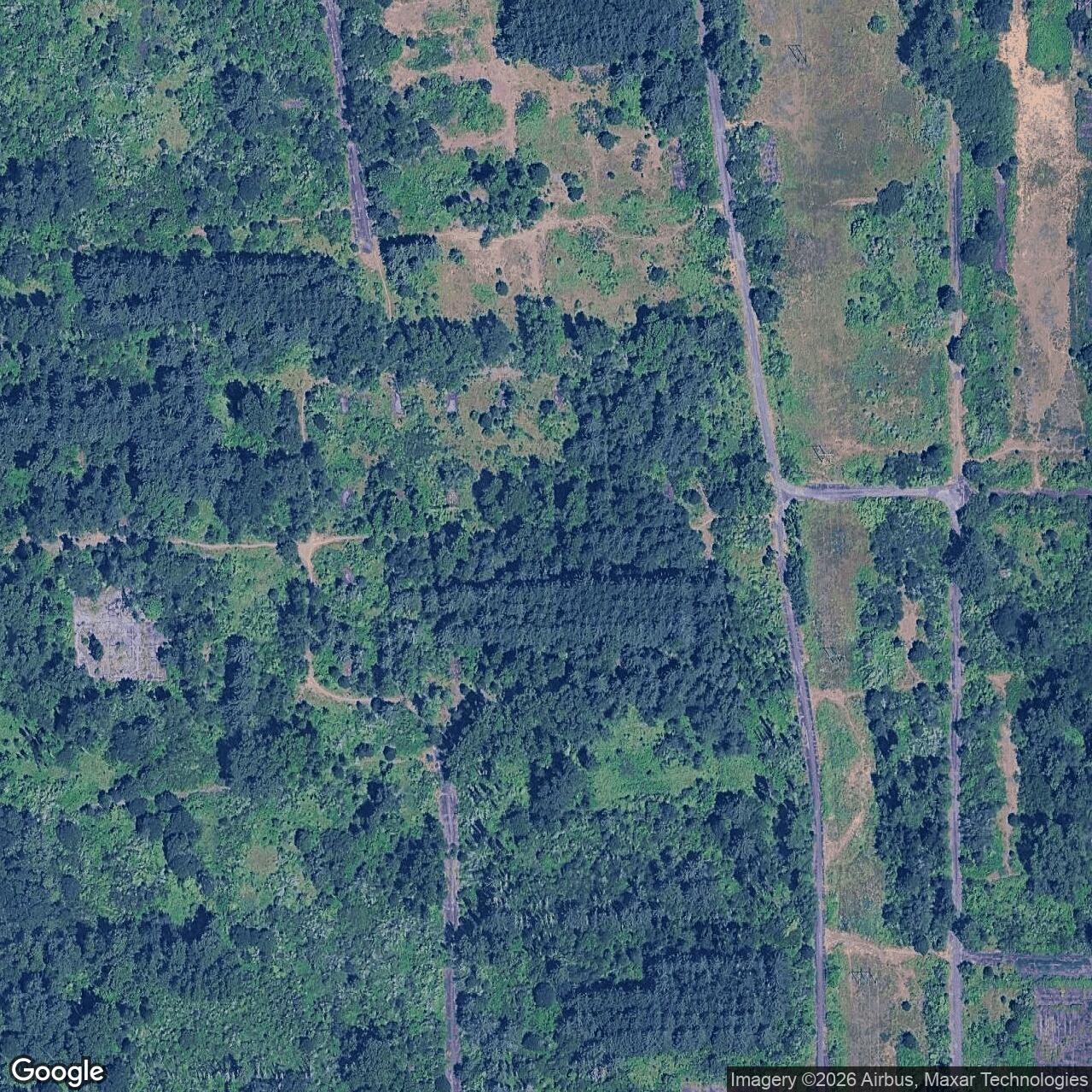
The launcher foundations themselves remained. Living History describes the modern area as overgrown and notes that 2017 archaeological survey work examined the accessibility and condition of construction remains. The surviving concrete was reportedly in good condition precisely because the site was never subjected to decades of operational modification and demolition.
Vegetation now dominates the launch area. Local historical description notes Douglas fir, Himalayan blackberry, poison oak, and efforts or intentions to return the landscape toward Willamette Valley oak savanna conditions. The contrast is striking. A site designed for hardened missile shelters and controlled access became wooded federal land where unfinished Cold War concrete sits within a recovering natural landscape.
Current City of Adair Village history places the former missile area on land now associated with the U.S. Forest Service just north of Camp Adair Road. Adair Living History identifies management through the Siuslaw National Forest office in Corvallis. A 2022 Benton County public document adds an important qualification, noting a federal tax lot where the Forest Service maintains jurisdiction but suggesting that parts of the former BOMARC site might still involve Department of Defense control. The exact present parcel interests therefore merit cautious wording.
The present site should not be described as a public museum or maintained missile park. Adair Living History and local preservation advocates have discussed interpretation and preservation, but the remains are archaeological and landscape resources rather than a restored operational exhibit. Access, ownership, and land-management restrictions should be confirmed locally before any field visit.
Current Status and Land Management
The Camp Adair BOMARC Missile Launch Facility is closed and was never operational. Its surviving identity is archaeological and historical rather than military. No missile squadron, nuclear alert, launch function, or Air Force command mission remains. Treating those stages separately also prevents the unfinished launcher site from being confused with the operational SAGE station or with completed BOMARC bases elsewhere.The City of Adair Village identifies the area of the planned missile installation as land now associated with the U.S. Forest Service north of Camp Adair Road. Adair Living History likewise states that the site is managed through the Siuslaw National Forest office in Corvallis and describes the area as wooded and overgrown.
Present federal control is not entirely transparent from the public record. Benton County documents from 2022 identify a federal parcel in the vicinity and say the Forest Service maintains jurisdiction over parts of it while suggesting the former BOMARC site might retain some Department of Defense interest.
The launch remains survive as incomplete features, including concrete pads or foundations associated with the twenty-eight planned launch positions. Local preservation work in 2017 found substantial construction remnants still in good condition. The project stopped before repeated operational modifications could erase its initial layout, making the site an unusually direct archaeological record of a missile base frozen during construction.
Adair Living History has expressed interest in working with federal land managers to preserve and interpret the BOMARC remains as part of the larger Camp Adair and Adair AFS landscape. Current preservation advocacy does not mean the site has formal museum status or open visitor infrastructure. The appropriate current-use description is wooded federal land with surviving Cold War archaeological features and active historical-preservation interest.
Chronology
- 1958-05 Public planning for a twenty-eight-shelter BOMARC-B missile installation at Camp Adair was sufficiently advanced for Associated Press distribution of a scale model showing the planned site.
- 1958-06-16 Representative Walter Norblad announced that no nearby farmland would be condemned and that the Air Force would lease the 175 acres needed for the missile site from the Army and State of Oregon.
- 1958-06-18 Oregon newspapers published the 175-acre land requirement and lease plan.
- 1958-08 Congress approved defense authorization that included a Camp Adair defensive missile project.
- 1958-10-22 Congressional and local political attention focused on the SAGE and BOMARC projects during visits to Camp Adair.
- 1958-11 Contemporary reporting described SAGE construction and noted that the nearby BOMARC installation would be integrated with the air-defense system.
- 1959-01 Oregon reporting described a roughly $40 million overall Camp Adair BOMARC project during the planning phase.
- 1959-05-21 The Oregon Statesman published a scale-model image showing twenty-eight planned BOMARC-B shelters, an assembly and maintenance building, and related utility structures for Camp Adair and Paine Field.
- 1959-07-15 Adair's SAGE computers were formally accepted while final congressional action on the adjacent BOMARC project was still pending.
- 1959-07-23 The Army Corps of Engineers announced Donald M. Drake Company of Portland as apparent low bidder for the twenty-eight launcher shelters and related buildings.
- 1959-07-24 Newspapers reported Drake's $2,496,758 bid for launcher shelters, assembly and maintenance, ordnance storage, and security control facilities.
- 1959-08-28 A 47-foot BOMARC display missile appeared at the Oregon Centennial Exposition with a public report stating that it would later be installed at Camp Adair; its later operational status is not documented.
- 1959-10-19 Foundations were being poured for the first of twenty-eight planned launch positions at Camp Adair.
- 1959-10 Donald M. Drake Company was publicly identified as the launcher contractor, with the individual launch foundations described as approximately twenty by sixty feet.
- 1959-1960 Construction proceeded on launcher positions, roads, utilities, water, sewage, communications, and support facilities.
- 1960-03-25 The Air Force decision to eliminate the Camp Adair BOMARC project became public while retaining the Adair SAGE installation.
- 1960-03-26 Oregon reporting announced that the missile base was to be scrapped while SAGE remained active.
- 1960-03-27 The Oregon Statesman photographed partially completed launch positions and reported substantial installed infrastructure and roughly $2 million spent on launcher work.
- 1960-03-27 Boeing chief engineer James Dalton described the Camp Adair project as about 60 percent complete and said missiles would otherwise have been installed the following year.
- 1960-03-31 The Corps of Engineers received the official Washington stop-work order directing construction to halt; the active $5.3 million project was reported 52 percent complete.
- 1960-03-31 Representative Norblad proposed reusing the unfinished site for Minuteman, but no ICBM conversion followed.
- 1960-06-08 A Senate defense appropriations subcommittee supported funds to complete the Camp Adair and Paine Field BOMARC bases, briefly raising the prospect of revival.
- 1960-06-28 A Senate-House conference committee refused completion funds for the Camp Adair and Paine Field sites.
- 1960-06-29 Oregon reporting described Camp Adair as roughly two-thirds finished in the broader political debate and confirmed no change to the adjacent SAGE mission.
- 1960 Construction ceased permanently and the Camp Adair BOMARC facility never entered operational missile service.
- 1969 Adair Air Force Station closed, ending the nearby SAGE mission that would have controlled the missile installation.
- 1970 Adair AFS and remaining federal lands entered excess-property transfer and disposal processes.
- 2006 USACE reported more than 1,000 individuals and agencies owning portions of the former Camp Adair property, including the U.S. Forest Service and other public and private entities.
- 2017 Archaeological survey work documented surviving unfinished BOMARC construction and assessed accessibility and condition.
- 2022 Benton County public records described federal jurisdiction in the vicinity and noted uncertainty over whether portions of the former BOMARC site might retain Department of Defense interest.
- 2024-05-06 Adair Living History published a focused history of the unfinished BOMARC site and described current Forest Service management and preservation interest.
- 2025 Local preservation advocates continued to identify the unfinished BOMARC pads as significant Cold War resources within the former Camp Adair landscape.
- 2026 Adair Living History continued public interpretation and preservation advocacy for Camp Adair and the unfinished missile area.
- Present The former missile facility remains closed and non-operational, with overgrown concrete launch remains on federal land north of Camp Adair Road and no active Air Force missile mission.
Sources & References
- WEB U.S. Army Corps of Engineers, "Camp Adair" Source for official FUDS property history, Air Force BOMARC construction, non-completion, Adair AFS history, post-1970 transfer, and broader environmental context.
- PDF The News-Review, June 18, 1958, "No Farm Land To Be Taken For Missile Base" Contemporary source for the 175-acre site requirement and announcement that land would be leased from the Army and State of Oregon rather than condemned from nearby farms.
- WEB Oregon Statesman, May 21, 1959, Camp Adair BOMARC scale model Contemporary source for the planned twenty-eight BOMARC-B shelters, assembly and maintenance hangar, utility buildings, and standardized site concept.
- WEB Oregon Statesman, July 24, 1959, "Missile Job Near" Contemporary source for Corps of Engineers bidding, Donald M. Drake Company's $2,496,758 low bid, twenty-eight launcher shelters, assembly and maintenance building, ordnance storage, and security control building.
- WEB Oregon Statesman, October 19, 1959, "Foundations Laid For Bomarc Pads" Contemporary source confirming active construction, twenty-eight planned launch positions, pad dimensions, and Donald M. Drake Company launcher work.
- WEB Oregon Statesman, March 27, 1960, "Anyone Want a Couple Million Unused Bomarc Launching Pads?" Contemporary source for partial launch construction, installed utilities, approximately $2 million in launcher work, SAGE control relationship, and immediate cancellation uncertainty.
- WEB Oregon Statesman, March 27, 1960, "Boeing Engineer Not Notified of Adair Missile Base Scrapping" Contemporary source for Boeing chief engineer James Dalton, approximately 60 percent construction status, anticipated missile installation in 1961, and Boeing deployment plans.
- WEB Oregon Statesman, April 1, 1960, "Order Official For Work Halt" Contemporary source for the Corps of Engineers' receipt of the official stop-work order on March 31, 52-percent completion status, $5.3 million active project figure, and proposed Minuteman reuse.
- WEB Oregon Statesman, June 9, 1960 Contemporary source for the Senate subcommittee effort to restore $75 million for Camp Adair and Paine Field and the continuing political debate after the construction halt.
- WEB Oregon Statesman, June 29, 1960 Contemporary source for final Senate-House conference denial of completion funds, continued BOMARC-B funding elsewhere, and explicit retention of Adair SAGE.
- WEB Oregon Statesman, June 29, 1960, "Bomarc Money Going Into Ballistic Missiles" Contemporary source for the strategic reallocation toward ICBMs, missile-warning systems, and other defense programs and the rejected Camp Adair revival.
- WEB Oregon Statesman, July 15, 1959, "Adair Computers to Be Accepted by AF Today" Contemporary source for the neighboring SAGE computer system and its relationship to the planned BOMARC installation.
- WEB News-Review, August 28, 1959, "Bomarc Missile Shown At Centennial Fair" Contemporary source for the 47-foot display missile and the statement that it was intended to go to Camp Adair after the Oregon Centennial Exposition.
- WEB Adair Living History, "BOMARC Missile Site at Camp Adair" Local historical source for site layout, planned twenty-eight launch pads, relationship to the SAGE blockhouse, present overgrown condition, 2017 archaeological survey, Forest Service management, and preservation interest.
- WEB City of Adair Village, "About Adair Village" Municipal source placing the former BOMARC area on U.S. Forest Service-associated land just north of Camp Adair Road.
- WEB Oregon State Archives, "Adair Air Force Station 1957-1969" State archival collection description identifying BOMARC construction and cancellation newspaper records and broader Adair AFS documentation.
- WEB National Museum of the United States Air Force, Boeing CIM-10 Bomarc Official Air Force museum source for the weapon's basic identity as a surface-launched pilotless interceptor designed to destroy enemy aircraft.
- WEB National Museum of the United States Air Force, Bomarc Missiles Official Air Force historical photograph of BOMARC missiles on launch structures, useful for understanding what Camp Adair's incomplete launch positions were intended to support.
- WEB Adair Living History, "The Need for Preservation" Local preservation source for continuing efforts to interpret unfinished BOMARC missile pad areas and the broader Camp Adair cultural landscape.
- WEB Adair Living History, "About Us" Source for 2017 U.S. Forest Service archaeological survey participation documenting the unfinished BOMARC missile pads.
- PDF Benton County Talks Trash, Republic Landfill and Neighborhood Tours Q&A County public-record source describing federal tax-lot jurisdiction in the vicinity and uncertainty over whether portions of the former BOMARC area retain Department of Defense interest.