
Paine Field BOMARC Missile Launch Facility, Everett Washington
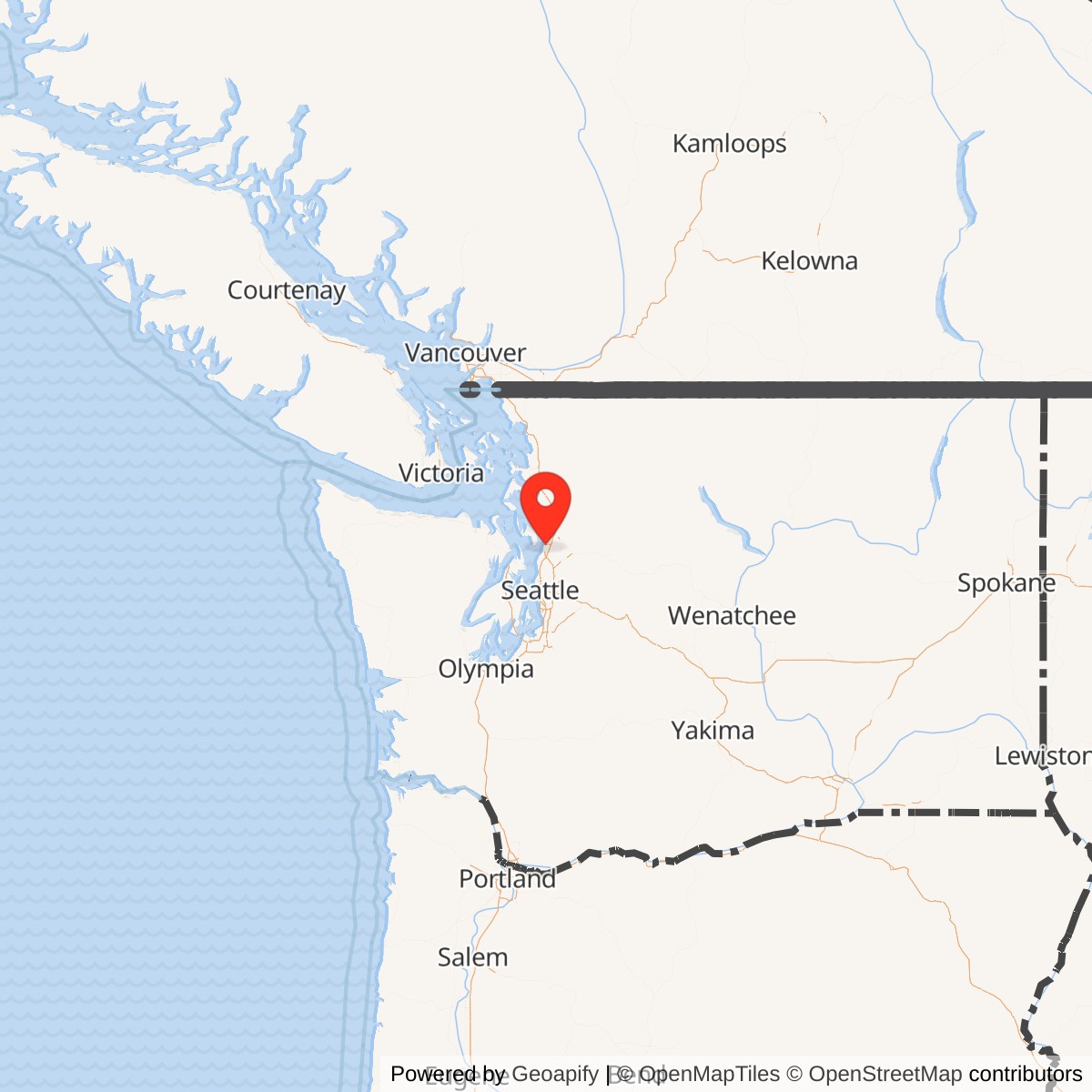
Longitude: -122.26558
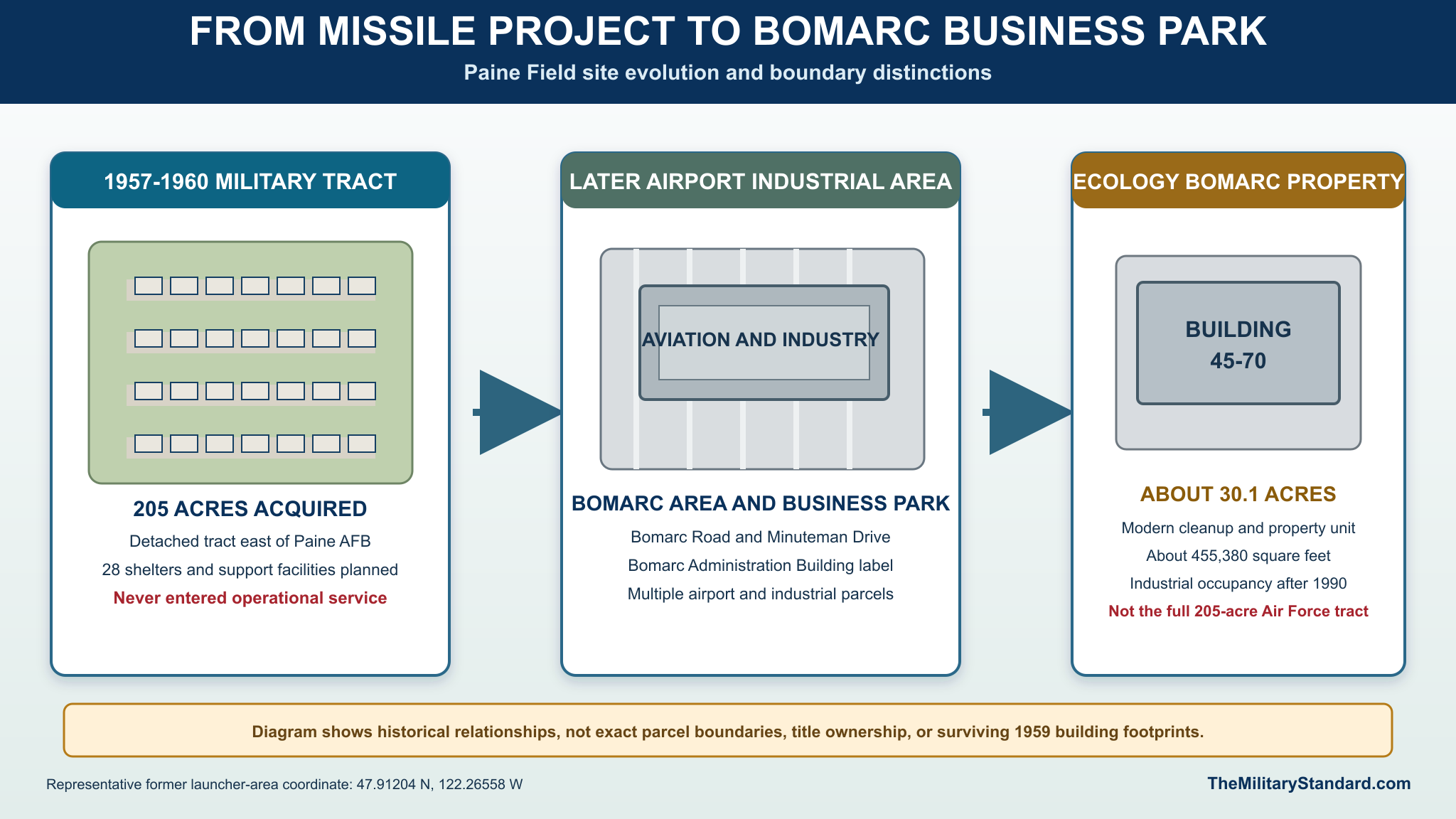
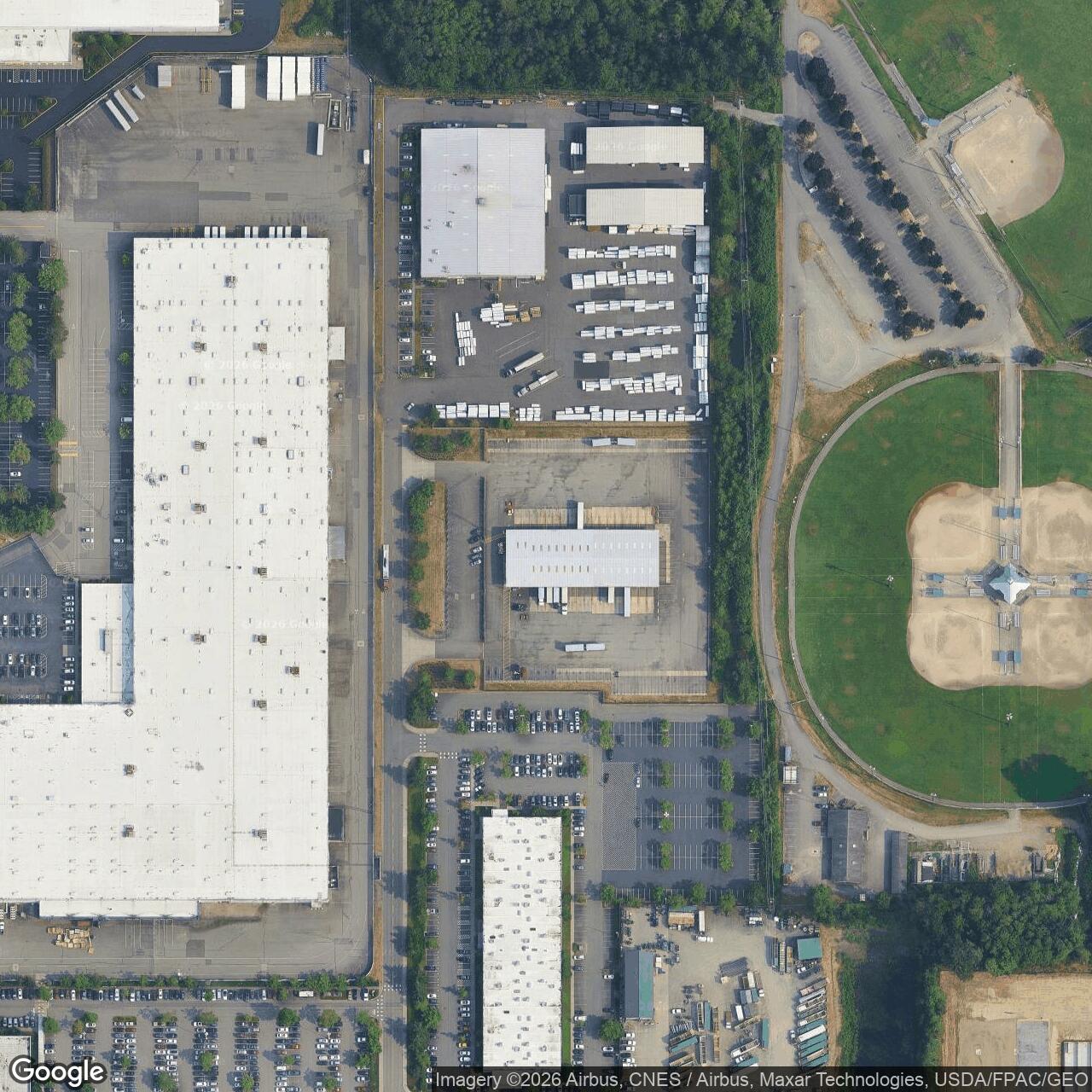
Current Role: Airport-related commercial and industrial development within the Paine Field Bomarc Area and Bomarc Business Park. Current airport plans retain Bomarc Road, Bomarc Administration Building, and BOSA BOMARC lot labels. An approximately 30.1-acre modern BOMARC Property containing Building 45-70 is administered within the Boeing Everett environmental cleanup program; it is not the full historic tract.
The Paine Field BOMARC Missile Launch Facility was an unfinished United States Air Force air-defense installation on a federally acquired tract east of Paine Air Force Base in Snohomish County, Washington. The Air Force planned the site for 28 IM-99B BOMARC long-range surface-to-air interceptor missiles. Construction began formally in September 1959 and had advanced far enough by March 1960 for contemporary accounts to describe the facility as mostly or nearly complete. A major reduction of the national BOMARC program then removed Paine from deployment. The site never became operational, no Air Defense Missile Squadron entered alert service there, and no reviewed evidence establishes that operational missiles or nuclear warheads were accepted at Paine.
Paine occupied an important place in the planned geography of continental defense. Air Defense Command intended it to anchor the northern end of a west-coast BOMARC line that continued through Camp Adair in Oregon, Travis Air Force Base in northern California, and Vandenberg Air Force Base in southern California. From the Puget Sound area, a functioning battery would have contributed long-range protection against hostile bombers approaching aircraft plants, naval facilities, ports, population centers, and regional military bases. Its mission would have depended on the Semi-Automatic Ground Environment, or SAGE, rather than on an isolated local radar and manual firing process.
The facility was physically and historically separate from Paine Field itself. The parent air base housed fighter-interceptor and support organizations and remained a shared military and civil airport. The missile tract resulted from a separate 205-acre federal acquisition in August 1957, lay east of the airfield, and was developed with specialized launcher, control, maintenance, assembly, storage, utility, and security facilities.
Cancellation did not erase the physical project. The former tract entered decades of airport-related commercial and industrial development. Planning documents continued to call it the Bomarc Site or Bomarc Area, and current airport records preserve such names as Bomarc Road, Bomarc Business Park, Bomarc Administration Building, and BOSA BOMARC lots. A portion of the later industrial area is also identified by the Washington State Department of Ecology as the BOMARC Property within the Boeing Everett cleanup program. Those modern names refer to overlapping parts of the former military landscape, but they do not all describe the same boundary or acreage.
This history treats Paine as a construction-stage missile installation whose greatest significance lies in what was built, what was intended, why the project ended, and how the tract was reused. It does not convert plans into operations. The 28 shelters were intended to house BOMARC B missiles, but capacity is not proof of loading. SAGE integration was required, but no completed Paine operational circuit has been demonstrated. Nuclear capability was part of the weapon system, but no warhead stockpile at Paine has been verified. These distinctions are essential to an accurate account.
Installation Identity, Location, and Boundaries
The preferred historical name is Paine Field BOMARC Missile Launch Facility. Period and later sources also use Paine AFB BOMARC Site, Paine Field BOMARC Site, Paine BOMARC facility, Bomarc missile base, Bomarc Site, and Bomarc Area. The word field in the name reflects association with Paine Field, not placement on the runway or within the principal flight-line complex. The project occupied a detached tract east of the runway system.Paine Field's airport-planning documents locate the Bomarc Area east of Runway 16L/34R and northeast of the Airport Road and 100th Street SW intersection. The relationship places the tract on the east side of the airport, close enough for parent-base support but distinct from the main runway, flight line, and cantonment. Modern roads and industrial buildings have altered internal circulation, and an exact overlay between the 1957 acquisition and today's parcels requires a title and cadastral study beyond the available planning maps.
The separate identity also prevents the missile story from distorting the parent-base record. Paine Field began as a county airport, served the Army Air Corps and Army Air Forces during World War II, returned to civil control, and was reactivated for Air Defense Command during the Korean War. The missile project was only one proposed element within that broader history. Its cancellation did not close Paine AFB in 1960, and the base continued supporting fighter-interceptor activity until the later Air Force withdrawal.
Strategic Origins of the BOMARC Program
BOMARC developed from the search for a pilotless interceptor able to attack bombers at ranges beyond local point-defense weapons. The name combined Boeing and the Michigan Aeronautical Research Center, two organizations associated with development. The weapon was launched from the ground, accelerated into flight by a booster, sustained by ramjet engines, guided during the middle portion of its flight by commands from the air-defense network, and directed in the terminal phase by an onboard radar seeker.The system was designed against aircraft, especially Soviet long-range bombers, rather than against intercontinental ballistic missiles. That distinction shaped both its promise and its eventual contraction. During the early and middle 1950s, bomber attack remained a central continental-defense problem. By the end of the decade, the Soviet ballistic-missile threat was growing rapidly. A fast surface-to-air interceptor could still threaten bombers, but it could not intercept a ballistic missile descending from space under the concepts then available.
Early planning was expansive. Air Defense Command at one stage sought 40 squadrons and 4,800 missiles. Cost, development delays, launcher expense, changing deployment concepts, congressional dispute, and competition for resources repeatedly reduced those ambitions. By June 1958, Headquarters USAF contemplated 31 bases, with most receiving 28 launchers. Fiscal 1959 construction authorization provided ten additional bases beyond the first four, and Paine survived into this reduced program.
The Air Force and Army also argued publicly over the relationship between BOMARC and Nike Hercules. BOMARC was an area-defense weapon intended to reach targets far from the defended objective. Nike Hercules was a shorter-range point-defense system deployed in batteries around particular cities, industrial regions, and military targets. The two could be complementary, but competition over budgets and service roles made them appear to Congress as rivals. The 1959 Master Air Defense Plan attempted a compromise and reduced the BOMARC program to 18 sites, including two Canadian locations.
Paine ranked ninth in the mid-1959 18-site sequence. ADC Historical Study No. 14 (link to PDF in Sources & References section at bottom of page) gave it a July 1960 activation target and a July 1961 operational target. Four west-coast locations, Paine, Adair, Travis, and Vandenberg, were to form the Pacific segment. This planned chain would have been separated by hundreds of miles and supported by radar and SAGE infrastructure. Paine was therefore not conceived as a stand-alone defense of one airport. It was a regional weapon node in a continental system.
Why Paine Field was Selected
Paine's strategic setting made it a logical candidate. The Puget Sound region contained Boeing production facilities, naval installations, shipyards, ports, communications, population centers, and other military facilities. Air approaches from the North Pacific and Alaska already received attention from radar and fighter-interceptor forces. A long-range missile battery near Everett could add another layer before hostile bombers reached the Seattle metropolitan and industrial area.The parent base offered practical advantages. Paine AFB already supported Air Defense Command flying activity and could provide housing, administration, supply, transportation, medical care, communications coordination, security support, and other services that did not need to be duplicated fully at a detached launcher site. Air Force planning generally placed BOMARC installations on or near existing bases for this reason. The missile tract still required its own secure operating plant, but association with Paine reduced the burden of creating a self-contained base.
The location east of the runway also offered development space without placing the launcher rows on the active airfield pavement. The federal acquisition created a substantial tract for setbacks, security, launcher spacing, internal roads, utilities, support buildings, and future expansion. The 205-acre figure was larger than the approximately 100 acres cited in 1958 for a typical BOMARC installation and suggests room for the complete project, circulation, and property buffers. It does not establish that every acre was graded or covered by missile facilities.
The Army Corps of Engineers Seattle District handled site acquisition, feasibility studies, ground surveys, and design. That district responsibility is important because it links the project to the Corps' broader missile-construction role. The Air Force defined the weapon requirement and operational concept, while Corps engineers translated the requirement into land, plans, contracts, and construction. Boeing supplied the missile system, and local contractors performed much of the physical work.
Land Acquisition and Early Planning, 1957-1958
The August 1957 land acquisition predates the formal 1959 groundbreaking by roughly two years. During that interval, the project moved through survey, design, funding, coordination, and contracting. Such a gap was normal for a specialized military installation, especially one tied to a weapon still undergoing technical change. The Air Force could not simply pour generic pads and add missiles later. Shelter configuration, utilities, guidance equipment, maintenance space, safety distances, and support systems had to match the version being deployed.
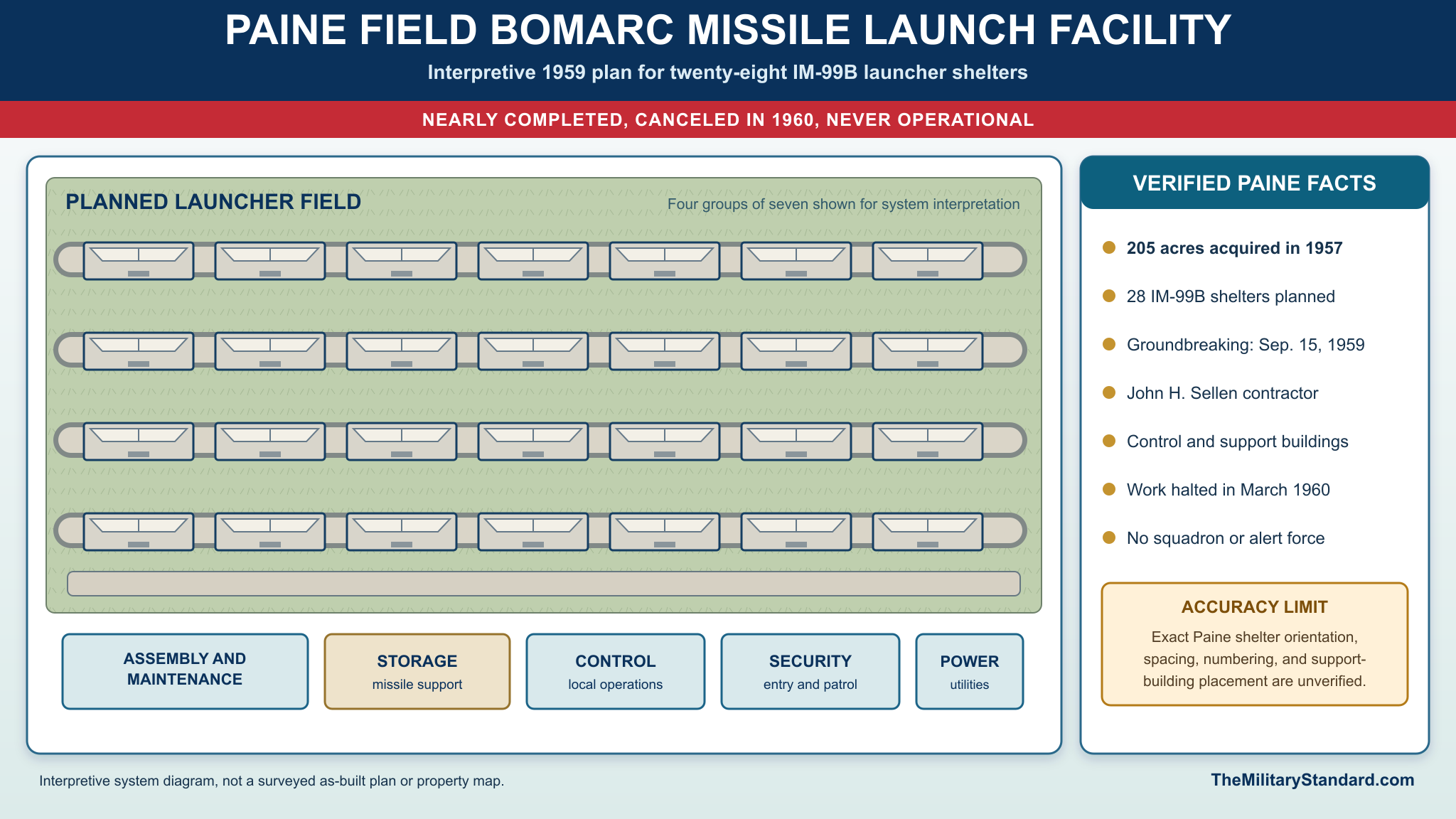
The expected weapon was the IM-99B, later redesignated CIM-10B. The B model's solid-propellant booster and longer-range design reduced some of the elaborate liquid-fuel support requirements of the A model. Paine's construction therefore belonged to the later 28-shelter B-site pattern, not the earliest massive liquid-booster configuration.
Contracting and Groundbreaking, 1959
The Air Force formally broke ground at Paine on September 15, 1959. A specialist history based on the Everett Herald reports participation by Colonel William Shaeffer and Colonel R. P. Young of the North Pacific Division or Corps engineering organization. The ceremony marked the visible start of a project already supported by land acquisition, design work, and congressional authorization.John H. Sellen Construction Company of Seattle received the principal construction contract. Two published figures survive. The August 17, 1959 issue of Missiles and Rockets listed a contract of $2,512,495 for construction of BOMARC facilities at Paine AFB. The later Radomes history, drawing on local newspaper coverage, gives $2,486,125. The difference is $26,370. It may reflect an initial award, a reported bid, a later adjustment, or a transcription difference.
The contract called for 28 launch shelters for BOMARC B missiles and buildings for control, maintenance, assembly, storage, and support. Construction would also have required grading, drainage, roads, fencing, security control, electrical distribution, standby power, water, sewer or waste handling, communications ducts, and hardstands. Some functions might be combined within one structure, and the exact Paine building schedule has not been located.
Contemporary descriptions of standard sites help explain the physical work but cannot serve as an as-built Paine plan. A typical launcher shelter was a garage-like building holding one missile horizontally on a launcher. Its roof opened, and the launcher elevated the missile to the firing position. B-model facilities used lighter construction than the environmentally controlled A-model shelters because solid booster propulsion removed liquid-fuel and oxidizer systems.
Construction proceeded rapidly. The national program expected site activation in July 1960 and operational readiness one year later. Those dates implied that buildings, utilities, launcher mechanisms, electronics, communications, missile delivery, testing, personnel training, and acceptance had to be sequenced tightly. The phrase nearly complete in later official history refers to physical construction progress, not completion of this entire operational chain.
The Planned 28-SHELTER Facility
The launcher area was to contain 28 individual shelters. Operational BOMARC sites often arranged shelters in groups of seven, a configuration visible in completed examples and described in Air Force historical accounts. Paine's contract count supports four groups of seven for interpretive purposes, but no authenticated Paine as-built plan was found. The accompanying layout graphic therefore labels its arrangement as a standardized interpretive reconstruction and does not claim exact Paine spacing, orientation, or numbering.Each B-model shelter protected a single missile and its launcher from weather while allowing rapid elevation for firing. The movable roof and hydraulic or mechanical erection system made the shelter itself part of the weapon system. It was not simply storage. Power, control circuits, drainage, inspection access, environmental protection, and safe operating clearances were needed for the launcher to function reliably in western Washington's wet climate.
The missile assembly and maintenance function would have received, inspected, tested, and serviced airframes and components. Specialized checkout equipment was necessary because the missile combined propulsion, flight-control, guidance, radar, electrical, hydraulic, and warhead-related systems. Storage buildings supported spare parts, tools, gases, and controlled materials. Control and security buildings regulated entry and local operations. Fire protection and emergency access were required even though the B model avoided the A model's liquid-booster fuel plant.
The exact warhead-support arrangement at Paine remains unresolved. An operational BOMARC B force was nuclear capable, and completed sites required secure munitions and custody functions. However, a planned building is not proof that a warhead was ever delivered. The facility must therefore be described as designed for a nuclear-capable weapon, not as a verified nuclear stockpile.
Internal roads connected the gate, support area, and launcher rows. Security fencing and controlled circulation would have separated the restricted missile plant from the parent base and surrounding community. Communications lines had to connect the local equipment with the wider defense network. Some underground work could survive later surface redevelopment, but no complete archaeological utility survey has been found.
The IM-99B BOMARC Weapon System
The planned missile was the IM-99B. After the 1962 joint designation system, the same model became CIM-10B, but Paine had already been canceled. Using CIM-10B as a modern cross-reference is helpful, while using it as a 1959 Paine construction designation would be anachronistic. No evidence supports deployment of the earlier IM-99A at this site.The B model used a solid-propellant rocket booster to accelerate from the shelter and two ramjet engines for sustained flight. Solid propulsion simplified readiness compared with the A model's liquid booster and eliminated the need for its liquid-fuel, acid, and related conditioning facilities. The missile was still a complex aircraft-like interceptor requiring inspections, electrical checkout, guidance testing, and careful handling.
Midcourse control depended on commands produced by the air-defense system. Radar stations supplied tracks, a SAGE direction center processed the air picture, and weapons controllers selected an intercept. Commands then traveled through communications circuits to a ground-to-air transmitter and by radio data link to the missile. In the terminal phase, the missile's own radar seeker acquired the target for final homing.
Published performance varies with source and test condition. The B model is commonly associated with a range near 400 miles, speeds above Mach 2, and high-altitude capability. Those figures describe the weapon family, not a proven Paine engagement envelope. Actual coverage would have depended on launch geometry, target altitude and course, radar detection, data-link reach, terrain, equipment status, rules of engagement, and the command network.
The B model could carry a nuclear warhead, generally identified with the W40 in operational service. Nuclear yield offered a way to attack formations and compensate for the difficulty of a direct hit at high speed. It also imposed exacting security, custody, authorization, safety, maintenance, and emergency-response requirements. Because Paine never reached operational status, no alert warhead inventory should be inferred from the planned missile type.
SAGE, Radar, and Data-Link Relationships
Paine's proposed battery belonged to the SAGE era. The Seattle Air Defense Sector was organized at McChord Air Force Base on January 8, 1958, and its direction center became the first operational SAGE sector in the 25th Air Division and the western United States. Paine AFB's fighters operated within that regional environment. A completed BOMARC battery would likewise have required SAGE tracking and engagement support.SAGE combined radar inputs, digital computers, communications, identification procedures, and weapons-control personnel. It did not make the launch site automatic in the sense of operating without people. Human controllers evaluated tracks and directed engagements, while local crews maintained missiles, shelters, data-link equipment, power, and security. The system reduced the time needed to convert dispersed radar information into a coordinated response.
The precise final Paine control circuit has not been documented in the sources located. McChord's Seattle sector is the logical and regionally documented direction-center relationship, but Paine was canceled before operational acceptance. This history therefore describes McChord as the planned regional SAGE environment rather than asserting a tested, accepted, and continuously operational Paine-to-McChord missile-control circuit.
The same caution applies to the Ground-Air Transmitter. BOMARC B required a radio data link, and national planning called for directional transmitter capability where necessary. No Paine-specific public record reviewed here establishes a separate completed GAT property, formal site code, accepted AN/GKA equipment configuration, or operational date.
Radar stations along the Pacific Northwest approaches would have contributed tracks to the regional picture, while fighters at Paine and other bases supplied manned interception. The BOMARC launcher site did not replace those sensors or aircraft. Its value depended on them. Conversely, long-range missiles could extend the reach of the network beyond the immediate fighter base and local point defenses.
Planned Units, Staffing, and Daily Operations
No Air Defense Missile Squadron is documented as having activated at Paine. ADC Historical Study No. 14 lists a planned site activation and operational date, but the March 1960 reduction intervened before those milestones. Operational BOMARC unit lists include eight United States squadrons and two Canadian squadrons in the final force, not a Paine squadron. The absence is substantive, not merely a missing unit name.This finding prevents a common error. Paine AFB hosted fighter-interceptor units, including the 321st and later 64th Fighter-Interceptor Squadron and the 57th Fighter Group, but they were not Paine BOMARC missile operators. Their presence demonstrates parent-base air-defense activity and potential support infrastructure. It does not establish that aircrew maintained launch shelters or stood missile alert.
Had the site entered service, its workforce would have required operations, missile maintenance, electronics, communications, munitions, civil engineering, security police, supply, transportation, administration, and emergency-response specialists. Work would have continued around the clock because alert readiness, power, communications, shelter condition, and security could not be left unattended. Parent-base organizations would have provided housing and other services.
At Paine, the documented workforce was instead a construction organization. Corps district personnel, Air Force representatives, engineers, contractor managers, trades, equipment operators, and laborers moved the site toward completion. The exact peak workforce, individual roster, shift pattern, and construction-safety record were not located. It would be misleading to convert a typical operational squadron strength from another base into a Paine staffing figure.
Likewise, planned routines must not be narrated as completed operations. There is no evidence of daily missile status boards, alert crew changes, simulated launches, warhead inspections, operational readiness inspections, or live-fire deployments at Paine. The most defensible daily-life account concerns construction, weather, security of an unfinished defense project, and preparation for a mission that never began.
Cancellation in March 1960
The national turning point came on March 23, 1960, when Headquarters USAF informed Air Defense Command that IM-99B deployment would be limited to seven United States sites under the particular program formulation described in ADC records. On March 24 the Air Force returned to Congress with a drastically reduced procurement request, cutting proposed IM-99B funding from $421.5 million to $40 million and stating that further procurement would end. The final accounting retained eight United States operational sites and two Canadian sites because some locations combined A and B models.
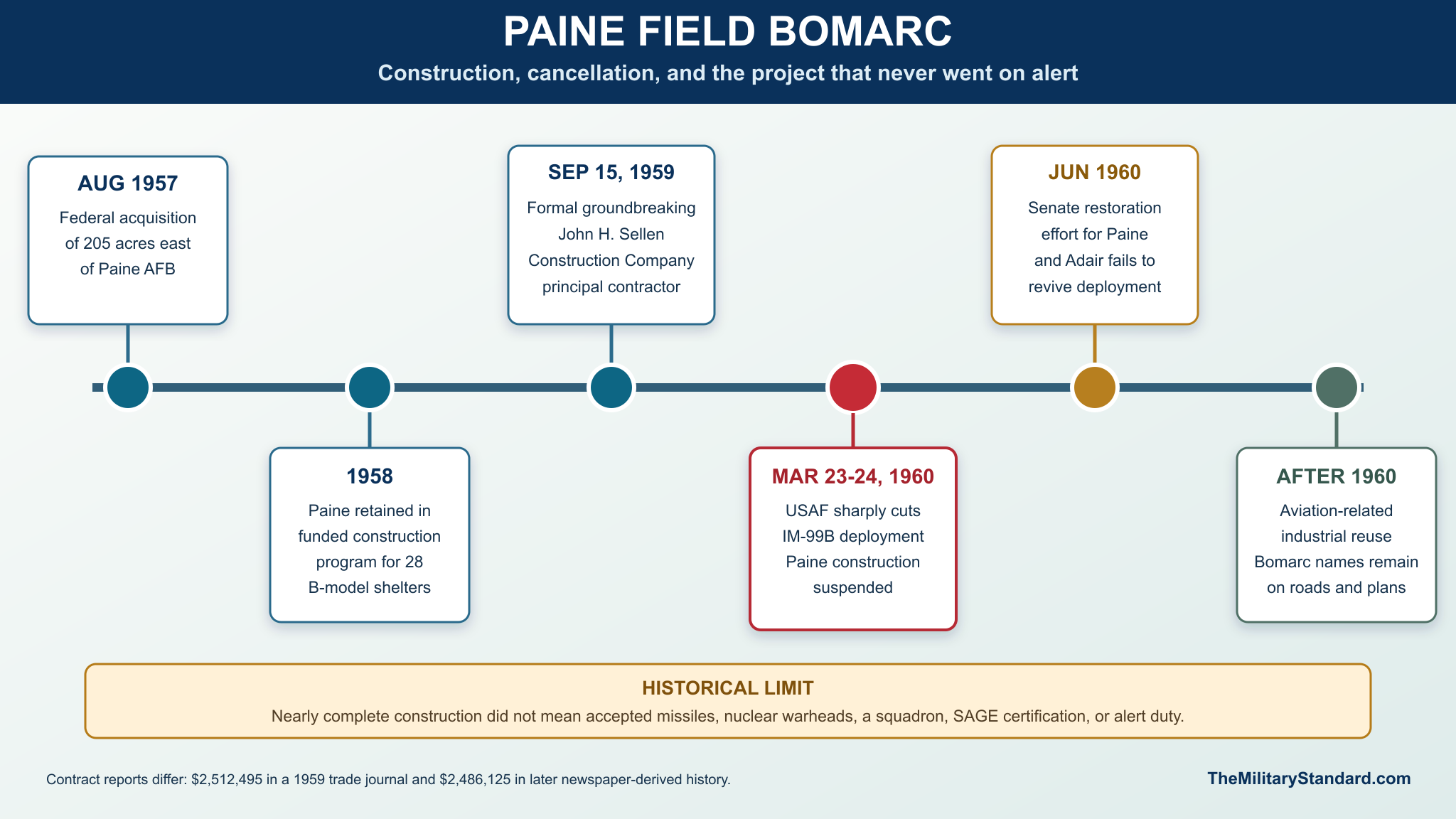
The reasons extended beyond a single technical failure. The Soviet emphasis on intercontinental ballistic missiles reduced the strategic value of a system unable to attack them. BOMARC continued to encounter development and operational delays. Money was needed for higher-priority Atlas and Titan intercontinental ballistic missile programs and for other air-defense forces. Congress also remained skeptical about the cost and effectiveness of competing missile systems.
From the local perspective, the decision stranded a large construction investment. Representative Jack Westland of Everett reportedly accepted that rapid missile development had shifted attention away from manned-aircraft defense and suggested possible conversion to an ICBM or antiballistic-missile role. No such conversion occurred. BOMARC shelters and support facilities were designed for a horizontal, atmospheric interceptor and could not simply become strategic-missile silos without major reconstruction.
This history uses 1960-03 as the close date. Several exact dates could be proposed: the March 23 force decision, the March 24 budget revision, the later public announcement, or the local stop-work implementation. Available sources do not provide a Paine-specific final contract-termination order matching the March 31 Corps order documented at Camp Adair.
The June 1960 Attempt to Revive Paine
Cancellation was briefly contested. On June 8, 1960, Washington senators Henry M. Jackson and Warren G. Magnuson announced that a Senate military appropriations subcommittee had restored funds connected with completion of the Paine and Adair facilities and missile procurement. A contemporary Oregon Statesman report described a $75 million action for the two projects. The restoration showed that western congressional supporters still considered the partially built sites worth completing.The Senate action did not return Paine to the operational program. Later congressional decisions and the final Air Force deployment left the west coast without the planned four-site BOMARC chain. The final operational force concentrated in the northeastern United States, northern Great Lakes region, and Canada. Paine's July 1960 activation and July 1961 operational targets passed without an operating squadron.
The failed revival matters because it separates an immediate stop-work decision from final abandonment. For several months in 1960, completion remained a political possibility. Construction already performed could be cited as a reason to continue, while program critics saw further spending as an escalation of sunk cost. The national shift prevailed.
Post-Cancellation Property Disposition
The exact parcel-by-parcel disposal instrument and date have not been located in the online record. The former missile tract remained entangled with federal airport obligations and later county planning. By 1978, the Paine Field mediated planning process included a specific section on use of the Bomarc Site and recommended aeronautical-related purposes and industry. The report also called for work with the General Services Administration and Federal Aviation Administration to resolve use conditions and keep the property under Snohomish County stewardship.This language suggests that disposition was not a simple private sale immediately after March 1960. Federal investment, airport sponsorship, land-use covenants, and aviation policy shaped later decisions. The 1978 record does not by itself establish the legal title chain for all 205 acres. It does show that the former military tract remained a recognized planning unit almost two decades after cancellation.
Later findings state that the Bomarc site was redeveloped with aviation-related business and manufacturing facilities. This reuse fit Paine Field's growing aerospace economy. Boeing selected nearby land for its wide-body production plant in the 1960s, and the airport developed a mixed landscape of manufacturing, maintenance, training, general aviation, and support businesses.
Modern roads and lots preserve the old program name even where the original military structures are altered or gone. Bomarc Road and Bomarc Business Park make the history legible in place names. The persistence of a Bomarc Administration Building label in the 2024 airport data sheet is stronger evidence for at least one named surviving or successor building, but the label alone does not establish an unaltered 1959 structure.
Industrial Reuse and the Modern Bomarc Area
Paine Field planning identifies the Bomarc Area east of Runway 16L/34R and northeast of Airport Road and 100th Street SW. The plan anticipates continued use for Bomarc Business Park and related functions. The former defense tract is therefore part of an active airport and industrial landscape rather than an abandoned fenced missile base.The modern area includes multiple parcels and tenants. Airport records identify BOSA BOMARC lots, the Bomarc Administration Building, and other aviation, manufacturing, logistics, public-service, and commercial facilities in the broader vicinity.
One important later development is Boeing Building 45-70. Washington Ecology describes an approximately 455,380-square-foot building on an approximately 30.1-acre BOMARC Property at 9205 Airport Road. Boeing occupied the property from 1990 through 1999 for commercial-aircraft interior subassembly. The building was unoccupied from 1999 through 2003 and later subleased to tenants engaged in recycling, aerospace manufacturing, warehousing, and distribution.
The 30.1-acre Ecology parcel is a modern cleanup and property-management unit. It is not the same as the full 205-acre Air Force acquisition and must not be represented that way. Building 45-70 also postdates the canceled missile project and reflects major redevelopment. Its size and later manufacturing history help explain why much of the original launcher landscape is no longer readily readable from current development.
Environmental Investigation and Cleanup
The Washington Department of Ecology includes the BOMARC Property in the larger Boeing Everett cleanup site. The agency's 2025 update described cleanup as started and reported an Agreed Order for the Bomarc portion. This administrative relationship allowed cleanup work to proceed while supporting property transfer. It does not mean that the Air Force BOMARC project caused every contaminant found in the modern parcel.Investigation history is complex. A 1989 Dames and Moore investigation identified limited petroleum-impacted soil in the southeastern portion of the property at the north end of a bunker complex and near storage silos in the north-central area. Water from a former septic tank contained metals and halogenated volatile compounds above drinking-water standards. The tank was removed during site preparation, but the excavation was backfilled before the bottom could be fully assessed.
The words bunker complex and storage silos in environmental records may refer to surviving or repurposed former-site features, but they should not be confused with underground strategic-missile silos. BOMARC used above-ground shelters. Local environmental terminology can describe reinforced or subsurface storage structures without changing the launch method.
Later investigations addressed underground storage tanks, soils, groundwater, sub-slab vapor, indoor air, oil-water separators, former paint or chemical-storage areas, and industrial tenant spaces. Five emergency-containment underground tanks were removed in 2003; investigators reported no evidence of a release to surrounding soil during removal, although one perched-groundwater sample contained benzene above a cleanup level. Other work identified cadmium in soil and compounds including Freon-12 and trichloroethylene beneath or within Building 45-70.
Ecology's cleanup plan lists the building interior, oil-water separators, cadmium-contaminated soil, and vapor or indoor-air concerns among the relevant solid-waste management units and areas of concern. Selected or considered remedies include soil excavation, monitoring, and institutional or engineering controls. The exact remedy varies by medium and location.
Attribution must remain precise. Some petroleum evidence was associated with older structures, while later contamination was investigated in areas used by Boeing and subsequent tenants. The cleanup record spans decades of industrial occupancy. Without chemical-specific release histories and property records, it would be inaccurate to label the entire modern cleanup as a legacy of Air Force missile construction. The history therefore records the environmental program as part of the site's full record while avoiding unsupported causal claims.
Surviving Features and Current Status
The former 205-acre military tract is now substantially altered by roads, parking, large industrial buildings, airport-support activities, and parcel redevelopment. Current airport plans still identify a Bomarc Administration Building and Bomarc business lots. These names confirm continuity of place, but not the survival of every launcher shelter, roof mechanism, control room, fence, or utility line.
The installation is closed as a military missile site and never achieved operational status. Its current use is best described as airport-related commercial and industrial development within the Paine Field Bomarc Area and Bomarc Business Park, with portions included in the Boeing Everett environmental cleanup program.
Access must be described cautiously. The area contains active businesses, airport property, controlled industrial parcels, and cleanup locations. The representative coordinate is not an invitation to enter a private or restricted parcel. Public roads may provide views of the wider area, but property rights, airport rules, business operations, and safety requirements govern access.
Detailed Chronology
- 1951: Paine Field is reactivated for Air Defense Command use during the Korean War era, establishing the parent-base air-defense setting.
- 1955-1956: Air Defense Command develops large national BOMARC deployment concepts, including a planned Paine location in successive force lists.
- 1957-08: The federal government acquires 205 acres east of Paine Air Force Base for a BOMARC missile site.
- 1958-01-08: The Seattle Air Defense Sector is organized at McChord Air Force Base, creating the regional SAGE command environment relevant to Paine.
- 1958-06: Headquarters USAF moves toward a reduced 31-base BOMARC concept, with most sites planned for 28 launchers.
- 1958: Fiscal 1959 military construction authorization adds ten BOMARC bases beyond the first four and keeps Paine in the funded construction program.
- 1958-12: ADC's ordered construction list places Paine eleventh among 29 projected locations.
- 1959-06: The compromise Master Air Defense Plan reduces BOMARC deployment to 18 sites, including two in Canada.
- 1959 midyear: Paine ranks ninth in the revised program, with July 1960 activation and July 1961 operational targets.
- 1959-08-17: Missiles and Rockets reports a $2,512,495 John H. Sellen Construction Company contract for Paine BOMARC facilities.
- 1959-09-15: The Air Force formally breaks ground at the Paine Field BOMARC site.
- 1959-09-16: The Everett Herald reports the groundbreaking and project details.
- Late 1959: Construction proceeds on 28 B-model launch shelters and control, maintenance, assembly, storage, and support facilities.
- 1960-01: Air Force testimony continues to imply an 18-site deployment program and requests major IM-99B procurement funding.
- 1960-03-23: Headquarters USAF informs Air Defense Command that the IM-99B deployment program will be sharply limited.
- 1960-03-24: The Air Force asks Congress to reduce IM-99B procurement from $421.5 million to $40 million and signals an end to further procurement.
- 1960-03: Work at Paine is suspended while the site is described as mostly or nearly complete.
- 1960-03-26: Local reporting discusses the suspended Paine project and Representative Jack Westland's reaction.
- 1960-06-08: Senators Henry M. Jackson and Warren G. Magnuson announce a Senate subcommittee action intended to restore funds for Paine and Adair.
- 1960-06: The attempted congressional revival does not restore Paine to the final operational program.
- 1960-07: The planned Paine activation month passes without an activated missile squadron.
- 1961-07: The planned operational month passes without missiles on alert at Paine.
- 1962: The IM-99B receives the later designation CIM-10B; Paine remains canceled and never operates under either designation.
- 1968-09-30: The principal Air Defense Command base era at Paine ends with the inactivation of the 57th Fighter Group, separate from the 1960 missile-site cancellation.
- 1978-04-11: Snohomish County adopts a mediated planning direction for Paine Field that includes future use of the Bomarc Site.
- 1978: Planning recommends aeronautical-related and industrial uses for the former missile tract and coordination with GSA and FAA over property-use conditions.
- 1989: Environmental investigation identifies limited petroleum-impacted soil near a bunker complex and storage silos and samples a former septic-tank area.
- 1990: Boeing begins occupying the later approximately 30.1-acre BOMARC Property for commercial-aircraft interior subassembly.
- 1992: Petroleum-contaminated soil identified in the former property area is excavated and treated off site according to later investigation summaries.
- 1999: Boeing ends the documented aircraft-interior subassembly occupancy of Building 45-70.
- 1999-2003: Building 45-70 is reported unoccupied.
- 2002-2003: Investigators evaluate and remove five emergency-containment underground storage tanks at the BOMARC Property.
- 2003 and after: Building 45-70 returns to multi-tenant industrial, recycling, aerospace, warehouse, and distribution use.
- 2007-2014: Additional investigation addresses soil, sub-slab vapor, indoor air, cadmium, Freon-12, trichloroethylene, and other concerns at the modern BOMARC Property.
- 2018-2021: Ecology prepares and finalizes cleanup planning and an Agreed Order for the Bomarc portion of the Boeing Everett site.
- 2024-05: Paine Field's Airport Layout Plans still identify Bomarc Administration Building and BOSA BOMARC lots within the active airport-industrial landscape.
- 2025-05: Washington Ecology lists cleanup as started and continues separate agreed-order administration for the Bomarc property.
- 2026: The former launcher tract remains a closed, never-operational military installation within an active airport-related commercial and industrial area.
Sources & References
- PDF Air Defense Command, ADC Historical Study No. 14, History of Air Defense Weapons, 1946-1962 Source for National program reductions, 1958 and 1959 construction lists, Paine priority, activation and operational targets, west-coast chain, March 1960 decision, strategic reasons, and final force size.
- PDF U.S. Army Corps of Engineers, Defend and Deter: The Legacy of the United States Cold War Missile Program Source for Paine site selection, Seattle District acquisition, feasibility studies, ground surveys, design responsibility, nearly completed construction, and 1960 halt.
- PDF United States Air Force, Leading the Way: The History of Air Force Civil Engineers Source for Air Force missile-construction organization, BOMARC engineering, A-model and B-model facility differences, launcher-shelter design, support functions, and Corps relationships.
- PDF Congressional Record, Military Construction Authorization for Fiscal Year 1959 Source for Congressional construction context and inclusion of Paine, printed as Payne, among the funded BOMARC locations.
- PDF Missiles and Rockets, August 17, 1959, Contracts Source for Contemporary $2,512,495 John H. Sellen Construction Company contract listing and period industry context.
- WEB Radomes.org, Paine AFB BOMARC Recent Photos and History Source for September 15, 1959 groundbreaking, local participants, alternate $2,486,125 contract figure, 28 B-model shelters, support-building functions, March suspension, near-completion description, congressional response, and 1997 photographs.
- WEB HistoryLink, Paine Field, Snohomish County Source for Parent-field history, Air Defense Command context, August 1957 federal acquisition of 205 acres, east-of-base location, canceled project, later airport development, and Everett Herald citations.
- WEB Paine Field, Airport Plans Source for Official location of the Bomarc Area east of Runway 16L/34R, relationship to Airport Road and 100th Street SW, and continuing business-park use.
- WEB Paine Field, Airport Data, Airport Layout Plan Sheet 2, May 2024 Source for Current official Bomarc Administration Building and BOSA BOMARC lot labels and present airport-facility context.
- WEB Paine Field, Existing Airport Layout Plan, May 2024 Source for Current map relationship among Bomarc Road, Minuteman Drive, Bomarc Business Park, airport boundary, runways, and identified buildings.
- WEB Snohomish County, Paine Field Mediated Role Determination Report Source for 1978 recommendations for aeronautical-related and industrial use, GSA and FAA coordination, county stewardship, later redevelopment, and long-term planning context.
- WEB Washington State Department of Ecology, Boeing Everett Cleanup Site 4534 Source for Current cleanup status, BOMARC Property Agreed Order, property-sale context, cleanup documents, and agency oversight.
- WEB Washington State Department of Ecology, Boeing Everett Upland Areas and Powder Mill Gulch Cleanup Action Plan Source for Modern 30.1-acre BOMARC Property, Building 45-70 size and use, tenant chronology, areas of concern, contaminants, selected actions, and distinction from the full historic acquisition.
- WEB Washington State Department of Ecology, Boeing Everett Remedial Investigation Report Source for 1989 investigation, bunker and storage-silo references, petroleum and septic-tank findings, later tank removal, sub-slab and soil investigations, and source-attribution limits.
- PDF Air and Space Forces Magazine, The Bases, August 1958 Source for Contemporary description of a typical BOMARC installation, approximately 100-acre functional planning, shelter operation, support facilities, and parent-base support concept.
- WEB Air and Space Forces Magazine, The Heyday of Nuclear Air Defense Source for BOMARC and Nike relationship, national air-defense context, launcher groups, nuclear capability, construction controversy, and program scale.
- WEB Air Force Historical Research Agency, Western Air Defense Sector Lineage Source for Official Seattle Air Defense Sector establishment, assignment to the 25th Air Division, McChord station, and regional SAGE context.
- PDF Washington State Digital Archives, Western Air Defense Sector History Source for Seattle sector operational chronology, McChord SAGE direction-center activation, regional defense mission, and later organizational continuity.
- WEB Oregon Statesman, June 9, 1960 Source for Contemporary Senate subcommittee effort to restore funds for Paine and Adair and the amount associated with missile-site completion and procurement.
- PDF National Park Service, Cold War Defense of the United States Theme Study Source for BOMARC A and B development, SAGE integration, strategic change from bomber to ballistic-missile threat, and final cancellation context.