
Duluth BOMARC Missile Site / French River Missile Site, Minnesota
Longitude: -91.8827778
Site Number: BOMARC B; CIM-10B; 74th Air Defense Missile Squadron; Model IV
Official Base Website: Former Duluth BOMARC Missile Site / French River Industrial and Storage Property
Current Role: Private industrial, warehouse, and storage reuse on the former Bergquist Road missile property. Specialist and regional sources report shelter storage or mini-storage and support-building use by stone, wood-products, marble, or other industrial businesses at different dates. Surviving shelter rows, support structures, roads, and the water tower remain on private property. Current owner permission is required for access.
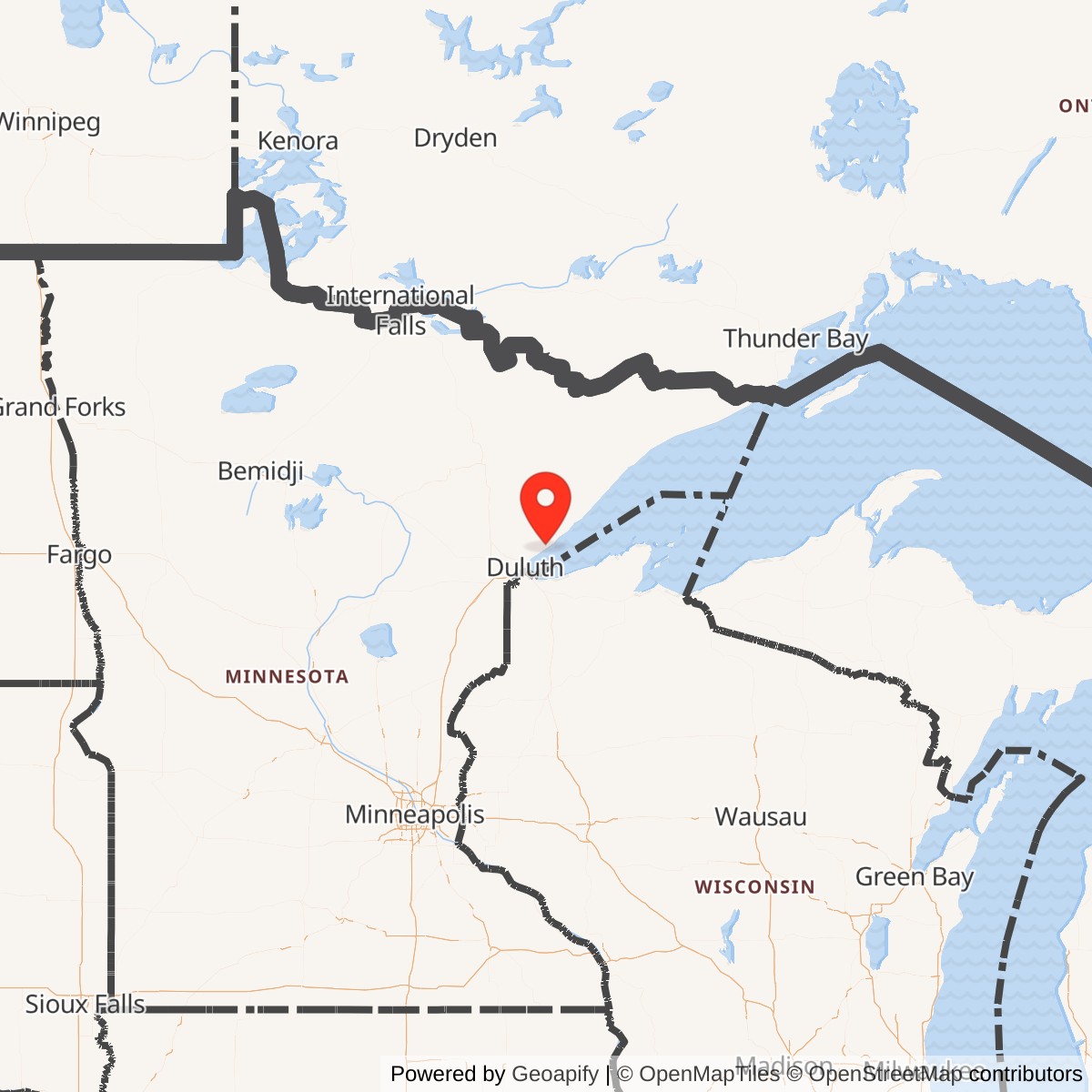
The Duluth BOMARC Missile Site was a detached Air Defense Command installation on Bergquist Road near French River in Duluth Township, northeast of Duluth, Minnesota. The 74th Air Defense Missile Squadron operated 28 IM-99B, later CIM-10B, BOMARC long-range surface-to-air interceptor missiles from individual Model IV launcher shelters. Its combat purpose was to engage hostile bombers approaching the western Great Lakes, northern industrial and military areas, and the continental interior. The battery was one element of the radar, computer, communications, fighter, and missile network that defended the United States and Canada through NORAD.
The Air Force constituted and activated the 74th on December 17, 1959, then organized it at Duluth Municipal Airport on April 1, 1960. The squadron moved to the French River missile property in July 1960 while construction, equipment installation, training, and acceptance continued. BOMARC B weapons arrived in early 1961, and the first missile was ready for launch on August 18, 1961. The site remained an alert installation until the 74th inactivated on April 30, 1972.
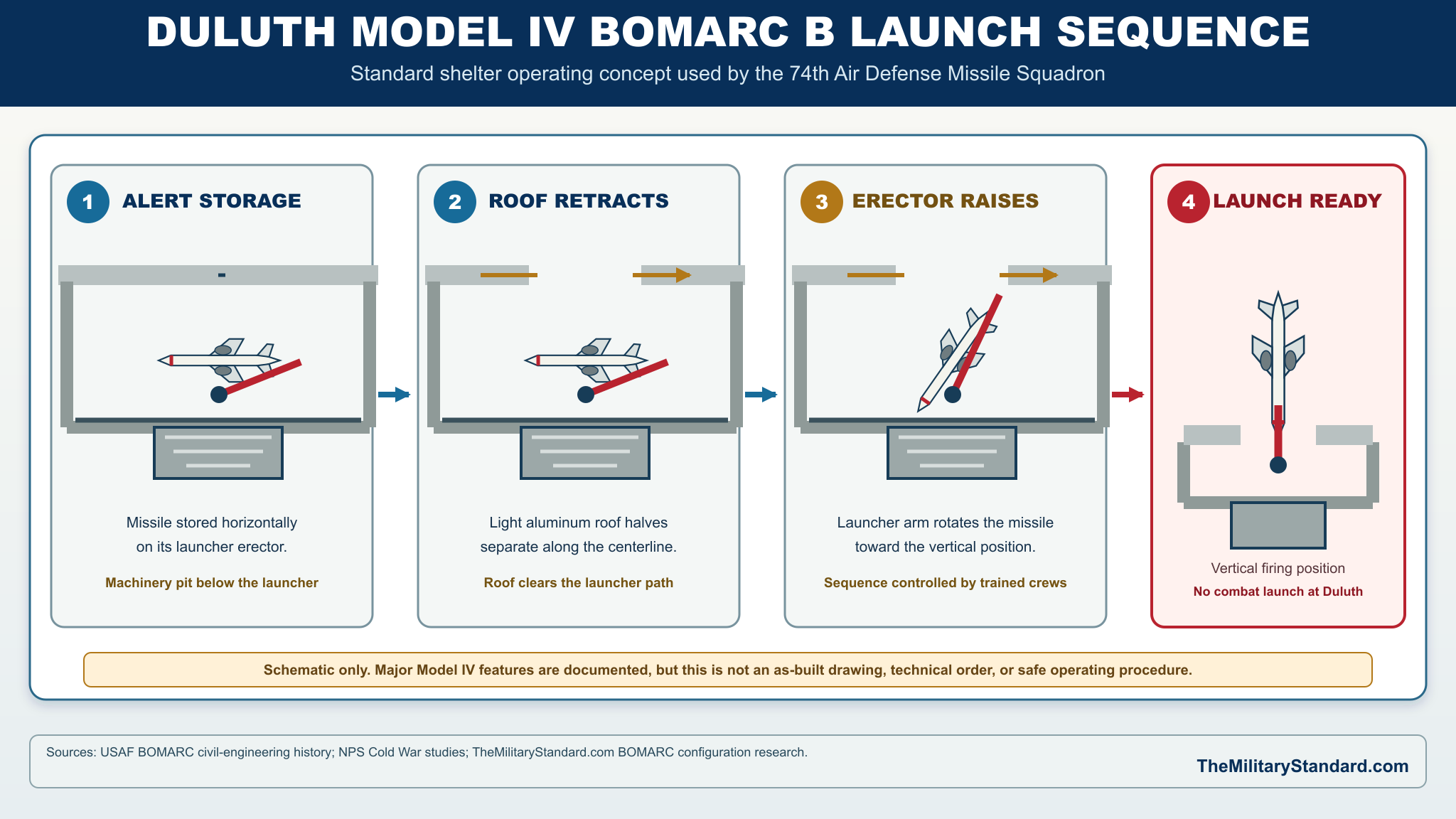
French River was built specifically for the solid-booster B model and never operated the liquid-booster BOMARC A. Its 28 above-ground launcher shelters used thin precast-concrete walls and a light two-part roof that separated along the centerline and rolled aside. The weapon then rose from its horizontal storage position on a launcher erector. This Model IV design reduced the elaborate propellant, cooling, and utility systems required at early A-model batteries.
The missile plant was geographically and functionally separate from Duluth Air Force Base at the municipal airport. Duluth supplied administrative and logistical support, while the nearby SAGE direction center processed the regional air picture and issued engagement information through the command network. The French River crews maintained missiles, shelters, electronics, communications, security, utilities, and alert readiness. The site therefore had its own physical identity even though official station records often placed the squadron at Duluth Municipal or International Airport.
After closure, the last 28 missiles were reportedly removed in August 1972. Local historical reporting states that Duluth Township acquired the property in 1976 and intended to resell it for industrial use. The site subsequently supported Army Reserve maintenance and several private industrial or storage uses. The shelter rows, support buildings, water tower, road pattern, and other altered features preserve a rare example of a complete northern-tier BOMARC B battery.
Federal and state records also document post-military environmental review. The U.S. Army Corps of Engineers lists the property as Formerly Used Defense Site E05MN0235, USAF Duluth Missile/USARC Maintenance Site, with two containerized hazardous-waste response projects. Minnesota Pollution Control Agency data identifies the Former Duluth Bomarc Missile Site as petroleum-release investigation LS0005928, opened in 1992 and closed in 1996 with no current tasks indicating risk. Those administrative closures do not prove that every parcel or building is free of all hazards, and the township's 2025 emergency plan separately notes possible later gun-manufacturing materials.
Installation Identity, Location, and Boundaries
The formal name used here is Duluth BOMARC Missile Site / French River Missile Site. Period and later sources also use Duluth Air Force Missile Site, Duluth AFB BOMARC Site, Duluth AB BOMARC Site, French River BOMARC Base, Knife River BOMARC Site, and 74th Air Defense Missile Squadron site. The French River name best describes the physical location. The Duluth name records the squadron's station and parent-base relationship rather than placement on the airport flight line.The site lies in Duluth Township in St. Louis County, near the unincorporated French River community and several miles inland from Lake Superior. Period sources variously call it 10 miles northeast of the airport, 22 miles northeast of Duluth, near Knife River, or near French River. The differences reflect the point of origin and whether distance was measured by road, straight line, city center, or airport. They do not indicate several separate BOMARC batteries.
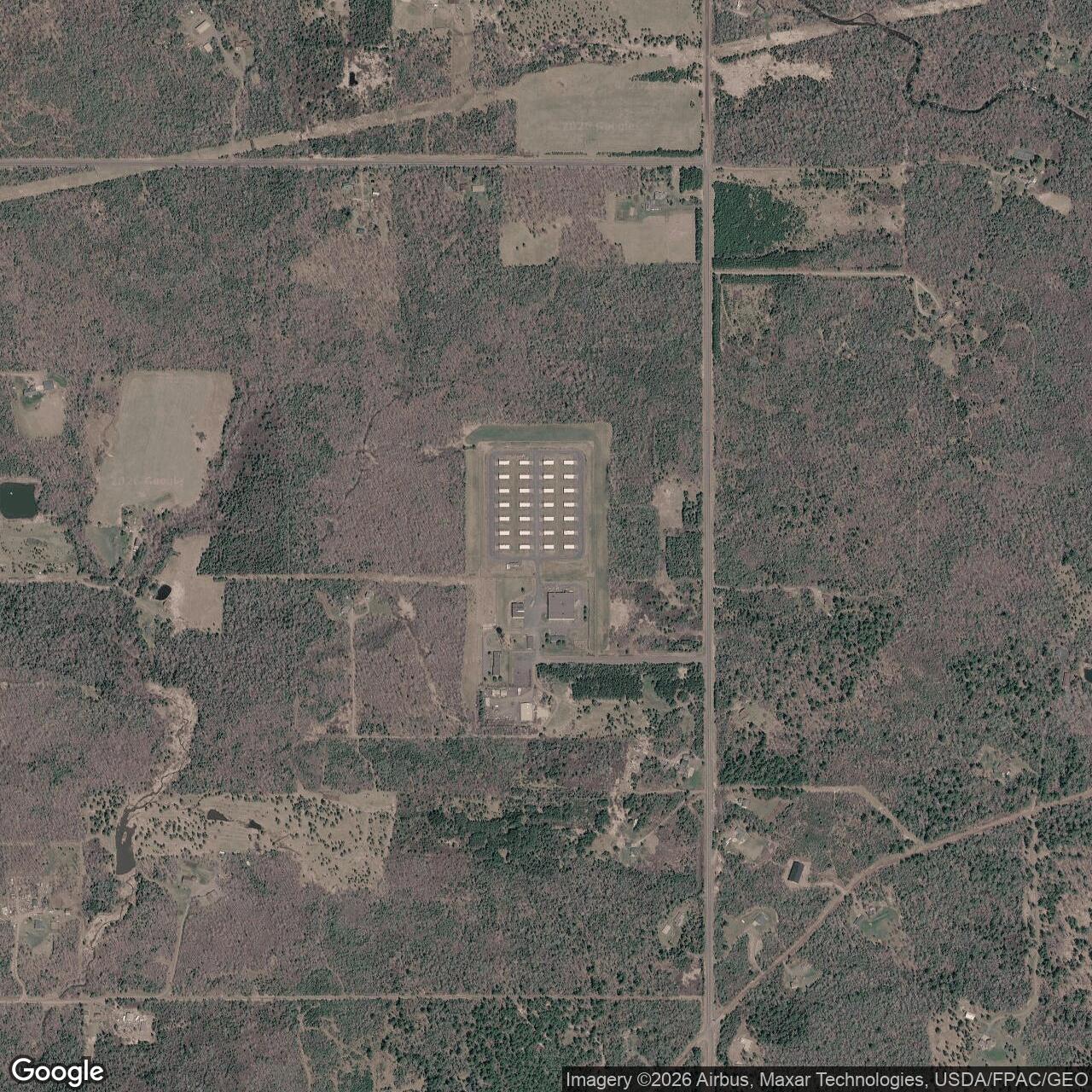
The missile property included the rectangular launcher field, support and maintenance buildings, internal roads, utilities, security areas, and the prominent water tower. A local newspaper account identifies 28 launch facilities, missile service and assembly shops, an automotive maintenance shop, dormitory, fire hall, and supporting utility systems. Surviving aerial imagery and specialist reports confirm a compact installation with parallel shelter rows. A verified as-built property drawing remains necessary to assign every structure number and exact original boundary.
The missile site must remain distinct from Duluth Air Force Base, the Duluth SAGE Direction Center, Finland Air Force Station, and other radar or communications locations. It also must not be merged with the community of French River or the present industrial parcels. These places were operationally connected or geographically nearby but had different missions, facilities, and land interests. The shared name Duluth can otherwise obscure a network of separate installations.
Strategic Origins of the BOMARC Program
BOMARC grew from a postwar requirement for a pilotless interceptor able to attack bombers far beyond a defended city. It was a surface-launched air-defense missile, not an intercontinental ballistic missile and not a ground-attack weapon. The name combined Boeing and the Michigan Aeronautical Research Center, two principal development organizations. Air Defense Command treated it as a component of an integrated weapons system rather than an independent artillery battery.Early planning was much larger than the force ultimately built. Proposals changed repeatedly as cost, technical delays, competition with Army Nike Hercules, SAGE expense, and the emerging ballistic-missile threat altered national priorities. In March 1960 the Air Force reduced the United States B-model force to a limited group of sites, generally with 28 launchers and approximately 30 missiles per squadron allowance. French River survived that contraction and became one of eight operational United States BOMARC complexes.
The site belonged to the northern tier of the deployed system. Other northern batteries included Dow in Maine, Niagara Falls in New York, Kincheloe at Raco in Michigan, and the Canadian sites at North Bay and La Macaza. Southern and eastern sites covered Long Island, New Jersey, Cape Cod, Virginia, and the Gulf test and training complex. Together they formed a discontinuous long-range barrier designed around likely bomber approaches and defended regions rather than a sealed border line.
Duluth had strategic importance beyond its population. The port, rail and industrial network, Lake Superior approaches, air base, SAGE direction center, and routes toward Strategic Air Command facilities made the region part of the continental-defense problem. A French River battery could support engagements across northern Minnesota, Lake Superior, the Upper Peninsula, and adjoining Canadian airspace. Its reach complemented fighter-interceptors and radar stations rather than replacing them.
The Air Force selected a detached rural location because a BOMARC battery required space, separation, secure roads, communications, and a clear operating environment. Distance from the parent airfield reduced risk to flight-line and urban facilities while keeping the unit within practical support range. The Bergquist Road setting also placed the installation near the regional command system it would serve. Public evidence reviewed does not establish the complete parcel-by-parcel selection process or all rejected alternatives.
Authorization, Funding, and Construction, 1959-1961
By 1958 the Air Staff had approved a group of BOMARC units and completed site surveys for the deployed complexes. Official Air Force civil-engineering history identifies Duluth among the second group of four completed sites, together with Niagara Falls, Kincheloe, and Langley. Congressional debate in 1959 and 1960 records the program's cost pressure and changing launcher totals. French River construction proceeded while national plans were being cut back around it.The Air Force constituted the 74th Air Defense Missile Squadron on December 17, 1959. It organized at Duluth Municipal Airport on April 1, 1960 under the Duluth Air Defense Sector. Personnel could begin administration, training, equipment familiarization, supply preparation, and construction surveillance before the remote site was fully ready. Unit activation is therefore the correct opening milestone for the installation record, but it is not the same as operational readiness.
Construction transformed rural land on Bergquist Road into a secure guided-missile plant. Work included grading and drainage, an access road, perimeter fencing, guard facilities, internal streets, launcher foundations, 28 shelters, power distribution, communications, water and sewage, fire protection, heating, maintenance spaces, assembly and service buildings, vehicle support, and personnel facilities. Northern Minnesota cold and snow affected roof operation, pavement, heating, standby power, and emergency access. The site required dependable utilities because alert equipment could not simply be shut down during severe weather.
The B model simplified the civil works compared with the A model. The solid-propellant booster eliminated the liquid-fuel and oxidizer storage and transfer plant. The missile's internal cooling arrangement also reduced shelter air-conditioning requirements. Model IV shelters used precast concrete, light roofs, and below-floor machinery pits, producing a battery that cost much less than the earlier massive concrete complexes.
A Duluth newspaper archival account reports that the Air Force spent $3.65 million on the base. That figure is consistent with the general $3 million to $4 million range reported for B-model Model IV batteries, but the reviewed clipping does not identify whether it includes land, government-furnished equipment, later modifications, or only construction contracts. It should be read as a reported historical cost, not a complete life-cycle accounting. Inflation conversions are omitted because they would not resolve the original cost scope.
The 74th moved from the airport to the French River site in July 1960. The move did not mean the battery was immediately combat ready. Missile deliveries, technical acceptance, communications integration, crew certification, shelter checkout, and command-system tests continued into 1961. The local community history remembers 1961 as the base's construction or opening year because that was when the operational plant became visible and active.
Missile Area and Physical Layout
The launch area contained 28 individual Model IV shelters arranged in rows with separation between buildings. Each missile rested horizontally inside a narrow above-ground structure on its launcher erector. At launch, the light roof halves separated along the building centerline and moved aside, then the launcher raised the missile into its firing position. The shelter was not an underground vertical silo, even though newspaper and popular accounts sometimes use that word.Model IV design placed important mechanical and electrical equipment in a pit beneath the launcher. Thinner walls and a light aluminum roof reduced construction cost, while greater spacing helped prevent an accident in one shelter from involving its neighbors. The site pattern therefore combined compact operations with deliberate separation.
The launcher rows were only the most visible part of the installation. Missile service and assembly work required protected shops, checkout equipment, handling space, spare parts, tools, and trained technicians. The reported automotive shop supported government vehicles and mobile equipment. The fire hall, utilities, and water tower provided emergency and infrastructure functions that a remote alert site could not depend on the township to supply instantly.
The dormitory indicates that some personnel could remain at the detached site, but it does not prove that the full squadron lived there. Many members and families used housing or civilian residences closer to Duluth, and host-base services remained at the airport. Shift changes, weather, duty status, and security requirements determined who stayed on the missile property. The reported staffing figure of 157 airmen is plausible and useful, but it comes from local secondary reporting rather than a dated unit manning document.
The water tower became the site's most conspicuous landmark. Duluth Township histories identify the old BOMARC base as the place where the water tower stands, and the 2025 emergency plan still uses the old missile site as a recognized location. The tower helps orient the historic property but should not be assumed to mark its center or boundary. Later industrial additions, removed structures, and parcel division complicate visual interpretation.
Roads and security circulation separated the public approach from restricted operational areas. Missile handling routes had to support long vehicles and controlled movement between service buildings and shelters. Snow removal and drainage were operational requirements because blocked shelter aprons or frozen mechanisms could affect readiness.
The IM-99B / CIM-10B BOMARC Weapon
French River received the B model, initially designated IM-99B and renamed CIM-10B in 1962 under the joint service designation system. A solid-propellant Thiokol booster accelerated the missile after launch. When the booster separated, two Marquardt ramjet engines sustained high-speed atmospheric flight. SAGE-generated commands guided the missile during the main portion of the intercept, and an onboard active radar seeker supported terminal homing.
The operational B model was nuclear capable and associated with the W40 warhead. A nuclear air-defense weapon could attack a bomber formation and compensate for terminal errors, but it imposed strict custody, security, maintenance, safety, and authorization controls. Public sources do not provide French River warhead serial numbers, a daily custody log, or a shelter-by-shelter loading record.
Missile readiness depended on far more than propulsion. Crews maintained guidance receivers, electrical checkout equipment, telemetry and test functions, gas and hydraulic systems, launcher machinery, environmental protection, communications, power, and shelter mechanisms. A missile could be present but unavailable because of inspection, component replacement, launcher work, command-network status, or safety restrictions. Twenty-eight shelters represent installed capacity, not proof that all 28 weapons were continuously launch ready.
The B model reduced some risks without making the installation simple. It avoided the A model's liquid-booster fuel and oxidizer systems, but solid rocket motors, explosives, a nuclear warhead, high-pressure equipment, electrical power, hydraulics, solvents, fuels, and heavy handling equipment remained hazardous. Formal technical orders controlled inspection, movement, maintenance, and emergency response. The absence of a documented French River missile fire must not be converted into a claim that the site had no industrial or weapons hazards.
SAGE Control, Radar, and Data Link
BOMARC's long range was useful only when paired with a command system capable of finding, identifying, and tracking targets. Ground radars, picket systems, and airborne sensors sent observations into SAGE direction centers. Computers correlated those observations into tracks and helped weapons directors assign fighters or missiles. Engagement commands then passed through communications and data-link equipment to the selected weapon.
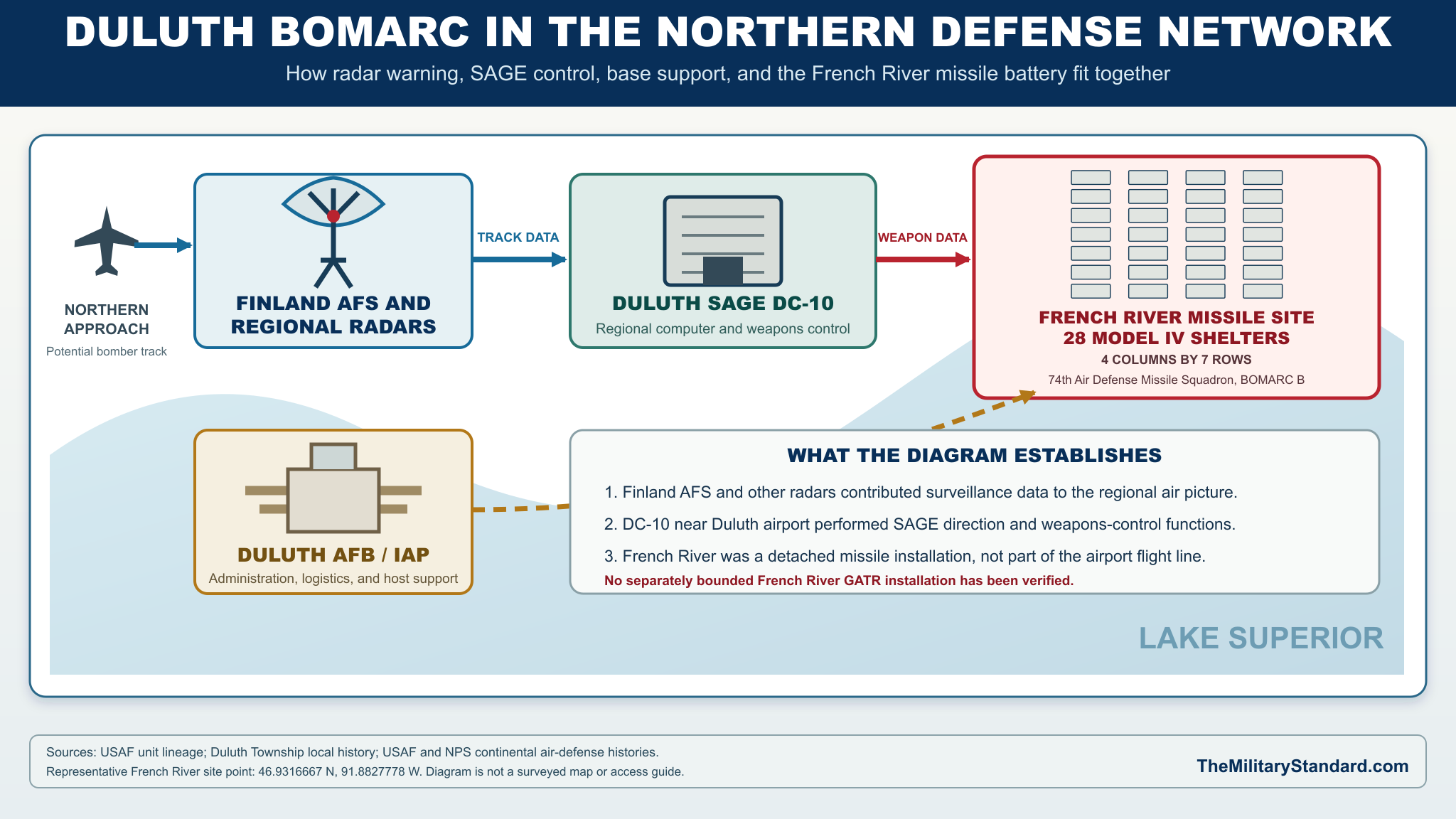
The missile received command guidance during the midcourse phase through the Ground-Air Transmitter and Frequency Division Data Link system. The launcher plant supplied a ready weapon and local technical support, but it did not independently create the continental air picture. A failure of radar coverage, SAGE computing, circuits, transmitter coverage, or identification could affect the engagement even when the missile itself was serviceable. The system's strength and vulnerability both came from this distributed architecture.
Public materials reviewed do not establish a separately bounded French River GATR annex with its own real property and unit identity. Some BOMARC locations relied on distinct remote transmitter sites, while other supporting transmitters were identified through the broader sector communications network.
The 74th initially belonged directly to the Duluth Air Defense Sector. When the sector was discontinued on April 1, 1966, the squadron passed to the 29th Air Division. It transferred to the 23rd Air Division on November 19, 1969 and remained there until inactivation. These organizational changes altered command relationships but did not move the French River battery.
The 74th Air Defense Missile Squadron
The Air Force constituted and activated the 74th on December 17, 1959 and organized it on April 1, 1960. Its official station remained Duluth Municipal Airport, later Duluth International Airport, through April 30, 1972, even though the operating site was at French River. This station notation explains why some summaries place the missiles at the airport. The unit's own operations account states that it moved to French River in July 1960.Major Edward S. Fitzgerald commanded from organization on April 1, 1960. Lieutenant Colonel Gaylord L. Fletcher took command on April 1, 1961, followed by Lieutenant Colonel Bernard R. Sorensen on July 1, 1963. Lieutenant Colonel Charles D. Jones commanded from July 1967, Lieutenant Colonel Wallace N. Robinson III from January 30, 1969, and Lieutenant Colonel Richard F. Van Saun from July 17, 1970 through inactivation. These dates establish senior continuity but do not substitute for a squadron roster.
The unit combined operations, missile maintenance, munitions, electronics, communications, civil engineering, security, supply, transportation, administration, and emergency-response work. The official emblem explanation described three types of teams in the maintenance and operations branches. Skilled airmen and civilian specialists translated a highly automated weapon concept into around-the-clock readiness. Their work was dominated by testing, preventive maintenance, inspections, training, and secure routine rather than missile firing.
The 74th received the Air Force Outstanding Unit Award for January 1, 1968 through May 31, 1969. That period crossed the command of Lieutenant Colonel Jones and the opening months of Lieutenant Colonel Robinson's tenure. The award demonstrates recognized performance during the site's mature operating years. No additional unit decorations were verified in the lineage record.
The lineage later became administratively complex. On September 19, 1985 the Air Force reconstituted and consolidated an earlier antisubmarine squadron, the 24th Tactical Missile Squadron, and the 74th Air Defense Missile Squadron. The consolidated inactive organization retained the 24th Tactical Missile Squadron designation. This paper lineage action did not reactivate French River, return missiles, or create a new post-1972 mission at the property.
Alert Operations, Training, and Daily Work
French River's mission was measured in dependable readiness. Crews verified the path from radar detection and command decision to data transmission, missile power-up, roof movement, launcher raising, and release. They checked missiles, shelters, communications, utilities, fire systems, vehicles, and security equipment. Any fault had to be isolated, documented, repaired, or reflected in the readiness report.The official operations history states that BOMARC B missiles arrived in early 1961 and the first was ready for launch by August 18. The squadron thereafter maintained launch-ready weapons and trained missile crews until inactivation. The 1962 Aerospace Year Book called Duluth the second operational B-model site, ready about two months after Kincheloe. These sources support an August 1961 operational milestone without implying that the full 28-shelter force reached readiness on one day.
Training combined classroom study, equipment practice, maintenance certification, simulated engagements, emergency drills, and inspections. Live firings occurred at controlled test and training ranges rather than across northern Minnesota. Personnel had to understand their individual systems and the timing of the larger engagement chain. Repetition was essential because an actual bomber warning would permit little time for diagnosis or improvisation.
Shift work continued through severe northern weather. Snow and ice affected road travel, shelter aprons, roof movement, drainage, power, and emergency access. Cold could expose weaknesses in batteries, seals, lubricants, hydraulic systems, and vehicles. The experiences preserved by former members repeatedly emphasize the climate, distance, and close-knit character of the unit.
The squadron depended on Duluth for many host services. The airport installation provided or coordinated housing, medical care, personnel administration, finance, supply, transportation, chapel, recreation, and broader civil-engineering support. French River nevertheless required enough local capability to sustain a secure alert site at all hours. The parent relationship should not be confused with a lack of operational independence at the missile plant.
Local reporting says approximately 157 airmen staffed the installation. The figure probably reflects a particular period and may not include every civilian, contractor, tenant, or support person. Manning would have changed with organizational tables, vacancies, maintenance demands, and closure actions. It is retained as a qualified contemporary-scale estimate, not a fixed total for all twelve years.
Security, Nuclear Custody, and Safety
French River protected nuclear-capable missiles, classified guidance and communications equipment, explosives, and critical infrastructure. Security included controlled entry, identification, restricted areas, patrols, barriers, lighting, reporting procedures, and coordination with the parent base and local authorities. Former personnel recollections refer to named security flights and isolated posts, but the public record does not provide a complete guard schedule. Exact alarm zones and force strength remain unresolved.Nuclear custody separated physical possession from authority to employ the weapon. Local crews maintained and protected the system, while launch authorization depended on the national command chain and air-defense rules. SAGE could create an intercept solution and transmit guidance, but it did not eliminate human identification, engagement, and release decisions. This separation was central to controlling a fast-response weapon in peacetime.
Emergency planning covered fire, explosive mishap, accidental movement, launcher failure, electrical fault, gas or hydraulic release, vehicle accident, severe weather, and security incident. The site had a fire hall because response time mattered within the fenced plant. The 1960 nuclear-weapon fire at McGuire involved a liquid-fueled A model and should not be misrepresented as a French River event. It nevertheless reinforced the need for disciplined emergency response throughout the BOMARC force.
Routine industrial materials also created long-term concerns. Fuels, lubricants, solvents, batteries, paints, shop wastes, and later tenant activities could affect soil or containers even without a missile accident. Available environmental summaries do not attribute a major nuclear or missile-propellant release to the 74th. They identify limited containerized-waste and petroleum-investigation records whose precise sources are not fully described in public summaries.
The surrounding community would have seen truck movements, construction, fencing, lights, the water tower, commuting personnel, and occasional raised missiles. The weapons mission was classified in detail but the physical battery was not invisible. Local memory preserved the base long after closure, sometimes using imprecise terms such as silo or nuclear missile base. Historical interpretation must acknowledge the nuclear alert mission while correcting the physical description.
Reorganization and Final Years, 1966-1972
Air defense organization contracted as technology and strategy changed. On April 1, 1966 the Duluth Air Defense Sector ended and the 74th transferred to the 29th Air Division. On November 19, 1969 it transferred to the 23rd Air Division. The unit remained at French River and continued its alert and training responsibilities through each administrative change.The 1968 to 1969 Outstanding Unit Award shows that the battery remained operationally valued during the period of consolidation. Yet BOMARC faced worsening strategic economics. Intercontinental ballistic missiles could bypass a defense optimized for aircraft, while improved fighter systems and other sensors competed for resources. A small network of specialized missiles, unique support equipment, nuclear warheads, and aging infrastructure became difficult to sustain.
The B model still offered a real bomber-defense capability, and closure should not be described as proof that the site had failed. National force planning accepted lower continental missile coverage as the bomber threat, budgets, and technology changed. French River's ending belonged to a system-wide phaseout. Personnel continued to maintain ready missiles and train until the squadron's final day.
Official lineage gives April 30, 1972 as inactivation. Some secondary compilations use October 30 or describe operations through later 1972, apparently combining unit closure with missile removal or property activity. The Air Force date governs the operational close field. August 1972 missile shipment and later disposal actions are recorded separately rather than changing the unit date.
Shutdown and Missile Removal
Inactivation required more than lowering a flag. Missiles and warheads had to be made safe, withdrawn, inventoried, transported, or disposed of under separate procedures. Classified records and technical equipment required controlled disposition. Utilities, contracts, personnel assignments, vehicles, spares, and property accountability also had to be closed or transferred.The Duluth News Tribune archive reports that the last 28 missiles left French River in August 1972. They were sent to a naval storage depot in Virginia, where Air Force officials said they might become practice targets for missiles or aircraft. The source includes a photograph of the last weapon on a flatbed and describes an explosives placard in place of a normal license plate. This is credible local closure evidence, though it does not reconstruct the later fate of each airframe.
Missile removal did not erase the plant. Twenty-eight shelters, support buildings, the water tower, roads, utilities, and perimeter features remained as a large specialized industrial property. Some equipment would have been removed because it was reusable, classified, hazardous, or government-owned. Other fixtures and buildings became part of the real-property disposal. A detailed excess-property inventory has not been located.
The interval between April inactivation, August missile removal, and 1976 township acquisition shows why closure has several dates. Operational mission, weapons withdrawal, caretaker status, federal disposal, local acquisition, and private reuse were separate stages. The history does not collapse them into a single unsupported turnover event.
Township Acquisition and Private Reuse
Local archival reporting says the Town of Duluth bought the former base for $126,000 in 1976. The stated plan was to sell it to Mathisen Tire Company for $140,000. The same account says the documentary trail then became unclear and that various businesses used the property over time. These reported figures require confirmation from deeds and township minutes before being treated as a complete chain of title.
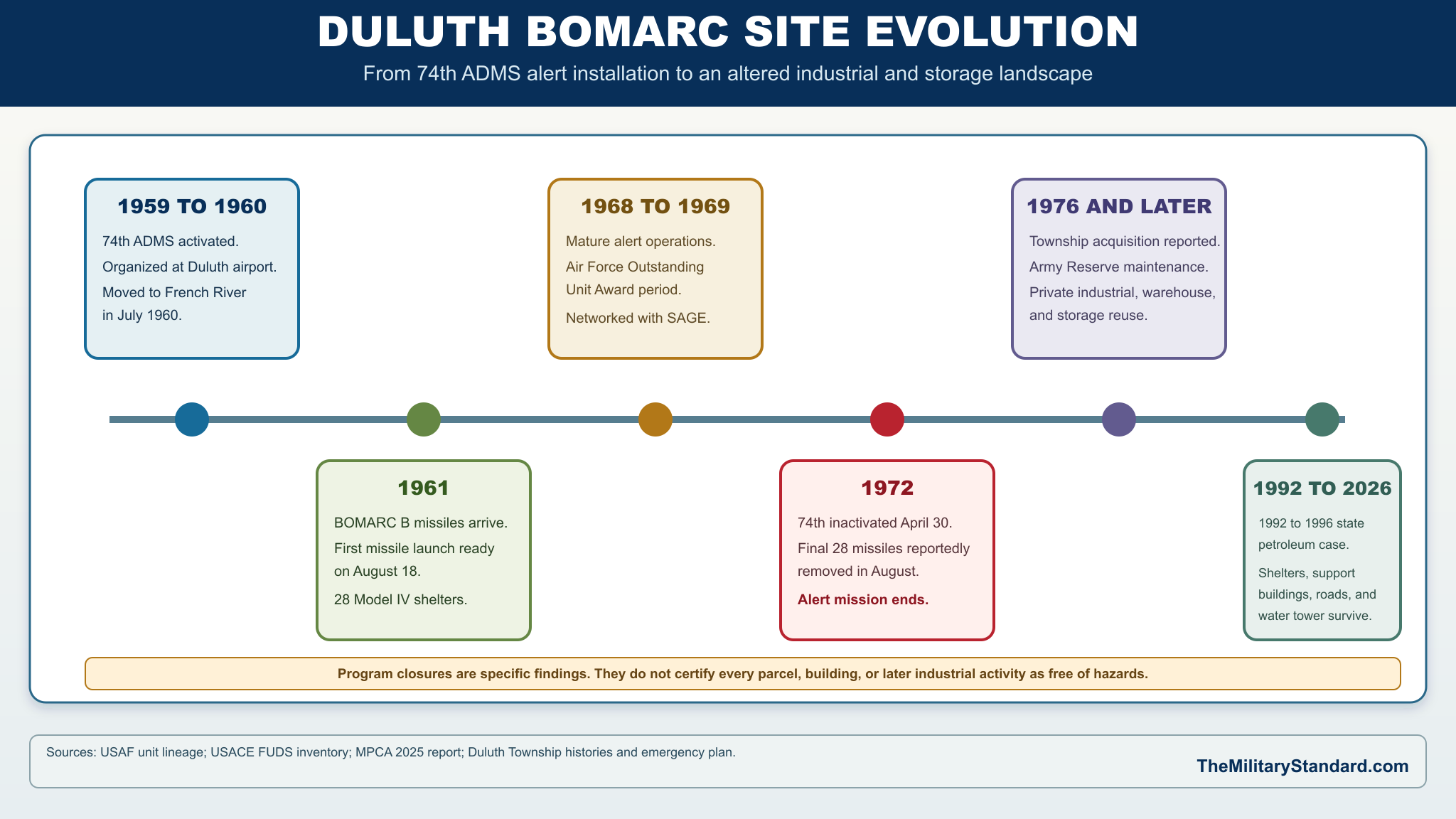
Radomes.org reports that missile shelters became storage and main buildings were used by a stone company. A Historic American Engineering Record table described private ownership by a wood-products and marble manufacturer. These accounts may describe different periods, related businesses, or changes in tenant activity. They establish industrial and storage reuse but do not provide a current parcel-by-parcel tenant list.
A 2024 regional television report referred to the site as used for mini-storage units. That description is consistent with the shelter form and earlier specialist reporting.
The water tower and shelter pattern remain important landmarks in community memory. The property is not an abandoned public park, and surviving military features may stand on active private parcels. Historical interest does not confer a right to enter. Any visit, photography, or field survey requires current owner permission and attention to industrial and environmental safety.
Army Reserve Maintenance Reuse
Federal environmental records name the property USAF Duluth Missile/USARC Maintenance Site. USARC ordinarily denotes United States Army Reserve Center or Army Reserve activity, and the combined name preserves a post-Air Force maintenance use. The record therefore confirms that Army Reserve maintenance occurred somewhere within the former missile property. It does not specify unit, activation date, closure date, acreage, or a separately conveyed parcel.The Army Reserve phase may have used existing automotive, storage, or support buildings rather than the launcher shelters. Such adaptive use would fit the site's infrastructure, but the exact building assignment has not been verified. No reliable source located identifies a formal installation title beyond the FUDS property name.
Surviving Structures and Current Condition
The 28-shelter pattern remains the defining feature visible in modern aerial imagery and specialist photographs. Individual buildings have been altered for storage, but their spacing and orientation still reveal the launch field. Support buildings and the water tower also survive in modified industrial use. The degree of original launcher machinery, below-floor pits, doors, cabling, and interior equipment remaining in each shelter is not documented here.Preservation is uneven because reuse favors practical function rather than museum restoration. Roof mechanisms may have been removed or immobilized, openings changed, and utilities replaced. New sheds, stockpiles, vehicles, fencing, and business equipment can obscure the Cold War layout. A structure can remain externally recognizable while losing most of its original technical fabric.
The site has exceptional interpretive value because it represents the lower-cost Model IV B battery. It can illustrate how the Air Force converted a missile from horizontal protected storage to vertical launch, how shelter spacing managed accident risk, and how a compact remote squadron depended on SAGE. Comparison with A-model sites reveals the effect of solid propulsion on architecture.
Environmental Investigation and Response
The U.S. Army Corps of Engineers lists the former property as FUDS E05MN0235, USAF Duluth Missile/USARC Maintenance Site, at French River in St. Louis County. The inventory contains site 01 and site 02, both categorized as containerized hazardous, toxic, or radioactive waste projects. The category identifies the response program and does not prove that radioactive contamination was present. Public summaries do not provide a complete container inventory or tie each item to one military user.The Government Accountability Office's historical status table records site 01 work from 1990 through 1994 at approximately $27,000 and site 02 work from 1994 through 1996 at approximately $130,000. Both were listed as Complete-RA-C with waste-disposal treatment. Those figures and statuses describe the reporting period and particular response phases. They are not current property appraisals, total environmental spending, or proof that no later issue can exist.
Department of Defense restoration tables later list the property as having achieved response complete before fiscal year 2018. Response complete means planned remedial action for the listed project has been carried out or no further action was selected under that program. It does not erase land-use restrictions, state files, private cleanup duties, or hazards from later occupants. The combined FUDS name also prevents automatic attribution of all materials to the Air Force missile mission.
Minnesota's 2025 petroleum tank release report identifies the Former Duluth Bomarc Missile Site as activity ID 196616 and site ID LS0005928. The state investigation began on November 17, 1992 and closed on June 24, 1996. The report marks no current tasks indicating risk, no cleanup activities, and a low-risk symbol. This supports a closed state petroleum investigation, not a blanket certification for every environmental medium or building.
The township's February 2025 emergency plan separately lists the old BOMARC site on Bergquist Road as an area of possible gun-manufacturing materials, with adjacent landowners as the evacuation area. The language appears to concern a later industrial use rather than an identified Air Force release. The plan does not describe a spill, chemical, investigation, or current violation. It is nevertheless relevant current evidence that emergency planners do not treat the private property as hazard free.
Detailed Chronology
- 1946 Postwar Air Force research begins toward a long-range pilotless interceptor concept that evolves into BOMARC.
- Early 1950s Air Defense Command and industry develop BOMARC in parallel with the SAGE radar and computer network.
- 1955 The Air Force orders BOMARC into production while deployment plans continue to change.
- 1957-1958 Air Staff planning calls for multiple BOMARC units and surveys potential tactical locations.
- 1958 The Air Staff approves an initial group of ten units; site surveys identify Duluth among the eventual completed complexes.
- 1959 Congressional and Air Force planning supports construction of a BOMARC B battery in the Duluth defense area.
- 1959-12-17 The Air Force constitutes and activates the 74th Air Defense Missile Squadron under Air Defense Command.
- 1960-04-01 The 74th is organized at Duluth Municipal Airport and assigned to the Duluth Air Defense Sector.
- 1960-04-01 Unit activation begins administration, training, construction surveillance, and preparation before missile readiness.
- 1960-03 to 1960-04 The national B-model deployment plan is sharply reduced, but Duluth remains among the selected operational sites.
- 1960 Construction proceeds at the detached Bergquist Road property near French River.
- 1960 Work includes 28 Model IV launcher shelters, maintenance and assembly facilities, roads, utilities, security, fire protection, and personnel support.
- 1960-07 The 74th moves from the airport to the French River missile site while acceptance and installation continue.
- Late 1960 Crews train on BOMARC B equipment, shelters, communications, and launch-readiness procedures.
- Early 1961 The 74th receives its first BOMARC B missiles.
- 1961 Local history remembers the base as constructed or opened on Bergquist Road near the water tower.
- 1961-08-18 The first French River BOMARC B is ready for launch.
- 1961-08 Contemporary aerospace reporting identifies Duluth as the second operational B-model BOMARC site.
- Late 1961 Missile delivery, acceptance, crew certification, and alert buildup continue across the 28-shelter battery.
- 1962 The joint service designation system changes IM-99B to CIM-10B.
- 1962 French River operates within the Duluth SAGE and NORAD command network during a period of high continental-defense readiness.
- 1963-07-01 Lieutenant Colonel Bernard R. Sorensen assumes command of the 74th.
- 1963 Local regional-defense accounts connect French River, the Finland radar station, Duluth fighters, and the Duluth SAGE center.
- 1964-1965 The battery sustains normal alert, inspection, maintenance, security, and crew-training cycles.
- 1966-04-01 The Duluth Air Defense Sector is discontinued and the 74th transfers to the 29th Air Division.
- 1967-07 Lieutenant Colonel Charles D. Jones assumes command.
- 1968-01-01 The 74th's documented Air Force Outstanding Unit Award period begins.
- 1968 A Duluth newspaper photographs a BOMARC missile in the ready position at French River.
- 1969-01-30 Lieutenant Colonel Wallace N. Robinson III assumes command.
- 1969-05-31 The Outstanding Unit Award period ends.
- 1969-11-19 The squadron transfers to the 23rd Air Division without moving the missile plant.
- 1970-07-17 Lieutenant Colonel Richard F. Van Saun assumes command and remains through inactivation.
- 1971 The 74th continues maintaining launch-ready weapons and training crews as the national BOMARC phaseout approaches.
- 1972-04-30 The Air Force inactivates the 74th Air Defense Missile Squadron and ends the French River operational mission.
- 1972-05 to 1972-08 The Air Force carries out missile, warhead, equipment, personnel, and property closeout actions.
- 1972-08 Local reporting records removal of the last 28 missiles for shipment to a naval storage depot in Virginia.
- 1972-1976 The former launcher and support complex passes through federal disposal or caretaker stages not fully reconstructed here.
- 1976 Duluth Township reportedly buys the former base for $126,000 and plans an industrial resale.
- After 1976 Existing shelters and support buildings enter Army Reserve maintenance and private industrial or storage reuse.
- 1985-09-19 The Air Force consolidates the inactive 74th lineage into the 24th Tactical Missile Squadron without reactivating the site.
- 1990 The Corps' historical table records the beginning of response activity for FUDS site 01.
- 1992-11-17 Minnesota opens petroleum-release investigation LS0005928 for the Former Duluth Bomarc Missile Site.
- 1994 FUDS site 01 reaches the recorded completion milestone, and work begins for site 02.
- 1996-06-24 Minnesota closes the petroleum investigation.
- 1996 FUDS site 02 reaches the recorded response-complete milestone in the historical federal table.
- 2000s Specialist reports describe missile shelters in storage use and main buildings in stone-company use.
- 2010 The Duluth News Tribune archive publishes the closure photographs and appeals for more information about ownership and reuse.
- 2013 Duluth Township publishes a local history linking the BOMARC base, Finland radar site, Duluth fighters, and SAGE center.
- 2015 The official Corps FUDS inventory continues to list E05MN0235 with two containerized-waste response projects.
- 2024 Regional public television and news coverage renews interest in French River and the broader Duluth Cold War network.
- 2025-02-13 Duluth Township's emergency plan lists the old BOMARC site and possible gun-manufacturing materials as a local planning concern.
- 2025 Minnesota's statewide report identifies LS0005928 as closed, low risk, with no current risk tasks or cleanup activity.
- 2026 The former launcher field remains a private industrial and storage landscape with recognizable shelter rows, support structures, and water tower.
Sources & References
- PDF United States Air Force Organizational History, 24th Tactical Missile Squadron and 74th Air Defense Missile Squadron Lineage Source for Constitution, organization, station, assignments, commanders, BOMARC B service, July 1960 move, early 1961 missile receipt, August 18 readiness, training, award, inactivation, and 1985 lineage consolidation.
- PDF ADC Historical Data, 1946-1973, Aerospace Defense Command (17.67 MB) Source for Air Defense Command force structure, continental-defense chronology, SAGE and BOMARC context, command reorganizations, and comparison with the completed radar and missile network.
- PDF North American Air Defense Command and Continental Air Defense Command Historical Summary, January-June 1960 Source for Official confirmation that the 74th activated at Duluth Municipal Airport on April 1, 1960 and belonged to the growing operational BOMARC force.
- PDF Department of Defense, Leading the Way: The History of Air Force Civil Engineers Source for BOMARC site selection, Duluth's place among the eight completed United States complexes, A-model and B-model facility differences, standard components, shelter construction, propulsion-related simplification, and engineering context.
- PDF National Park Service and Department of Defense, To Defend and Deter: The Legacy of the United States Cold War Missile Program Source for National BOMARC deployment history, Duluth B-model and Model IV identity, August 1961 operations, continental missile context, and preservation significance.
- PDF Library of Congress, Historic American Engineering Record MN-88, Nike Missile Site MS-40 Source for Comparative Minnesota Cold War missile context and its table identifying Duluth, Knife River, the 74th, BOMARC B, and later private wood-products and marble use.
- PDF U.S. Army Corps of Engineers, Formerly Used Defense Sites Inventory for Minnesota Source for Property name USAF Duluth Missile/USARC Maintenance Site, property number E05MN0235, French River location, St. Louis County, and the two containerized-waste response projects.
- WEB U.S. Government Accountability Office, Defense Environmental Restoration Program, Minnesota Property Status Source for Historical response dates, Complete-RA-C status, waste-disposal treatment, and reported costs for FUDS sites 01 and 02.
- PDF Department of Defense, Environmental Restoration Program Table 9 Source for Later federal confirmation that the combined USAF Duluth Missile/USARC Maintenance Site achieved response complete before fiscal year 2018.
- PDF Minnesota Pollution Control Agency, 2025 Petroleum Tank Release Cleanup Response Report Source for Activity ID 196616, site ID LS0005928, November 17, 1992 investigation start, June 24, 1996 closure, low-risk marker, and absence of current risk tasks or cleanup activities.
- WEB Minnesota Pollution Control Agency, What's in My Neighborhood Source for Interpretation limits for state environmental listings and the warning that appearance in a state database does not by itself establish a current harmful condition.
- PDF Duluth Township, Emergency Management Plan, February 13, 2025 Source for Current official local recognition of the old BOMARC site on Bergquist Road, possible later gun-manufacturing materials, and the adjacent-landowner evacuation planning area.
- PDF Duluth Township, A Brief History of the French River District Source for Local geographic context, Bergquist Road, community memory of 1961 construction, and identification of the water tower as the former base landmark.
- PDF Duluth Township Newsletter, The Missile Train Source for Local explanation of the French River BOMARC battery's connection with Duluth fighters, Finland radar, and the Duluth SAGE building.
- WEB Duluth News Tribune Attic, French River Missile Base Source for Local archival photographs, 28 launch facilities, support-building list, reported staffing and cost, April 1972 closure context, August missile removal, Virginia destination, and reported 1976 township acquisition.
- WEB PBS North, Almanac North: Military Source for Current public-history interpretation, former-member artifact recovery, and the Duluth and the Cold War exhibit context.
- WEB Northern News Now, Holding History: Duluth and the Cold War Source for Current regional interpretation, surviving local memory, and reported mini-storage reuse of the former French River property.
- WEB Radomes.org, Duluth BOMARC Site Source for Specialist coordinate, 74th ADMS identity, IM-99B equipment, operational years, French River location, shelter storage reuse, main-building stone-company use, maps, photographs, and aerial images.
- WEB Royal Canadian Air Force Journal, Secrets of the BOMARC, Part 2 Source for Northern-tier geography, binational coverage, W40 context, SAGE relationships, range discussion, and limits on claims about alternative anti-ballistic-missile roles.
- WEB National Museum of the United States Air Force, Boeing CIM-10B BOMARC Photograph Source for Authoritative visual identification of the B-model missile and public-domain illustration context.
- WEB Tinker Air Force Base, Douglas IM-99 BOMARC Missile Source for Official Air Force description of BOMARC as a ground-based long-range antiaircraft missile and general weapon-system history.
- PDF Congressional Record, 1960 BOMARC Program Debate, Part 12 Source for Revised national deployment plan, 28-launcher squadron structure, United States and Canadian site count, program cost, and strategic-policy context.
- PDF Congressional Record, 1960 BOMARC Program Debate, Part 10 Source for Revised launcher and missile allowances, bomber-threat debate, ballistic-missile shift, and distinction between planned and installed inventory.
- PDF Aerospace Industries Association, 1962 Aerospace Year Book Source for Contemporary report that Duluth was the second B-model base ready for operation in August 1961 and broader BOMARC B test performance context.
- WEB Virtual Globetrotting, 74th ADMS BOMARC Site Source for Secondary coordinate comparison, aerial orientation, and clearly identified former-member recollections of security, electronics, missile-maintenance, climate, and service dates.
- WEB Star Tribune, Finland Air Force Station and Northern Minnesota Cold War History Source for Recent regional context and confirmation that local 1972 reporting documented the French River missile-removal convoy; used within the source's quotation and access limits.