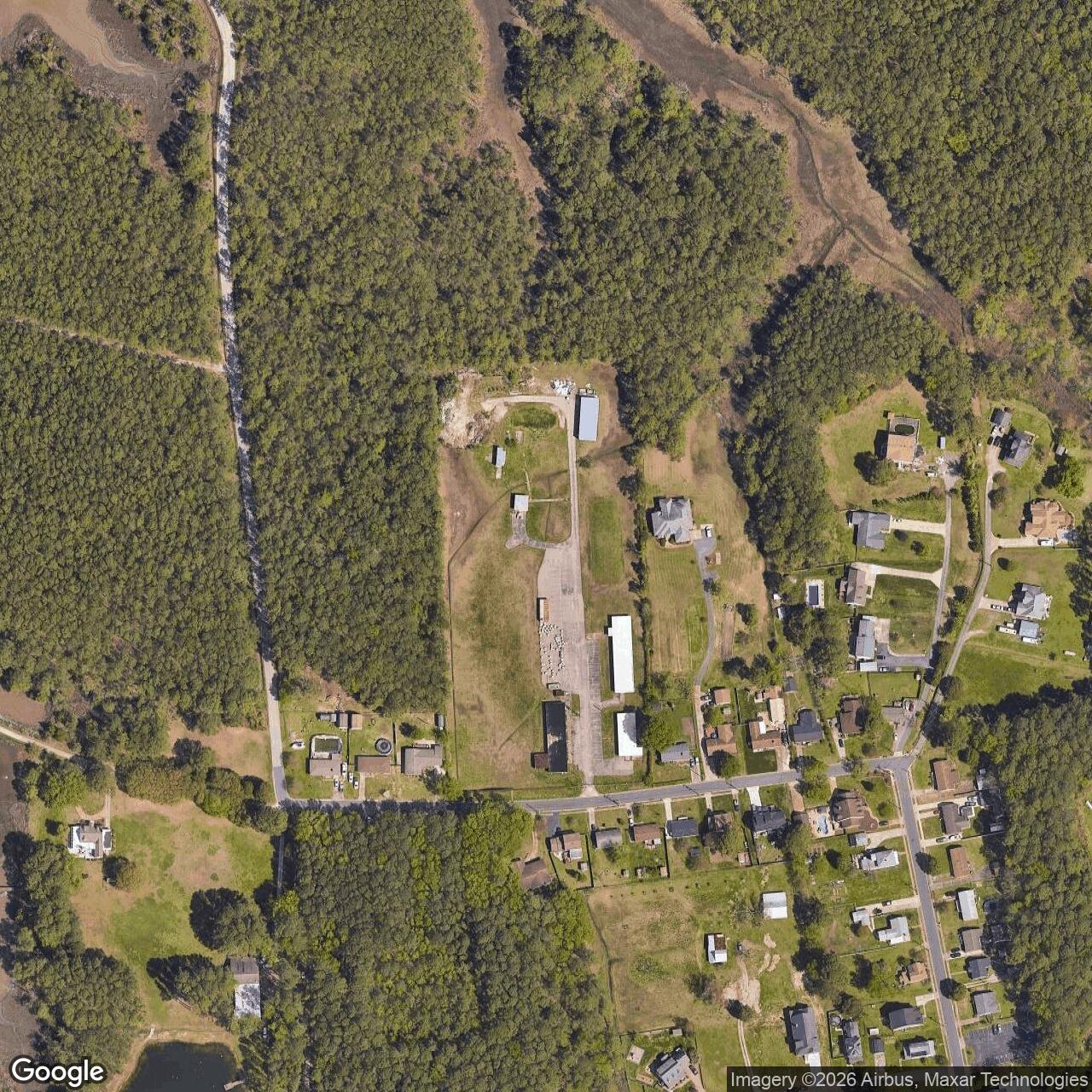
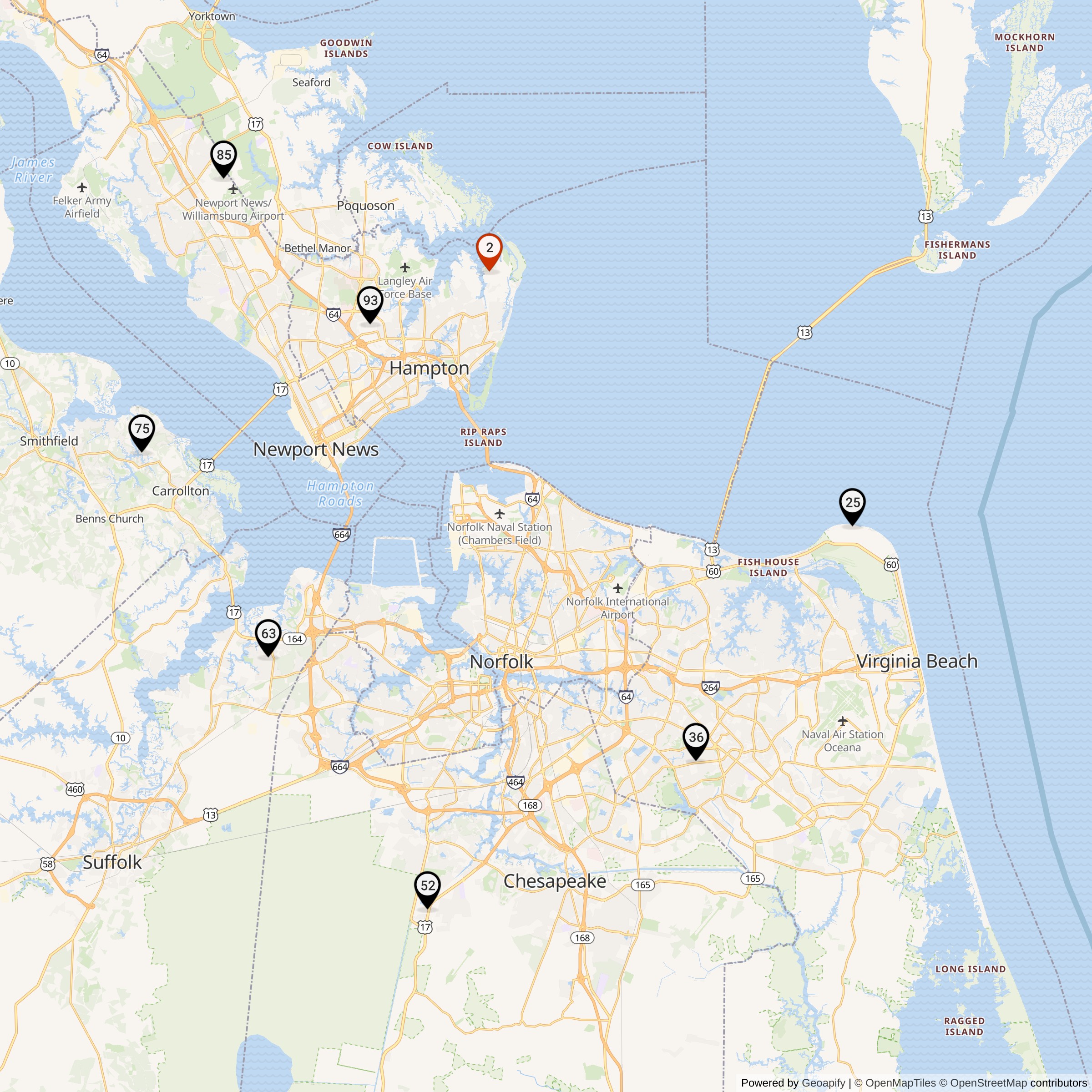
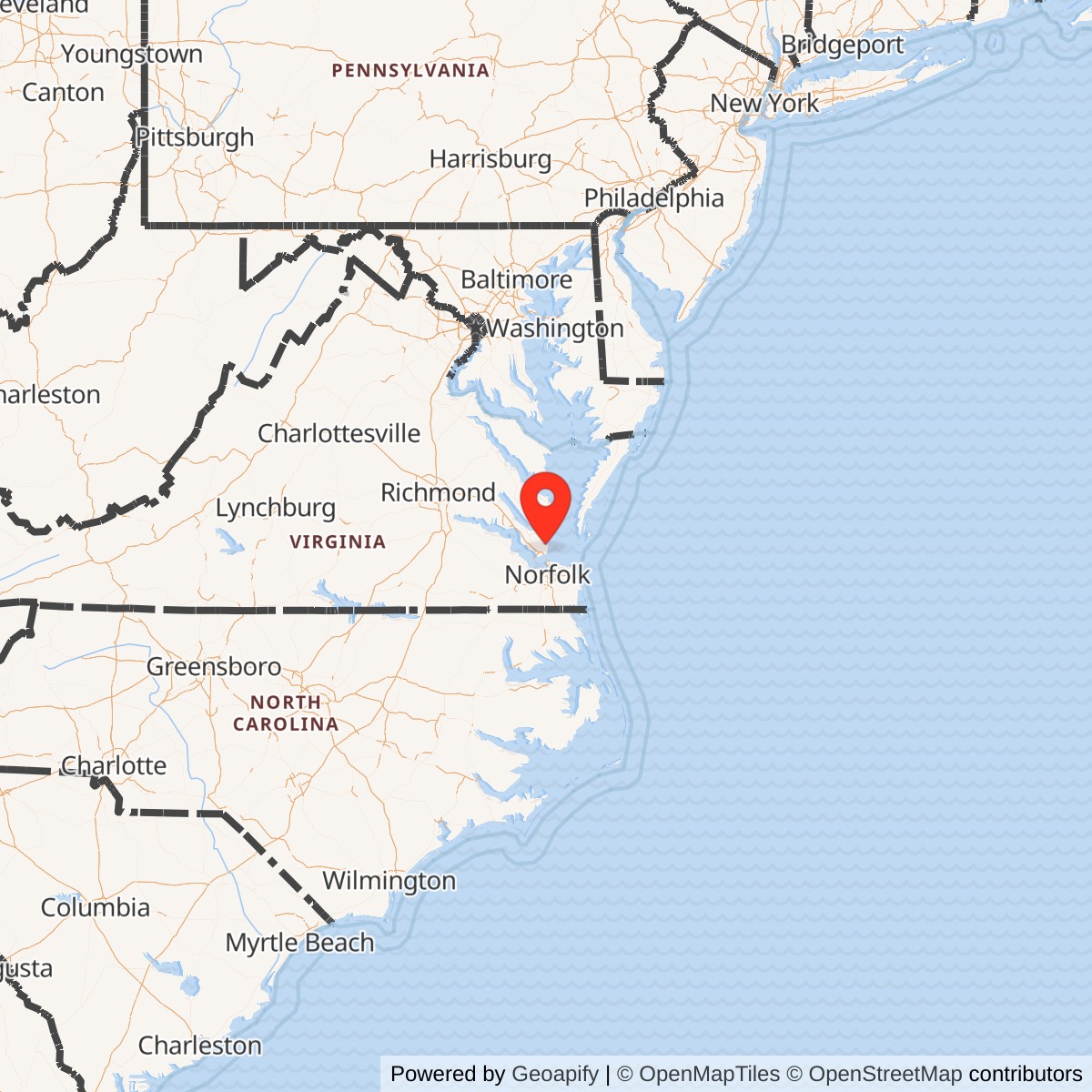
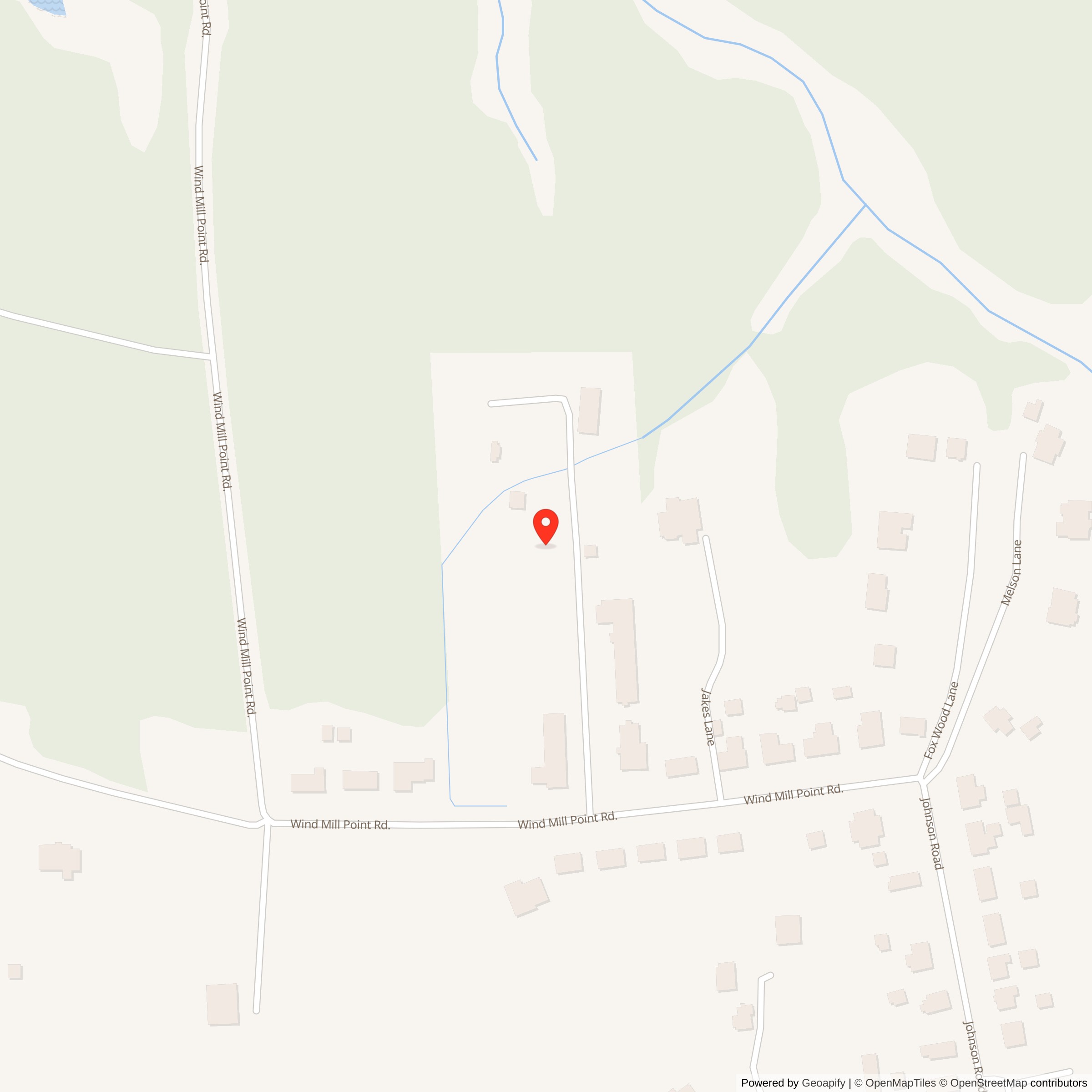
Nike Missile Site N-02 IFC, Fox Hill Virginia
Longitude: -76.2987058421238
This location was part of the Norfolk Defense Area
Site ID: N-02
This site controlled the missiles at the Launch Area located here.
Site Role: IFC
A typical Nike air defense site consisted of two separate parcels of land. One area was known as the Integrated Fire Control (IFC) Area. This site contained the Nike system's ground-based radar and computer systems designed to detect and track hostile aircraft, and to guide the missiles to their targets.
The second parcel of land was known as the Launcher Area. At the launcher area, Nike missiles were stored horizontally within heavily constructed underground missile magazines. A large, missile elevator brought the Nikes to the surface of the site where they would be pushed across twin steel rails to one of four satellite launchers.
Elaboration on how Nike worked here.
Current site status:
Nike Missile Site N-02 was a U.S. Army Nike Ajax surface-to-air missile battery in the Norfolk Defense Area. It was located in the Fox Hill section of Hampton, Virginia, near Langley Air Force Base, NASA Langley, Fort Monroe, Hampton Roads, and the lower Chesapeake Bay approaches. N-02 was not a Nike Hercules site and should not be treated as a later nuclear-capable Hercules conversion. The site was an Ajax-era installation whose federal missile-type code is Nike 2C,1B/30A/12L-A: three underground missile magazines, storage capacity for approximately thirty Nike Ajax missiles, and twelve Ajax launchers. It was active from 1955 to 1963.
The former launcher and integrated fire-control properties remain identifiable as Cold War defense sites, but they are no longer used for Nike missile operations. Later field notes identify the control area as a secured Hampton City Schools maintenance-related facility and the launch area as a locked, gated private or non-public property near the end of Grundland Drive/Bells Island Road.
Location, Terrain, and Site Layout
N-02 occupied a low Tidewater Virginia landscape in the Fox Hill area of Hampton. The launcher was placed near the end of Grundland Drive, close to Bells Island Road, northeast of the IFC area. The IFC/control area was southwest of the launcher, in the Wind Mill Point Road area. The two components were separated by roughly 0.8 mile, close enough for an integrated missile battery but far enough to give the radars useful geometry and line-of-sight relationships to the launch area and the airspace they were assigned to defend.This split layout was standard for Nike Ajax batteries. The launcher area stored the missiles horizontally in underground magazines and raised them to surface launchers by elevator. The IFC site contained the radar and computer equipment that detected aircraft, tracked the target, tracked the missile, calculated the intercept, and transmitted steering commands to the missile in flight. At an Ajax battery, the principal radar set normally included an acquisition radar, a Target Tracking Radar, and a Missile Tracking Radar. The system was command-guided: the missile did not independently home on the target. Instead, the ground-based radars and analog computer continuously compared the target and missile tracks and sent guidance commands to steer the missile toward interception.
The N-02 launcher coordinate sits in the Fox Hill/Grandview area of Hampton, a position that gave the battery coverage over the northern and eastern approaches to Hampton Roads. From that general sector, an Ajax battery could contribute to the defense of Langley Air Force Base, Fort Monroe, Hampton Roads shipping lanes, naval facilities around Norfolk and Portsmouth, Newport News Shipbuilding, and the Chesapeake Bay approach corridor. The IFC coordinate is southwest of the launch area, consistent with the Nike pattern of separating radar/control functions from missile storage and launch functions.
Strategic and Regional Context
The Norfolk Defense Area existed because Hampton Roads was one of the most militarily valuable regions in the United States. The area included Norfolk Naval Base / Naval Operating Base, Norfolk Naval Air Station, Langley Air Force Base, Norfolk Naval Shipyard at Portsmouth, Oceana Naval Air Station, Naval Weapons Station facilities, and Newport News Shipbuilding and Dry Dock Company. In Cold War terms, that made Hampton Roads both a high-value military target and a critical naval-industrial complex. A Soviet bomber attack on the region could have threatened fleet operations, ship repair, naval logistics, aircraft operations, and command infrastructure.The Nike system was the Army's contribution to continental air defense. The Air Force provided long-range warning, interceptors, and later BOMARC missiles; the Army provided fixed surface-to-air missile batteries around high-value urban, industrial, military, and transportation targets. Nike Ajax was the first operational U.S. surface-to-air missile system. It was designed to replace or supplement antiaircraft gun defenses by engaging high-speed, high-altitude bombers before they could reach the defended area.
The Norfolk Defense Area included eight permanent Nike batteries and one temporary site. The listed Nike locations in the region included Fox Hill (N-02), Ocean View temporary site (N-20), Fort Story (N-25/later N-29), Kempsville (N-36/later N-49), Deep Creek/Portsmouth (N-52/later N-59), Nansemond/Suffolk (N-63/later N-69), Smithfield/Carrollton (N-79/later N-75), Denbigh/Patrick Henry (N-85/later N-97), and Hampton/Spiegelville (N-93/later N-99). Headquarters facilities for the Norfolk Defense Area were located at Fort Monroe in Hampton, Ballantine School in Norfolk, Reedsville/South Norfolk, Cradock Branch/Portsmouth, and Newport News.
N-02 was one of the early Ajax batteries in that network. Its position in Fox Hill gave it a role on the Hampton side of the defense ring, facing the Chesapeake Bay and the northern side of the Hampton Roads complex. The installation's mission was not to defend Fox Hill as a local community; its purpose was to defend the strategic complex around Hampton Roads.
Development and Construction
Nike Ajax deployment accelerated after the Soviet Union acquired atomic weapons and after the Korean War intensified U.S. concern about air attack. The Army chose fixed battery sites around major defense areas, with underground magazines rather than a semi-mobile launch concept. That underground-magazine layout reduced the land requirement and made the missile sites easier to fit into suburban and military landscapes.N-02 was built as part of the mid-1950s deployment of Nike batteries around Hampton Roads. Unlike later Nike Hercules conversion sites, N-02 remained an Ajax installation. The federal missile-type code records the site as Nike 2C,1B/30A/12L-A. The "30A/12L-A" part of that code indicates Ajax missile storage and Ajax launchers. No Hercules-launcher notation is attached to N-02 in the federal listing. This is important because three Norfolk Defense Area sites, N-25, N-52, and N-85, were modernized for Nike Hercules, while N-02 was not. N-02 therefore belongs to the first-generation Ajax layer of the Norfolk defense system.
A standard Nike Ajax launcher area of this kind included underground magazines, elevator platforms, surface launcher rails, a missile assembly and test building, generator and power-conversion facilities, security fencing, fuel-handling and warhead-related support areas, and administrative or support functions. The IFC area required a high, clear radar field and normally contained radar towers or radar pads, radar vans or buildings, tracking equipment, generator support, communications equipment, and barracks or administrative/support buildings depending on the specific site arrangement.
Operational History
N-02 entered active service in 1955. During its operational life, it was part of the Norfolk Defense Area's fixed missile ring. The battery's crews maintained readiness to engage hostile bomber formations approaching Hampton Roads. In practice, that meant constant maintenance, training, radar calibration, communications checks, launcher readiness, security duty, inspections, and periodic live-fire qualification at missile ranges such as Red Canyon Range in New Mexico.The Nike Ajax system required a tightly sequenced crew process. A target detected by acquisition radar would be assigned for engagement. The Target Tracking Radar would lock onto the aircraft, the Missile Tracking Radar would lock onto the selected missile after launch, and the battery control equipment would calculate the intercept. The missile would launch from the surface launcher after being raised from the underground magazine. Once airborne, it was steered by ground commands until the battery control system detonated the warheads near the target.
Ajax was a liquid-fueled missile with solid boosters. Its warhead arrangement was conventional high explosive fragmentation, not nuclear. This distinguished N-02 from later Hercules batteries. Nike Hercules had solid-fuel propulsion, longer range, higher altitude capability, and nuclear-warhead capability. N-02's active period ended before the final phase of the Nike program and before the Norfolk Defense Area was reduced to the longer-lived Hercules sites.
The broader Norfolk Defense Area relied on command-and-control facilities as well as the individual batteries. A BIRDIE command-and-control site at Hampton Roads Army Terminal coordinated Nike operations in the region. This allowed the batteries to function as a defense area rather than as isolated weapons. The air-defense network had to prevent duplicate engagements, coordinate with Air Force systems, and avoid conflicts with friendly aircraft operating from Langley, Oceana, naval air facilities, and other regional airfields.
Unit and Command Context
The full battery-level unit sequence for N-02 requires additional unit-record confirmation, but the broader Norfolk Defense Area was manned by Regular Army and Virginia Army National Guard elements. The Hampton Roads Nike units were associated with the 3rd Artillery Group and the 4th Missile Battalion, 51st Artillery during the late 1950s. Contemporary historical context from the Norfolk Defense Area notes that men of the 4th Missile Battalion, 51st Artillery formed an integrated choral group in 1958 and that Regular Army and Virginia Army National Guard units both contributed to the operation of the area's Nike sites.Available veteran/personnel listings for N-02 identify individuals at the Fox Hill site during the late 1950s and early 1960s, including personnel serving in assembly, fire-control maintenance, and supply functions. Those roles are consistent with the technical division of labor at a Nike Ajax battery: launch-section personnel handled missile storage, assembly, fueling, testing, launcher operations, and magazine safety; IFC personnel maintained and operated radar, computer, and communications equipment; administrative and security personnel supported a 24-hour military installation.
Deactivation
N-02 was deactivated in 1963. Its closure fits the national pattern of early Ajax-site reduction. By the early 1960s, the Army was converting selected batteries to Nike Hercules and closing others. Because Hercules had greater range and destructive power, fewer batteries could cover a defense area. At the same time, the strategic threat was shifting from manned bombers toward ballistic missiles, against which Nike Ajax had no practical defensive value.In the Norfolk Defense Area, the sites that remained longest were Hercules-capable batteries such as N-52 and N-85, which stayed active until April 1974. N-02 did not receive that extended life. It ended as a first-generation Ajax battery in 1963.
Post-Closure and Current Site Condition
After Nike operations ended, N-02 passed into non-Nike use. Older federal summaries recorded both the control and launch sites under Fort Monroe / Headquarters, Training and Doctrine Command, reflecting the administrative military ownership or custody context at the time those summaries were compiled. Later field notes give a more precise local reuse picture: the former control area off Wind Mill Point Road has been used by Hampton City Schools as a locked, gated, secured maintenance facility, while the former launcher area at the end of Grundland Drive/Bells Island Road has been locked, gated, and used for storage or private/non-public purposes.
Chronology
- 1945: Nike surface-to-air missile development began after World War II as the Army sought a guided successor to conventional antiaircraft artillery.
- 1950: The outbreak of the Korean War and concern about Soviet air attack accelerated U.S. continental air-defense programs.
- 1953: The first Nike Ajax operational unit was established at Fort Meade, Maryland, establishing the pattern for fixed Nike air-defense batteries.
- 1954: Construction of Nike Ajax batteries expanded nationally around key military, industrial, government, and transportation targets.
- 1955: Nike Site N-02 became active at Fox Hill in Hampton, Virginia, as part of the Norfolk Defense Area.
- 1955: N-02 entered service as an Ajax battery with a federal missile-type code of Nike 2C,1B/30A/12L-A.
- 1950s: The Norfolk Defense Area developed into an extensive air-defense network protecting the Hampton Roads military and naval complex.
- 1958: Nike Hercules began replacing or modifying selected Nike Ajax batteries nationally, but N-02 was not one of the Norfolk sites modernized for Hercules.
- 1958: The 4th Missile Battalion, 51st Artillery was active in the Hampton Roads Nike system and was later noted for high performance in annual practice firing.
- Late 1950s: Command-and-control functions for Norfolk-area Nike operations were coordinated through a BIRDIE site at Hampton Roads Army Terminal.
- 1961: N-75, another Norfolk Defense Area Ajax site, was deactivated; this marked the beginning of reductions among the region's first-generation Ajax batteries.
- 1963: N-02 was deactivated and ended its role as an operational Nike Ajax battery.
- 1964: N-63 became the last Norfolk Defense Area Nike Ajax site to operate, deactivating in November 1964.
- 1974: The remaining Norfolk-area Hercules-capable sites at N-52 and N-85 remained active until April 1974.
- 2014: Field notes recorded the former N-02 control area off Wind Mill Point Road as a locked and secured Hampton City school-system maintenance facility.
- 2014: Field notes recorded the former N-02 launch-area entrance near the end of Grundland Drive as locked, gated, and secure, with apparent storage use.
- Present: N-02 is inactive as a military missile installation; the former Fox Hill launch and IFC areas remain identifiable in the landscape but are not public Nike museum sites.
List of all Nike Installations in Virginia