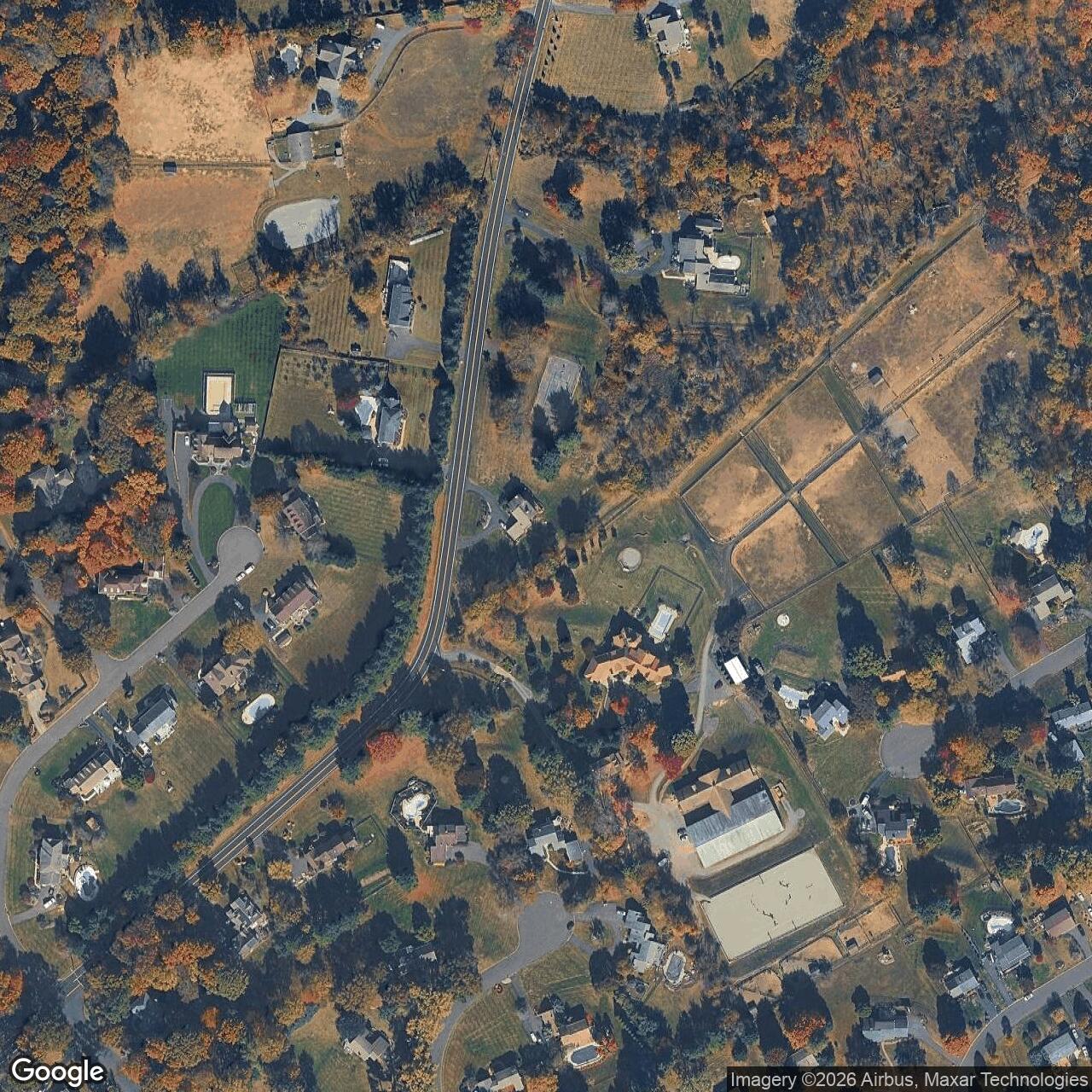
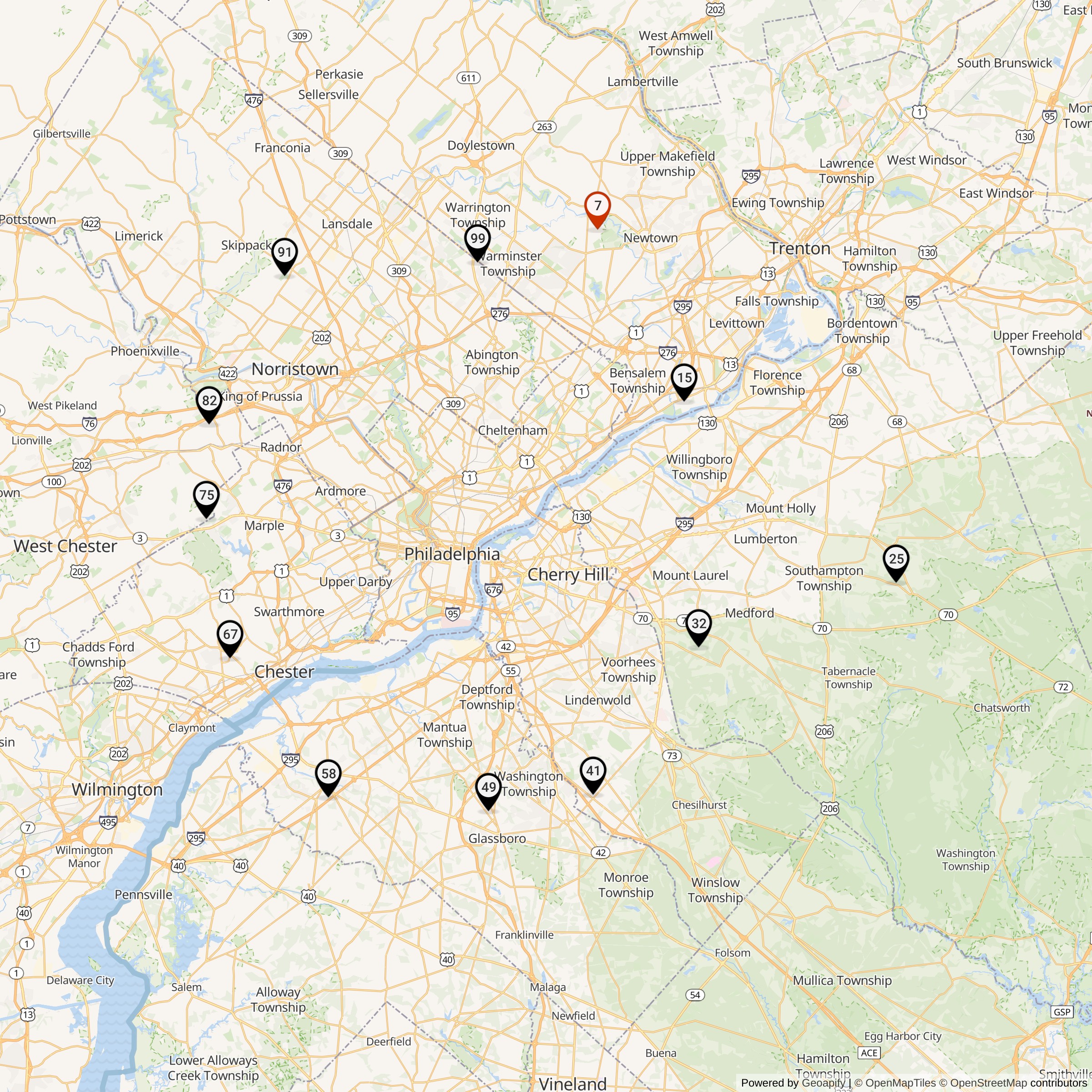
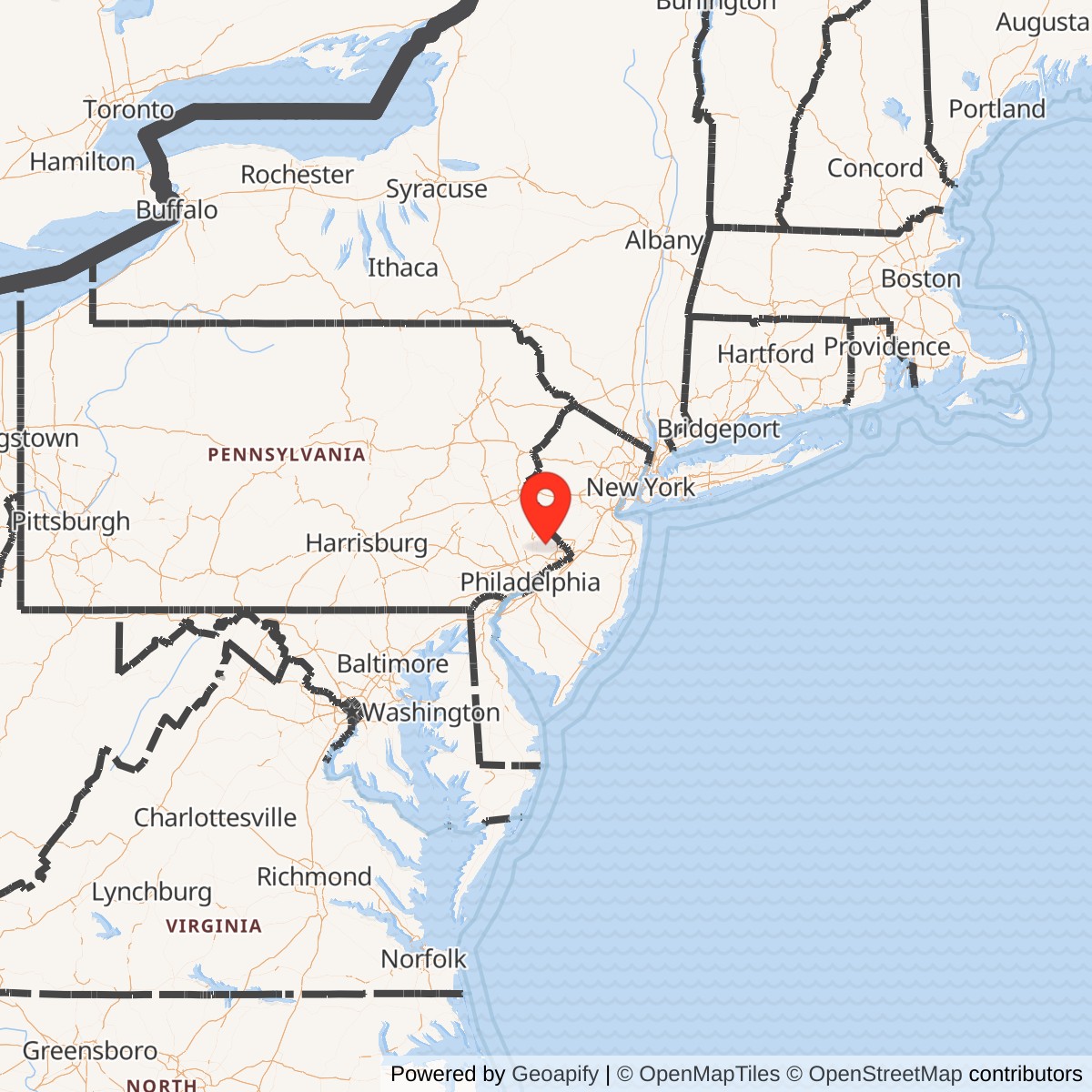
Nike Missile Site PH-07 Launcher, Richboro Pennsylvania
Longitude: -74.9965
This location was part of the Philadelphia Defense Area
Site ID: PH-07
The missiles at this Launch Area were controlled by the Integrated Fire Control site located here.
Site Role: Launcher
A typical Nike air defense site consisted of two separate parcels of land. One area was known as the Integrated Fire Control (IFC) Area. This site contained the Nike system's ground-based radar and computer systems designed to detect and track hostile aircraft, and to guide the missiles to their targets.
The second parcel of land was known as the Launcher Area. At the launcher area, Nike missiles were stored horizontally within heavily constructed underground missile magazines. A large, missile elevator brought the Nikes to the surface of the site where they would be pushed across twin steel rails to one of four satellite launchers.
Elaboration on how Nike worked here.

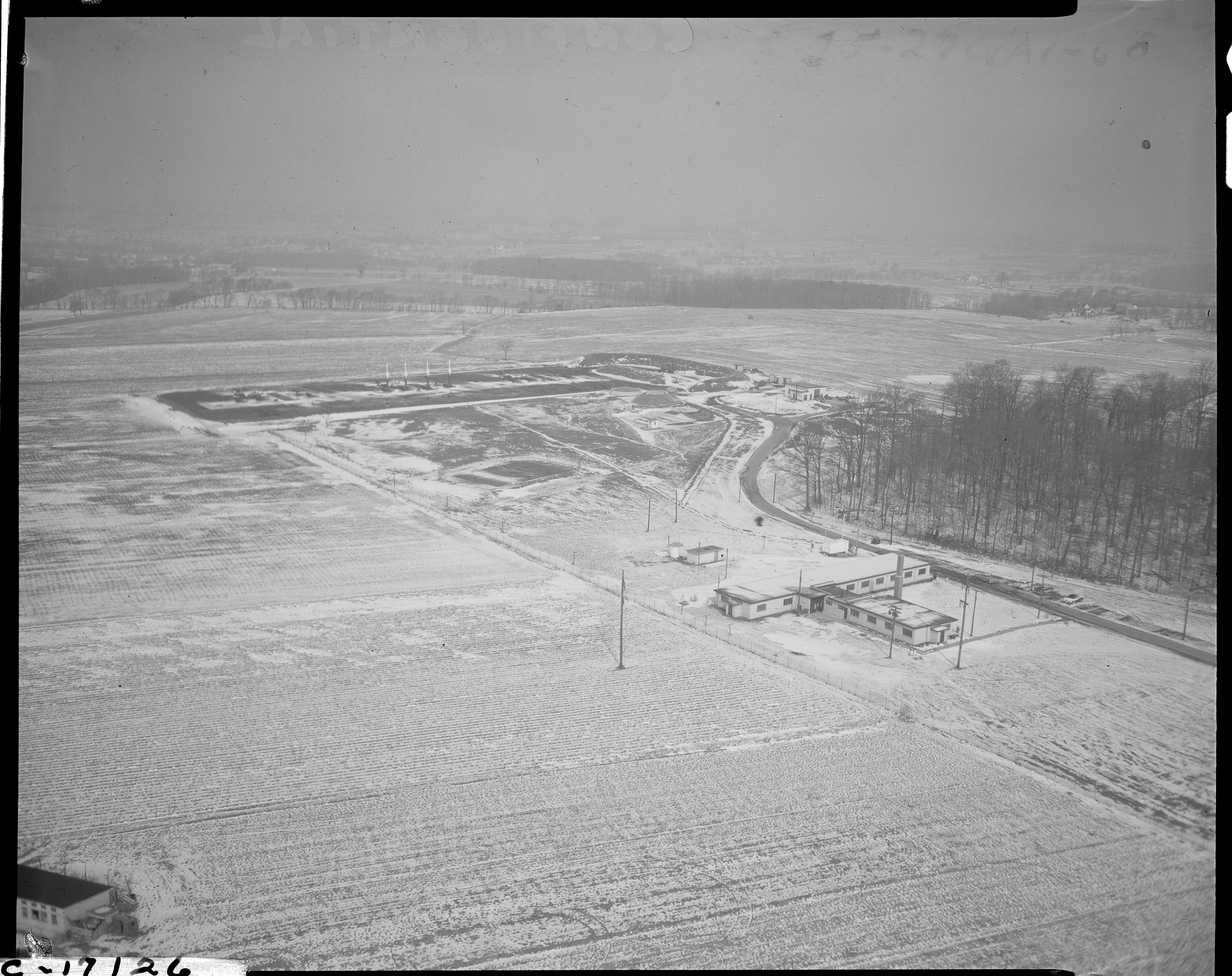
Nike Missile Site PH-07 was a U.S. Army Nike Ajax air-defense missile battery in the Philadelphia Defense Area. The site was located in Richboro, Northampton Township, Bucks County, Pennsylvania, northeast of Philadelphia. It was one of the Pennsylvania-side Nike batteries that formed the Cold War air-defense ring around Philadelphia and the Delaware River industrial corridor.
It was an Ajax-only site, active from 1956 to September 1961. It was not converted to Nike Hercules. After closure, the former Integrated Fire Control area was reused by the Council Rock School District, while the launcher area became part of local recreational use, with the missile-magazine area incorporated into the Northampton Township recreation landscape.
History
PH-07 belonged to the Philadelphia Defense Area, the Nike air-defense network built to protect Philadelphia, Camden, Wilmington, and the surrounding Delaware River industrial region. Philadelphia was a high-value Cold War target not only because it was a major city, but because the region contained port facilities, petroleum storage and refining, shipbuilding and repair assets, rail lines, highways, bridges, aircraft and electronics industries, military depots, and heavy industrial facilities. In the early Cold War, U.S. planners expected that a Soviet attack on the United States would likely come by long-range bomber, and the Nike program was designed as the last fixed missile layer of defense for selected metropolitan and industrial targets.Before the Nike batteries were complete, Philadelphia was defended by conventional antiaircraft-gun batteries. The DoD Legacy missile history describes a dozen gun batteries positioned roughly six to seven miles from the center of the city in the early 1950s. In the mid-1950s, the Philadelphia District of the Corps of Engineers supervised construction of a ring of twelve Nike Ajax sites averaging about twenty-five miles from Center City. The Pennsylvania-side sites included PH-07 at Richboro, PH-15 at Newportville / Croydon, PH-67 at Chester / Media, PH-75 at Edgemont / Delaware City, PH-82 at Valley Forge / Paoli, PH-91 at Worcester / Center Square, and PH-99 at Warrington / Eureka. The New Jersey and Delaware-side sites completed the ring.
PH-07 occupied the northeastern Pennsylvania sector of that ring. Its Richboro location gave the Philadelphia Defense Area coverage over the northern and northeastern approaches to the city and helped protect the broader Bucks County / Montgomery County suburban approaches to the Delaware Valley. The site's role was not local defense of Richboro alone. It was one component of a regional system built to defend the Philadelphia metropolitan-industrial target complex.
Units and Manning
Local Richboro Nike history identifies the first operating unit at PH-07 as Battery C, 506th Antiaircraft Artillery Missile Battalion. The site began operation in 1956 under C/506th. In September 1958, the site changed to Battery C, 3rd Missile Battalion, 60th Artillery, which operated the battery until decommissioning in September 1961.
Reported unit sequence:
1956-September 1958 - Battery C, 506th Antiaircraft Artillery Missile BattalionSeptember 1958-September 1961 - Battery C, 3rd Missile Battalion, 60th Artillery
The unit history reflects the broader Army air-defense transition during the 1950s. Early Nike batteries used antiaircraft-artillery battalion designations rooted in the gun-defense era. As the Army reorganized missile air-defense forces under the Combat Arms Regimental System and later air-defense-artillery structures, unit titles changed even when the operating site and mission remained essentially the same.
Mission and Operation
PH-07's mission was to detect, track, and, if ordered, engage hostile aircraft approaching the Philadelphia Defense Area. It was a fixed, radar-guided, surface-to-air missile battery. It did not operate independently in the strategic sense; it was part of the regional and national air-defense system, linked to higher command-and-control channels and the wider Army / Air Force continental air-defense network.The site used the Nike Ajax missile. Nike Ajax was the Army's first operational guided surface-to-air missile. It was designed to intercept bomber aircraft by using ground-based radar and computer guidance. The missile itself did not autonomously search for a target. Instead, radar equipment at the Integrated Fire Control area tracked the target and the missile, while ground-based computers calculated the intercept course and transmitted steering commands to the missile in flight.
The Ajax missile was a first-generation system. It used a liquid-fueled sustainer and solid booster, and it carried high-explosive fragmentation warheads rather than a nuclear warhead. Local Richboro history describes the Nike Ajax as 34 feet tall with its booster, having a 4-foot wingspan, reaching speeds up to approximately 1,600 mph, and engaging targets at altitudes up to about 70,000 feet with a range of roughly 25 miles. It carried three high-explosive fragmentation warheads mounted in the nose, center, and aft sections.
The federal Nike inventory lists PH-07 as Nike 2B/30A/8L-A. Local Richboro sources give a slightly different operational summary: two Type B magazines, 20 Ajax missiles, and eight A-type launchers. The inventory designation and local site history agree on the key historical interpretation: PH-07 was an Ajax-only site with two Type B magazines and eight Ajax launchers, and it was not converted to Hercules.
Site Layout
PH-07 followed the standard Nike arrangement: a separated Integrated Fire Control area and launcher area.The Integrated Fire Control area was located on Twiningford Road. Local sources give the IFC address as 301 Twining Ford Road. The IFC contained the radars, fire-control electronics, computer equipment, operating buildings, and most of the administrative and support buildings. Doug Crompton's Richboro Nike history states that the IFC site was at one of the highest locations in Northampton Township. That mattered because Nike radars required good line-of-sight for acquisition, tracking, and guidance.
The launcher area was located on Richboro-Newtown Road / Newtown Richboro Road, at 345 Newtown Richboro Road. This parcel held the underground missile magazines, elevator structures, launcher rails, missile servicing areas, and launch-control functions. Local accounts describe the Richboro launch area as the place where missiles were launched, stored, and serviced.
The two parcels were separated by roughly one mile, consistent with the basic Nike design. The separation allowed the radars to occupy suitable high ground while the launch area used land better suited for secure underground storage and launch operations. Administrative functions could be collocated with either the IFC or launcher area, but Richboro sources state that the majority of the buildings were at the IFC side. The administrative buildings typically included barracks, mess hall, recreation/administration supply building, and support structures.
Nike Ajax Period
PH-07 entered service in 1956 during the main Nike Ajax buildup around Philadelphia. The Philadelphia-area sites replaced the earlier gun-defense positions with a modern guided-missile network. A Richboro local history states that the site began under C/506th and later changed to C/3/60th in September 1958.During its operational period, PH-07 would have been maintained on a readiness schedule. Radar operators, missile technicians, maintenance personnel, security forces, cooks, administrative personnel, and officers all supported the battery. Local Richboro history states that a Nike site normally had about 100 personnel, including administrative, security, cooking, maintenance, missile-technician, and command personnel.
The site's work was technical and repetitive. Crews maintained missiles, radars, launch rails, elevators, generators, communications equipment, vehicles, security fencing, and support buildings. They trained to acquire aircraft, track targets, prepare missiles, and execute launch procedures only under command authority. No Nike missile was ever fired in combat from PH-07. The site existed as part of the deterrent and defensive posture of the Cold War: it was maintained so that it could respond immediately if a bomber attack came.
No Hercules Conversion
PH-07 was not converted to Nike Hercules. This is one of the most important facts for interpreting the site. Nike Hercules was the larger, longer-ranged successor to Nike Ajax. Hercules could carry either conventional or nuclear warheads and allowed the Army to defend broader areas with fewer sites.The DoD Legacy missile history identifies PH-75 and PH-99 as the Pennsylvania-side Philadelphia sites upgraded to Nike Hercules and states that, after modernization, the remaining Nike Ajax sites were deactivated from 1961 to 1963.
Command and Control
PH-07 operated within the Philadelphia Defense Area command system. The regional command-and-control structure eventually included a Missile Master facility based at Pedricktown, New Jersey. That facility hosted command-and-control functions for Philadelphia-area Nike defenses. For a site like PH-07, this meant that local radar and launcher crews were not simply making independent decisions. Target assignment, identification, engagement authority, and regional air-defense coordination flowed through higher command channels.In operational terms, PH-07's radar and launcher crews could track and prepare to engage targets, but the site was one node in a larger integrated defense network. The network connected local Nike batteries, Air Force radar surveillance, fighter-interceptor forces, regional command centers, and national air-defense authority.
Deactivation
PH-07 was deactivated in September 1961. The early closure reflects the rapid technological turnover of the Nike program. The site had been built for Nike Ajax in the mid-1950s, but by the end of the decade the Army had begun fielding Nike Hercules. Hercules had greater range and could carry nuclear warheads, so the Army did not need to retain every Ajax battery. Instead, it closed many Ajax-only sites and kept selected converted batteries.PH-07's service life was therefore relatively short: roughly five years. This short lifespan was typical of many first-generation Nike Ajax locations. The Army built a dense ring of Ajax sites in the mid-1950s, then quickly reduced and modernized the system as Hercules became available and as the strategic threat began shifting from bomber attack toward ballistic missiles.
Post-Closure Use and Current Condition
After closure, the two PH-07 parcels followed different civilian reuse paths.The IFC/control area on Twiningford Road was reused by the Council Rock School District. A 2002 observer note stated that the former control site still served as Council Rock School District offices, that several original buildings remained in use, and that one apparent radar pad was still identifiable.
The launcher area on Newtown Richboro Road became part of recreational use in Northampton Township. A 2002 observer note stated that the magazines were intact and not filled, that both elevators were intact, and that township batting cages had been erected directly over the area between the elevators. Later public summaries describe the launch site as part of the Northampton Township Recreation Center, with batting cages placed on top of the two missile magazines, which appear otherwise intact.
List of all Nike Installations in the Philadelphia Defense AreaList of all Nike Installations in Pennsylvania