
Minter Field Army Air Field, Bakersfield California
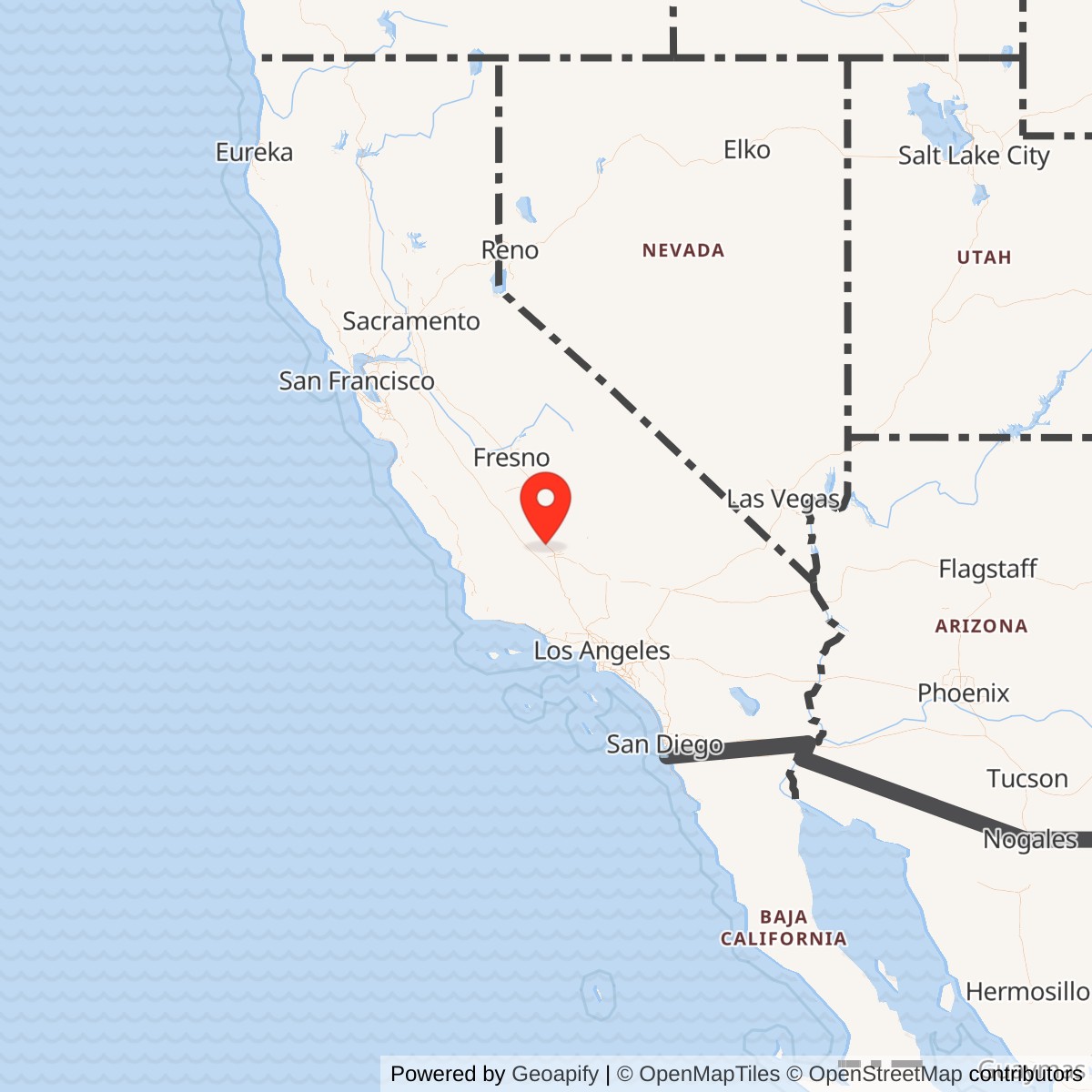
Longitude: -119.1921306
Official Base Website: Minter Field
Current Role: Active Shafter-Minter Field public general aviation airport
Airport ICAO ID: KMIT
Minter Field was a World War II U.S. Army Air Corps and Army Air Forces basic flying school in the southern San Joaquin Valley. It began as Lerdo Field, a new Army training airfield near Shafter, and became one of the major West Coast pilot-training bases during the emergency expansion that preceded and followed Pearl Harbor. Its purpose was direct and urgent: turn aviation cadets into trained military pilots quickly enough to feed the Army Air Forces' expanding bomber, fighter, transport, and observation force.
The field occupied flat agricultural land east of Shafter, close to U.S. Highway 99, the rail and road corridor through Kern County, and the larger Bakersfield labor and service area. That geography mattered. The Army needed open flying weather, unobstructed terrain, room for runways and auxiliary fields, and enough separation from dense urban areas to operate hundreds of training aircraft. At the same time, the base had to be close enough to a city, railroad, roads, water, power, construction labor, and supply channels to build and operate a wartime aviation town. Minter Field fit that requirement almost exactly.
The installation was not a permanent Regular Army post in the older fort sense. It was a purpose-built wartime air-training base, a sub-depot and support center, and a temporary military community. During the war it had the normal physical and social apparatus of a large Army Air Forces station: barracks and tents, classrooms, hangars, maintenance spaces, fire and crash-rescue facilities, a hospital or infirmary, post office, theater, chapel, swimming pool, recreation facilities, administrative buildings, warehouses, streets, utilities, and a network of auxiliary landing fields. The Minter Field Airport District later summarized the base as a self-contained city that served about 7,000 personnel during World War II.
The Army airfield was named for First Lieutenant Hugh C. Minter, a Bakersfield-area member of the locally prominent Minter family and a World War I veteran aviator who was killed in a mid-air collision over March Field in July 1932. The naming rooted the new federal airfield in Kern County memory while also connecting it to the Army's earlier interwar aviation lineage. Official dedication occurred on February 7, 1942, but operations had already begun in June 1941, when only a small guard detachment occupied the unfinished field and base personnel had to make do with improvised quarters scattered between Bakersfield and Wasco.
Minter Field's military career should be understood in three overlapping layers. First, it was a World War II pilot-training base, operating first as Lerdo Field and then as Minter Field / Minter Army Air Field. Second, it was part of a broader training and logistics system: West Coast Training Center, the 35th Flying Training Wing, basic flying squadrons, a sub-depot tied to the Sacramento Air Depot, and multiple auxiliary landing fields spread across Kern County. Third, after the war, it became a reused civil aviation and aviation-industrial site. The modern Shafter-Minter Field Airport is active, but the Army Air Forces training installation closed as a military base and returned to local/civil control after the war.
Mission Evolution
Minter Field emerged from the Army's prewar expansion of flying training. By 1940 the United States knew it needed thousands of pilots, but existing Army flying fields were not enough. California was especially attractive for training because its inland valleys and deserts offered long flying seasons, generally favorable weather, and open land. Gardner, Hammer, Mather, and Minter Fields were authorized in the fall of 1940 and were active by the following spring, making Minter part of the first wave of major California Army Air Forces training installations created before the United States formally entered the war.
The first mission was basic pilot training. Cadets did not arrive at Minter as finished pilots. They came as part of the staged Army Air Forces training pipeline. After primary flying and preflight screening, basic training built the skills required before advanced single-engine, twin-engine, bomber, transport, or other specialty training. At Minter, that meant repeated takeoffs and landings, formation practice, instrument and navigation work, emergency procedures, radio discipline, night and cross-country flying, instructor evaluation, and the constant maintenance and dispatch work needed to keep trainers in the air.
The base opened under austere conditions. In June 1941 the field was garrisoned by only a small guard unit. Colonel Carl Pyle, the early base commander, used the Bakersfield Junior College campus as headquarters while personnel lived in temporary quarters from Bakersfield to Wasco. By early August 1941, multiple units were moving onto the still-growing field, and construction of wooden buildings accelerated. The name Lerdo Field reflected the nearby highway before the airfield was renamed for Hugh Minter.
In October 1941 the Minter Sub-Depot was established as a branch of the Sacramento Air Depot. This was an important change because it made Minter not merely a runway and classroom site, but an aircraft maintenance, repair, and supply node. A training base with hundreds of aircraft could not function unless engines, instruments, propellers, tires, radios, spare parts, tools, fuel systems, and trained mechanics were available. The sub-depot mission tied Minter to the Army Air Forces' logistics system and helped support the high sortie rates required of a basic flying school.
After the United States entered World War II, Minter's mission intensified. The field was officially dedicated on February 7, 1942. In April 1942 construction contracts were let for more than sixty-five on-base buildings, while the number of cadets grew so fast that a large tent city had to serve as temporary housing. By July 1942, the California Military Department's historical summary described Minter as the largest training base of its type on the West Coast, supported by a network of auxiliary fields.
The wartime training mission matured into a large-scale production system for pilots. Minter was known at times as Bakersfield Air Corps Flying School and later as an Army Air Forces Pilot School (Basic). The principal training aircraft was the Vultee BT-13 Valiant, often called the "Vultee Vibrator," a rugged basic trainer powered by a Pratt & Whitney radial engine. Other aircraft associated with the field included the Cessna UC-78 Bobcat, AT-6 Texan, B-25 Mitchell, P-38 Lightning, and other fighter, bomber, transport, and observation types that appeared in the course of training, ferrying, maintenance, or transient operations.
Late in the war the base also trained Chinese pilots. That detail is important because it places Minter Field inside the Allied aviation-training system, not merely within domestic Army Air Forces schooling. Cadets trained in Kern County went on to fly in multiple theaters, and the field's output was tied to global air war requirements. Local histories and the California Military Department summary credit Minter with graduating more than 11,000 Army Air Corps / Army Air Forces cadets during the war.
The postwar mission changed rapidly. Once the urgent pilot-training requirement ended, the Army no longer needed Minter as a major training base. Some military functions lingered through the late 1940s, and the Minter Field Airport District summarizes U.S. Army operation as 1941 to 1949. A Corps of Engineers historical note records that the United States acquired Minter Field by eminent domain in December 1942 and returned the airport to Kern County by quitclaim deed in 1949, with a recapture clause. Kern County managed the airport until 1985, when the Minter Field Airport District was created to own and operate the field.
Minter's later history did not end with civil aviation. During the Cold War, the site was associated with the Shafter Gap Filler Annex P-59A and a remote ground-to-air transmit/receive site. In 1968-1973 a small leased portion of the field was used by Edwards Air Force Base's Army Aviation Test Activity for performance testing of new aircraft, including takeoff, landing, and hovering data. The former wartime training field therefore had a modest postwar military afterlife even after the main Army Air Forces station closed.
World War II Pilot Training and Daily Operations
Minter Field's central wartime work was flight training at scale. A basic flying school was a disciplined production system. Cadets arrived in classes, received ground and flight instruction, flew repeated sorties with instructors, progressed through increasingly demanding maneuvers, and were either graduated to advanced training or washed out if they could not meet standards. Every graduation class represented months of labor by instructors, mechanics, dispatchers, weather observers, medical personnel, cooks, clerks, quartermasters, crash crews, control-tower operators, and administrative staff.
The field's pace can be understood through its aircraft. The BT-13 Valiant was not glamorous, but it was a critical machine in the Army Air Forces training pipeline. It sat between light primary trainers and more specialized advanced aircraft. Cadets had to master its greater weight, speed, instrument panel, radio procedures, and handling characteristics. The BT-13 taught military pilots to manage a more complex airplane before moving on to fighters, bombers, transports, or specialized advanced schools. Minter's many BT-13s therefore formed the practical heart of its mission.
The UC-78 Bobcat added twin-engine training and utility capability. B-25s, P-38s, AT-6s, and other aircraft seen at the field made Minter's flight line more varied than a simple basic school might suggest. Some were transient aircraft, some supported training or familiarization, and some reflected the broader wartime traffic that passed through Army Air Forces installations. The important point is that Minter's runways and shops had to support a dense, mixed wartime flying environment.
The base depended heavily on its auxiliary landing fields. Basic training generated constant takeoff and landing practice, and one main airfield could not safely absorb all of it. Auxiliary fields gave instructors and cadets satellite locations for pattern work, emergency-landing practice, dispersal, and repetitive flight exercises. Minter's network included fields identified in historical summaries as Wasco, Pond, Famoso, Dunlap, Semi-Tropic, Poso, Lost Hills, and other auxiliary or satellite landing areas in the surrounding agricultural landscape. This network greatly expanded Minter's effective training footprint beyond the main field.
Flying training was inherently dangerous. Basic flight schools existed to teach inexperienced pilots, often in crowded airspace and under the pressure of wartime schedules. Accidents were an unavoidable part of the Army Air Forces training system across the country. Minter's auxiliary-field history includes crashes involving BT-13 and AT-6 trainers, and the larger history of the site should be read with that reality in mind. The base produced pilots for combat, but it also consumed aircraft, fuel, labor, and sometimes lives during training.
The non-flying side was just as important. The 1945 War Department facility data reproduced in the California Military Department history listed mobilization capacity for 3,593 enlisted personnel, theater-of-operations capacity for 442 enlisted personnel, total enlisted capacity of 4,035, officer capacity of 336, and station-hospital capacity of 169. It recorded 1,467 owned acres, with a government cost since July 1, 1940 of about $5.63 million, including land and construction. Those figures show that Minter was a major physical plant, not a simple country strip.
Minter also operated as a community. The airport district history remembers a chapel, swimming pool, theater, post office, and infirmary, while military histories describe a tent city, wooden buildings, and later more permanent facilities. The field housed, fed, treated, entertained, disciplined, and transported thousands of people. Many who trained or worked there later returned to visit, bringing memories of the swimming pool, infirmary, chapel, wartime marriages, aircraft noise, class books, newsletters, and the everyday social life of a wartime aviation base.
The presence of a prisoner-of-war camp adds another operational layer. The California Military Department history notes that a POW camp at Minter held about 600 prisoners. The available compact sources do not provide the same depth of prisoner detail that exists for larger Texas and Arizona POW camps, but the number is sufficient to show that Minter participated in the wartime custody-and-labor system as well as the aviation training system. The POW camp would have required guards, administrative supervision, food, medical support, restrictions on movement, and coordination with other Army functions on the field.
Units, Organizations, and Systems
Minter Field's assigned organizations changed over time, but the Army Station Lists summarized by the California Military Department show the basic structure of the wartime base. On June 1, 1943, the listed Army Air Forces organizations included the Army Air Forces Basic Flying School, Aviation Cadet Detachment, a Type B Army Air Forces Weather Station, finance, medical, veterinary, weather, freight, base headquarters, basic flying training, aviation, signal, guard, quartermaster, and ordnance detachments. These were the practical operating parts of a large training base.
The 324th, 326th, 327th, 525th, 526th, 739th, and 740th Basic Flying Training Squadrons appear in the historical station-list extract. Their presence shows that Minter's flying mission was divided into multiple training squadrons rather than handled by a single undifferentiated school staff. Each squadron would have managed instructors, cadets, aircraft scheduling, training records, discipline, and progression through the basic syllabus.
The 64th Base Headquarters and Air Base Squadron, 872nd Guard Squadron, 543rd Army Air Forces Band, and various quartermaster, ordnance, signal, weather, finance, and medical detachments show how many non-flying organizations were necessary to keep the school functioning. The station's African American support organizations, including the 23rd Aviation Squadron (Colored), Medical Detachment (Colored), and quartermaster truck platoon listed in the station extract, also place Minter within the segregated structure of the World War II Army. Their service was essential to base operations even though the wartime military system divided many duties by race.
By April 7, 1945, the station list identified the Army Air Forces Pilot School (Basic), Third Echelon Repair Shop, 35th Flying Training Wing, Headquarters and Headquarters Squadron, elements of the 68th Army Air Forces Base Unit, a detachment of the 85th Army Air Forces Base Unit tied to Army Airways Communications Service, the 543rd Army Air Forces Band, the 3001st Army Air Force Base Unit for Headquarters 35th Flying Training Wing, the 3008th Army Air Forces Base Unit for the Pilot School (Basic), and a Women's Army Corps Squadron. This later structure reflects the wartime Army Air Forces shift from many named squadrons toward numbered base units and consolidated administrative structures.
The 35th Flying Training Wing was especially important. Wing-level organization placed Minter inside a larger training command system that supervised multiple schools and standardized pilot production. Minter did not operate in isolation. It belonged to the West Coast Training Center / Army Air Forces Training Command pipeline, which received aviation cadets, distributed them to schools, pushed them through training phases, and sent graduates onward to advanced training or operational units.
The Minter Sub-Depot connected the base to the Sacramento Air Depot and the wider maintenance and supply system. A training field with hundreds of aircraft could not depend solely on local improvisation. It required depot channels for parts, repair standards, engines, propellers, instruments, tires, fabric, radios, fuel-system components, and specialized tools. The sub-depot and third-echelon repair functions made Minter a maintenance center as well as an instructional field.
Site Design and Physical Layout
Minter Field's design was shaped by wartime urgency and aviation-training function. The core was the airfield itself: runways, taxiways, ramps, hangars, maintenance shops, control and operations facilities, crash-rescue structures, fuel systems, and aircraft parking areas. Around that technical core stood the support city: barracks and tents, messes, administrative buildings, warehouses, hospital or infirmary facilities, recreational facilities, chapels, post office, swimming pool, theater, roads, utilities, and storage areas.
The flat San Joaquin Valley setting made large-scale flying possible but also gave the field a stark wartime landscape. Aircraft, dust, heat, wind, irrigated fields, highway traffic, and construction crews defined the base environment. Early personnel lived in temporary conditions because the flying mission started before the installation was physically complete. That sequence was common across the wartime Army Air Forces: build, train, expand, and improvise at the same time.
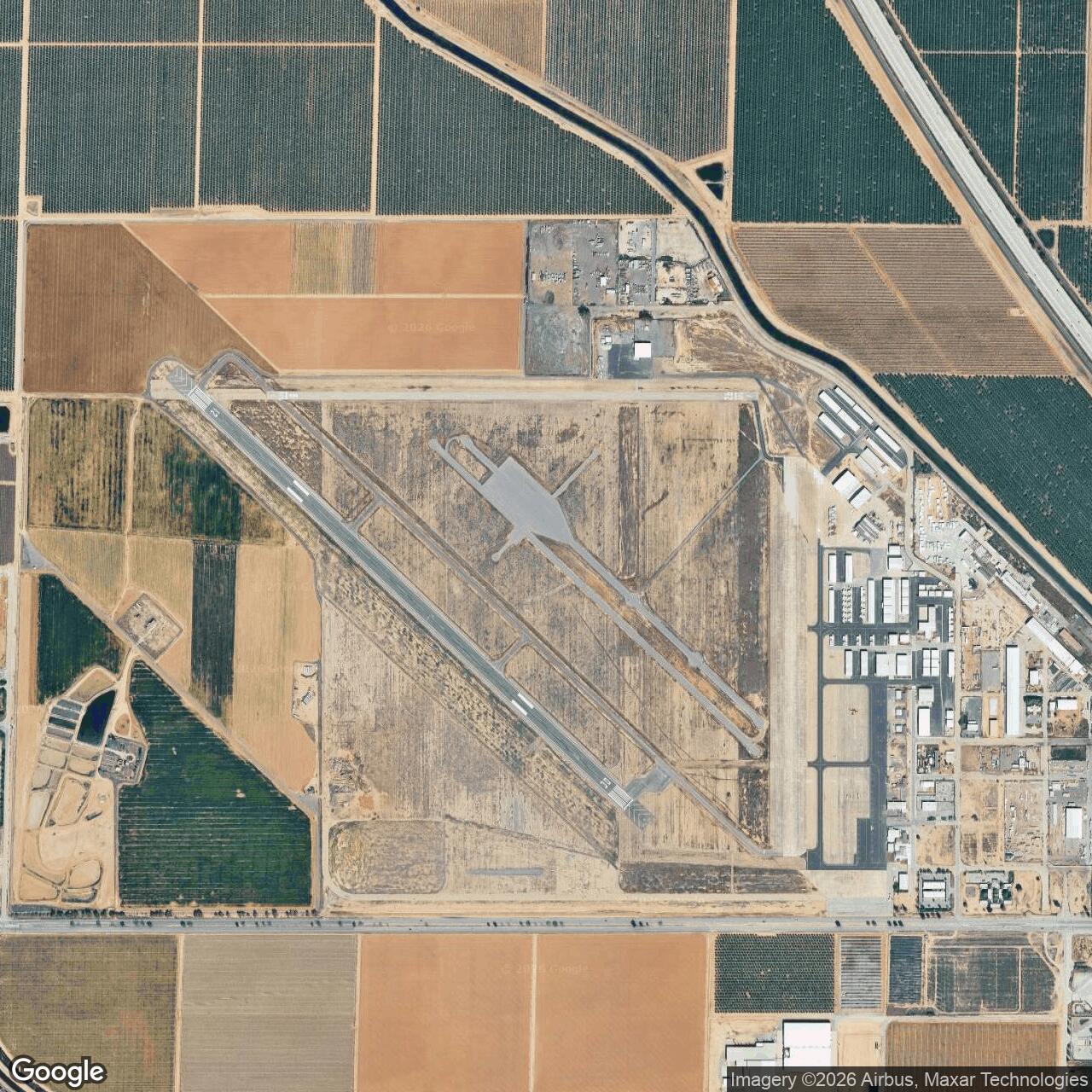
The 1945 facility inventory listed 1,467 acres owned by the federal government. Modern airport references list Shafter-Minter Field at roughly 1,206 acres, reflecting the current civil-airport footprint rather than necessarily the full wartime property accounting. The surviving airport keeps the aviation geometry visible, but the old Army base has been reduced, adapted, and reoccupied. Remaining wartime or postwar buildings have been used as offices, warehouses, aviation facilities, museum space, and industrial structures.
The auxiliary-field network was part of the site's functional design even though those satellite fields were physically separate. Basic flying required a distributed pattern of landing mats and emergency fields. Wasco, Pond, Famoso, Dunlap, Semi-Tropic, Poso, Lost Hills, and other auxiliaries spread Minter's training system across Kern County. Some had simple landing surfaces and minimal crash-rescue or stage-house facilities. Others left little or no visible trace after the war. They were temporary tools for wartime pilot production, and their disappearance is a reminder that much of the Army Air Forces' training landscape was built to be used hard and then released.
Current Shafter-Minter Field remains an active general aviation airport. The Minter Field Airport District operates the airport for the general aviation community, with fuel, maintenance, hangar and tie-down services, industrial opportunities, and the Minter Field Air Museum on the field. Airport-data sources identify Shafter-Minter Field as KMIT / MIT, at roughly 425 feet elevation, with a principal runway of about 4,501 feet and additional runway infrastructure. The modern site is civil, but its runways, open field, and surviving buildings still reveal the wartime training origin.
Closure, Reuse, and Postwar Military Afterlife
Minter Field's wartime training mission declined with victory. Once pilot demand collapsed, the Army Air Forces no longer needed the base as a high-volume training school. The airfield passed out of its primary military role after the war, and local sources describe its transfer to Kern County and later district ownership. The key status distinction is that the World War II Army Air Forces base closed, while the airfield itself continued as a civil airport.
The postwar record is complicated enough to require careful wording. The Minter Field Airport District states that the U.S. Army ran the field from 1941 to 1949 and that, after the war, it was turned over to Kern County, which managed it until 1985. The Corps of Engineers note reproduced in the California Military Department history states that the United States acquired Minter Field by eminent domain on December 5, 1942, and that in 1949 the airport was returned to Kern County by quitclaim deed with a recapture clause. For historical inventory purposes, the safest close date for Army control is therefore 1949, with the understanding that the main training mission had ended earlier.
Kern County's management kept the airfield in aviation use rather than allowing it to disappear completely. In 1985, tenants and local aviation supporters formed the Minter Field Airport District to take over ownership and operation from the county. That district identity remains central to the site today. The district's current mission is to provide a safe, FAA-compliant, efficient, fiscally responsible general aviation airport.
The Cold War brought small, specialized military reuse. The Shafter Gap Filler Annex P-59A was associated with the Air Defense Command radar network, a system designed to detect low-flying aircraft that might evade longer-range radar coverage. A planned long-range radar site at Shafter was not built, but a gap-filler radar and related communications functions were associated with the former field. This role was very different from the wartime pilot school: Minter became a node in continental air-defense surveillance rather than a place where thousands of cadets learned to fly.
The 1968-1973 Shafter Army Aviation Test Activity was another small but meaningful reuse. The Department of Defense leased 1.16 acres from Kern County for Edwards Air Force Base / Army Aviation Test Activity use. The property included Building T-58 and adjacent land, and the mission involved performance testing of new aircraft to determine takeoff, landing, and hovering data. The lease ended in May 1973. Building T-58 later burned in 1988, leaving foundation and subsurface remains used by the airport district for storage of portable aircraft hangars. This episode shows how a former World War II airfield could remain useful for limited military aviation testing decades after the main base closed.
Minter Field also became a civil aviation heritage site. The Minter Field Air Museum, located on the airport, preserves artifacts, photographs, class books, newsletters, aviation equipment, military uniforms, a Link Trainer, a Norden bombsight, vehicles, aircraft, and local aviation records. The museum's work is important because so much of the original wartime base has been removed or reused. Without the museum and local preservation effort, the field could be mistaken for an ordinary rural general aviation airport rather than one of the West Coast's major wartime pilot schools.
Gossamer Condor and Aviation Legacy
Minter Field's most famous postwar aviation event occurred on August 23, 1977, when the Gossamer Condor completed the first successful human-powered flight to meet the Kremer Prize challenge. Designed by Dr. Paul MacCready and flown by Bryan Allen, the aircraft completed a figure-eight course around two pylons one-half mile apart in six minutes and twenty-two seconds. The Royal Aeronautical Society awarded the 50,000-pound prize, and California later designated the site as California Historical Landmark No. 923.
This event is not Army history in the narrow sense, but it belongs in Minter Field's full installation history because it demonstrates the airfield's second life. The same broad, open aviation landscape built for wartime pilot training became a proving ground for one of the most celebrated experimental aircraft of the late twentieth century. Minter's legacy therefore links military pilot production, agricultural-valley aviation, warbird restoration, Reno air-racing culture, and human-powered flight.
The Minter Field Airport District also notes that the field was once home to several Reno Air Racers, including Strega, Miss TNT, Warlock, and Huntress, and that warbird activity and air shows became part of the airport's postwar culture. Visit Bakersfield describes the museum collection as including artifacts and photographs from the men and women stationed at Minter, military uniforms, radio equipment, Link Trainer material, a Norden bombsight, medals and patches, class books, newsletters, hundreds of photographs and documents, and aviation art. This modern heritage layer is part of why the wartime base remains visible in public memory.
Current Status
Minter Field is closed as a U.S. Army / Army Air Forces installation, but active as Shafter-Minter Field Airport. It is owned and operated by the Minter Field Airport District and serves general aviation, corporate aircraft, maintenance, fuel, hangar, tie-down, industrial, and aviation-service users. The field is publicly identified by FAA/IATA/ICAO codes MIT / KMIT and remains a working airport east of Shafter.
The wartime base's surviving physical landscape is mixed. Many World War II buildings have been removed, and remaining buildings have been converted to offices, warehouses, airport functions, museum use, or other aviation and industrial roles. The airport still preserves the broad geometry of an Army training field: runway pavement, open approaches, aviation streets, hangars, ramps, and a dispersed airport-industrial setting. The Minter Field Air Museum preserves the human and documentary memory of the wartime station.
The current official airport district history is careful to connect the modern airport to its Army origins. It states that Minter Field was constructed under the Defense Landing Area Program for the U.S. Army, opened in 1941 as a flight training center, served about 7,000 personnel during World War II, was run by the Army from 1941 to 1949, and then passed through Kern County management before the airport district formed in 1985. That makes the present status dual: the military installation is historic and closed, while the aviation field remains active in civil use.
Chronology
- 1940 Gardner, Hammer, Mather, and Minter Fields were authorized in the fall of 1940 as part of the Army Air Forces' prewar expansion in California.
- 1941-06 Operations began at the unfinished Lerdo Field / future Minter Field when a small Army guard unit occupied the site.
- 1941-08 Multiple units began moving onto the field as construction of wooden buildings accelerated.
- 1941-10 The Minter Sub-Depot was established as a branch of the Sacramento Air Depot.
- 1941 The field opened as a U.S. Army flight training center under the Defense Landing Area Program.
- 1942-02-07 Minter Field was officially dedicated and named for First Lieutenant Hugh C. Minter.
- 1942-04 Contracts were let for construction of more than sixty-five on-base buildings while cadets were still being housed in a large tent city.
- 1942-07 Minter Field had become the largest training base of its type on the West Coast, supported by a network of auxiliary landing fields.
- 1942-12-05 The United States acquired Minter Field / Shafter Airport by eminent domain for establishment of an Army Air Corps training center.
- 1943-06-01 Army Station List extracts identify the Army Air Forces Basic Flying School, Aviation Cadet Detachment, weather, finance, medical, veterinary, sub-depot, base headquarters, basic flying training squadrons, guard, signal, quartermaster, ordnance, and other support organizations at Minter Field.
- 1943 Minter Field functioned as a large basic flying school and support base, with a prisoner-of-war camp associated with the field.
- 1945-01 The War Department inventory listed Minter Field with 1,467 owned acres, enlisted capacity of 4,035, officer capacity of 336, and a 169-bed station hospital capacity.
- 1945-04-07 Army Station List extracts identify the Army Air Forces Pilot School (Basic), Third Echelon Repair Shop, 35th Flying Training Wing, base units, communications-service detachment, band, and Women's Army Corps Squadron at the field.
- 1945 Late-war training included Chinese pilots, while the basic flying school continued to send graduates onward to the wider air war.
- 1946-05-07 Army Station List extracts still identified the 35th Flying Training Wing, headquarters and headquarters squadron, the 543rd Army Air Forces Band, and communications-service detachments at Minter Field.
- 1949 The airport was returned to Kern County by quitclaim deed with a recapture clause; the Minter Field Airport District later summarized U.S. Army operation as 1941 to 1949.
- 1950s-1960s The former field was associated with the Shafter Gap Filler Annex P-59A and related air-defense radar / communications functions.
- 1968-04-01 The Department of Defense acquired 1.16 acres from Kern County by lease for the Shafter Army Aviation Test Activity.
- 1969-04-01 A Corps of Engineers summary also records the DOD lease of 1.16 acres, including Building T-58, for Edwards Air Force Base / Army Aviation Test Activity use.
- 1973-05-10 The Army Aviation Test Activity lease was terminated, releasing the 1.16-acre property.
- 1977-08-23 The Gossamer Condor completed the first successful human-powered flight to meet the Kremer Prize circuit at Minter Field.
- 1978-10-15 The Gossamer Condor flight site was registered as California Historical Landmark No. 923.
- 1985 The Minter Field Airport District was formed by tenants and local citizens to take over ownership and operation of the airport from Kern County.
- 1988-06 Building T-58, associated with the former Army Aviation Test Activity, burned down, leaving its foundation and related subsurface remains.
- 2005 The California Military Department history described Minter Field as still active in general aviation.
- 2022-02-05 Minter Field marked the 80th anniversary of its official dedication, with local commemoration at the air museum.
- Present Shafter-Minter Field Airport remains an active public general aviation airport operated by the Minter Field Airport District, with the Minter Field Air Museum preserving the field's Army Air Forces and Kern County aviation history.
Information sources (12)
- WEBMinter Field Airport District
Our History
- WEBMinter Field Airport District
home page / mission
- WEBMinter Field Airport District
Shafter-Minter Field Airport (MIT)
- WEBMinter Field Air Museum
Minter Field Air Museum
- WEBCalifornia State Military Department / California Military Museum
Historic California Posts: Minter Field
- WEBCalifornia State Military Department / California Military Museum
Major Army Air Force Installations During World War II
- WEBAirNav
KMIT - Shafter Airport-Minter Field
- WEBCalifornia Office of Historic Preservation
Site of the Flight of the Gossamer Condor, California Historical Landmark No. 923
- WEBVisit Bakersfield
Minter Field Air Museum
- WEB23ABC Bakersfield
Celebrating 80 years of the dedication of Minter Field
- WEBCEQAnet
Shafter Airport Minter Field Master Plan Report
- WEBAbandoned & Little-Known Airfields
Bakersfield Area