Nike Missile Site D-23 IFC, Detroit City Airport Michigan
Longitude: -82.9413453094529
This location was part of the Detroit Defense Area
Site ID: D-23
This site controlled the missiles at the Launch Area located here.
Site Role: IFC
A typical Nike air defense site consisted of two separate parcels of land. One area was known as the Integrated Fire Control (IFC) Area. This site contained the Nike system's ground-based radar and computer systems designed to detect and track hostile aircraft, and to guide the missiles to their targets.
The second parcel of land was known as the Launcher Area. At the launcher area, Nike missiles were stored horizontally within heavily constructed underground missile magazines. A large, missile elevator brought the Nikes to the surface of the site where they would be pushed across twin steel rails to one of four satellite launchers.
Elaboration on how Nike worked here.
Missile Type: Ajax
The Nike Ajax was the first in the Army's family of guided missiles, and the world's first operational, guided, surface-to-air missile system. Nike Ajax had a burnout speed of Mach 2.3, a range of 25-30 miles, and a ceiling of 65,000 feet.
Designed to carry either nuclear and/or high-explosive warheads, the Nike Hercules missile could attack supersonic aircraft operating at altitudes in excess of 150,000 feet and at a range of more than 87 miles.
Battery Type: single
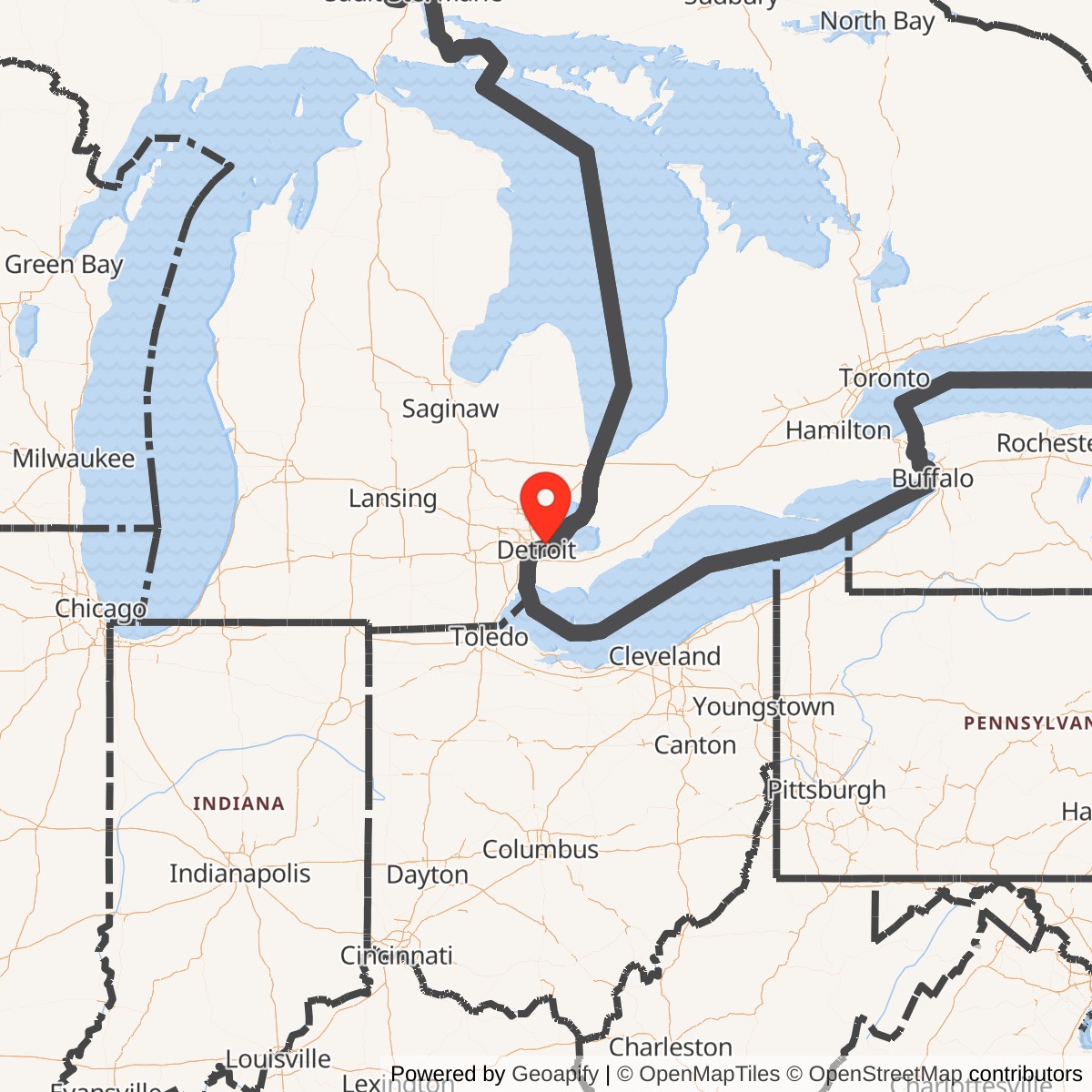
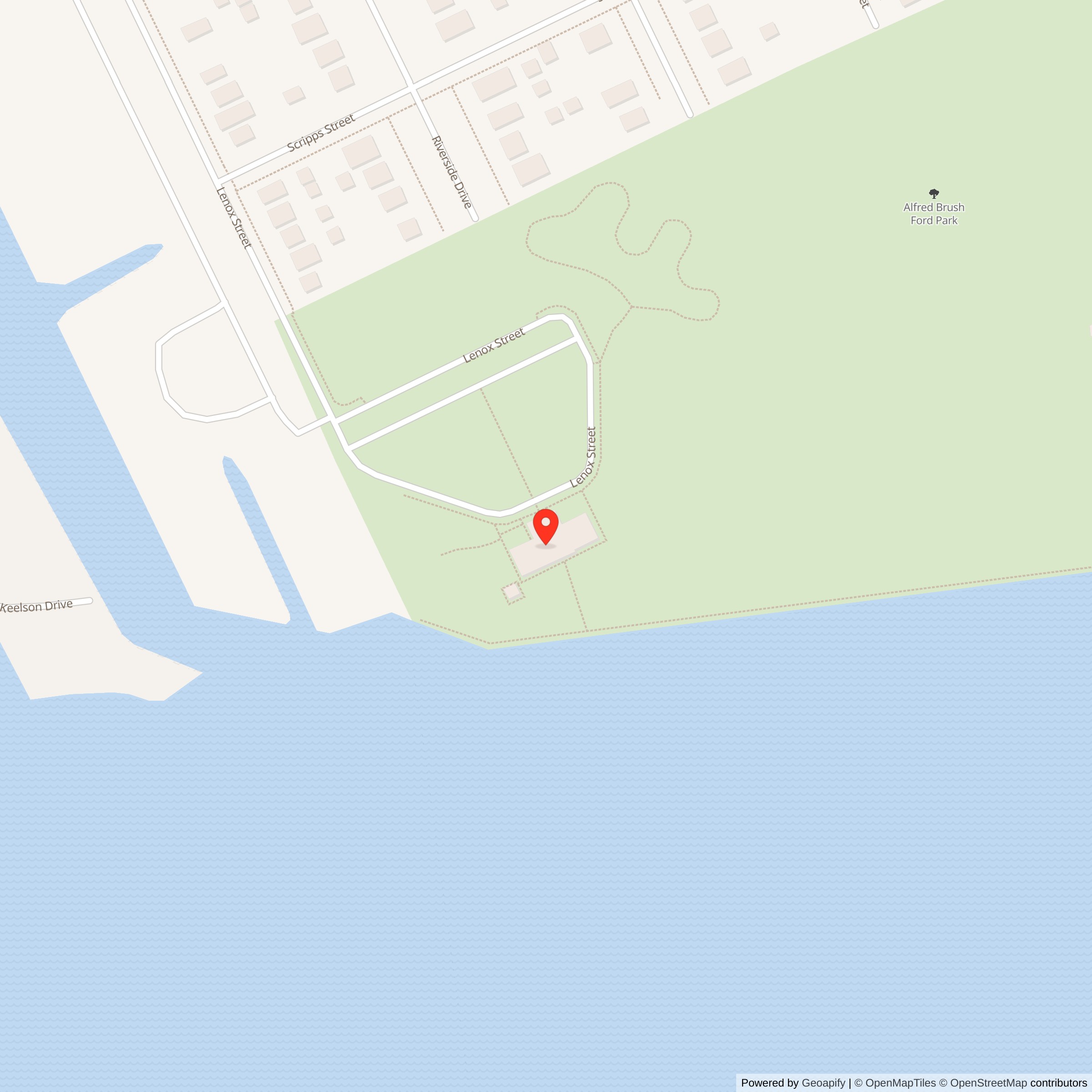
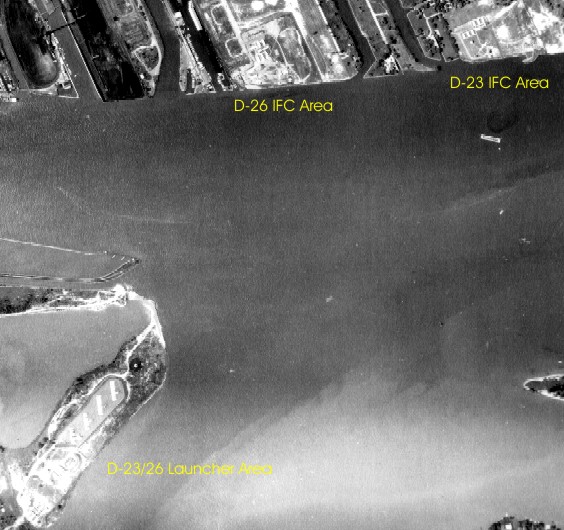
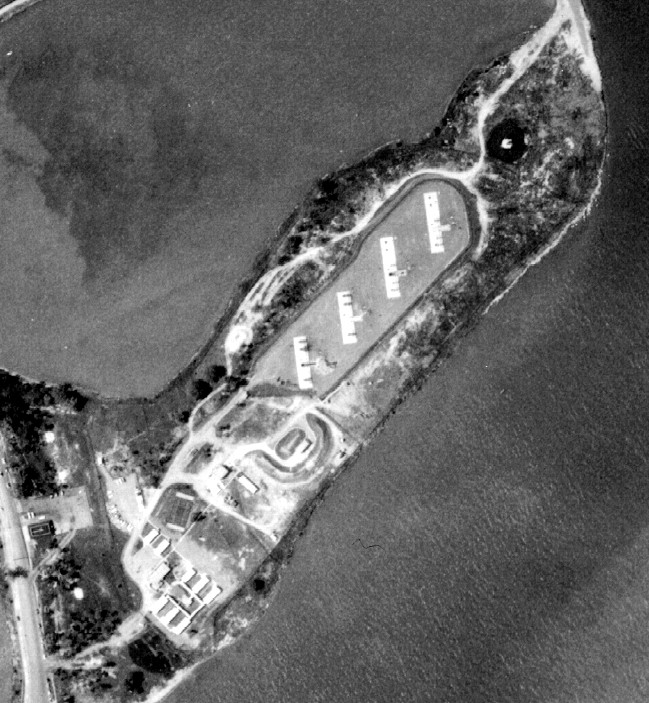
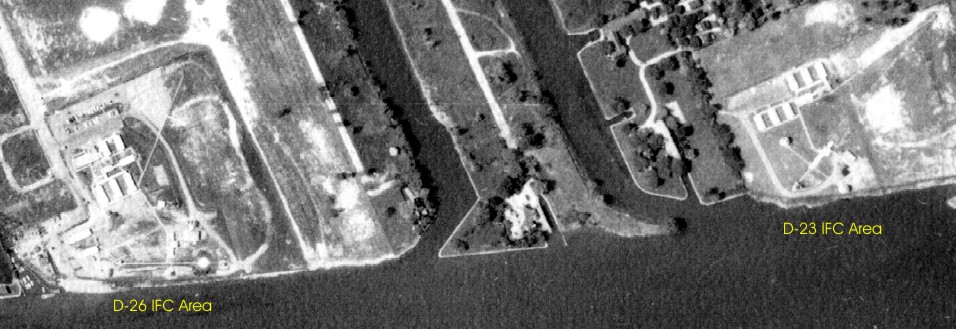
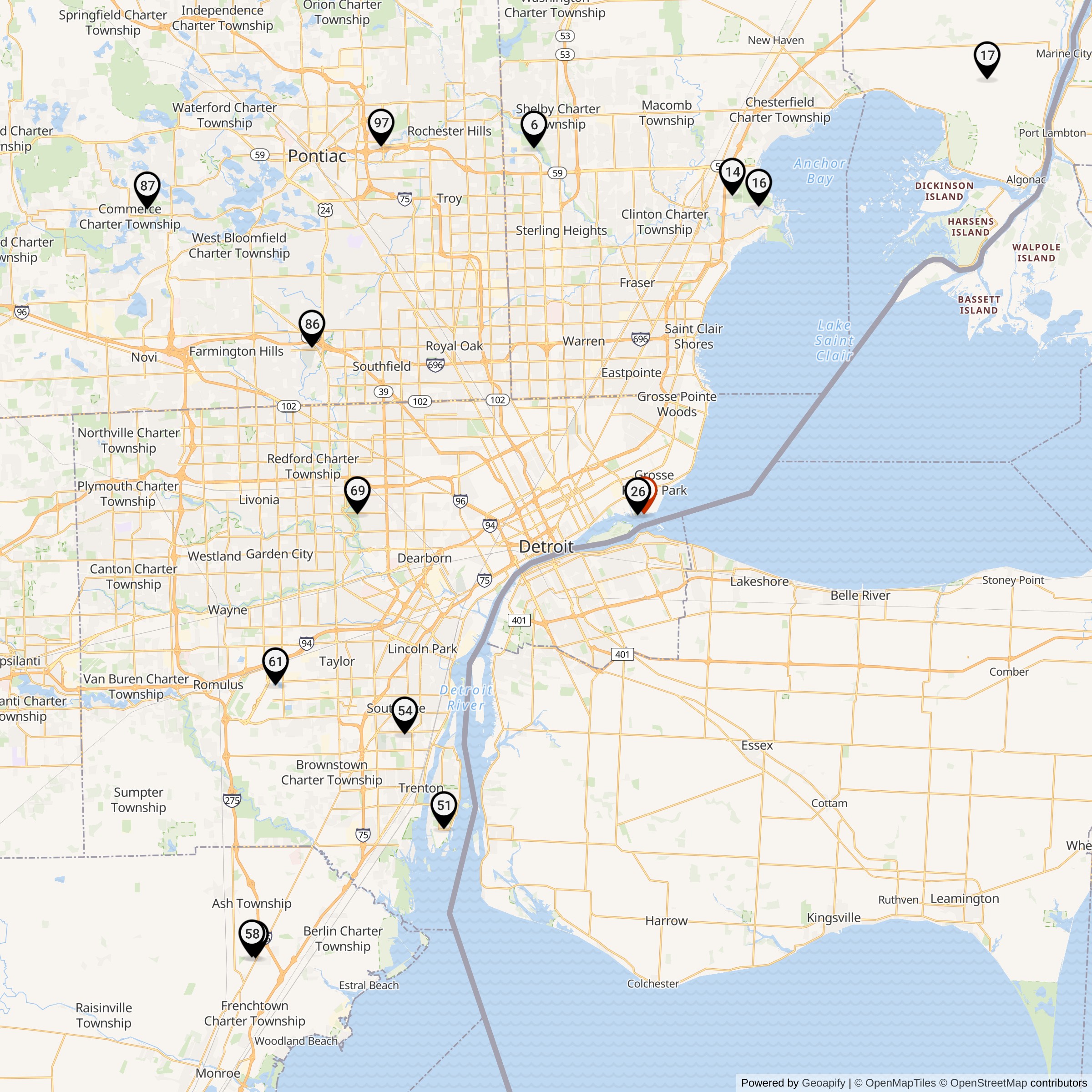
Nike D-23 and D-26 formed one of the most unusual arrangements in the Detroit Defense Area. Their missile launchers occupied a shared double launch compound on the eastern end of Belle Isle, south of Blue Heron Lagoon and close to the William Livingstone Memorial Lighthouse. Their Integrated Fire Control areas were not on the island. They stood separately on Detroit's mainland riverfront, about 1,500 feet apart, so each firing battery had its own radar and guidance plant while both used the same large launch property across the water.
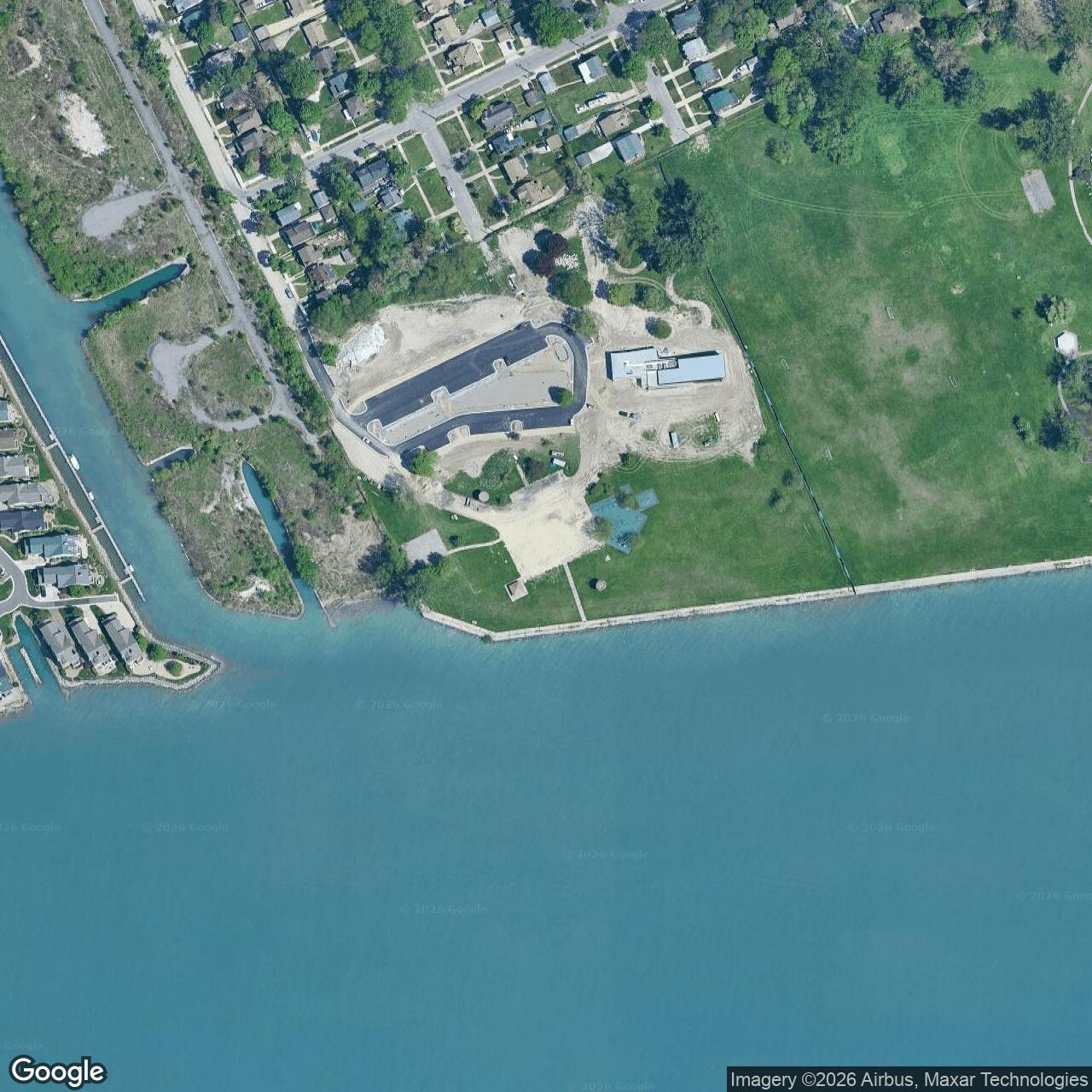
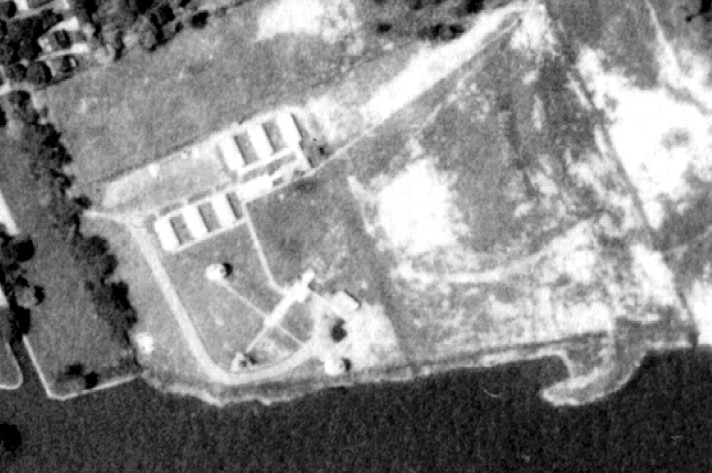
The D-23 IFC occupied Alfred Brush Ford Park, now A.B. Ford Park, at the foot of Lenox Street in the Jefferson Chalmers neighborhood. The D-26 IFC stood to the west in Peter Maheras Playground, now Maheras-Gentry Park, near the foot of Conner Street. These locations matter because two historical labels are misleading. The official national inventory calls D-23 "Detroit City Airport," although the permanent IFC was not at the airport. Other directories call D-26 "Fort Wayne/Detroit," although the documented permanent IFC was in Maheras-Gentry Park and the launcher was on Belle Isle, far from Historic Fort Wayne.
The three properties sat in a compact Detroit River landscape. The mainland IFCs looked toward Belle Isle and the international waterway. The shared launcher stood near the island's northeastern shore, opposite Canada and near the transition from the Detroit River into Lake St. Clair. No exact coordinates are included in this history. The location is described by parks, streets, waterways, and the relationship among the two IFCs and shared launcher.
Site Overview
D-23 and D-26 became operational in April 1955 as Nike Ajax batteries guarding the eastern side of metropolitan Detroit. D-23 remained Ajax-only and closed in December 1960. D-26 was selected for Nike Hercules conversion. Army program records show conversion construction from May through July 1958 and identify October 1, 1958 as the operational date with Hercules missiles. D-26 then remained on alert until November 1968.The arrangement changed functionally after D-23 closed. Before December 1960, two firing batteries operated separate IFCs and used different halves of the double Belle Isle launch plant. After D-23's deactivation, D-26 alone continued the mission, using the Hercules-converted portion of the launcher while the Army's inventories continued to describe a mixed Ajax and Hercules configuration. The shared property therefore had three distinct phases: double Ajax operation, mixed Ajax/Hercules operation with both batteries active, and D-26-only Hercules-era service.
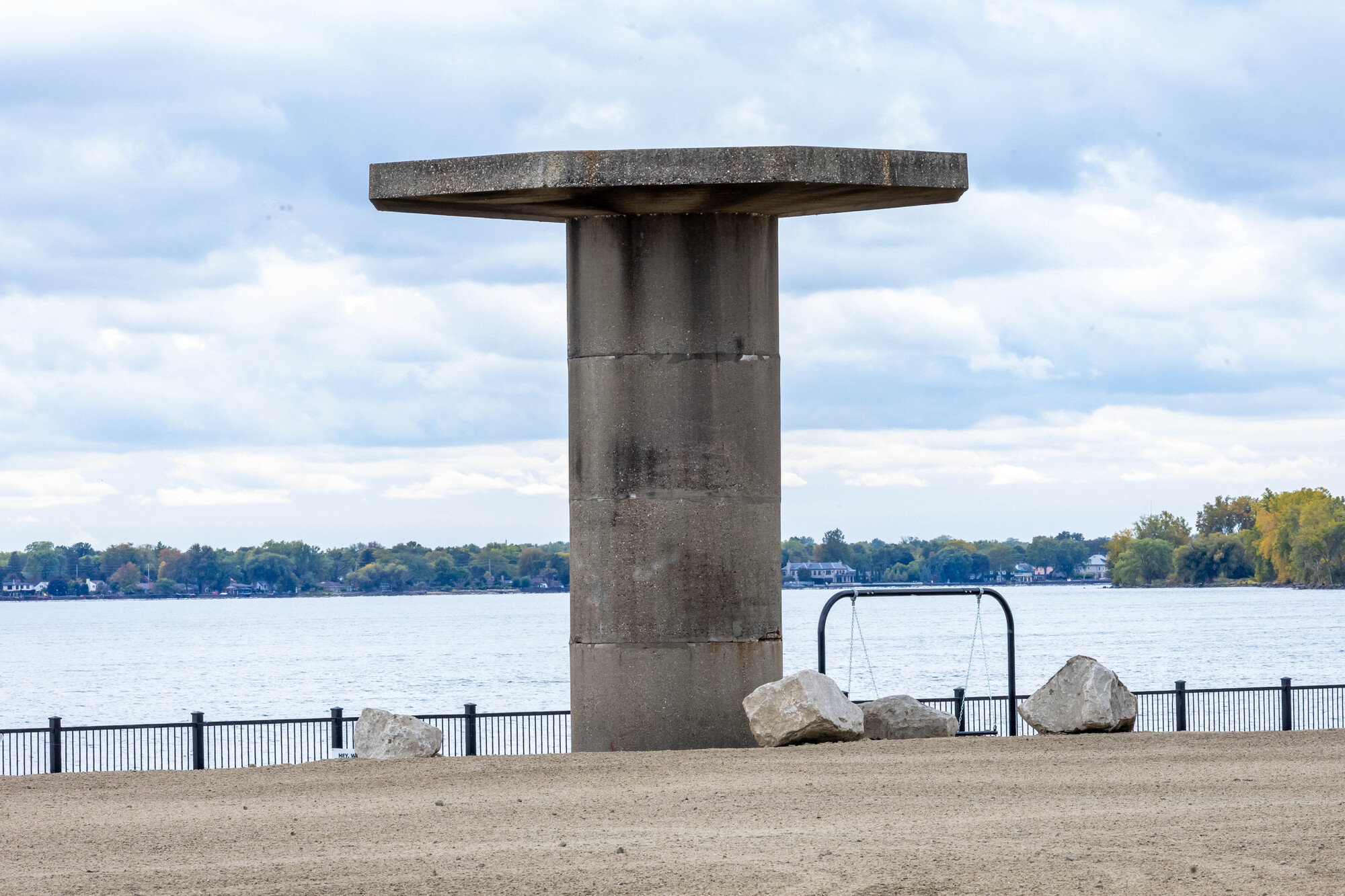
The surviving physical evidence is equally divided. At A.B. Ford Park, two tall concrete radar-tower bases from the D-23 IFC remain. The City of Detroit incorporated them into a 2026 public-art project after a major park renovation. The D-26 IFC in Maheras-Gentry Park is reported obliterated, and current city park material does not identify surviving Nike structures. The Belle Isle launch plant had already been leveled by 1988. Its former area is now open parkland owned by the City of Detroit and managed by the Michigan Department of Natural Resources.
Why the Detroit River Sector Mattered
Detroit remained one of the nation's most important industrial regions after World War II. Its automobile and truck plants, steel mills, chemical works, machine-tool capacity, ports, rail links, engineering centers, and skilled workforce made the metropolitan area both an economic center and a reserve of military production. The same plants that had supplied the wartime "Arsenal of Democracy" could again produce vehicles, engines, weapons, and other defense material.The riverfront sites also occupied a strategically useful sector. A bomber approaching the upper Great Lakes through Canadian airspace could pass Lake Huron and Lake St. Clair before reaching Detroit's factories and transportation network. D-23 and D-26 helped cover the eastern metropolitan edge, the Detroit River corridor, and the approaches between Detroit and Selfridge Air Force Base. They were not isolated point defenses for Belle Isle or the nearby neighborhoods. Their engagement zones overlapped with other Nike batteries in a regional ring coordinated from the Selfridge command complex.
The riverside geography imposed complications as well as advantages. The Army needed clear radar horizons, reliable communications across water, secure urban parcels, and a launcher location with sufficient safety area. Belle Isle offered space for a large double launch plant without requiring a comparable block of dense mainland neighborhood. The two waterfront parks gave the radar crews open views toward the island and river. Together, the three properties solved an urban land problem, but at the cost of a more complex communications and command relationship than a conventional two-parcel Nike battery.
The Three-Property Physical Arrangement
The IFC was the operational brain of a Nike battery. Acquisition radar searched for aircraft. Once a target was selected, a target-tracking radar followed it while a missile-tracking radar followed the Nike after launch. Analog computing equipment compared the two tracks, generated steering commands, and transmitted those commands to the missile. The launch crew could prepare and fire a weapon, but the missile could not complete an engagement without the radar and computer crew at the IFC.D-23's IFC occupied the eastern mainland park at Lenox Street. Its documented acquisition set was LOPAR, the low-power acquisition radar used at many Ajax sites. Period photographs and the surviving towers establish a conventional Nike control compound with target- and missile-tracking positions, operations and support structures, and a clear view over the riverfront. The two concrete cylinders surviving in A.B. Ford Park carried radar equipment rather than missiles. They were never silos and never stored warheads.
D-26's IFC occupied the western mainland park near Conner Street. The specialized site history identifies an AN/FPS-71 acquisition radar during its later service. Hercules operation required more capable fire control than early Ajax, including system modifications for longer-range, higher-altitude engagements and the different missile. Army Corps of Engineers drawings linked from the D-26 history show the IFC building and tower plan and provide a stronger basis for reconstructing the compound than modern surface appearance.
The Belle Isle launch property was a double plant. Below-ground reinforced-concrete magazines stored missiles horizontally and used elevators to bring them to the surface. Crews moved missiles along rails to launchers, connected and tested them, and erected them for firing. The surface compound also required assembly, test, electrical, generator, security, fueling, neutralization, and support facilities. Contemporary images show a single large fenced installation, not two remote launcher properties accidentally sharing a name.
Communications connected each mainland IFC to the island. The fire-control crews had to pass status and firing information to the appropriate launcher section, and the launcher crew had to confirm missile readiness. The water gap did not change the command-guidance principle, but it made dependable land-line or equivalent communications essential. A prepared missile on Belle Isle was useless if its associated IFC could not track, compute, and transmit guidance.
Configuration and Decoded Meaning
The national inventory gives D-23 the notation "Nike 2B/20A/8L-A." Read literally, that means two B-type underground missile magazines, a designed allowance of twenty Nike Ajax missiles, and eight Ajax launchers. The B magazine was an underground storage and elevator design that could be modified to handle the larger Hercules missile, although D-23 itself was not converted. "8L-A" describes eight surface launchers assigned to Ajax. It does not mean eight individual missile silos.The same inventory gives D-26 the notation "Nike 2B,2C/12H,20A/16L-UA, (8L-H)." It records two B-type and two C-type magazines, allowances of twelve Hercules and twenty Ajax missiles, and sixteen launchers in a mixed universal/Ajax arrangement. The parenthetical "8L-H" states that eight launchers were converted for Hercules. The C magazine was an Ajax-only design; the B magazine could be modified for Hercules handling. A universal launcher could handle the larger Hercules as well as Ajax, while the remaining Ajax launchers preserved the mixed capability.
These two codes cannot safely be added together as if they were independent inventories measured at the same moment. Doing so would imply six magazines and twenty-four launchers, a total that conflicts with the specialized D-26 description of the shared plant as four magazines and sixteen launchers. The most likely explanation is that the D-23 line describes its active Ajax battery, while the D-26 line reflects the combined or post-conversion double-launch property used after modernization. However, the reviewed national inventory does not explain its counting convention for this unusual shared site.
How the Ajax Batteries Would Have Fought
An engagement began with warning, identification, and target assignment. The wider Air Force and Army network could alert the Detroit batteries, while each local acquisition radar searched its sector. Regional command personnel coordinated which Nike battery should engage a particular track. That coordination reduced the risk that several batteries would waste missiles on the same bomber.At the assigned IFC, the target-tracking radar established a stable track on the aircraft. After launch, the missile-tracking radar followed a beacon or transponder on the Nike. The analog computer continuously compared target and missile position, calculated steering corrections, and sent commands to the missile through the tracking system. At the proper intercept point, a command detonated the warheads. Nike Ajax was not a heat-seeking weapon and did not become independent after launch.
Ajax carried conventional fragmentation warheads. Its sustainer used liquid fuel and inhibited red fuming nitric acid oxidizer, while its booster was solid fueled. The Belle Isle crews therefore worked with corrosive and toxic propellants as well as explosives, electrical systems, and heavy handling equipment. Protective clothing, fueling and neutralization procedures, leak response, ventilation, and disciplined maintenance were daily safety requirements.
The double-site arrangement did not combine D-23 and D-26 into one radar battery. Each IFC still had to track the target and the missile assigned to its own firing unit. The shared launch compound concentrated storage and surface launch equipment, but the two control systems remained functionally separate.
D-26 Hercules Conversion
Nike Hercules was larger, longer ranged, higher flying, and solid fueled after boost. It could carry either conventional or nuclear warheads. Its reach allowed the Army to defend a broad metropolitan area with fewer batteries than the dense Ajax network required. Detroit sites selected for conversion became the long-term backbone of the defense ring, while many Ajax-only batteries closed around 1960 to 1963.The Hercules program history gives D-26 priority number eight among converted defense sites. Its table records two B-type magazines in the conversion work, a construction period from May through July 1958, and an operational-with-Hercules date of October 1, 1958.
Only half of the sixteen launchers were converted for Hercules. Secondary site research states that the other half remained Ajax, a pattern consistent with D-23 continuing Ajax operations until December 1960 while D-26 took on Hercules. The mixed period is historically important. For more than two years, the Belle Isle plant supported an Ajax-only battery and a Hercules-capable battery at the same property.
Hercules also changed the security and command environment. A Hercules site could support nuclear-capable weapons, but that does not establish the number or type of warheads present on a particular date. The site records document missile and launcher configuration, not a complete warhead custody log.
Units and Manning
The D-23 history identifies Battery A, 85th Antiaircraft Artillery Missile Battalion from April 1955 to September 1958. It then lists Battery A, 3rd Missile Battalion, 55th Artillery through D-23's December 1960 closure.The D-26 history describes the double site's larger organizational footprint. From April 1955 to September 1958 it lists Headquarters and Headquarters Battery and Batteries A and B of the 85th. From September 1958 to December 1960 it lists Headquarters and Headquarters Battery and Batteries A and B of the 3rd Battalion, 55th Artillery. From December 1960 to November 1968 it identifies Battery B, 3rd Battalion, 517th Artillery at D-26.
The unit lists fit the physical history. While D-23 and D-26 both operated, Batteries A and B corresponded to the two firing missions, with battalion headquarters also associated with the complex. When D-23 closed, Battery A's separate mission ended, and Battery B continued at the Hercules-capable D-26 site. Army-wide redesignations in 1958 changed unit names under the Combat Arms Regimental System without necessarily replacing every soldier or piece of equipment at once.
These were Regular Army units in the D-23/D-26 directory, not a Michigan Army National Guard handoff of the kind seen at some other Detroit sites. Maintaining continuous alert required radar operators, computer personnel, launcher crews, missile maintenance specialists, generators and communications technicians, fuel handlers during the Ajax years, guards, cooks, medics, administrators, and command personnel. The two IFCs and island launch plant also imposed transportation and communications demands uncommon at rural two-parcel sites.
Daily Readiness on the Riverfront
Most work at D-23 and D-26 was preventive rather than dramatic. Radar crews calibrated equipment, checked alignment, and practiced acquisition and tracking. Computer crews tested analog circuits and simulated intercepts. Launcher crews inspected magazines, elevators, rails, erecting mechanisms, launchers, electrical connections, and missiles. Generator personnel prepared for commercial-power failures. Communications technicians maintained the links between the mainland and island.The shared launcher added a coordination problem. Two batteries had to use the same guarded property without confusing readiness status, maintenance responsibility, missile handling, or firing assignments. During the mixed Ajax/Hercules period, crews also worked around two different missiles and two launcher capabilities. Ajax required liquid-propellant handling; Hercules used a solid-fueled sustainer and different handling dimensions. Clear equipment identification and disciplined procedure were essential.
Exercises could begin as simulated warning at an IFC and proceed through acquisition, target assignment, tracking, computing, and launcher preparation without an actual firing over Detroit or Canada. Live qualification launches occurred at designated firing ranges. The purpose of daily training in Detroit was to prove that every human and technical link could function on short notice.
The river itself could affect radar operation. A former crew account preserved by Ed Thelen recalls a ship grounding in front of the fire-control area and blocking a radar's view across the water. The account is plausible in the busy Detroit River setting and illustrates the unusual operational environment, but no official incident report was found. It should be treated as an attributed recollection rather than a fully documented shutdown event.
Selfridge and Regional Command
D-23 and D-26 belonged to the Detroit Defense Area rather than operating as independent city installations. Early Nike coordination depended heavily on voice reports, plotting, and manual target assignment. In 1960 the Army placed Missile Master at Selfridge, adding automatic data communications, processing, and displays to help the defense-area commander coordinate the batteries.Missile Master did not directly steer a D-23 or D-26 missile. It helped assign targets and manage the regional fight. The selected battery's own IFC still had to acquire the target, track target and missile, compute the intercept, and transmit guidance. This division between regional coordination and local command guidance remained central after automation.
D-23 closed in the same month that the specialized unit chronology shifts D-26 to Battery B, 3rd Battalion, 517th Artillery. The timing reflects consolidation around Hercules-capable sites. D-26 continued to cover the riverfront sector with greater range while other Detroit Ajax batteries were removed. Its service through November 1968 bridged the transition from the dense early Nike ring to a smaller Hercules network.
D-23 Closure in December 1960
The national inventory and specialized site history agree that D-23 closed in December 1960. Its Ajax-only mission ended, its separate IFC left the operational network, and the eastern half of the double-site arrangement ceased to function as an independent battery.D-23's closure was not evidence that the Belle Isle position had become useless. It was possible precisely because D-26 had been modernized. Hercules covered more distance and altitude, allowing one improved firing unit to replace part of the earlier Ajax density. The continuing D-26 battery retained the strategically valuable riverfront position for eight more years.
D-26 Closure in November 1968
D-26 remained operational until November 1968. By then the bomber threat had declined relative to intercontinental ballistic missiles, against which the existing Nike system was not a comprehensive defense. The Army was also concentrating resources at fewer batteries and preparing broader reductions in continental air defense.The final closure ended thirteen years of Nike operation across the three properties. It removed the last active firing mission from Belle Isle and returned the mainland control parcels to park use. The site never fired at an enemy aircraft. Its mission was deterrence and readiness: the ability to make a bomber attack more difficult and costly even if the missiles were never used in combat.
D-23 IFC Afterlife at A.B. Ford Park
The D-23 IFC returned to Alfred Brush Ford Park, now A.B. Ford Park. Most buildings and technical equipment disappeared, but the two concrete bases for the missile- and target-tracking radar positions survived. Their height and cylindrical form made them the clearest visible Nike remnants in Detroit's riverfront parks, even though visitors often called them silos.WDET documented the towers and public awareness of the Cold War site in 2015. The article described a public park whose fishermen and families used the riverfront around the unmarked concrete structures. It correctly connected the mainland radar site with missiles stored on Belle Isle, although its broad statement that the station closed in the 1970s is not used for the chronology. D-23 closed in 1960 and D-26 closed in 1968.
The City of Detroit completed an $11.9 million improvement and environmental-remediation project at the thirty-four-acre park and reopened it in October 2025. The work added playgrounds, riverwalk and railing replacement, walkways, recreation facilities, a natural meadow, lighting, and extensive new tree planting. The city's announcement explicitly identified the two surviving structures as former missile radar-tower bases.
In April 2026, the city issued an open call for artists to paint the two towers. The project document identifies them as D-23 relics, gives each tower a height of nineteen feet, and schedules mural completion for July or August 2026.
D-26 IFC Afterlife at Maheras-Gentry Park
The D-26 IFC returned to the public park now called Maheras-Gentry Park. The specialized D-26 history reports that no IFC structure remains. Unlike the D-23 towers, no identified radar base or operations building appears in current City of Detroit park material.The city describes Maheras-Gentry as a fifty-three-acre regional riverfront park with ball fields, basketball, a playground, picnic shelters, a lagoon, and the beginning of the Conner Creek Greenway. Recent work has included an accessible path to a river overlook, habitat restoration at the lagoon, and trail improvements. These current descriptions verify continued park reuse, not the survival or exact removal date of every military foundation.
A field survey would still be useful. "Obliterated" in a national inventory generally means the military site is no longer legible as an operating compound, not that every buried utility or slab has been archaeologically removed.
Shared Launcher Afterlife on Belle Isle
The Belle Isle launch plant was demolished and leveled. A site-specific photograph captioned as 1988 shows the area after leveling. Later photographs show open ground with concrete and brick debris reported in poor fill. No reviewed source documents a surviving magazine hatch, launcher rail, operational building, or radar structure at the shared launcher today.Belle Isle became Michigan's 102nd state park in February 2014 under a long-term lease. The City of Detroit retained ownership while the Michigan Department of Natural Resources assumed management. The former launcher area is therefore public parkland rather than an abandoned military property. The nearby Livingstone Memorial Lighthouse remains a working navigational light, and the Blue Heron Lagoon remains a named park water feature.
Current DNR material describes Belle Isle as a 985-acre public park with recreation, cultural institutions, waterways, the lagoon, and the lighthouse. It does not identify or interpret the Nike launch site. The former military boundary is not readily legible from those visitor materials. Site-specific drawings and 1961 aerial imagery remain the best tools for understanding the historic footprint.
Why the Historic Names Caused Confusion
The label "Detroit City Airport" sent researchers to the actual airport at Conner Street and Gratiot Avenue, where they found no convincing permanent D-23 layout. The specialized D-23 page suggests that an old map or regional naming convention may explain the label and acknowledges earlier uncertainty about whether the two mainland IFC identities had been reversed.Later reconciliation using veteran accounts, 1961 imagery, surviving towers, Corps drawings, and the relationship to the shared launcher places D-23 at Lenox Street and D-26 at Conner Street. The City of Detroit's 2026 tower project independently identifies the A.B. Ford Park radar remains as D-23. This current official identification strengthens the modern assignment.
The "Fort Wayne/Detroit" label for D-26 is similarly unhelpful. The permanent D-26 IFC and launcher were not at Historic Fort Wayne. It may reflect an early planning label, a broader Detroit location reference, or an inherited directory error.
What Remains and What Does Not
The clearest surviving elements are the two concrete radar-tower bases at the D-23 IFC in A.B. Ford Park. They are publicly accessible within a renovated city park and are the subject of a 2026 mural project.At the D-26 IFC, the documented military buildings and towers are gone from the visible park landscape. At the shared launcher, the double plant was leveled by 1988 and is now park field. Surface debris was photographed or reported after demolition, but no present controlled field survey was found. The absence of visible superstructure does not by itself prove removal of every buried foundation, utility, or filled magazine cavity.
The National Archives offers the most promising route for reconstructing what has vanished. Its Chicago finding aid lists Belle Isle Nike as-built drawings from 1953 to 1954 for D-23 and D-26 in Record Group 77, Detroit Box 88. Those records could resolve the magazine-count issue, show property boundaries and utility routes, and distinguish original construction from conversion work.
Chronology
- 1953 to 1954 Army Corps of Engineers as-built drawings are prepared for the Belle Isle Nike installation, Sites D-23 and D-26. The surviving drawing set is listed in National Archives Record Group 77, Detroit Box 88.
- April 1955 D-23 and D-26 become operational as Nike Ajax batteries. D-23 uses the IFC at Alfred Brush Ford Park; D-26 uses the IFC at Peter Maheras Playground; both use the shared double launcher on Belle Isle.
- April 1955 to September 1958 The specialized histories associate Battery A of the 85th with D-23 and Headquarters and Headquarters Battery plus Batteries A and B of the 85th with the wider D-23/D-26 complex.
- May to July 1958 Army program records document the D-26 Hercules conversion construction period.
- September 1958 The specialized histories shift the operating organizations to Headquarters and Headquarters Battery and Batteries A and B, 3rd Battalion, 55th Artillery.
- October 1, 1958 The Army Hercules deployment table records D-26 operational with Hercules missiles. Eight of the shared plant's sixteen launchers are documented as converted for Hercules.
- 1960 Missile Master becomes operational at Selfridge, improving automated regional coordination and target assignment for the Detroit Defense Area.
- December 1960 D-23 closes. Battery A's Ajax-only mission ends. D-26 continues at the Hercules-capable portion of the Belle Isle plant.
- December 1960 to November 1968 The specialized D-26 history identifies Battery B, 3rd Battalion, 517th Artillery as the operating unit.
- 1961 Site-specific aerial images document both mainland IFCs and the shared Belle Isle launcher shortly after D-23's closure.
- November 1968 D-26 closes, ending active Nike service at the two mainland parks and Belle Isle.
- By 1988 A site-specific photograph shows the Belle Isle launcher area leveled.
- 1999 to 2009 Observer reports and veteran recollections help reconcile the D-23 and D-26 identities, confirm the shared launcher, and describe the D-23 towers and open former launch field.
- February 2014 Belle Isle becomes a Michigan state park under lease. Detroit retains ownership and the Michigan Department of Natural Resources assumes management.
- July 2015 WDET publishes a feature on the surviving radar towers and Cold War history at Alfred Brush Ford Park.
- Spring 2024 to October 2025 Detroit carries out environmental remediation and major recreation improvements at A.B. Ford Park.
- October 16, 2025 The City of Detroit reopens the renovated A.B. Ford Park and identifies the two surviving structures as former missile radar-tower bases.
- April 2026 Detroit issues an artist call for murals on the two D-23 radar towers, with completion scheduled for July or August 2026.
- Present A.B. Ford Park and Maheras-Gentry Park serve Detroit's riverfront neighborhoods. The former launcher lies within Belle Isle Park. Only the two D-23 radar-tower bases are confirmed above-ground Nike remains.
List of all Nike Installations in Michigan
Sources & References
- PDF Defend and Deter: The Legacy of the United States Cold War Missile Program Source for the Detroit Defense Area, D-23 and D-26 official inventory notations, active-service endpoints
- WEB National Archives at Chicago, Nike Missile Sites Source for Record Group 77, Detroit Box 88, Belle Isle Nike, As Built, 1953-1954, Sites D-23 & 26, and for related Detroit Nike engineering collections.
- WEB Ed Thelen, Missile Sites: Michigan Secondary compilation preserving veteran and observer evidence.
- WEB 34-acre A.B. Ford Park reopens on Detroit's east Riverfront after $12M renovation & cleanup, October 16, 2025 Official current source for the park's renovation, environmental remediation, amenities, and two surviving missile radar-tower bases.
- WEB City of Detroit, AB Ford Park Radar Towers Open Call 2026 Official current source identifying the towers as D-23 remains, recording two nineteen-foot mural surfaces, and scheduling the public-art project for summer 2026.
- WEB City of Detroit, Maheras-Gentry Park Official current source for the former D-26 IFC property's fifty-three-acre riverfront park use.
- WEB Michigan Department of Natural Resources, Belle Isle Park Official current source for DNR management, the public-park setting, current acreage, Blue Heron Lagoon, and the Livingstone Memorial Lighthouse.
- WEB State of Michigan, Belle Isle closer to becoming state park under lease signed by city, state, October 1, 2013 Official source for Detroit's retained ownership, the long-term lease, and Michigan DNR management responsibility.
- WEB WDET, Alfred Brush Ford Park's Cold War History, July 31, 2015 Local reporting and site visit documenting the surviving towers, public park use, and connection to the Belle Isle launcher.