
AN/FYQ-9 Alaska Air-Defense Data System
Radar found an aircraft. AN/FYQ-9 helped Alaska's air-defense crews turn that detection into a track they could report and use, linking isolated stations to regional control centers before the later satellite-based network.
- Full designation
- Alaskan Air Command Data Processing and Display System, AN/FYQ-9.
- Role
- Semiautomatic radar-track entry, reporting, processing and display.
- Operator
- United States Air Force, Alaskan Air Command.
- Accepted
- July 1, 1965, initially in limited operational status.
- Deployment
- Distributed among Alaska Aircraft Control and Warning radar reporting sites and control centers.
- Radar transmitter
- None. AN/FYQ-9 processed information from separate search and height-finding radars.
Overview
AN/FYQ-9 was the data-processing and display system built for Alaska's Aircraft Control and Warning network. It was not a search radar, a height finder or a White Alice antenna. A separate radar detected the aircraft; FYQ-9 equipment helped personnel enter, transmit, process and display its track so that a distant control center could maintain an air picture. Contemporary NORAD records call it the Alaskan Air Command Data Processing and Display System and describe equipment at both radar reporting sites and control centers. [1] [2]
The system reached Alaska after the continental United States had already invested heavily in the Semi-Automatic Ground Environment. Alaska's immense distances, scattered radar stations and difficult communications made its warning chain a distinct problem. AN/FYQ-9 supplied a semiautomatic answer for that network in the mid-1960s, improving the movement of track information without removing the operators at the remote sites. [1] [4]
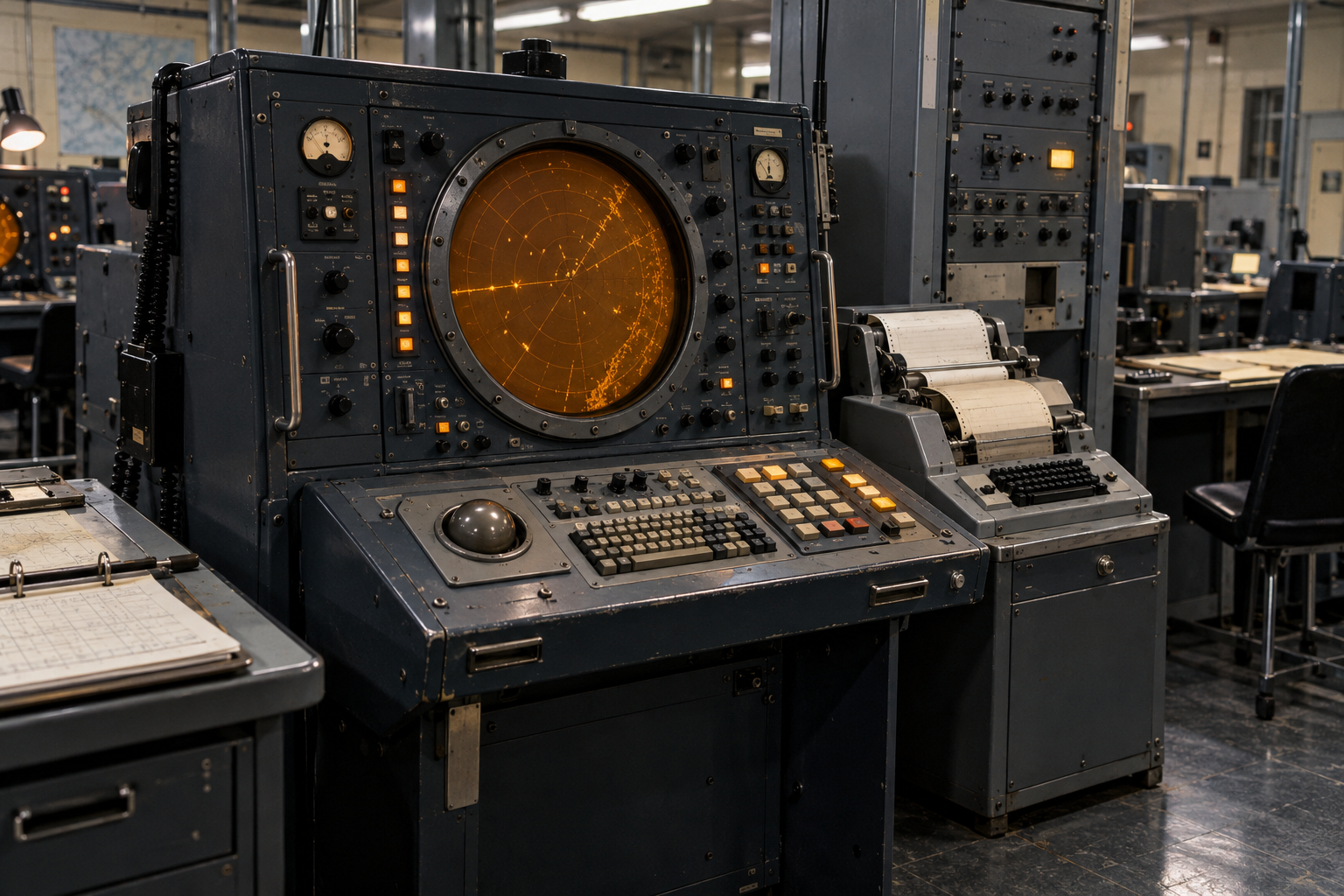
A period photograph shows Airman Second Class Larry Pronovost operating a UPA-35 radar scope with a FYQ-9 track-input shelf at Kotzebue Air Force Station in 1972 or 1973. The surviving image provides a rare view of the equipment as an Alaska radar crew used it. [8]
The Manual Warning Chain
Before FYQ-9, an operator watched a plan-position-indicator scope, followed successive radar returns, and helped plot and report a possible aircraft track. Other crew members passed the information to a direction or combat center, often through voice procedures. A controller needed a continuing track, not merely a single echo, to judge a target's course and arrange an interception. Alaska's historical survey records the labor-intensive manual system that FYQ-9 was intended to replace. [4] [5]
The distinction mattered at installations such as King Salmon. Its search and height-finding radars supplied measurements, while the station's direction-center role required crews to assemble information from a wider sector. Adding AN/FYQ-9 did not change an AN/FPS-87A into a different radar. It changed how observations from radar scopes became usable reports and displays within Alaska's air-defense organization. [1] [4]
A Distributed System
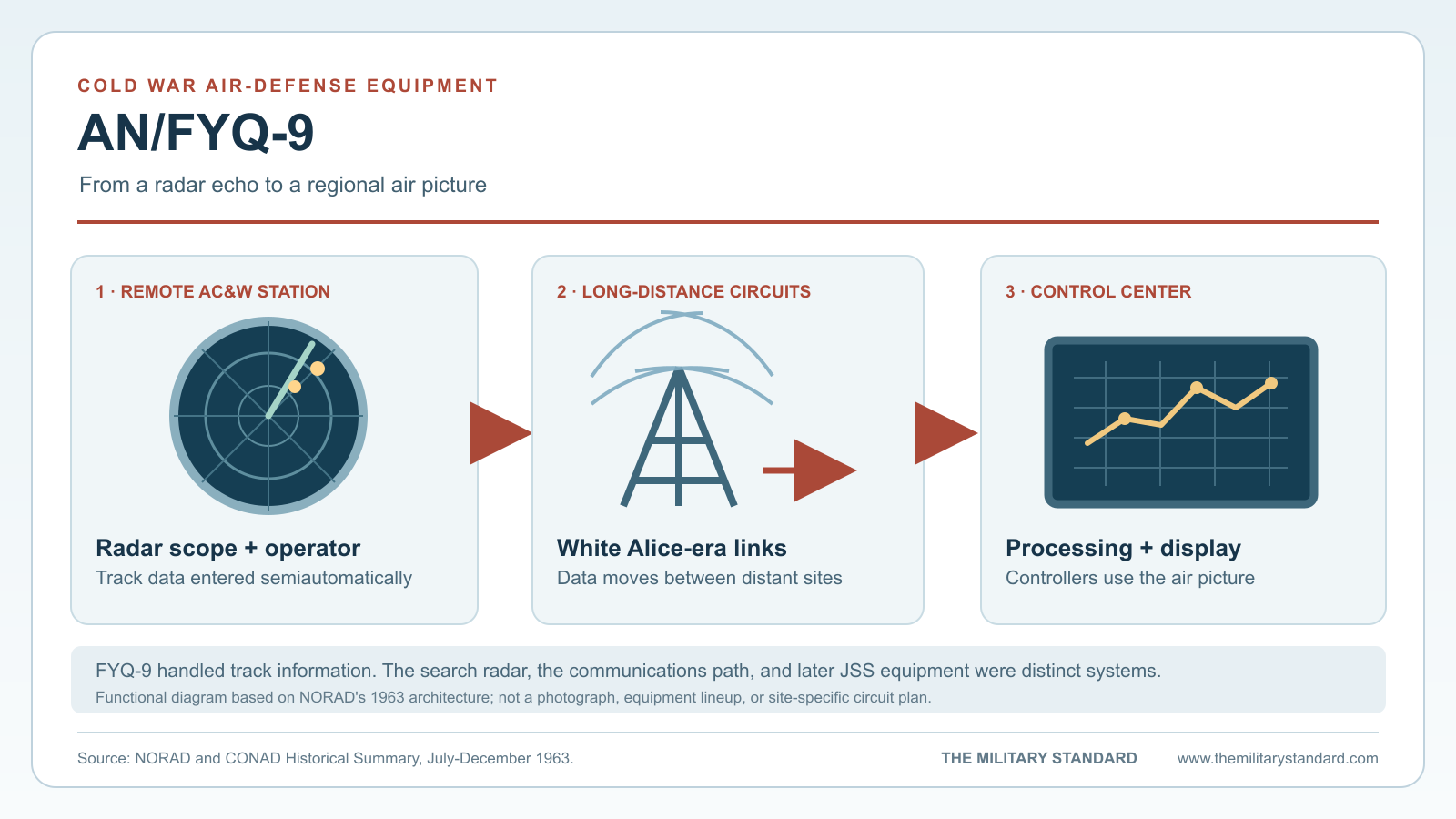
NORAD's 1963 account described semiautomatic track-data inserters and teletype equipment for radar reporting sites. The planned control-center complement included a teletype, computer, display and read-out console at each of four centers. Those elements explain the FYQ-9 designation as a system rather than a single cabinet: equipment and operators at the radar station prepared reports, a communications network carried them, and control-center equipment presented the developing air picture. [1]
The arrangement remained semiautomatic. Station personnel still watched radar indications, assessed contacts and entered information. FYQ-9 reduced the repeated manual relay of track data and gave control centers a more timely, consistent display. The controls did not make independent decisions about whether a contact was hostile, nor did the system generate radar echoes. Human surveillance and weapons-control work remained central to the mission. [1] [4]
Air Force historical accounts identify the system in the equipment histories of several stations, including Cape Newenham, Cape Romanzof, Indian Mountain and Sparrevohn. Their search-radar models and local buildings differed, but they participated in the same regional track-reporting mission. [4]
Acceptance and Early Operation
The original schedule called for the system to operate in early 1964. By late 1963, NORAD reported that the target had slipped to July 1964. Further problems delayed acceptance until 12:01 a.m. Alaska Standard Time on July 1, 1965. This was a major milestone, but the contemporary record adds a necessary qualification: supportability and maintainability deficiencies led Alaskan Air Command to put the new system temporarily in limited operational status, with a manual backup air-defense display in use. [1] [2]
At Cape Newenham, the state AC&W history dates operation of the semiautomatic data equipment to 1965. At Indian Mountain and Cape Romanzof, it records installation in the same year. The July 1 command acceptance should therefore be read as a system-level event, while each site's construction, checkout and day-to-day use belonged to its own local history. [4]
Maintenance was an operational issue, not simply a procurement footnote. The Alaska study quotes a Murphy Dome squadron history reporting a shortage of personnel qualified to maintain AN/FYQ-9. A sophisticated system distributed over remote stations could improve reporting only when its operators, technicians, spare parts and communications circuits were available. [4]
Communications Across Alaska
FYQ-9 depended on a reliable path between radar stations and the control organization. During its 1960s introduction, the White Alice Communications System supplied much of Alaska's long-distance military telecommunications through tropospheric-scatter and microwave links. The data equipment and White Alice network served different functions: FYQ-9 prepared and displayed air-defense information, while communications circuits carried it. [4] [5]
The security of those circuits became a contemporary concern. In July 1965, Alaskan Air Command told NORAD that FYQ-9 made online encryption technically possible for the first time in this reporting system. NORAD and the command then studied whether and how to secure the Alaska data links. Those records describe a proposed protection effort, not proof that every FYQ-9 circuit was already encrypted. [3] [6]
Satellite terminals gradually replaced White Alice links in the late 1970s. That communications change did not itself create FYQ-9, which had been accepted in 1965. The later Joint Surveillance System was another step: common digitizers and satellite data links supported the Regional Operations Control Center at Elmendorf in the early 1980s. Keeping these stages separate shows how Alaska's warning network evolved from voice reporting, to semiautomatic FYQ-9 reporting, to more centralized remote surveillance. [4] [5]
Stations and Control Centers
King Salmon illustrates the system's value at a staffed control point. Its mid-1960s modernization paired improved search and height-finding radars with FYQ-9 equipment, reducing the slow manual passage of track data. Fort Yukon illustrates the remote-station end of the chain: crews still had to watch their sector, but semiautomatic reporting helped deliver their tracks to the wider Alaska system. [4] [5]
At Indian Mountain, the historical study expressly says the AN/FYQ-9 remained until 1982, when Joint Surveillance System equipment replaced its data-transmission role. This is a documented station-specific endpoint rather than a universal retirement date for all FYQ-9 installations. Other Alaska stations followed their own modernization schedules as the regional control architecture changed. [4]
Replacement and Legacy
The FYQ-9 era ended through a broader redesign of Alaska air defense. The Joint Surveillance System and the Elmendorf Regional Operations Control Center shifted more track processing and fighter-control work away from permanently staffed remote sites. The SEEK IGLOO program added minimally attended AN/FPS-117 radars at many surviving locations, while the later AN/FYQ-93 computer generation served regional and sector centers. FYQ-9 was not itself a component of either later system: it belonged to the older staffed network and a different information flow. [4] [7]
AN/FYQ-9's historical importance lies between two better-known generations. It carried Alaska's air-warning system beyond exclusively manual plotting and voice reporting, yet it still relied on radar-site crews and regional operators. Its development delays and initial limited status also show the practical difficulty of automating a far-flung defense network. The equipment is a reminder that a radar's warning value depended as much on moving and interpreting its tracks as on detecting them in the first place. [1] [2] [4]
Chronology
- 1963: NORAD describes installation of AN/FYQ-9 equipment at Alaska radar reporting sites and four control centers. [1]
- Early 1964: The original target for operation passes without system acceptance. [1] [2]
- July 1964: A revised operational target also slips during development and installation. [1] [2]
- July 1, 1965: Alaskan Air Command accepts AN/FYQ-9 at 12:01 a.m. Alaska Standard Time; maintainability problems initially limit operation. [2]
- July 1965: Alaskan Air Command raises the possibility of online encryption for the FYQ-9 data circuits. [3]
- 1965: Alaska's site histories record FYQ-9 installation or operation at King Salmon, Cape Newenham, Cape Romanzof, Indian Mountain and Sparrevohn. [4]
- 1966: Military commands continue studying how to secure the system's communications circuits. [6]
- Late 1970s: Satellite terminals begin replacing White Alice communications paths at many Alaska stations. [4] [5]
- 1982: At Indian Mountain, Joint Surveillance System equipment replaces the FYQ-9 data role documented in the state history. [4]
- 1983: The Elmendorf regional operations center becomes operational as Alaska shifts toward remotely monitored radar sites. [4]
Information sources (5)
- WEB1. NORAD and CONAD, Historical Summary, July-December 1963, Alaskan Region Combat Operations Center section. Source for the system name, planned radar-site inserters and teletype equipment, four control-center equipment suites and original schedules
https://www.northcom.mil/Portals/28/Documents/Supporting%20documents/%28U%29%201963%20NORAD%20CONAD%20History%20Jul-Dec.pdf
- PDFhttps://www.northcom.mil/Portals/28/Documents/Supporting%20documents/%28U%29%201965%20NORAD%20CONAD%20History%20Jan-Jun.pdf
3. NORAD and CONAD, Historical Summary, July-December 1965, Alaskan Region Communications Security section. Source for Alaskan Air Command's July 1965 discussion of potential online encryption and contemporary circuit-security concerns.
- WEB4. Alaska Office of History and Archaeology and Argonne National Laboratory, History of the Aircraft Control and Warning System in Alaska: Air Defense of Arctic Skies. Source for Alaska deployment, named station equipment, manual reporting, maintenance, White Alice and later JSS transition
https://dnr.alaska.gov/parks/oha/publications/histaircontrol.pdf
- PDFhttps://www.poa.usace.army.mil/Portals/34/docs/civilworks/archive/TheColdWarInAlaskaAManagementPlanForCulturalResourcesAug1994a.pdf
6. NORAD and CONAD, 1966 Historical Summary, Alaskan Region Communications Security section. Source for continuing surveys and planning for secure FYQ-9 communications.
- WEB7. U.S. Government Accountability Office, Computer Technology: Air Attack Warning System Cannot Process All Radar Track Data, IMTEC-91-15, 1991. Source for the later AN/FYQ-93 regional-center architecture, distinct from FYQ-9
https://www.gao.gov/assets/imtec-91-15.pdf