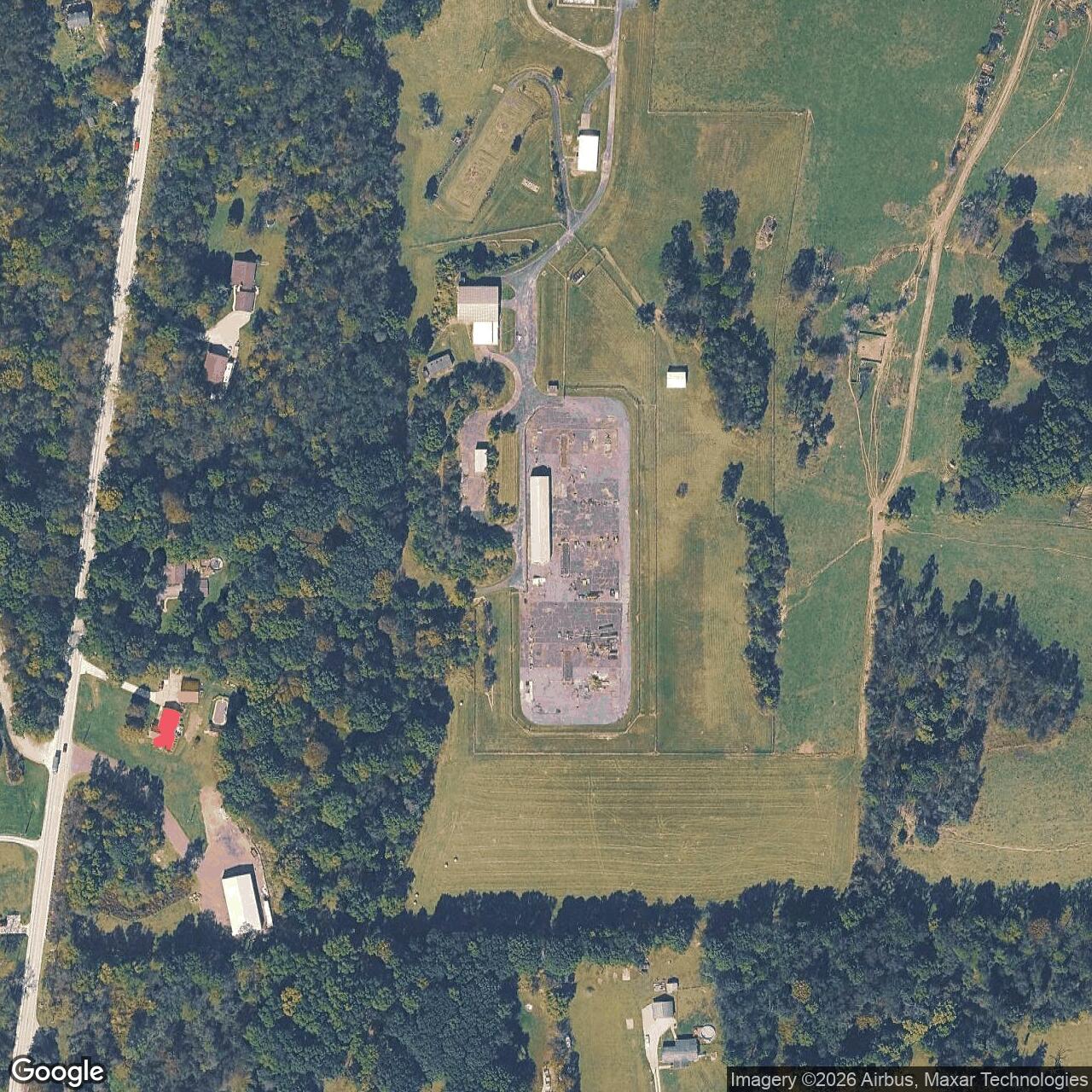
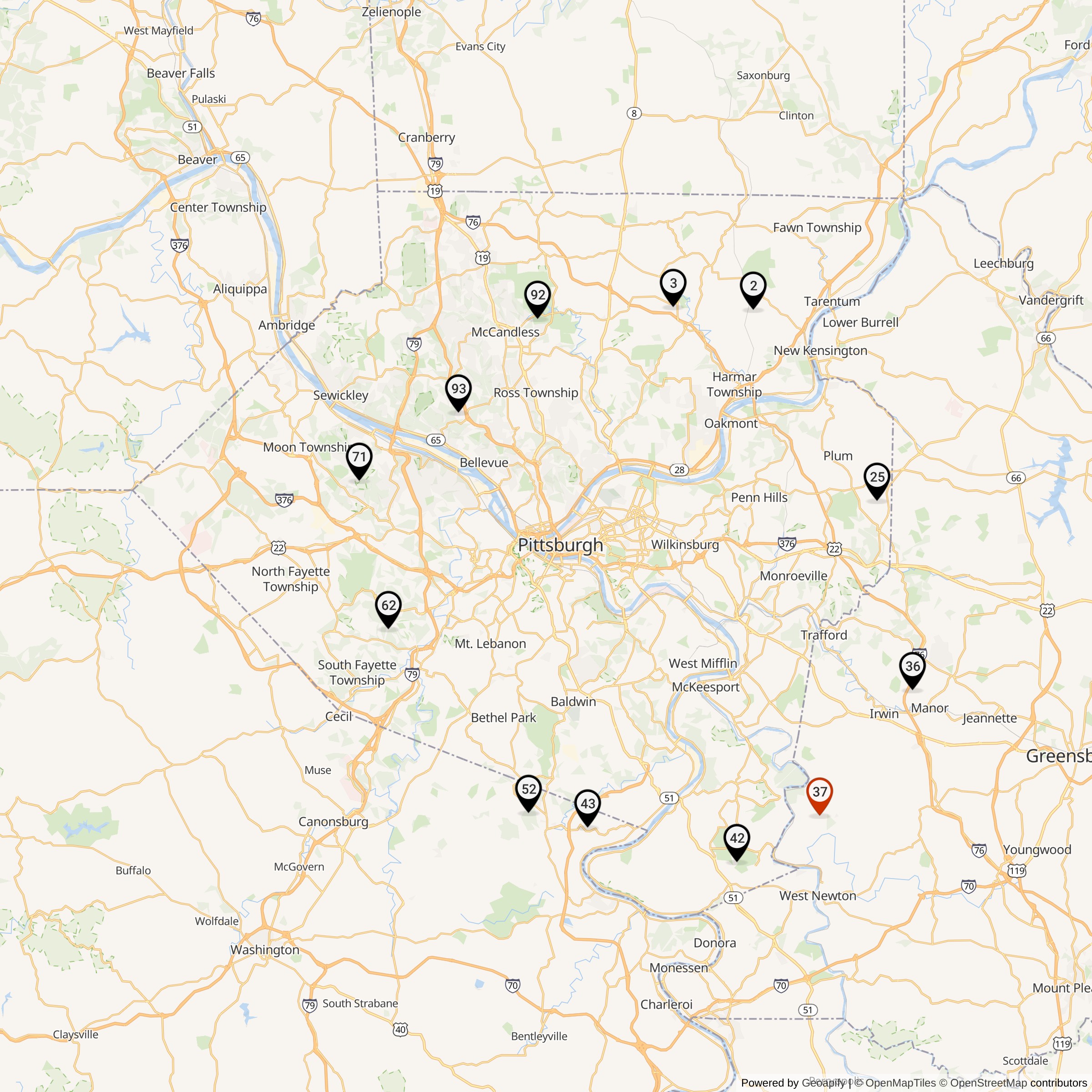
Nike Missile Site PI-37 Launcher, Cowansburg Pennsylvania
Longitude: -79.765271126897
This location was part of the Pittsburgh Defense Area
Site ID: PI-37
The missiles at this Launch Area were controlled by the Integrated Fire Control site located here.
Site Role: Launcher
A typical Nike air defense site consisted of two separate parcels of land. One area was known as the Integrated Fire Control (IFC) Area. This site contained the Nike system's ground-based radar and computer systems designed to detect and track hostile aircraft, and to guide the missiles to their targets.
The second parcel of land was known as the Launcher Area. At the launcher area, Nike missiles were stored horizontally within heavily constructed underground missile magazines. A large, missile elevator brought the Nikes to the surface of the site where they would be pushed across twin steel rails to one of four satellite launchers.
Elaboration on how Nike worked here.
Missile Type: Ajax/Hercules
The Nike Ajax was the first in the Army's family of guided missiles, and the world's first operational, guided, surface-to-air missile system. Nike Ajax had a burnout speed of Mach 2.3, a range of 25-30 miles, and a ceiling of 65,000 feet.
Designed to carry either nuclear and/or high-explosive warheads, the Nike Hercules missile could attack supersonic aircraft operating at altitudes in excess of 150,000 feet and at a range of more than 87 miles.
Battery Type: single
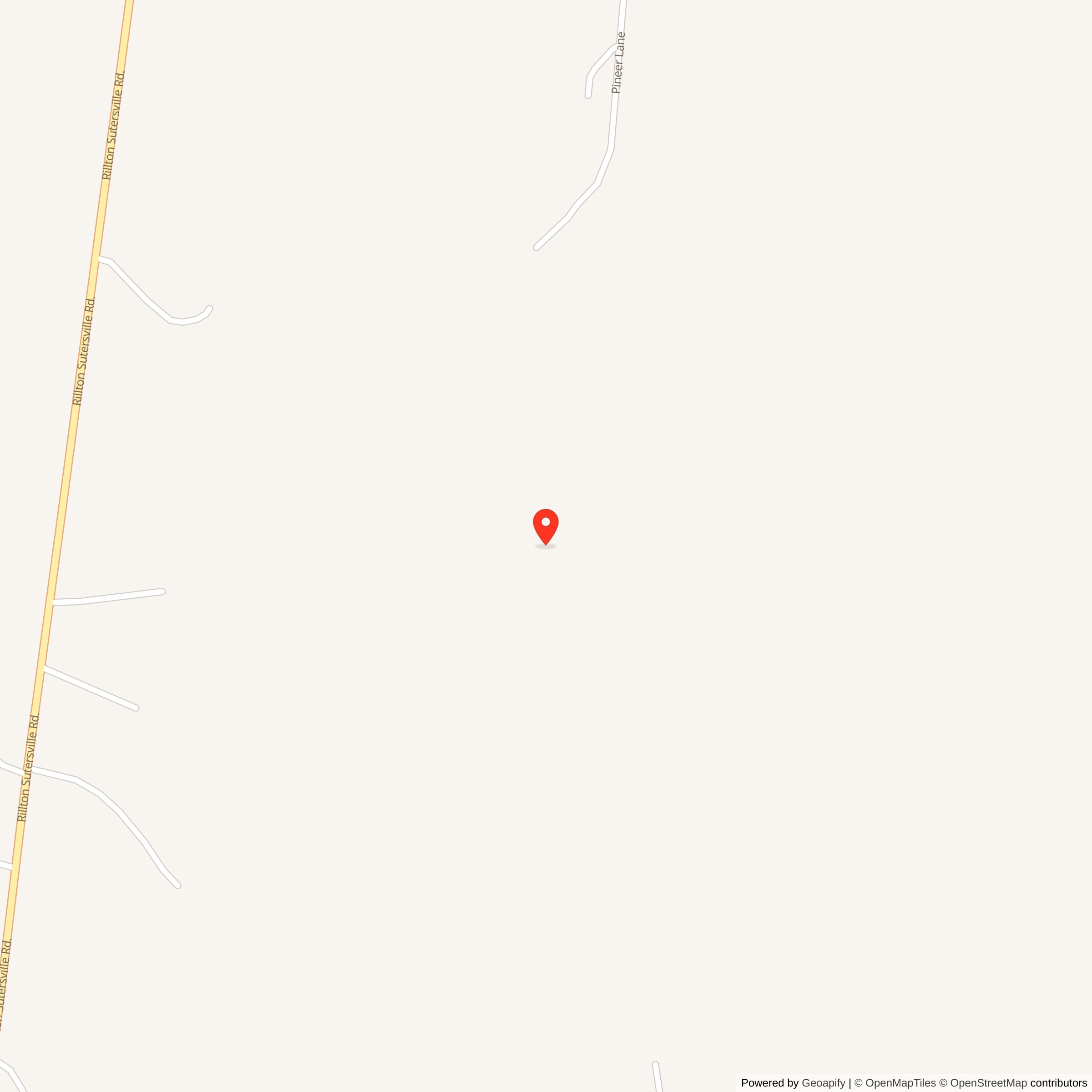
Nike Missile Site PI-37 was a former U.S. Army Nike Ajax and Nike Hercules air-defense missile battery in the Pittsburgh Defense Area. The site is associated with Cowansburg and Herminie in Westmoreland County, Pennsylvania, southeast of Pittsburgh. The federal Nike inventory lists PI-37 as active from 1956 to March 1974; the site-specific veterans' history states that the Herminie air-defense site was officially activated early in 1957.
PI-37 was an Ajax-to-Hercules site. The federal inventory lists it as Nike 3B/18H,30A/12L-U. That shorthand indicates a three-magazine Nike site with Type B missile-storage magazines, a reported capacity of 30 Nike Ajax missiles or 18 Nike Hercules missiles, and 12 universal launchers. The "U" launcher designation matters because Hercules conversion required launch equipment that could handle the larger missile. Appendix D of Mary T. Cagle's History of the Nike Hercules Weapon System Hercules conversion table also lists PI-37 among the converted Pittsburgh Defense Area sites. It shows PI-37 as a converted defense site with a 3B magazine configuration, construction work from June 1958 to May 1959, and a Nike Hercules operational date of November 22, 1959.
History
PI-37 belonged to the Cold War air-defense system built around Pittsburgh, a region the Army and Air Defense Command treated as a major industrial target. Pittsburgh was the "Steel City," and its industrial geography mattered militarily. The region contained steel mills, coke works, heavy industry, bridges, railroads, river transportation routes, power infrastructure, and urban population centers. In the early Cold War, planners assumed that Soviet long-range bombers, if they reached the continental United States, would be directed against precisely this type of industrial and transportation concentration.Before Pittsburgh received permanent Nike missile batteries, the Army first placed conventional antiaircraft gun defenses around the city. The DoD Legacy missile history describes an April 1952 movement of soldiers and heavy equipment through McKeesport toward Pittsburgh to establish a ring of 12 hastily sited gun positions to defend the Steel City. As in other major defense areas, those early antiaircraft troops initially worked in temporary field conditions. The coming of Nike Ajax changed the character of the system. Missile batteries required more permanent construction: underground missile magazines, launch pads, radar sites, plotting and control equipment, generator plants, barracks, administration buildings, roads, fenced security perimeters, and utility systems.
The Corps of Engineers Pittsburgh District was responsible for constructing the Nike sites that defended the Pittsburgh region. The Pittsburgh terrain complicated the engineering problem. A Nike battery needed a launch area and a separate Integrated Fire Control area that could see both the target and the missile. The two areas had to be separated for safety and technical reasons, but not so far or so poorly aligned that the radar and guidance system could not function. In the rolling and dissected terrain southeast of Pittsburgh, this meant placing radar equipment on a suitable high point while locating the launch area on a separate tract with enough usable ground for magazines, launchers, handling areas, and support buildings. The DoD Legacy history notes that Pittsburgh's rugged terrain forced engineers to build launcher and control radar sites apart from one another but still within sight of each other, and that construction costs in the region generally ran about $600,000 to $700,000 per site.
PI-37 was one of the sites in the southern and southeastern portion of the Pittsburgh ring. Its tactical purpose was to defend the metropolitan and industrial region against bomber approaches from that sector and to form an overlapping field of fire with neighboring Pittsburgh batteries such as PI-36 at Irwin, PI-42 at Elizabeth, and PI-43 at Elrama. The missile battery was never intended to act alone. It was one element in a wider system that combined early warning radars, command-and-control facilities, Army fire-control radars, Nike missiles, communications links, and crews trained to move quickly from surveillance to target engagement.
The site was originally armed with the Nike Ajax. Ajax was the first operational U.S. Army guided surface-to-air missile system and was deployed in the mid-1950s to replace or supplement conventional antiaircraft gun defenses around major cities, industrial areas, and military installations. A Nike Ajax battery used acquisition radar to detect targets, tracking radars to follow the target and missile, and a ground-based computer system to calculate intercept commands. The missile itself was stored at the launcher area and raised to the surface for firing. It carried a conventional high-explosive warhead and was designed to destroy enemy bomber aircraft before they reached the defended target.
PI-37's Ajax period was relatively short. The site-specific veterans' history states that Air Defense Site PI-37 at Herminie was officially activated early in 1957. The memorial and veterans' sources identify the Ajax-era unit as B Battery, 1st AAA Missile Battalion. During this early period, the site represented the first generation of the missile ring around Pittsburgh: fixed, radar-directed, conventional-warhead Nike Ajax batteries surrounding the city at suburban and rural edges.
By the late 1950s, the Army was already shifting the most important Nike locations from Ajax to the more powerful Nike Hercules. Hercules was much larger than Ajax, used solid propellant in both booster and sustainer sections, had much longer range and higher-altitude capability, and could carry either conventional or nuclear warheads. The nuclear-capable Hercules missile was designed to destroy bomber formations rather than a single aircraft at a time. This was a major change in the mission and significance of the battery. A Hercules site was not just a larger Ajax site; it represented the nuclearization and modernization of the Army's continental air-defense mission.
PI-37 was selected for this modernization. The federal inventory lists it as Nike 3B/18H,30A/12L-U, meaning the site retained the physical memory of its Ajax capacity but had been converted to support Hercules operations. Appendix D of the Nike Hercules history gives the conversion work for PI-37 as June 1958 through May 1959 and lists the operational date with Hercules missiles as November 22, 1959. That date is important because it places PI-37 among the Pittsburgh batteries that remained part of the long-lived Hercules network after the Ajax-only sites began to close.
After conversion, PI-37 became one of the six Pittsburgh sites specifically identified in the DoD Legacy history as receiving Nike Hercules: PI-03, PI-36, PI-37, PI-43, PI-71, and PI-93. The history states that operations at five of the Hercules sites continued until 1974. PI-37 was one of those long-duration sites, remaining active until March 1974. This gave it a Cold War service life of roughly 17 to 18 years, depending on whether the formal 1957 activation or the federal 1956 service year is used.
The site's command-and-control environment also changed as the Pittsburgh network matured. The DoD Legacy history states that command and control for the Pittsburgh Defense Area was handled by a Missile Master / Missile Mentor facility collocated with Air Force radars at a military reservation near Oakdale, with Missile Master becoming operational in 1960. That system improved the regional coordination of multiple Nike batteries and reduced the risk of duplicate or conflicting engagements. For PI-37, that meant the local battery was part of a networked defense system rather than a stand-alone missile base. The IFC area could acquire, track, and guide its own engagement, but the wider defense of Pittsburgh depended on centralized target assignment, communications, and battery coordination.
The men at PI-37 lived and worked in the routine rhythm of a Cold War missile battery. A site like Herminie required round-the-clock readiness, security, maintenance, inspections, equipment checks, radar operation, generator and communications upkeep, missile handling, warhead security procedures, and regular drills. The missile crew's mission was uneventful by design: the missiles were never fired in combat, and the battery's success lay in its deterrent and defensive readiness. Yet the work was exacting. Hercules sites involved sophisticated electronics, heavy missile-handling equipment, underground magazines, security procedures, and a constant expectation that crews could move from normal watchstanding to combat readiness quickly.
Site Layout and Operation
PI-37 followed the standard split Nike layout: an Integrated Fire Control area and a launcher area. The IFC / control area sat on higher ground north-northwest of Herminie. It contained the radars, control equipment, plotting and computer functions, generator support, and associated administrative and operational structures needed to detect and guide engagements. The control area is approximately 2 miles north-northwest of Herminie. Later condition notes describe the control area as abandoned and gutted, though with many structures historically remaining and several radar towers still standing in some listings.The launcher area lay farther south-southwest, approximately 2.5 miles northwest of Herminie. This was the physical missile-storage and firing side of the battery. It contained the underground missile magazines, launchers, missile assembly and test functions, security facilities, and support buildings. As a three Type B magazine site, PI-37 was larger and more substantial than a small single-magazine battery. The reported configuration of 30 Ajax missiles or 18 Hercules missiles and 12 universal launchers indicates the scale of the launch complex after conversion.
A Nike launcher area stored missiles horizontally in underground magazines. During operations, elevator platforms raised missiles to the surface, where crews moved them along rails to launchers. In an Ajax-era configuration, launchers and magazines were designed around the smaller missile. Hercules conversion required modifications to magazines and launch equipment because the Hercules missile was larger and heavier. Universal launchers allowed the site to support Hercules operations and explain the "12L-U" designation in the PI-37 listing.
The Herminie launcher area is especially significant because later site reports indicate that parts of it survived in industrial reuse. Ed Thelen's Pennsylvania Nike listing reports that the launch site was occupied by a machine shop and that the owner had drained and refurbished one of the magazines, using the elevator to access tools and material stored below. The same condition note states that the site definitely had nuclear capability and mentions kennels and a blockhouse. Other published inventories similarly describe the launch site as in use for light industry, with many buildings still in use and the magazines still electrified and operable. If accurate, that makes PI-37 one of the more physically legible Pittsburgh-area Nike launcher sites, because much of the operational layout could still be read through surviving magazines, paved surfaces, fencing, and reused buildings.
List of all Nike Installations in the Pittsburgh Defense AreaList of all Nike Installations in Pennsylvania