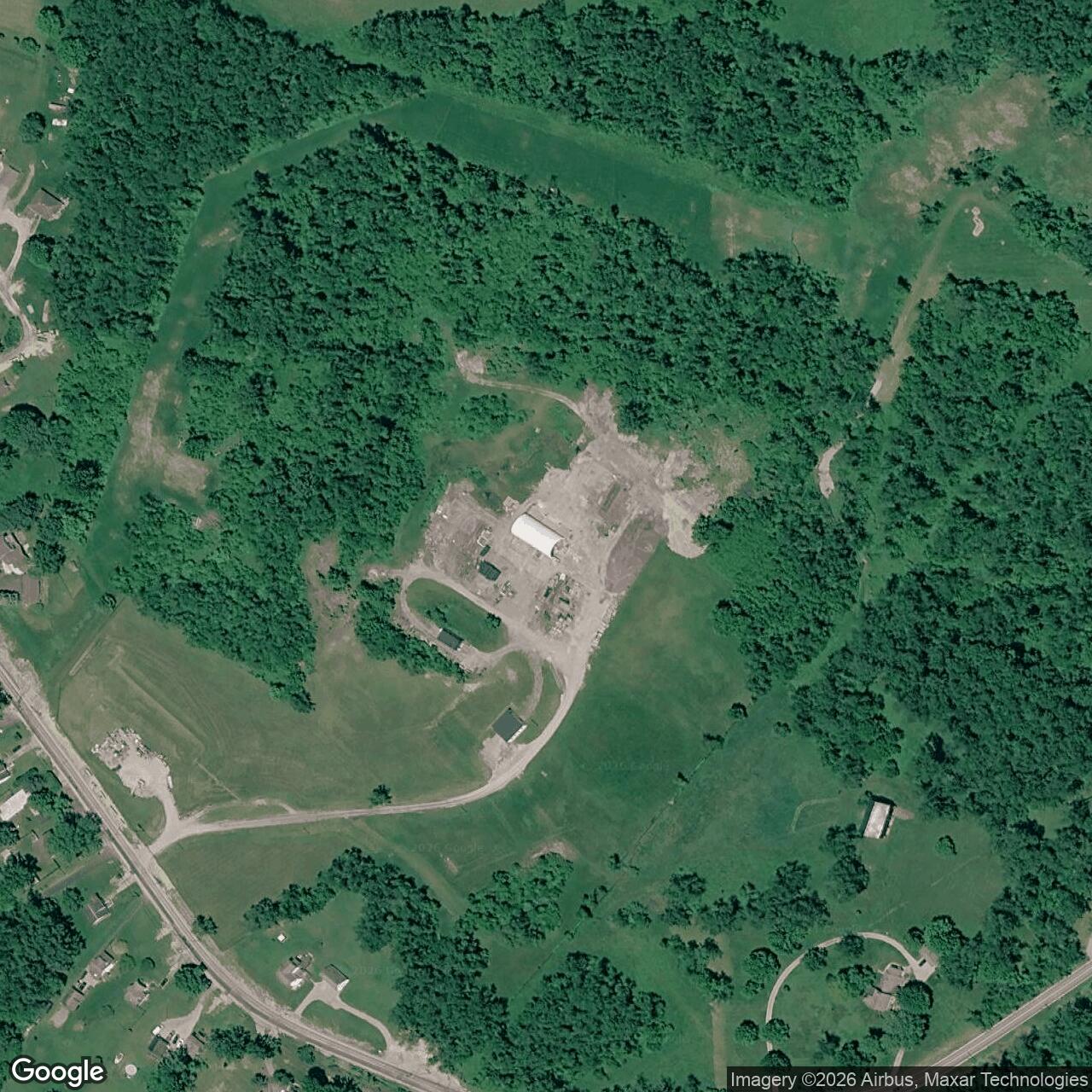
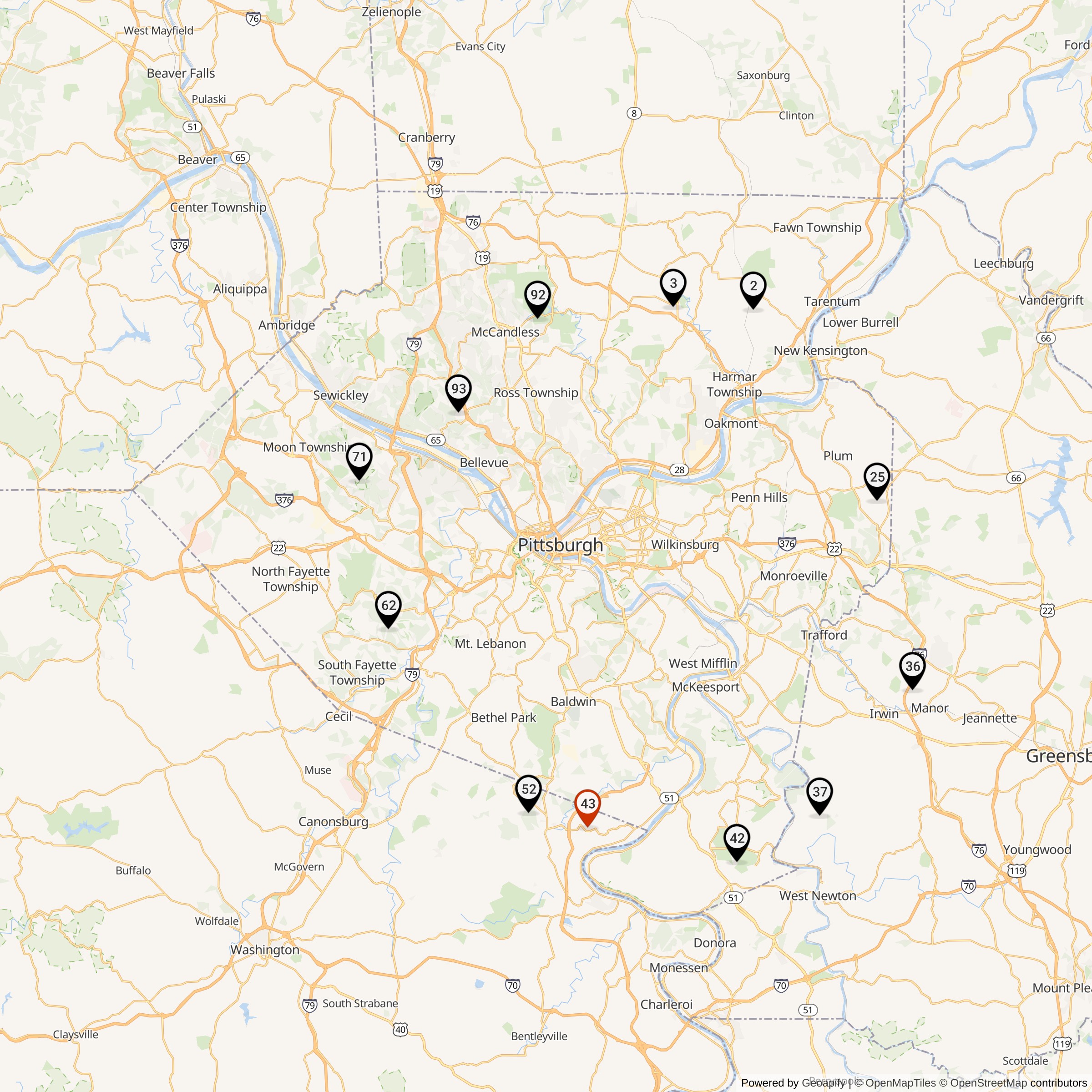
Nike Missile Site PI-43 Launcher, Elrama Pennsylvania
Longitude: -79.9666612984087
This location was part of the Pittsburgh Defense Area
Site ID: PI-43
The missiles at this Launch Area were controlled by the Integrated Fire Control site located here.
Site Role: Launcher
A typical Nike air defense site consisted of two separate parcels of land. One area was known as the Integrated Fire Control (IFC) Area. This site contained the Nike system's ground-based radar and computer systems designed to detect and track hostile aircraft, and to guide the missiles to their targets.
The second parcel of land was known as the Launcher Area. At the launcher area, Nike missiles were stored horizontally within heavily constructed underground missile magazines. A large, missile elevator brought the Nikes to the surface of the site where they would be pushed across twin steel rails to one of four satellite launchers.
Elaboration on how Nike worked here.
Missile Type: Ajax/Hercules
The Nike Ajax was the first in the Army's family of guided missiles, and the world's first operational, guided, surface-to-air missile system. Nike Ajax had a burnout speed of Mach 2.3, a range of 25-30 miles, and a ceiling of 65,000 feet.
Designed to carry either nuclear and/or high-explosive warheads, the Nike Hercules missile could attack supersonic aircraft operating at altitudes in excess of 150,000 feet and at a range of more than 87 miles.
Battery Type: single
Current site status: unknown
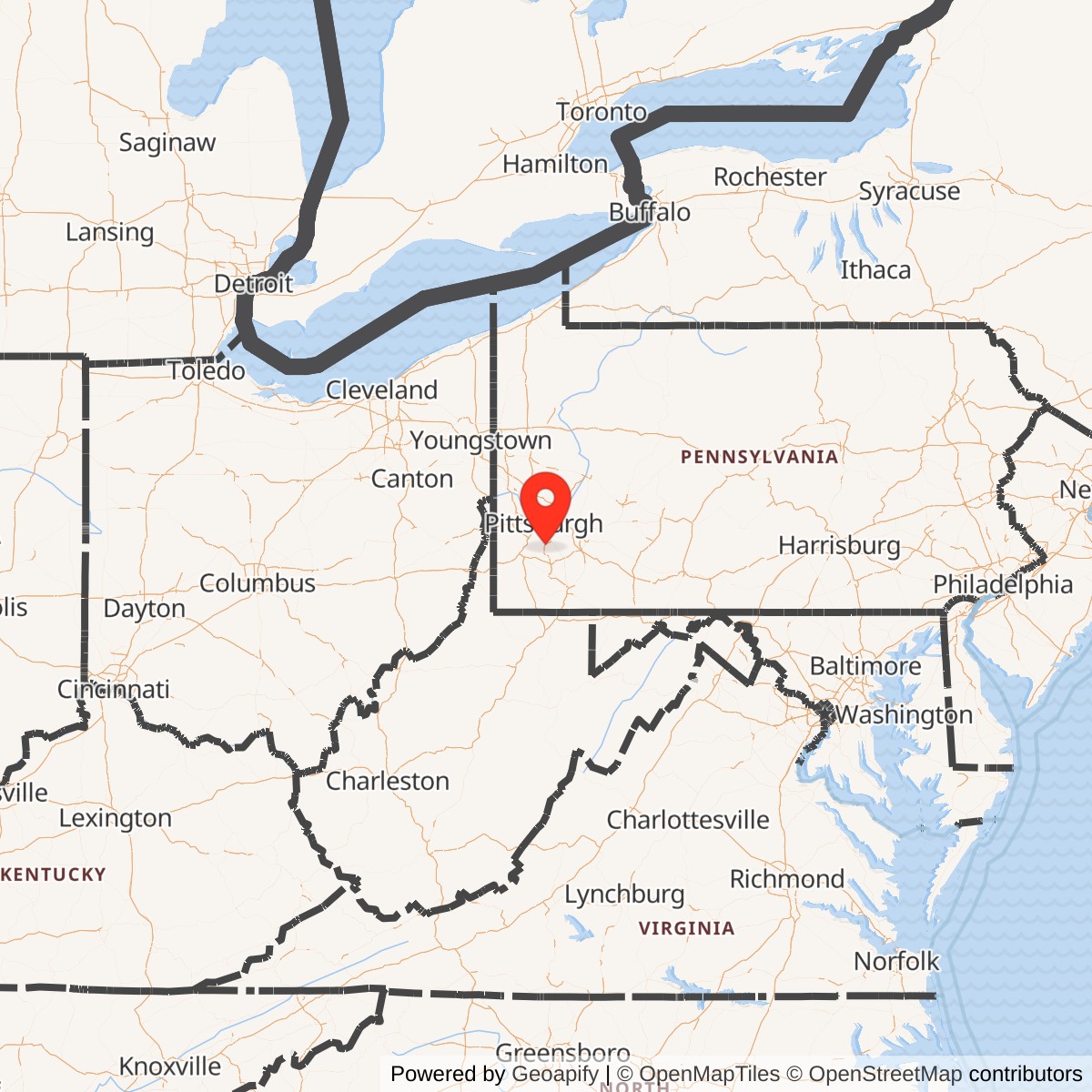
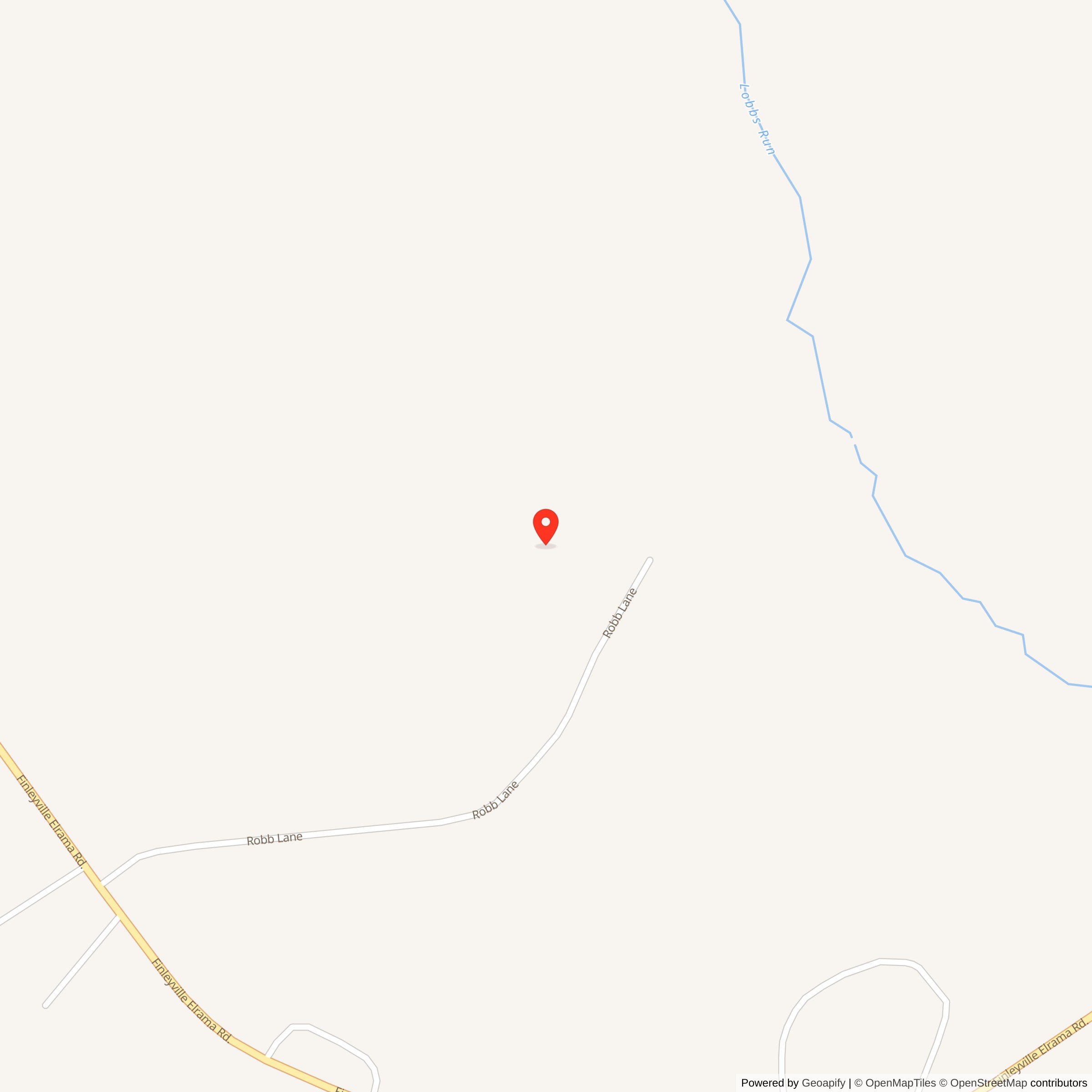
Nike Missile Site PI-43 was a U.S. Army Nike air-defense missile battery in the Pittsburgh Defense Area. The site was located near Elrama, in Union Township, Washington County, Pennsylvania, south of Pittsburgh and west of the Monongahela River. Contemporary and later Nike listings identify the site as Elrama, and the broader Pittsburgh Defense Area history describes it as "Elrama/east of Finleyville." Locally, later reuse and news coverage also associated the former installation with Gastonville and Finleyville-Elrama Road.
It was a Cold War air-defense battery built to protect the Pittsburgh industrial region, especially the steel-producing Monongahela Valley and the larger "Steel City" target complex, from Soviet bomber attack. The site entered service in May 1955, was converted from Nike Ajax to Nike Hercules during the late 1950s, and was deactivated in March 1974.
The site was a split Nike battery, not a single compact post. The launcher area lay west of the control site. The control area held the radar and fire-control equipment; the launcher area held the underground magazines, launch rails, missile-handling equipment, generator support, security fencing, and related operating structures. Later local reporting described the former control-side barracks and control buildings along Finleyville-Elrama Road, with the underground missile batteries about 1.5 miles away.
History
PI-43 belonged to the ring of U.S. Army Nike missile sites built around Pittsburgh during the 1950s. Pittsburgh was not just another city in the Cold War air-defense network. It was one of the nation's major industrial centers, and its steel mills, transportation corridors, river valleys, bridges, rail lines, power plants, and industrial workforce made it a strategic target in any wartime scenario involving Soviet long-range bombers. The Monongahela Valley south of Pittsburgh was especially significant because of its steel and heavy-industrial concentration. PI-43's location near Elrama placed it on the southern and southeastern side of the Pittsburgh defense pattern, in terrain that could support line-of-sight radar control and launcher separation while defending the industrial approaches along the river valley.The Pittsburgh Defense Area initially evolved from gun defenses into guided missile defenses. In April 1952, before Nike missiles were ready, soldiers and heavy equipment moved toward Pittsburgh to establish a ring of emergency antiaircraft gun positions. Those gun defenses were a stopgap measure during a period when the Soviet Union had acquired atomic weapons and U.S. planners feared a possible bomber attack against major American cities and industrial regions. As Nike Ajax became available, the temporary gun positions were replaced by permanent guided-missile sites. The Army Corps of Engineers Pittsburgh District had responsibility for building the Pittsburgh Nike sites, and the region's terrain complicated the work. Unlike flatter defense areas, Pittsburgh's ridges, river valleys, and industrialized corridors required launchers and radar-control sites to be separated but still mutually visible. Construction costs for Pittsburgh Nike sites were reported in the $600,000 to $700,000 range per site, and four additional sites were added in 1956 as the Pittsburgh defense network expanded.
PI-43 entered service in May 1955 as a Nike Ajax battery. Nike Ajax was the Army's first operational guided surface-to-air missile system. It was designed to engage formations of high-flying enemy bombers before they could reach defended targets. The Ajax system was built around radar acquisition, target tracking, missile tracking, and a ground-based analog computer. The acquisition radar searched for hostile aircraft. The target-tracking radar locked onto the target. The missile-tracking radar tracked the missile in flight. The computer calculated the intercept point and sent steering commands to the missile. At the launcher area, missiles were normally stored horizontally in underground magazines, raised to the surface on elevators, moved along launcher rails, and fired when the battery commander ordered an engagement.
For the communities around Elrama and Gastonville, the installation was both secretive and ordinary. It was a Cold War weapons site designed to support nuclear-age air defense, but it also had barracks, mess facilities, roads, maintenance buildings, fuel and generator support, and a daily population of soldiers. Later Observer-Reporter coverage of the former site described barracks near the control area that had once housed as many as 100 men. Those men were part of the round-the-clock Nike readiness system, maintaining radar, communications, missiles, launch equipment, and security so the battery could respond quickly if the Pittsburgh Defense Area received an air-defense alert.
By the late 1950s the Army was converting selected Nike Ajax batteries to Nike Hercules. Hercules was much larger than Ajax, used solid-fuel propulsion, had greater range and altitude capability, and could carry either conventional or nuclear warheads. In the Pittsburgh Defense Area, Hercules conversion was not applied to every site. The converted sites included PI-03, PI-36, PI-37, PI-43, PI-71, and PI-93. The Ajax-only sites were eventually deactivated earlier, while several Hercules batteries remained in service into the 1970s.
The federal Nike inventory identifies PI-43 as a Nike 3B/18H,30A/12L-U site. In that shorthand, the site had three Type B magazines, could support 18 Nike Hercules missiles and 30 Nike Ajax missiles in its converted configuration, and had 12 universal launchers. The Type B magazine designation indicates Ajax/Hercules-capable magazines that required modification for Hercules operations. The universal launcher designation reflects conversion from Ajax-only launch equipment to equipment capable of handling the larger Hercules missile. Appendix D of the Nike Hercules history lists PI-43 among the converted defense sites, with a 3B magazine configuration and a Hercules operational date of March 16, 1959. The site's Hercules status is therefore well supported by both the federal inventory and the conversion appendix.
The conversion to Hercules changed PI-43's operational meaning. In the Ajax period, the site was part of a conventional guided-missile air-defense ring. In the Hercules period, it became part of a longer-range and nuclear-capable air-defense system. Nike Hercules was intended to defeat massed bomber formations, including formations that might be too large or dispersed for individual conventional warheads to destroy effectively. The presence of Hercules at PI-43 does not by itself document the exact warhead custody history of every missile at the site, but the battery's converted status places it in the category of Pittsburgh Nike sites designed and equipped for Hercules operations.
PI-43 also operated within a larger command-and-control system. Pittsburgh's Nike batteries did not function as isolated local posts. They were coordinated through a regional air-defense network. In 1960, the Army Air-Defense Command Post PI-70DC was established at Oakdale to support Nike command-and-control functions for the Pittsburgh Defense Area. The Oakdale facility was initially an AN/FSG-1 Missile Master radar direction center and later used the AN/TSQ-51 Missile Mentor system. It was integrated with the Air Force / NORAD SAGE air-defense network as Site RP-62 / Z-62. This meant PI-43's local radars and launchers were part of a broader regional and continental command architecture, connecting Army Nike fire units with long-range radar surveillance and higher-level air-defense direction.
PI-43 remained operational until March 1974. Its long service life reflects the post-Ajax survival pattern of selected Hercules sites. Many Ajax-only sites around the country closed in the early 1960s as the bomber threat changed, budgets tightened, and the U.S. air-defense system shifted. Hercules sites such as PI-43 lasted longer because they offered greater range and a nuclear-capable engagement option. By the early 1970s, however, the national air-defense environment had changed. The Soviet strategic threat had shifted increasingly toward intercontinental ballistic missiles and submarine-launched ballistic missiles, against which Nike Hercules could not provide meaningful defense. The Army therefore shut down many remaining Nike Hercules batteries in 1974, including PI-43 and other Pittsburgh-area Hercules sites.
Site Layout and Operation
PI-43 followed the standard Nike split-site pattern. The IFC, or Integrated Fire Control area, was the radar and fire-control side of the battery. It contained the acquisition radar, target-tracking radar, missile-tracking radar, radar-control equipment, computer facilities, communications links, and operating buildings. The launcher area was located west of the control site and contained the underground magazines and launch equipment.The control side's elevation and line-of-sight relationship with the launcher were essential. Nike fire control depended on the radar system's ability to track both the target and the outgoing missile. The launcher and IFC therefore could not be placed randomly; they had to be separated for safety and radar geometry, but close enough and aligned well enough for the fire-control system to function.
The launch area's three magazines were the most important surviving physical elements documented by later visitors. A 2007 photographic survey of the Elrama launch site showed underground magazine doors, elevator controls, concrete pads, remaining fencing, the former generator building, and warning signage associated with missile fuel storage. The same survey described the launch area as then being used by a highway or municipal department, while the IFC was abandoned but locked. By that time, the missiles and military operating equipment were gone, but the concrete and steel infrastructure still clearly reflected the Nike function.
Post-Closure and Current Use
After PI-43 was deactivated in 1974, the property passed through a long period of military and quasi-military reuse before local transfer and redevelopment planning. Federal and Nike inventory sources identify both the control and launch areas as FDS, meaning they had passed through the Formerly Used Defense Sites process or had been transferred from Department of Defense control. Later site listings show the former control area used by the Pennsylvania Army National Guard, including D/876th Engineer Battalion, and the former launch area used by Army Reserve / Pennsylvania National Guard elements, including B/1/110th Infantry. A 1998 site note recorded that Army Reserve and National Guard units had pulled out of the former launch and control properties a few months earlier.Local newspaper coverage in 2017 described Union Township's later effort to demolish deteriorated Cold War-era barracks on the former Nike Site 43 property. The article identified the property as the former Gastonville Armory and explained that the Army had decommissioned the Nike missile site in 1974, then waited nearly 40 years before donating the control and launch properties to Union Township. It reported that the former control-side barracks were badly deteriorated, with damaged roofs, mold, failing ceilings, asbestos floor tile, and other long-term deterioration. The same report stated that the control and launch parcels together covered about 124 acres, and that Union Township had discussed possible recreational and economic-development reuse.
The former launch area retained visible Nike features longer than many comparable sites. The 2007 photo documentation showed missile magazine doors, launch-area pavement, elevator controls, fencing, generator-building remains, and evidence of post-military storage or municipal work-yard use. The condition described in that photo survey was already deteriorated, with water, vegetation, cracked pavement, and possible magazine/elevator settlement at one battery.
List of all Nike Installations in the Pittsburgh Defense AreaList of all Nike Installations in Pennsylvania