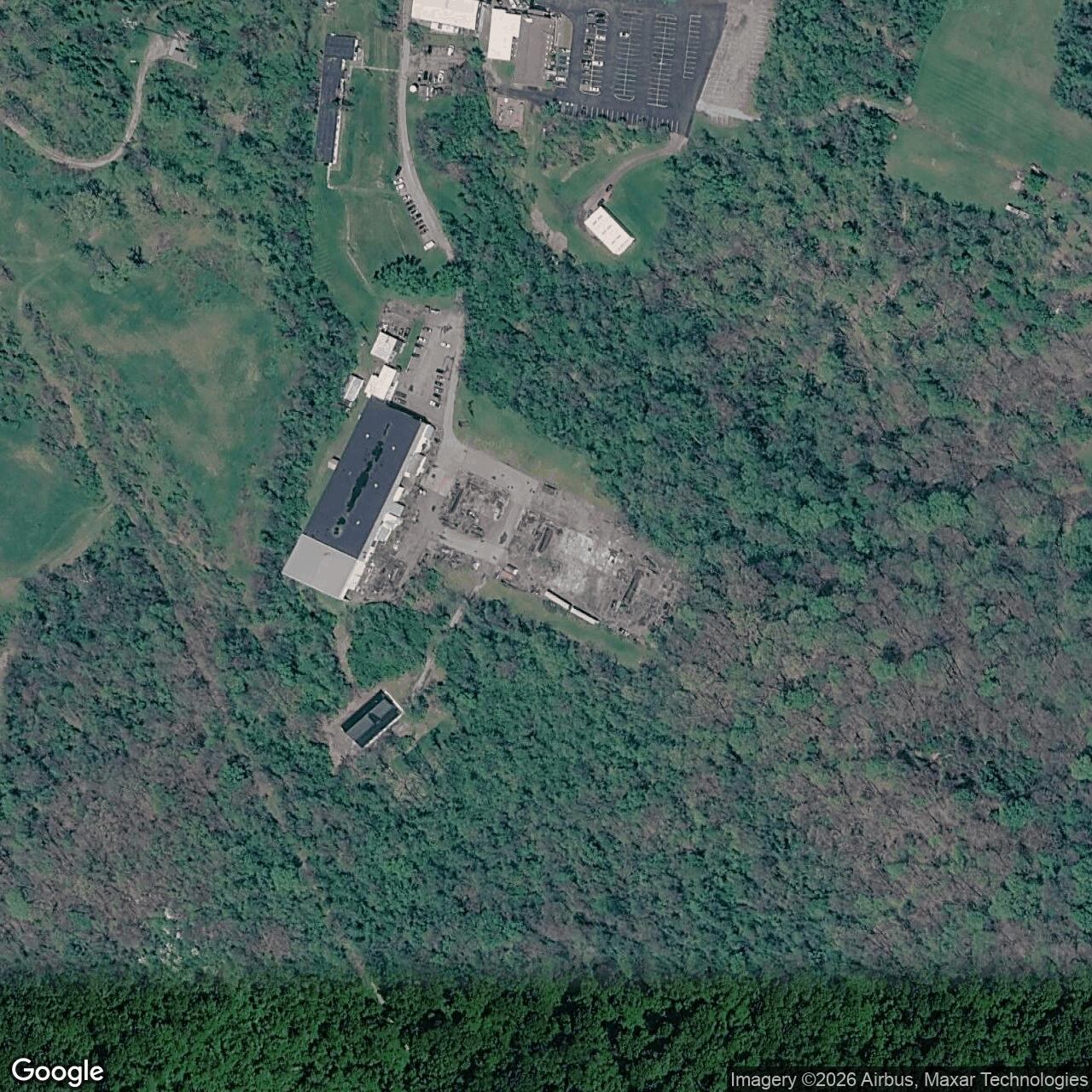
Nike Missile Site PI-52 Launcher, Finleyville Pennsylvania
Longitude: -80.0179213138063
This location was part of the Pittsburgh Defense Area
Site ID: PI-52
The missiles at this Launch Area were controlled by the Integrated Fire Control site located here.
Site Role: Launcher
A typical Nike air defense site consisted of two separate parcels of land. One area was known as the Integrated Fire Control (IFC) Area. This site contained the Nike system's ground-based radar and computer systems designed to detect and track hostile aircraft, and to guide the missiles to their targets.
The second parcel of land was known as the Launcher Area. At the launcher area, Nike missiles were stored horizontally within heavily constructed underground missile magazines. A large, missile elevator brought the Nikes to the surface of the site where they would be pushed across twin steel rails to one of four satellite launchers.
Elaboration on how Nike worked here.
Nike Missile Site PI-52 was a U.S. Army Nike Ajax air-defense missile battery in the Pittsburgh Defense Area. The site was located near Finleyville in Washington County, Pennsylvania, south of Pittsburgh, and formed part of the Cold War defensive ring built to protect Pittsburgh, the Monongahela Valley, the region's steel and heavy-industry base, and related transportation and power infrastructure from hostile bomber attack.
It was an Ajax-only Nike site, not a Nike Hercules conversion site. The federal Nike inventory identifies PI-52 as active from 1958 to July 1960, a notably short operational life compared with several other Pittsburgh-area Nike batteries. The short service period reflects the rapid transition from the first-generation Nike Ajax deployment pattern to the smaller number of longer-range Nike Hercules batteries retained around Pittsburgh.
History
PI-52 belonged to the Pittsburgh Defense Area, one of the Nike air-defense networks established around major American urban and industrial regions during the 1950s. Pittsburgh's importance in Cold War defense planning was tied to its industrial function. The region was a major center of steelmaking, heavy manufacturing, river navigation, rail transportation, bridges, power generation, and wartime industrial capacity. In the early Cold War, when U.S. planners expected that a Soviet attack would likely come first by long-range bombers carrying nuclear weapons, the Pittsburgh region was treated as a strategic target requiring fixed air-defense coverage.The Pittsburgh Nike network developed out of earlier antiaircraft-gun defenses. In April 1952, soldiers and heavy equipment moved into the region to establish temporary gun positions around the "Steel City." Those temporary batteries were part of a transitional phase between World War II-style gun defense and guided missile defense. By the mid-1950s, Nike Ajax batteries began replacing those temporary gun sites with permanent missile installations composed of separated launcher and radar-control areas.
The Corps of Engineers Pittsburgh District, a component of the Ohio River Division, was responsible for construction of the Pittsburgh-area Nike missile sites. The first construction contract for the Pittsburgh Nike system was awarded in July 1954. Constructing the system in western Pennsylvania was not simply a matter of placing batteries on open land. The region's steep ridges, river valleys, wooded hills, mining and industrial landscapes, and growing suburban communities all shaped where the Army could place launchers and radars. Nike sites required enough space for underground magazines and launch pads, but the IFC radar area also needed suitable elevation and line-of-sight. As a result, launcher and control parcels were often separated by significant distance and placed on different ridges or sides of a valley.
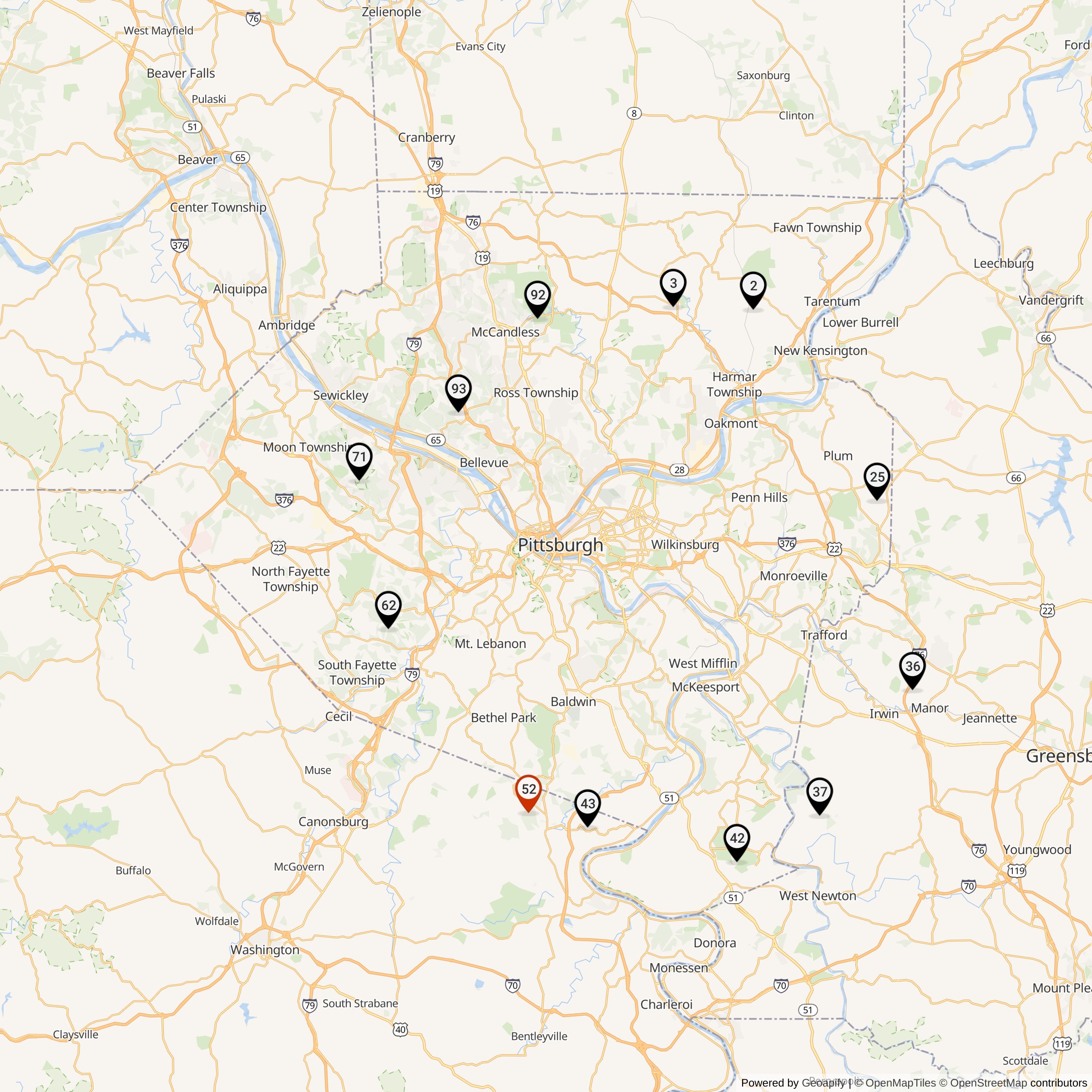
PI-52 was on the southern side of the Pittsburgh defensive ring. Its location near Finleyville placed it in the arc of sites covering the southern and southwestern approaches toward Pittsburgh and the Monongahela Valley. It worked in combination with other Pittsburgh-area batteries, including PI-02 at Rural Ridge, PI-03 at Dorseyville / Indianola, PI-25 at Murrysville / Monroeville, PI-36 at Irwin, PI-37 at Cowansburg / Herminie, PI-42 at Elizabeth, PI-43 at Elrama / east of Finleyville, PI-52 at Finleyville, PI-62 at Bridgeville / Hickman, PI-71 at Coraopolis / Beacon, PI-92 at Bryant / North Park, and PI-93 at West View.
Unlike PI-03, PI-36, PI-37, PI-43, PI-71, and PI-93, PI-52 was not selected for Nike Hercules conversion. That distinction is central to understanding the site. It belonged to the initial dense Ajax ring, but it did not survive into the later Hercules-era structure.
Site Layout
PI-52 followed the normal Nike battery arrangement: a separated Integrated Fire Control area and launcher area.The Integrated Fire Control area was the radar, tracking, and guidance side of the battery. It held the acquisition radar, tracking radars, fire-control equipment, communications equipment, power support, and operational buildings used by the radar and fire-control crews. A later field-visit identifies the control site as being in the Finleyville area. The same field-visit note stated that the control area was marked "no trespassing" when photographed in March 2021.
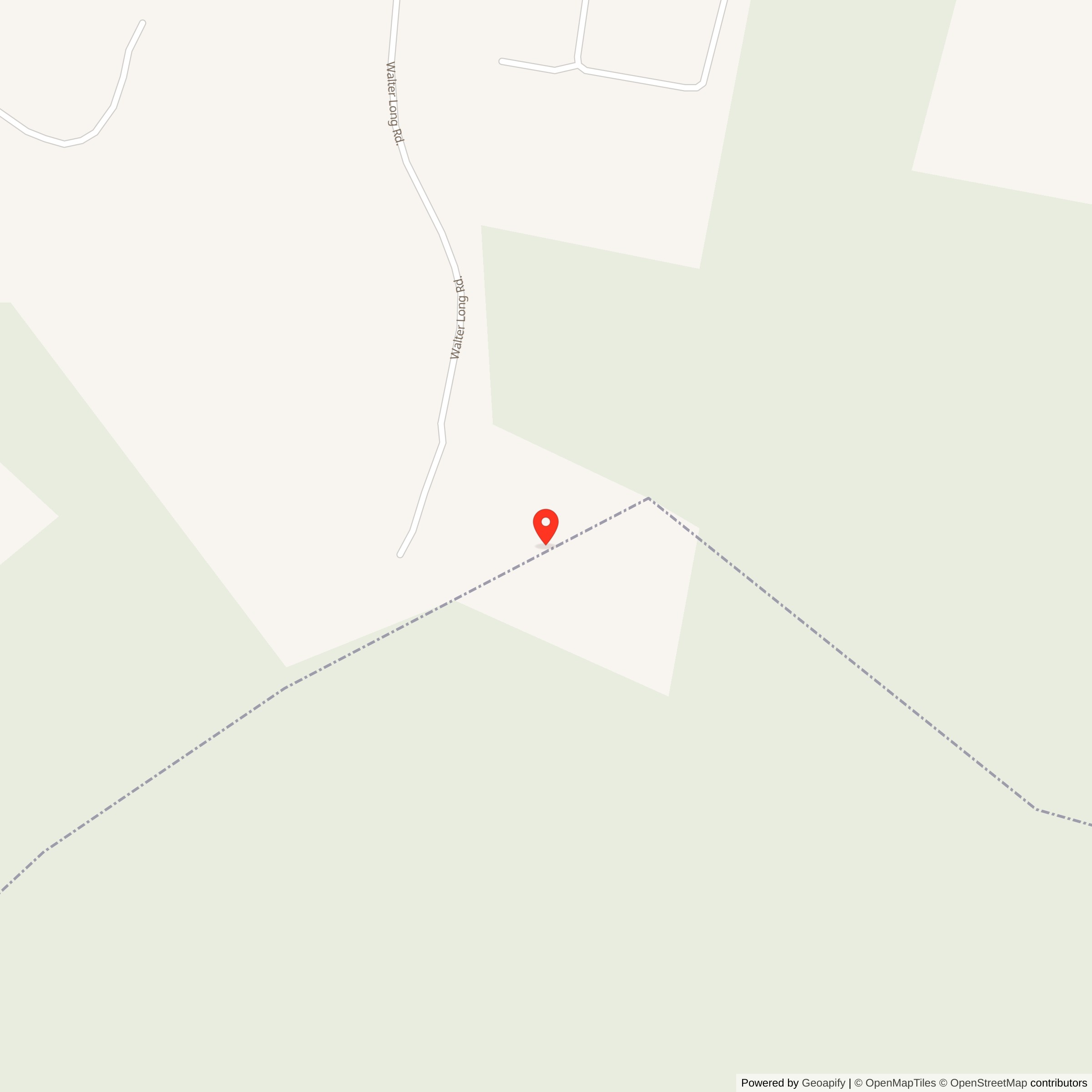
The launcher area was the missile-storage and launch side of the battery. It was located south of the control area. During the post-military period, the launcher parcel was associated with Walter Long Manufacturing Company and other civilian uses. Later public site summaries describe the launcher area as mostly redeveloped, with the magazine area in poor condition and used as a storage yard and parking lot.
The federal Nike inventory lists PI-52 as Nike 1B,2C/30A/12L-A. That shorthand indicates one Type B magazine, two Type C magazines, a listed complement of 30 Nike Ajax missiles, and 12 Ajax launchers. The "A" launcher designation is important: PI-52 was an Ajax site, not a universal-launcher Hercules site.
In a typical Nike Ajax launch area, missiles were stored horizontally in underground concrete magazines. Elevator platforms raised the missiles to the surface. Launch crews then moved missiles along rails to the launchers. The missile did not guide itself independently to the target. Instead, the IFC area tracked the target and missile, computed an intercept course, and transmitted guidance commands to the missile during flight.
Nike Ajax Operation
PI-52's operational weapon was the Nike Ajax. Nike Ajax was the Army's first operational guided surface-to-air missile and was designed to intercept enemy aircraft, particularly high-altitude bombers. The Ajax system represented a major technological shift from gun-based air defense. It relied on radar, computers, missiles, and trained crews rather than shells fired at an estimated target path.The standard Nike Ajax engagement process began with target detection and identification. The acquisition radar searched for incoming aircraft. Once a target was selected, the target-tracking radar locked onto it while a separate missile-tracking radar tracked the missile after launch. Ground-based computers compared the target and missile tracks, calculated the intercept point, and generated steering commands. The missile was command-guided from the ground and detonated near the target.
For PI-52, that meant the control area and launch area functioned as one battery even though they were physically separated. The control side was the brain of the site; the launcher side was the armed missile component. The two areas depended on communications, crew coordination, and strict procedures.
The site's Ajax-only status also meant that PI-52 did not assume the later nuclear-capable Hercules mission. Nike Hercules was larger, solid-fueled, longer-ranged, and capable of carrying a nuclear warhead intended to destroy bomber formations. PI-52's documented configuration remained Ajax, and the site was not included in Appendix D's list of converted Pittsburgh Hercules sites.
Operational Life
PI-52's operational life was short. The federal inventory lists the site as active from 1958 to July 1960. That places it among the shortest-lived Pittsburgh Nike sites. The site came into service during the Ajax deployment phase, but it was closed before the major deactivation wave that ended many other Ajax-only batteries in 1963.The short life of PI-52 can be understood through the speed of Cold War technology change. Nike Ajax was developed and deployed quickly because the United States urgently wanted guided missile defenses around important cities. Yet by the time many Ajax sites were fully integrated into local defense networks, the Army was already deploying Nike Hercules. Hercules had longer range, greater altitude capability, and a nuclear option, allowing fewer sites to cover wider areas. The result was that many Ajax-only sites had short careers. PI-52 is one of the clearest Pittsburgh examples.
The site's southern Pittsburgh location did not disappear from the defense scheme entirely; rather, the broader defense ring was rebalanced. Nearby Hercules-capable batteries, especially PI-43 at Elrama and PI-37 at Cowansburg / Herminie, helped maintain coverage of the southern and southeastern sectors after Ajax-only batteries such as PI-52 left service.
Command-and-Control Context
PI-52 operated during a transitional period in Pittsburgh air-defense command and control. The region's Nike batteries were part of a larger system that included Air Force radar surveillance, Army missile batteries, identification procedures, and regional command structures. By 1960, the Pittsburgh Missile Master / Missile Mentor command-and-control facility near Oakdale was operational. The Oakdale site, often identified as PI-70DC, became a key air-defense command node for the Pittsburgh Defense Area and was collocated with radar functions used by the Air Force, Army, and FAA.Because PI-52 was deactivated in July 1960, it overlapped only briefly with the fully developed Oakdale command-and-control environment. It was still part of the same regional defense system, but it did not remain long enough to become one of the later, enduring Hercules-era batteries integrated into the mature command network.
Deactivation
PI-52 was deactivated in July 1960. Its closure reflected the modernization and consolidation of the Pittsburgh Defense Area rather than a disappearance of the air-defense mission itself. The Army retained and upgraded selected Pittsburgh batteries to Hercules, while Ajax-only sites that were not selected for conversion were closed.After closure, the Army removed the missiles and classified equipment. The installation's military mission ended, but the physical parcels remained. As with many Nike sites, the two sides of the battery followed different civilian reuse paths.
Post-Closure Use and Current Condition
The former control area was later associated with South Hills Christian School. A 1992 observation stated that PI-52C was on the ridge north of the launcher area, was fairly intact, and was then serving as South Hills Christian School. The observer noted that he did not find clear evidence of radar pads behind the buildings but could see the Allegheny VORTAC on the next ridge.The former launcher area was associated with Walter Long Manufacturing Company and other civilian uses. A 1992 observation stated that the buildings were still present and that manufacturing buildings had been added at one end of the launcher section. Another site note reported that the former Nike housing had been civilianized, with six or seven houses still present, while the rest of the living quarters were gone.
Later public summaries describe the control area as mostly associated with South Hills Christian School, with some buildings in use and others deteriorated, and no visible radar towers. The launcher area is described as mostly redeveloped, with the magazine area in poor condition and used as a storage yard and parking lot. A 2021 Pittsburgh Nike field-visit coordinate sheet documented the control site and launch site photographically and described the control area as marked for no trespassing. It also included photographs of launch-area features, including visible underground or structural remnants.
List of all Nike Installations in the Pittsburgh Defense AreaList of all Nike Installations in Pennsylvania