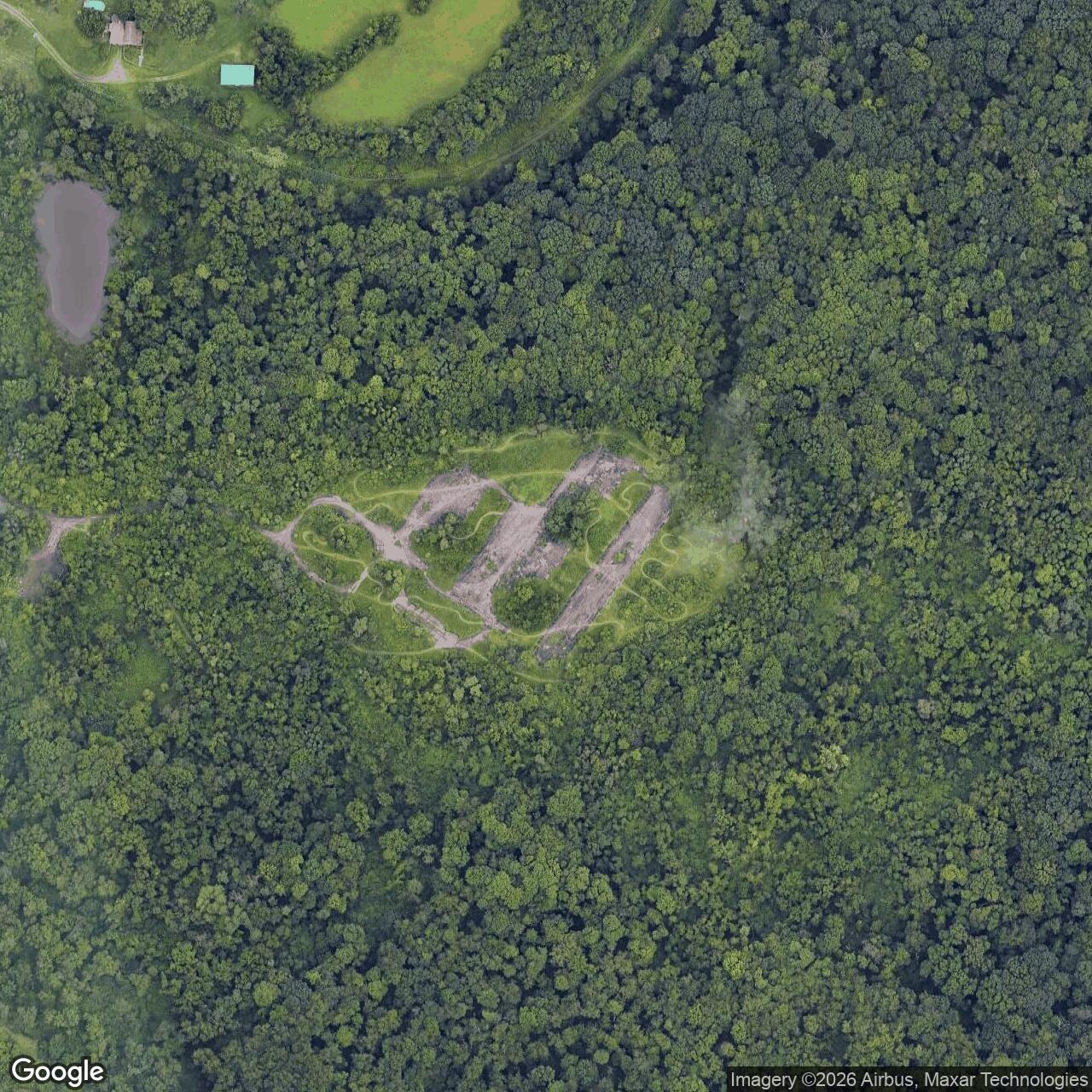
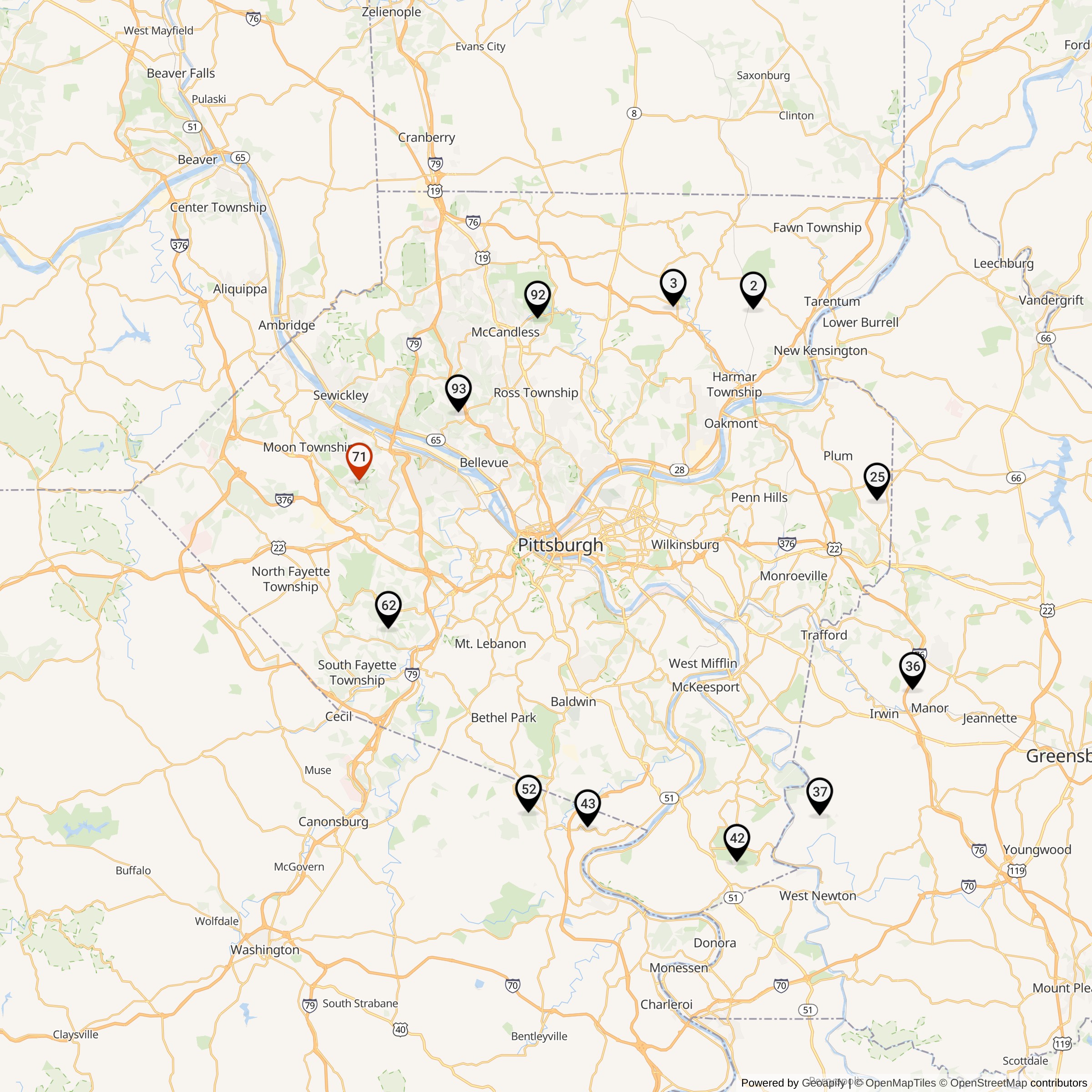
Nike Missile Site PI-71 Launcher, Coraopolis Pennsylvania
Longitude: -80.1639482632253
This location was part of the Pittsburgh Defense Area
Site ID: PI-71
The missiles at this Launch Area were controlled by the Integrated Fire Control site located here.
Site Role: Launcher
A typical Nike air defense site consisted of two separate parcels of land. One area was known as the Integrated Fire Control (IFC) Area. This site contained the Nike system's ground-based radar and computer systems designed to detect and track hostile aircraft, and to guide the missiles to their targets.
The second parcel of land was known as the Launcher Area. At the launcher area, Nike missiles were stored horizontally within heavily constructed underground missile magazines. A large, missile elevator brought the Nikes to the surface of the site where they would be pushed across twin steel rails to one of four satellite launchers.
Elaboration on how Nike worked here.
Missile Type: Ajax/Hercules
The Nike Ajax was the first in the Army's family of guided missiles, and the world's first operational, guided, surface-to-air missile system. Nike Ajax had a burnout speed of Mach 2.3, a range of 25-30 miles, and a ceiling of 65,000 feet.
Designed to carry either nuclear and/or high-explosive warheads, the Nike Hercules missile could attack supersonic aircraft operating at altitudes in excess of 150,000 feet and at a range of more than 87 miles.
Battery Type: single
Current site status: unknown
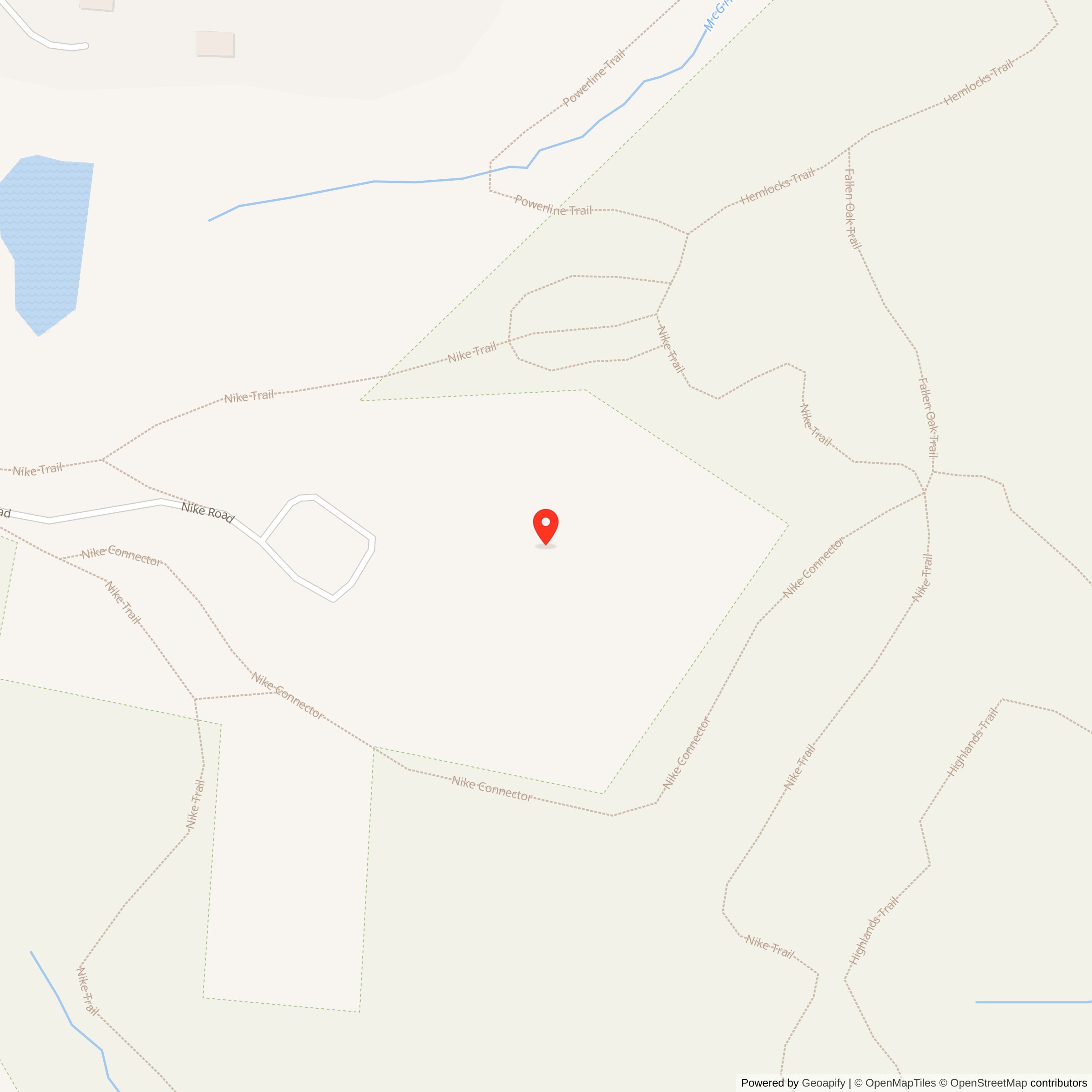
Nike Missile Site PI-71 was a U.S. Army Nike Ajax and Nike Hercules air-defense missile battery in the Pittsburgh Defense Area. The site is generally identified in Nike inventories as PI-71, Coraopolis / Beacon, Pennsylvania, and it was one of the western batteries in the defensive ring around Pittsburgh. In practical geographic terms, the site occupied the Moon Township / Coraopolis area west of Pittsburgh, with the launcher area on or near Nike Road in what is now the Montour Woods / Hollow Oak conservation landscape, and the Integrated Fire Control area on the higher ground toward the Robinson Township / Forest Grove side of the paired installation.
It entered active service in 1955 as part of the first Nike air-defense deployment around Pittsburgh, was converted from Nike Ajax to Nike Hercules in the late 1950s, and remained operational until March 1974. Its long service life reflects its selection as one of the Pittsburgh-area batteries retained after the shorter-lived Ajax-only sites were closed. The site's Cold War role ended when the Army phased out the remaining Pittsburgh Nike Hercules batteries in the 1970s.
History
PI-71 belonged to the Nike ring built around Pittsburgh during the early Cold War. Pittsburgh was not defended simply because it was a large city. It was defended because the region was one of the nation's major industrial centers, with steelmaking, heavy manufacturing, transportation infrastructure, river crossings, rail corridors, and other assets considered vital to national defense and wartime production. During the 1950s, U.S. air-defense planning assumed that Soviet long-range bombers could attack American industrial regions, and the Army's Nike system became the last layer of defense for selected metropolitan and military targets.The Pittsburgh Defense Area developed out of earlier antiaircraft-gun defenses. In April 1952, before the permanent Nike missile sites were complete, Army troops and heavy equipment moved through the region to establish gun positions to protect the "Steel City." These early gun batteries were a temporary and transitional measure. With the introduction of Nike Ajax, the region received permanent missile batteries with underground magazines, radar-guidance facilities, support buildings, and trained missile crews. The Corps of Engineers Pittsburgh District, part of the Ohio River Division, was responsible for constructing the Nike installations in the Pittsburgh area. The first construction contract for the Pittsburgh Nike system was awarded in July 1954.
Pittsburgh's terrain made site development difficult. Nike batteries required separated launcher and control areas: the launcher area had to provide secure missile storage and launch positions, while the IFC area had to provide radar line-of-sight for acquisition, target tracking, and missile tracking. Around Pittsburgh, steep hills, river valleys, wooded ridges, and suburban development forced the Corps and Army planners to place the paired parcels carefully. The result was a ring of dispersed sites, some on ridges for radar coverage and others on lower but usable ground for launch operations. PI-71 is a good example of that pattern: the launcher and IFC areas were separated by roughly two miles, but operated as a single battery.
The Pittsburgh Nike network included PI-02 at Rural Ridge, PI-03 at Dorseyville / Indianola, PI-25 at Murrysville / Monroeville, PI-36 at Irwin, PI-37 at Cowansburg / Herminie, PI-42 at Elizabeth, PI-43 at Elrama, PI-52 at Finleyville, PI-62 at Bridgeville / Hickman, PI-71 at Coraopolis / Beacon, PI-92 at Bryant / North Park, and PI-93 at West View. Of these, PI-03, PI-36, PI-37, PI-43, PI-71, and PI-93 were among the Pittsburgh sites upgraded to Nike Hercules.
The Pittsburgh Defense Area was initially manned by active Army antiaircraft and guided-missile units. When Nike Hercules entered the Pittsburgh defense system, manning eventually came from both an active-duty unit and the Pennsylvania Army National Guard. The DoD Legacy missile history identifies the long-term manning pattern as one active unit, the 3rd Missile Battalion, 1st Artillery, and one Pennsylvania Army National Guard battalion, the Duquesne Greys, formally the 2nd Missile Battalion, 176th Artillery.
Mission and Operation
PI-71's mission was to detect, track, and, if ordered, engage hostile aircraft approaching the Pittsburgh region. Like every Nike battery, it was not a free-standing tactical missile base in the later ballistic-missile sense. It was a fixed air-defense battery tied into a regional and national command-and-control network. The system worked by combining long-range radar detection, target tracking, missile tracking, and ground-based computer guidance.The Nike Ajax system used a command-guidance method. The missile did not independently search for the target. Instead, radar and computer equipment in the IFC area tracked both the target and the missile. Ground equipment calculated an intercept course and sent steering commands to the missile. When the missile reached the calculated intercept point, the system detonated its warhead.
The original Ajax missile was effective against individual bomber targets, but the emergence of larger bomber formations and nuclear-warhead air-defense doctrine pushed the Army toward Nike Hercules. Nike Hercules was larger, solid-fueled, longer-ranged, and able to carry either a high-explosive or nuclear warhead. Its deployment allowed fewer sites to cover larger areas, which is one reason many Ajax-only sites were deactivated while selected batteries, including PI-71, remained open.
For Pittsburgh, the shift to Hercules changed the structure of the defense area. PI-71 became one of the retained high-capability sites. Its designation in the federal Nike inventory as Nike 1B,2C/18H,30A/10L-U indicates a mixed Ajax-to-Hercules facility configuration: one Type B magazine and two Type C magazines, a listed complement of 18 Hercules missiles and 30 Ajax missiles, and ten universal launchers. In practical terms, this means the site began in the Ajax period but was modified to support Hercules operations, with universal launchers able to handle the later missile.
Site Layout
PI-71 consisted of two principal operating areas.The Integrated Fire Control area was the radar and guidance side of the battery. It contained acquisition and tracking radar equipment, target-identification and fire-control functions, guidance electronics, power and support facilities, and operating buildings. The IFC area is identified with the Coraopolis / Beacon side of the site
The launcher area was the missile-storage and launch side of the battery. It was located farther west, in the Nike Road / Moon Township area. This was the secured area that held the underground magazines, launchers, missile-handling surfaces, ready areas, access roads, fencing, and supporting utilities. The post-closure landscape has changed considerably, but modern accounts identify the former PI-71 launcher area as part of the Montour Woods / Hollow Oak landscape in Moon Township.
In standard Nike operation, missiles were stored horizontally in underground concrete magazines. Elevator platforms raised missiles to the surface, where crews moved them onto launch rails. At an Ajax site, the missiles were smaller and the launch-area configuration could be more compact. Hercules conversion required modification of magazines, launchers, handling procedures, and safety measures because Hercules was larger and could carry a nuclear warhead. The PI-71 inventory listing indicates ten universal launchers, meaning the site was adapted for Hercules-era operations rather than remaining a short-lived Ajax-only battery.
The separation between PI-71's launcher and IFC parcels was not incidental. It reflected the basic Nike architecture. Radars needed suitable elevation and line-of-sight; magazines needed secure land with enough space for launchers, roads, fences, and safety zones. The two parcels had to be far enough apart to work with terrain and safety requirements but linked operationally by communications and command systems.
Nike Ajax Period
PI-71 entered service in 1955 during the first permanent Nike missile buildup around Pittsburgh. At that time the site's weapon was the Nike Ajax. The Ajax missile represented the Army's first operational guided surface-to-air missile and replaced the earlier gun-battery concept with radar-guided missile defense. For the Pittsburgh area, this meant that air defense moved from temporary gun positions to a permanent and technologically sophisticated network of batteries around the city.The Ajax period at PI-71 coincided with rapid Cold War air-defense expansion across the United States. The Soviet atomic bomb, the Korean War, and the fear of bomber attack had pushed the United States to build a national air-defense system combining early-warning radars, fighter interceptors, command-and-control centers, and Army surface-to-air missile batteries. PI-71 was one local element of that national system.
In the first years of operation, PI-71 would have maintained missile crews, radar operators, maintenance personnel, guards, and support staff on a round-the-clock readiness basis. Nike service was routine, technical, and highly disciplined. Crews trained to receive target information, acquire and track aircraft, prepare missiles, and execute launch procedures only under command authority. Even though no Nike missile was ever fired in combat in the United States, the batteries were intended to be ready at all times.
Conversion to Nike Hercules
PI-71 was converted to Nike Hercules as part of the late-1950s modernization of the Pittsburgh Defense Area. Appendix D of the Nike Hercules history lists the Pittsburgh site PI-71 among converted defense sites, with a box/magazine configuration of 1B and 2C. The same Appendix D table gives a construction/conversion period of June 1958 to March 1959 and a Hercules operational date of May 7, 1959.The conversion placed PI-71 in the group of Pittsburgh sites that remained important after the Army began retiring many Ajax-only batteries. Nike Hercules provided greater range and altitude than Ajax and could use nuclear warheads intended to destroy bomber formations rather than a single aircraft. This capability changed the purpose of retained sites. PI-71 was no longer simply one of many Ajax points in a dense ring; it became part of a smaller, more powerful Hercules defense structure for the region.
The site's Hercules status also extended its life. Many Pittsburgh-area Ajax-only sites closed in the early 1960s, but PI-71 remained active into 1974. This places it among the late-surviving Nike Hercules sites whose operations overlapped the Vietnam War era, the Strategic Arms Limitation period, and the broader shift away from bomber defense toward ballistic-missile deterrence.
Command and Control
PI-71 operated as part of the Pittsburgh regional Nike command system. Command-and-control functions for the Pittsburgh Defense Area were handled through a Missile Master / Missile Mentor facility collocated with Air Force radars near Oakdale. The Missile Master became operational in 1960. The Oakdale site is commonly identified as PI-70DC and was tied into the Air Force air-defense radar and SAGE environment as part of the larger North American air-defense system.For a battery such as PI-71, this meant that local radar and launcher crews did not operate in isolation. The battery was part of a regional network in which surveillance data, target assignments, identification procedures, and engagement authority flowed through higher command channels. The Nike battery could track and fire locally, but target assignment and engagement control were coordinated within the regional air-defense command structure.
The presence of this command network is important for understanding PI-71's purpose. The site was not simply a set of missile pads. It was a node in an integrated defense system that linked Army missile batteries, Air Force radars, and national air-defense command organizations.
Landscape and Daily Life
Open-source site inventories rarely provide detailed daily-life accounts for PI-71 specifically, but its operation can be understood from the standard Nike site pattern and from descriptions of Pittsburgh-area batteries. The site would have required a mixture of technical, security, administrative, maintenance, and support work. Personnel maintained missiles, radars, generators, communications lines, fire-control equipment, vehicles, grounds, fences, magazines, and living or administrative buildings.The IFC area was the nerve center, staffed by radar and fire-control personnel. The launcher area was more heavily associated with missile assembly, storage, fueling-era procedures for Ajax, handling, elevator operations, launcher preparation, security, and later Hercules nuclear-weapons custody and safety procedures. Although the public often knew that "Nike sites" existed, many details of readiness, warhead status, and engagement procedures were not part of everyday local knowledge.
Pittsburgh-area Nike sites were also unusual in how visibly they interacted with difficult terrain. Some were on ridges, some were on slopes, some had launch and control parcels separated by valleys or wooded ground, and many became local landmarks after closure. PI-71's current conservation setting makes that landscape history especially visible: the former military geometry now sits inside a recreational wooded environment.
Deactivation
PI-71 remained operational until March 1974. By that time, the strategic logic that had created the Nike network had changed. In the 1950s, the United States feared massed Soviet bomber attack on industrial and urban targets. By the late 1960s and early 1970s, the main strategic threat had shifted toward intercontinental ballistic missiles and submarine-launched ballistic missiles. Nike Hercules could defend against aircraft, but it could not provide a meaningful shield against a large ballistic-missile attack.The Army gradually closed many Nike sites as air-defense priorities changed, budgets shifted, and the military reduced its fixed continental air-defense footprint. Pittsburgh's surviving Hercules batteries were among the later Nike sites in the country. Operations at five Pittsburgh Nike Hercules sites lasted until 1974, and PI-71 was one of the sites whose active military role ended in that final period.
Post-Closure Use and Current Condition
After deactivation, the PI-71 parcels followed different post-military paths.The IFC/control area was reported in Nike site inventories as being transferred out of Department of Defense control and later used by the Robinson Department of Public Works.
The launcher area on the Moon Township / Nike Road side was reported in older inventories as abandoned or privately owned, with no buildings or visible magazine structures remaining and the former magazines apparently dug up or filled. More recent local reporting and Hollow Oak Land Trust programming identify the former Moon Township Nike Hercules launch site as a surviving interpretive landscape within land managed by Hollow Oak Land Trust. Pittsburgh Magazine reported in 2025 that the old Nike Hercules Missile Site in Moon Township is now overgrown with trees and wildflowers and preserved by the Hollow Oak Land Trust. Hollow Oak's event listing for a Nike Missile Site History Walk gives the venue as Nike Road, 500 Nike Road, Moon Township, and describes a guided walk through a former Cold War Nike Hercules missile site.
This makes PI-71 one of the Pittsburgh-area Nike sites whose Cold War landscape remains publicly interpretable, even if the intact operational hardware is gone. The missiles were removed in 1974. The launch area no longer functions as a military site, and the surviving features appear to be landscape remnants, foundations, cleared pads, access patterns, and buried or altered magazine areas rather than preserved launchers. Its significance now lies in the combination of physical remnants, interpretive programming, and its location within the broader Pittsburgh Cold War air-defense ring.
List of all Nike Installations in the Pittsburgh Defense AreaList of all Nike Installations in Pennsylvania